Does your social media marketing strategy actually connect to revenue, or just generate likes?
Most businesses post on social media without a documented strategy. They react to trends, post inconsistently, and measure success by follower counts that never translate into customers.
A real social media marketing strategy is a documented system that defines your audience, platforms, content pillars, publishing schedule, paid amplification approach, and performance benchmarks before a single post goes live. This guide covers every step to build a strategy that drives measurable business growth rather than vanity metrics that look impressive but produce nothing.
What Is a Social Media Marketing Strategy?
A social media marketing strategy is a documented plan that defines what your brand wants to achieve on social platforms and exactly how it will achieve those goals. It covers your target audience profiles, platform selection rationale, content pillars, posting cadence, paid amplification approach, community management standards, and the metrics that define success.

The defining characteristic of a real social media marketing strategy is that it exists as a written document before any content is created. Brands with documented strategies consistently outperform those operating from intuition. The strategy becomes the reference point against which every content decision is evaluated. Without it, social media activity is expensive guesswork.
Why Strategy Beats Tactics Every Time
Tactics without strategy produce inconsistent results. Posting a viral-style video because a competitor did the same is a tactic. Understanding which content format your specific audience responds to most strongly, then producing that format consistently, is strategy. The first produces occasional wins. The second produces compounding growth.
Performance marketing vs growth marketing principles define the two strategic orientations available. Performance-focused social strategies prioritise immediate measurable conversion outcomes. Growth-focused strategies build audience depth and brand authority that compound over time. Both require documented strategy. Neither works through reactive, unplanned execution.
For businesses building digital marketing strategies across multiple channels, social media strategy must connect explicitly to email, SEO, and paid advertising plans. Disconnected channel strategies produce disconnected results. An omnichannel marketing strategy that integrates social into the full buyer journey consistently outperforms isolated social media activity.
Step One: Define Your Goals and KPIs
Setting Goals That Connect to Business Outcomes
Every effective social media marketing strategy begins with goals that connect directly to business outcomes. Vanity goal: gain 10,000 Instagram followers. Business goal: generate 200 qualified leads per month from social channels. The first measures a platform metric. The second measures a business outcome. Only one justifies your investment.
Set SMART goals for each social platform independently. Instagram goals may centre on brand awareness and lead generation. LinkedIn goals may centre on thought leadership and B2B pipeline. Facebook goals may centre on community building and retargeting conversions. Each platform serves a different audience behaviour and deserves distinct goals.
Define the KPIs that will measure progress toward each goal before launching. Reach and impressions measure awareness. Engagement rate measures content resonance. Click through rate measures call to action effectiveness. Cost per lead measures paid campaign efficiency. Revenue attributed to social measures ultimate business impact. Know which KPIs matter for your specific goals before you start.
Step Two: Research Your Audience Deeply
Building Detailed Buyer Personas
Social media marketing for small business and enterprise alike requires deep audience research before content planning begins. You need to know specifically who your buyers are, where they spend time online, what content formats they engage with, and what problems they are trying to solve when they encounter your brand.

Build buyer personas from real data rather than assumptions. Analyse your existing customer database for demographic patterns. Review your Google Analytics audience data for interest and behaviour insights. Survey your current customers about their social media habits and content preferences. Each data source adds specificity that makes your content strategy more precise and effective.
Platform demographics must match your buyer personas for each channel to justify investment. According to Sprout Social’s social media demographics research, platform audience compositions shift meaningfully year over year. Validating that your target buyers are actually active on the platforms you plan to invest in is essential before committing budget to any channel.
Step Three: Choose the Right Platforms
Matching Platforms to Audience and Goals
Platform selection is one of the most consequential decisions in your social media marketing strategy. Most businesses should not try to maintain an active presence on every platform simultaneously. Spreading effort too thin produces mediocre content everywhere rather than excellent content on the platforms that matter most.
Choose platforms based on three criteria: where your audience spends time, which formats your content strengths suit, and which platforms align with your specific business goals. B2B businesses typically prioritise LinkedIn and YouTube. D2C ecommerce brands typically prioritise Instagram and TikTok. Local service businesses typically prioritise Facebook and Google Business Profile.
Social media marketing Instagram deserves particular attention for visual product brands, lifestyle businesses, and consumer services. Instagram’s combination of feed posts, Stories, Reels, and shopping features creates multiple touchpoints within a single platform. Our guide on how to select the right keywords for Instagram SEO covers how to optimise your Instagram presence for organic discoverability alongside your paid strategy.
Step Four: Build Your Social Media Content Strategy
Defining Your Content Pillars
A social media content strategy organises your content into three to five thematic pillars that each serve a specific audience need and business purpose. Content pillars prevent random posting and ensure every piece of content contributes to a coherent brand narrative that builds recognition over time.
Example pillars for a digital marketing agency might include educational content about SEO and paid advertising, behind-the-scenes content showing client results and team culture, promotional content featuring services and case studies, industry news commentary, and user-generated content from happy clients. Each pillar serves a different stage of the buyer journey.
Map each content pillar to a specific audience intent. Educational content serves buyers in the awareness and consideration stages. Promotional content serves buyers in the decision stage. Community content serves existing customers in the retention stage. This mapping ensures your social media marketing funnel has content serving buyers at every stage rather than only at one or two.
Creating Your Content Calendar
Your content calendar translates your content strategy into a scheduled publishing plan. It specifies what type of content will be published on which platform on which day. It assigns production responsibilities to specific team members and sets approval deadlines before scheduled publish dates.

Social media automation tools like Buffer, Hootsuite, or Later implement your content calendar automatically. Once content is approved and loaded, the tool publishes it on schedule without manual intervention. This automation creates the posting consistency that social platform algorithms reward with increased organic reach.
Content writing services that specialise in social media copy can fill your content calendar with professionally written posts across every pillar simultaneously. High-volume content production at professional quality requires either significant in-house resource or specialist writing support. Our guide on how to identify the right content length covers format decisions for different social platforms and audience types specifically.
Step Five: Create Your Social Media Campaign Planning Framework
Planning Campaigns Around Business Objectives
Social media campaign planning differs from your always-on content calendar. Campaigns are time-limited, objective-specific initiatives that run alongside your regular content. A product launch campaign, a seasonal promotion, or a lead generation drive are all campaign types that sit above your baseline content strategy.
Plan each campaign with a clear brief before execution begins. The brief should define the campaign objective, target audience segment, key message, creative requirements, platform selection, budget if paid, timeline, and success metrics. Campaigns without documented briefs suffer from unclear objectives and inconsistent creative that dilutes their impact.
Facebook ads management and Instagram advertising are typically the paid amplification channels for campaigns targeting consumer audiences. Google Ads management captures demand that social campaigns generate. Running paid social and paid search together during campaigns maximises the total capture rate of interested buyers across every touchpoint.
Step Six: Social Media Lead Generation Systems
Building Lead Capture Into Your Social Presence
Social media lead generation requires dedicated systems rather than hoping that followers will organically find your website and convert. Active lead generation tactics include lead magnet promotions, native lead form ads, link-in-bio landing pages, direct message automation sequences, and webinar or event promotions that capture email addresses.
Lead magnets distributed through social media convert engaged followers into email subscribers you own. A free guide, checklist, template, or tool offered in exchange for an email address creates a permission marketing relationship that social following alone cannot provide. Email marketing sequences triggered by social lead capture then nurture those subscribers toward purchase decisions systematically.
AI automations for social lead generation include DM automation tools like ManyChat that trigger lead capture sequences from specific comment keywords or profile visits. These automation flows convert engaged social audiences into leads without requiring manual inbox management at scale. How AI converts text or images into video also applies here as video lead magnets distributed through social consistently outperform static document downloads for most audiences.
Step Seven: Social Media Marketing Funnel Integration
Mapping Social to Your Full Buyer Journey
A social media marketing funnel maps your social content and advertising strategy to each stage of the buyer journey from first discovery through to purchase and beyond. Most brands focus social content on the top of the funnel, neglecting the middle and bottom stages where conversion decisions are actually made.
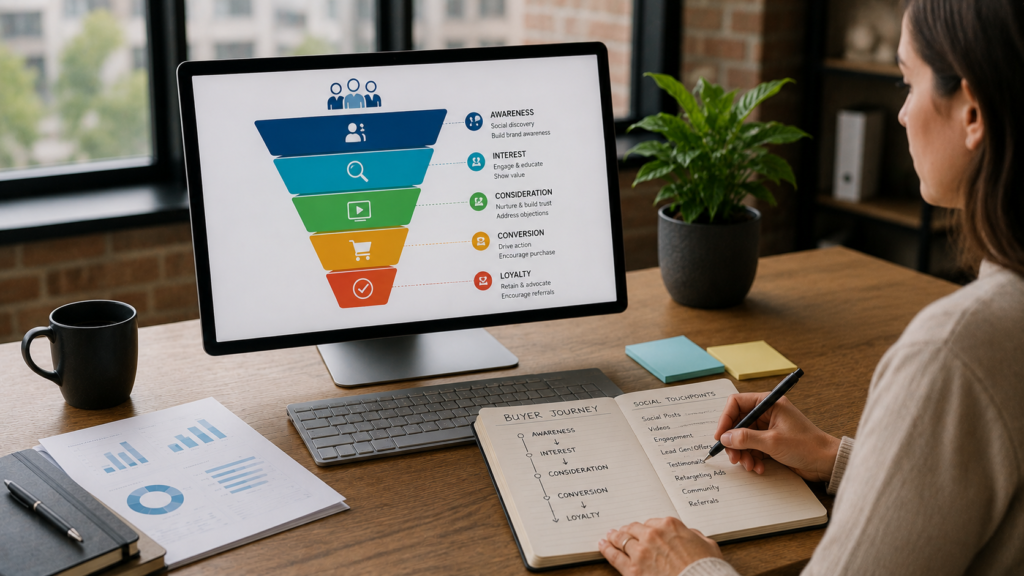
Top of funnel social content builds awareness through entertaining, educational, or inspiring content that reaches new audiences. Middle of funnel content builds consideration through case studies, comparisons, testimonials, and more detailed problem-solution content. Bottom of funnel content drives conversion through specific offers, urgency signals, and social proof that overcomes final purchase hesitation.
Run a funnel audit checklist on your current social presence to identify which funnel stages have content gaps. Most brands discover they have abundant top-of-funnel content and very little that directly addresses middle or bottom-of-funnel buyer questions. These gaps explain why social generates awareness without generating proportional revenue.
Retargeting campaigns through Facebook advertising and social media advertising fill the middle and bottom funnel gaps efficiently. Buyers who engaged with your top-of-funnel organic content are retargeted with middle-funnel consideration content. Buyers who visited your website are retargeted with bottom-funnel conversion offers. This staged approach dramatically improves your total social media ROI.
Step Eight: Social Media Growth Strategy and Scaling
Organic Growth Tactics That Compound
Social media growth strategy for organic channels centres on consistency, quality, and community engagement working together over time. Consistency in posting frequency trains platform algorithms to favour your content. Quality in creative and copy makes each piece worth sharing. Community engagement builds the reciprocal relationships that turn followers into advocates.
Collaborations with complementary brands and creators in your niche are among the fastest organic growth tactics available. Each collaboration introduces your brand to an established audience that already trusts the collaborating creator. Strategic collaboration partnerships provide audience growth that paid advertising cannot replicate in terms of warmth and existing trust transfer.
According to HubSpot’s social media marketing statistics, brands that engage consistently with their audiences rather than broadcasting content one-directionally achieve significantly higher organic reach and follower growth rates. Social media is a conversation medium. Treating it as a broadcasting medium produces the tepid engagement that characterises most under-performing brand accounts.
Paid Amplification for Accelerated Growth
Organic growth compounds but slowly. Social media marketing for small business often benefits from paid amplification to accelerate audience building during the launch phase when organic reach is limited by small existing following sizes.
Paid reach campaigns promote your highest-performing organic content to targeted audiences similar to your existing engaged followers. This approach validates paid investment with proven organic performance before committing paid budget to untested content. AI marketing strategy frameworks increasingly use AI-powered audience modelling to identify the most receptive expansion audiences for paid amplification campaigns.
For businesses expanding into new geographic markets, geo-targeted SEO insights inform social targeting by revealing which locations drive the highest organic engagement and conversion intent. Applying geographic intelligence from SEO data to your paid social targeting improves campaign efficiency before the first paid impression is delivered.
Measuring and Iterating Your Strategy
The Metrics That Prove Strategy Is Working
Measuring your social media marketing strategy correctly requires tracking metrics at each funnel stage rather than combining all metrics into a single performance view. Awareness metrics include reach, impressions, and share of voice. Engagement metrics include engagement rate, saves, shares, and comment quality. Conversion metrics include click through rate, lead form completions, and revenue attributed.

Analytics reporting dashboards that separate these metric categories provide the diagnostic clarity needed to identify exactly which funnel stage is underperforming. Declining reach suggests a content freshness or posting frequency problem. Strong reach with poor engagement suggests a content relevance problem. Strong engagement with poor conversion suggests a call to action or landing page problem. Each diagnosis points to a specific solution.
Review your complete strategy every quarter. Content audits of your social content reveal which posts, formats, and topics consistently outperform your averages. Double down on what your data confirms is working. Retire content types that consistently underperform despite testing and refinement. As Buffer’s social media strategy guide confirms, brands that conduct quarterly strategy reviews and act on their data consistently outperform those operating annual or irregular review cycles.
Data-driven marketing
Data-driven marketing applied to social media strategy means every significant content or campaign decision is justified by data rather than preference. Implement social media management reporting that surfaces the data your specific strategy decisions require rather than reporting whatever the platform dashboard shows by default. Understanding how to know if your seo is working alongside your social metrics creates a unified performance view across all organic channels simultaneously.
For franchise and multi-location businesses, our franchise digital marketing ROI strategies guide covers how to deploy social media strategy at scale across multiple locations without losing the local relevance that drives community engagement in each market. According to Hootsuite’s social media strategy resource, documented strategies are the strongest predictor of social media marketing success across every business size and industry type.
As Neil Patel’s social media strategy guide emphasises, the most important quality in any social strategy is its ability to evolve based on performance data. Static strategies that do not adapt to changing audience behaviour and platform algorithm updates consistently underperform those that treat strategy as a living document.
For complete social media marketing support including strategy development, content creation, campaign management, and reporting, explore our full services overview to find the right engagement model for your growth goals.
Frequently Asked Questions
A social media marketing strategy is a documented plan defining your audience, platforms, content, goals, and measurement approach. Every business needs one because consistent, data-informed social media activity produces compounding growth that unplanned posting cannot replicate regardless of content quality.
Define three to five content pillars aligned to your audience needs and business goals. Create a content calendar assigning specific topics and formats to each platform. Publish consistently and track performance weekly. Adjust your pillar balance based on which content types generate the strongest engagement and conversion results.
Combine consistent high-quality organic posting with paid reach campaigns promoting your best-performing content. Collaborate with complementary creators in your niche for audience access. Engage actively with your community daily. Paid amplification of organic winners accelerates growth faster than organic-only approaches for brands starting from small existing audiences.
Social media lead generation uses lead magnets, native lead form ads, DM automation sequences, and link-in-bio landing pages to convert social engagement into captured email addresses or direct enquiries. AI automation tools trigger lead nurture sequences automatically when followers engage with specific content or visit your profile.
Organic social media strategy typically produces measurable engagement improvements within 30 to 60 days of consistent implementation. Significant audience growth and lead generation results usually require three to six months. Paid social campaigns can generate leads within the first week but sustainable results require ongoing optimisation.
Conclusion
A documented social media marketing strategy is the difference between social media that generates real business growth and social media that consumes time and budget without measurable return. Every element works together. Audience research informs platform selection.
Platform selection shapes your social media content strategy. Content strategy drives your social media campaign planning. Campaign planning integrates with your social media marketing funnel. And your funnel feeds your social media lead generation systems. Build your strategy before your first post. Review it quarterly. Evolve it based on data.
And connect every social metric to the business outcomes that justify your investment. For brands ready to build a winning social media marketing strategy with professional support, explore our complete services overview or read our digital marketing strategies guide to understand how social media fits into your complete growth plan.

About the author
Ujjwal Kumawat
I specialize in SEO, website development, Google Ads and online business growth strategies. Through my blogs, I share practical insights, marketing tips and proven strategies to help businesses improve their online visibility, generate more leads and grow faster in the digital space.