Customers do not experience your brand as separate channels; they experience it as one continuous relationship. Every inconsistency leaves an impression, whether it is an email that conflicts with a recent ad, loyalty points missing from the app, or a support agent unaware of a recent purchase. These are not isolated customer experience issues but structural failures caused by disconnected data, tools, and channel-focused funnel strategies.
Solving them requires a true omnichannel marketing framework built around people, not platforms. This guide explains how to create a customer-centric funnel using unified data, align performance channels, personalize multi-location campaigns, and integrate AI automation across every stage.
Omnichannel Marketing vs Multichannel Marketing: A Critical Distinction
The two terms are used interchangeably in most marketing conversations. They describe fundamentally different operational models.
What multichannel marketing actually means
Multichannel marketing means being active on multiple platforms simultaneously — email, paid social, SMS, organic search, and others. Each channel is managed with its own goals, its own metrics, and its own audience logic. The customer is a different entity in each system.
This model is channel-centric. Teams optimise for channel-specific performance: open rate in email, ROAS in paid social, CTR in search. What gets lost is the relationship across channels — how a customer moves between them and what they expect to find when they do.
What omnichannel marketing actually means
Omnichannel marketing is customer-centric. A single verified identity connects every channel interaction, so the customer does not need to re-introduce themselves each time they switch context. The system recognises them, knows where they are in the relationship, and responds with something relevant to that specific moment.
The distinction has a measurable commercial impact. Customers who engage across three or more channels spend more per transaction and show higher retention rates than single-channel customers — not because they received more messages, but because those messages were coherent.
| Dimension | Multichannel Marketing | Omnichannel Marketing |
| Strategy focus | Channel performance maximisation | Customer relationship continuity |
| Data architecture | Siloed — each channel holds its own | Unified — one profile across all channels |
| Message logic | Campaign-triggered, channel-native | Behaviour-triggered, cross-channel aware |
| Audience overlap | Common — same person reached multiple times redundantly | Suppressed — coordination prevents duplication |
| Measurement | Per-channel metrics in isolation | Lifetime value and journey-level attribution |
The Data Foundation: What Has to Be True Before Automation Works
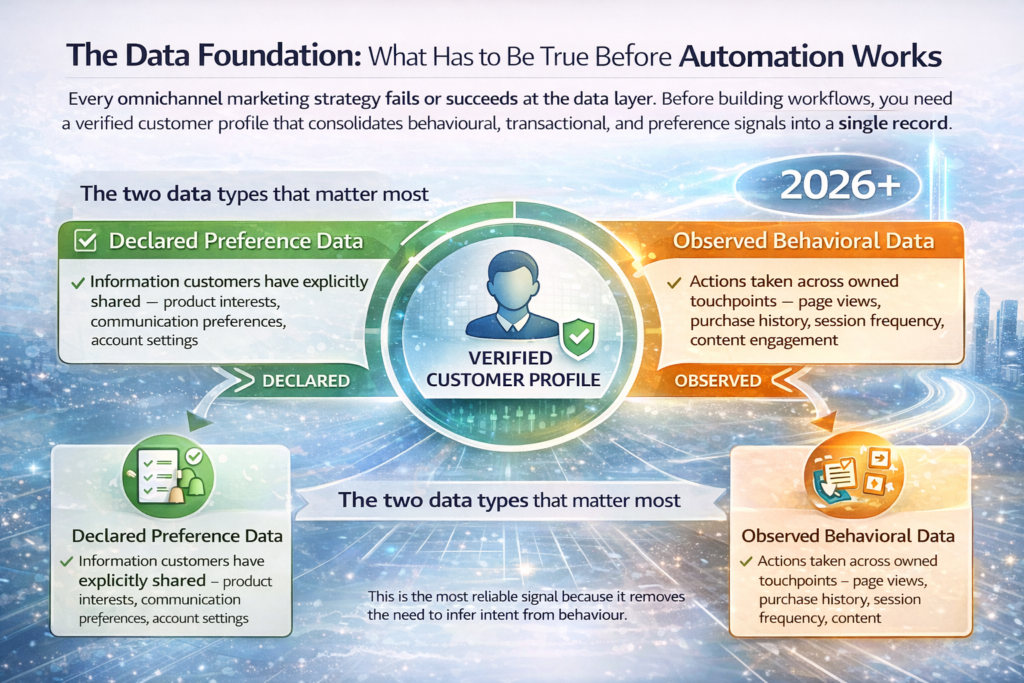
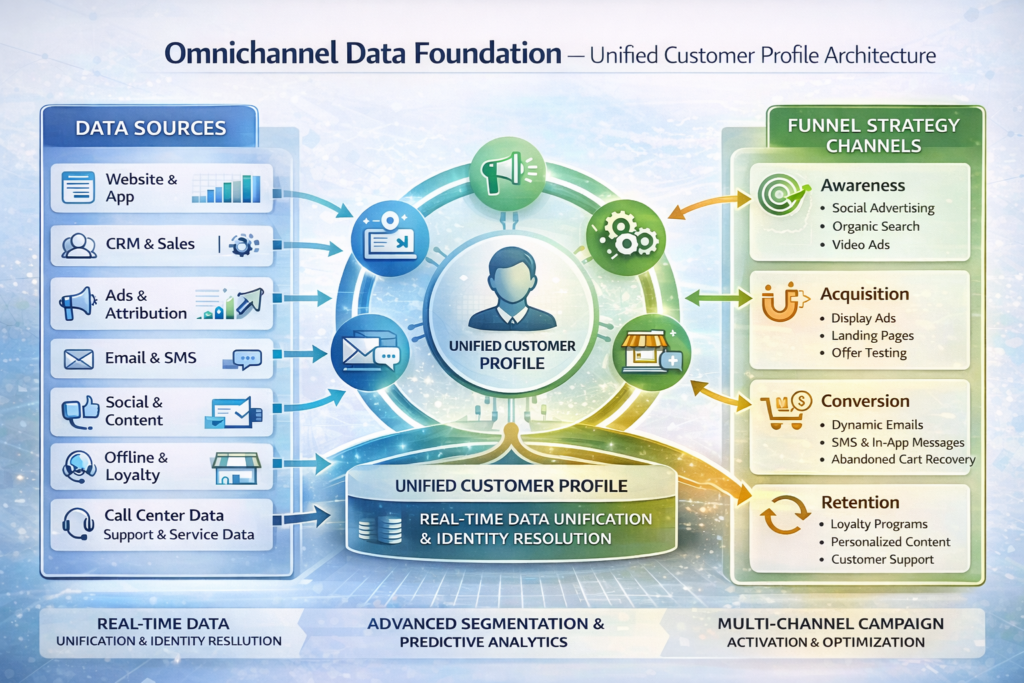
Every omnichannel marketing strategy fails or succeeds at the data layer. Before building workflows, you need a verified customer profile that consolidates behavioural, transactional, and preference signals into a single record.
The two data types that matter most
- Declared preference data: Information customers have explicitly shared — product interests, communication preferences, account settings. This is the most reliable signal because it removes the need to infer intent from behaviour.
- Observed behavioural data: Actions taken across owned touchpoints — page views, purchase history, session frequency, content engagement. This signal is more abundant and updates continuously.
A customer data platform (CDP) or an equivalent unified profile architecture combines both. The result is a 360-degree view that updates in real time as new signals arrive from any connected channel.
What unified data enables
- Dynamic audience segments that update automatically as customer behaviour changes
- Suppression lists that prevent messages from reaching customers who have already converted or recently churned
- Journey triggers that respond to specific behavioural signals rather than calendar-based send schedules
- Attribution models that trace revenue contribution across the full interaction sequence, not just the last click
Recommended Tool Stack by Business Size
| Business Type | Tools |
|---|---|
| SMB | Google Analytics, Mailchimp, HubSpot Starter, Meta Ads |
| Enterprise | Salesforce, Adobe Experience Cloud, Segment CDP, Marketo |
Building this data infrastructure is one component of a broader digital marketing capability. See Adclickr digital marketing strategies guide for how data infrastructure fits into a complete growth architecture.
The Funnel Strategy Framework: Four Steps That Hold It Together
A funnel strategy for omnichannel marketing needs structural principles that govern how every channel interaction is designed. Four principles consistently separate high-performing omnichannel programmes from fragmented ones.
| Funnel Stage | Social | SEO | PPC | |
|---|---|---|---|---|
| Awareness | Video ads, reels | Newsletter signup | Blog content | Display ads |
| Consideration | Retargeting content | Nurture emails | Comparison pages | Retargeting ads |
| Decision | Testimonials | Offers, discounts | Landing pages | Branded search ads |
Step 1: Coherence across every surface
The customer sees one brand. Pricing shown in a paid social ad matches what appears on the landing page. A discount applied via email is recognised immediately at the point of checkout, including in mobile app sessions. When coherence breaks, trust breaks with it — and trust is harder to rebuild than a sales metric.
Step 2: Context driving message timing
Context determines whether a message is valuable or intrusive. A re-engagement campaign sent to a customer who completed a purchase 48 hours ago is a context failure. A personalised follow-up sent after a second website visit with no conversion is context-aware and appropriate. Behavioural triggers built on real-time data produce context. Calendar-based batch sends produce noise.
Understanding how AI processes content signals — including review responses — informs how to build context-aware automation. See Adclickr guide on responding to reviews with AI in mind.
Step 3: Channel routing based on engagement probability
Different customers prefer different channels. A push notification that converts well for one segment may generate unsubscribes from another. Channel routing — directing each message to the platform where a specific customer has historically shown the highest engagement — is one of the clearest performance marketing applications within omnichannel architecture. Routing is not a creative decision; it is a data decision.
Step 4: Two-way conversation capability
Broadcast-only automation eventually alienates the audience it is trying to retain. Building reply handling into automation flows — either through AI chat routing or live agent escalation — converts the brand from a sender into a participant. Customers who receive responses to their replies show measurably higher retention rates than those who receive automated messages with no acknowledgement path.
Multi-Location Marketing: Scaling Omnichannel Across Geographies
Multi-location marketing adds a geographic dimension to the omnichannel challenge. The same customer relationship principles apply, but message content, promotional timing, and channel mix must be adapted to reflect regional context.
What makes multi-location omnichannel different
- Regional inventory and pricing variations must be reflected in personalised product recommendations and email content
- Local event calendars, holiday cycles, and regulatory differences shape message timing across markets
- Language and cultural register variations require genuine localisation, not translation
- Store-level data — in-store purchases, local loyalty programme activity — must feed back into the unified customer profile
Franchise brands managing omnichannel across multiple locations face a specific version of this challenge. See Adclickr franchise digital marketing ROI strategies for how multi-location brands structure coordinated campaigns.
Performance marketing in a multi-location context
Paid performance marketing channels become more effective in multi-location campaigns when geo-targeting is informed by the customer data layer. Suppression lists prevent national brand campaigns from reaching customers who have already responded to a local promotion. Lookalike audiences built from local high-value customers outperform national demographic targeting for location-specific campaigns.
Enterprise brands managing performance marketing across multiple locations benefit from a coordinated infrastructure. See Adclickr enterprise digital marketing services for how this scales at the enterprise level.
Performance Marketing Integration: How Paid Channels Fit Omnichannel
Performance marketing channels — paid search, paid social, programmatic display, affiliate — are most powerful when they are informed by the omnichannel customer data layer rather than operating independently from it.
Three ways performance marketing improves within omnichannel architecture
- Audience suppression reduces wasted spend: Customers who converted in the last seven days, customers who recently unsubscribed, customers flagged as churned — all of these should be excluded from paid acquisition targeting automatically. Without CDP-driven suppression, performance marketing campaigns reach people who should not be receiving ads, wasting budget and generating negative brand associations.
- First-party lookalike audiences outperform demographic targeting: Expanding from a seed audience of verified high-LTV customers produces better match quality than broad demographic parameters. The customer data layer makes this seed audience precise and continuously updated.
- Cross-channel attribution assigns credit accurately: When paid channel data is integrated with the CDP, attribution models can trace the full interaction sequence from first paid exposure through conversion. This reveals which paid channels are creating consideration and which are simply converting demand created by other touchpoints.
Verifying that your SEO and performance marketing infrastructure is functioning correctly is a prerequisite for omnichannel coordination. Use Adclickr technical SEO audit checklist to identify gaps before building automation workflows.
Benefits, Risks, and the Future of Omnichannel Execution
The compounding advantages of a unified approach
- Customer lifetime value increases when journey continuity replaces channel fragmentation
- Paid acquisition costs fall as first-party audiences improve targeting efficiency
- Support costs decrease when the service layer has access to the full customer history
- Revenue attribution becomes more accurate, making budget allocation decisions more defensible
Where omnichannel programmes most commonly fail
- Data infrastructure is underinvested relative to channel tool investment — automating before unifying creates faster fragmentation, not fewer silos
- Personalisation is applied at the creative level without data to support it — the result is messages that look personalised but carry generic content
- Privacy compliance is treated as a legal function rather than a design function — consent and data governance must be built into the customer data architecture from the start
Technical SEO and site architecture affect how customer data is captured and attributed. See Adclickr technical SEO for website performance for how site performance connects to omnichannel data quality.
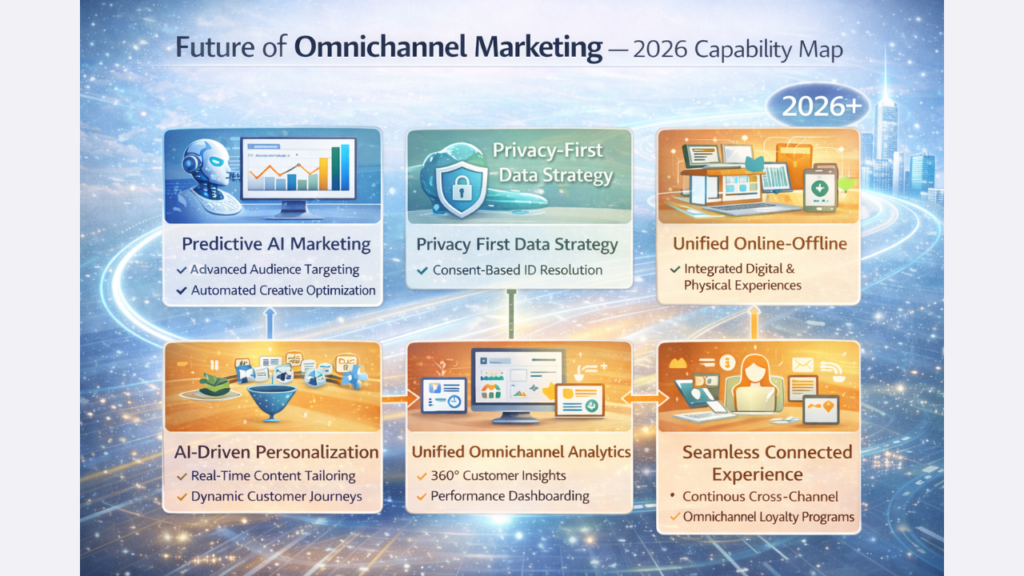
Three trends reshaping omnichannel strategy in 2026
- Predictive automation moving from reactive to anticipatory: AI models that identify churn risk, purchase probability, and optimal channel routing before behaviour becomes conclusive reduce the lag between signal and response to near-zero.
- Privacy-first data architecture becoming a competitive advantage: Brands that built robust first-party data collection with genuine value exchange will outperform those dependent on third-party signals as cookie deprecation continues.
- Unified commerce connecting online and offline fully: In-store behaviour feeding back into the digital omnichannel profile — purchase history, browsing at point of sale, loyalty redemption — creates the complete customer view that online-only data cannot.
Schema markup is one of the technical signals that improves how omnichannel content is indexed and surfaced by AI search systems. See Adclickr complete schema markup guide for implementation guidance.
Frequently Asked Questions
Omnichannel unifies customer data across channels for consistent messaging. Multichannel uses separate channels independently, often causing overlap, inconsistency, and fragmented customer experiences.
Omnichannel aligns messaging with customer journey stages using unified data, ensuring each interaction progresses the relationship and enables accurate full-funnel attribution.
Performance marketing improves with unified data through suppression lists, better audience targeting, and accurate cross-channel attribution, leading to more efficient spend and higher returns.
It requires a unified customer profile combining behavioral, transactional, and preference data via CDP or integrated CRM systems connecting all digital and offline touchpoints.
They should include location context in customer profiles, align local and national campaigns, and use geo-targeted data segments for relevant yet consistent customer experiences.
AI optimizes omnichannel efforts by predicting behavior, personalizing timing and messaging, improving targeting, generating content, and detecting performance issues based on data quality.
Conclusion: Building Omnichannel Marketing That Compounds
Start with the data foundation. Define the segments that matter for your business. Build the three or four workflows that have the highest revenue impact. Measure at the journey level, not just the channel level. Expand from there.
For brands ready to build this capability with expert support, Adclickr digital marketing and SEO services provide the strategic and technical infrastructure to move from channel-centric to customer-centric marketing.
adclickr.com/contacts/ | Free SEO Report | All Services

About the author
Ujjwal Kumawat
I specialize in SEO, website development, Google Ads and online business growth strategies. Through my blogs, I share practical insights, marketing tips and proven strategies to help businesses improve their online visibility, generate more leads and grow faster in the digital space.