Every quarter, the same argument surfaces in boardrooms and planning calls: one team wants to push harder on paid acquisition, the other is lobbying for content, SEO, and lifecycle investment. Neither side is wrong they are just solving different problems. Performance marketing and growth marketing are not competing philosophies in the abstract.
They are tools with distinct optimal conditions. Applying the wrong one at the wrong stage wastes budget, distorts metrics, and creates strategic drift that takes quarters to unwind. This guide builds a clear picture of both approaches through a data-driven marketing lens. You will see how each one structures a funnel strategy, where each delivers its strongest ROI, and how five actionable rules help you choose or blend them with intention rather than instinct.
Defining Performance Marketing and Growth Marketing Clearly
Loose definitions create bad decisions. Before comparing outcomes, the mechanics of each discipline need to be precise.
What performance marketing actually covers
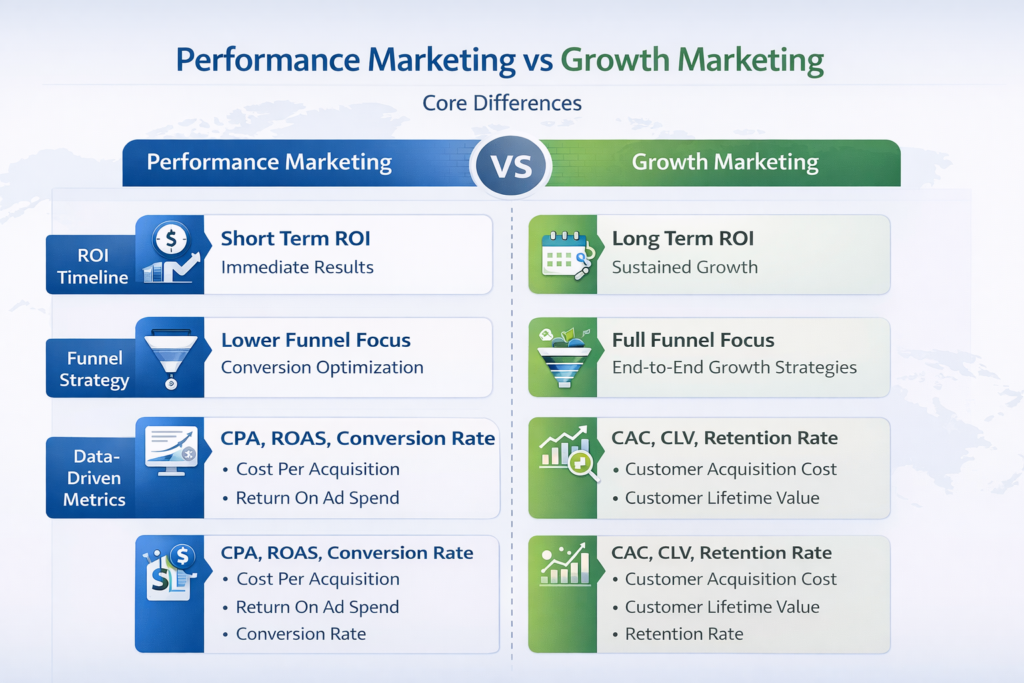
Performance marketing is a channel-level investment model where spend is tied directly to a defined outcome a click, lead, install, or sale. Advertisers pay for results rather than reach. The primary channels include paid search, paid social, affiliate networks, influencer performance deals, and programmatic display.
The defining characteristic is accountability at the transaction level. Every pound or dollar deployed generates a measurable signal almost immediately. This makes performance marketing the default choice when speed and predictability are the primary constraints.
What growth marketing actually covers
Growth marketing operates across the entire customer lifecycle from first awareness through activation, retention, expansion, and referral. It combines organic channels (SEO, content, community), product-level experimentation, lifecycle automation, and structured hypothesis testing.
The defining characteristic is compounding. Growth marketing builds assets ranked content, engaged audiences, optimized onboarding flows that generate returns over months and years rather than campaign cycles. The cost per acquisition from organic channels typically falls over time rather than rising with competition.
Neither approach is inherently superior
Gartner’s 2024 Tech Marketing Benchmarks found that growth-focused organizations still direct over 70% of their budgets toward short-term operational activity which includes performance channels. Nearly half simultaneously increased brand and awareness investment. The real world runs both in parallel.
Which is right for your business?
Choose performance marketing if:
- You need results fast
- You have ad budget
- You want quick testing
Choose growth marketing if:
- You want long-term traffic
- You have time (3–6 months)
- You want lower costs over time
ROI Comparison: How Each Strategy Generates Returns
ROI looks different depending on the time horizon you use to measure it. This is the root cause of most performance marketing vs growth marketing debates both sides are correct within their own measurement windows.
Where performance marketing ROI is strongest
Performance marketing delivers its CAC increases 20–50% as you scale best returns when three conditions exist: the audience has active purchase intent, attribution from click to conversion is reliable, and the channel has available scale without prohibitive bid competition. Under these conditions, a data-driven marketing team can optimize toward a target cost-per-acquisition and scale spend predictably.
The risk profile changes as markets mature. Customer acquisition costs rise with advertiser competition. SEO leads convert 14%+ (higher than ads). Ad fatigue reduces creative effectiveness. Channels that produced strong returns at lower spend volumes become progressively less efficient as budgets grow. This is the structural ceiling that performance marketing cannot escape through optimisation alone.
Where growth marketing ROI is strongest
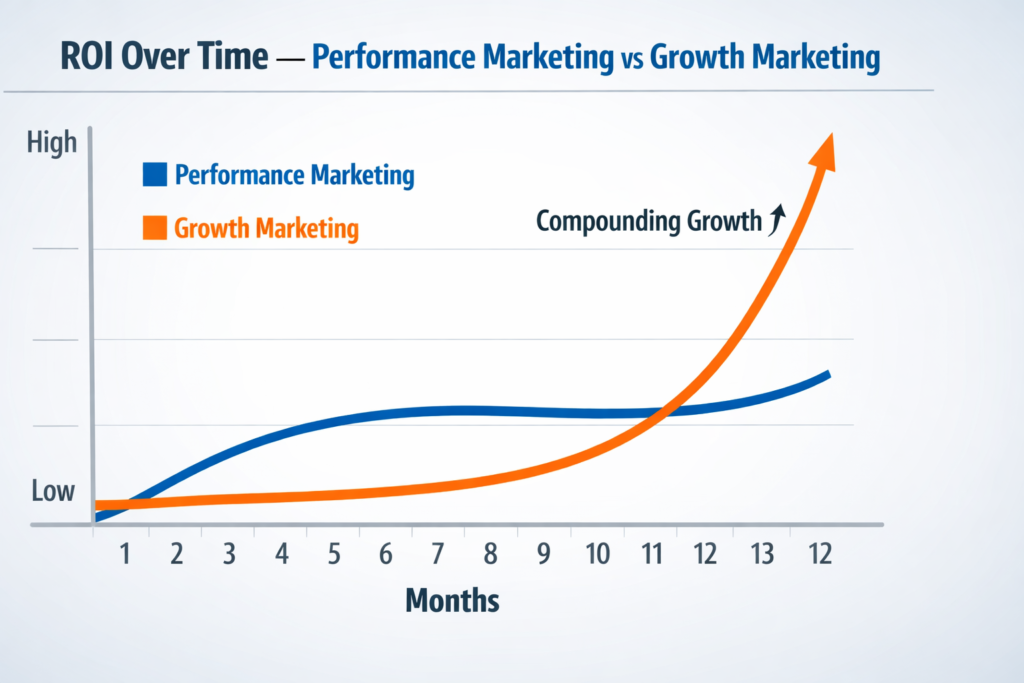
Growth marketing ROI compounds rather than plateaus. A body of ranked content, an engaged community, or a refined onboarding sequence continues producing results after the investment phase ends. HubSpot’s 2025 marketing data confirms that organic and content-led lead sources close at measurably higher rates than outbound-driven equivalents a revenue quality advantage that paid channels rarely match at scale.
The challenge is patience. Growth marketing investments typically take two to four quarters to show meaningful organic returns. Organisations expecting short-term attribution windows will consistently undervalue these channels even when they are producing superior lifetime economics.
Side-by-side: how the two approaches differ in practice
| Factor | Performance Marketing | Growth Marketing |
|---|---|---|
| Time to Results | Immediate (days/weeks) | Long-term (months/quarters) |
| Cost Trend | Increases with scale | Decreases over time |
| Dependency | Paid spend required | Compounds organically |
| Funnel Stage | Bottom funnel | Full funnel |
| ROI Type | Short-term | Long-term |
| Scalability | Limited by budget | Scales via assets |
Funnel Strategy: Where Each Approach Fits in the Buyer Journey
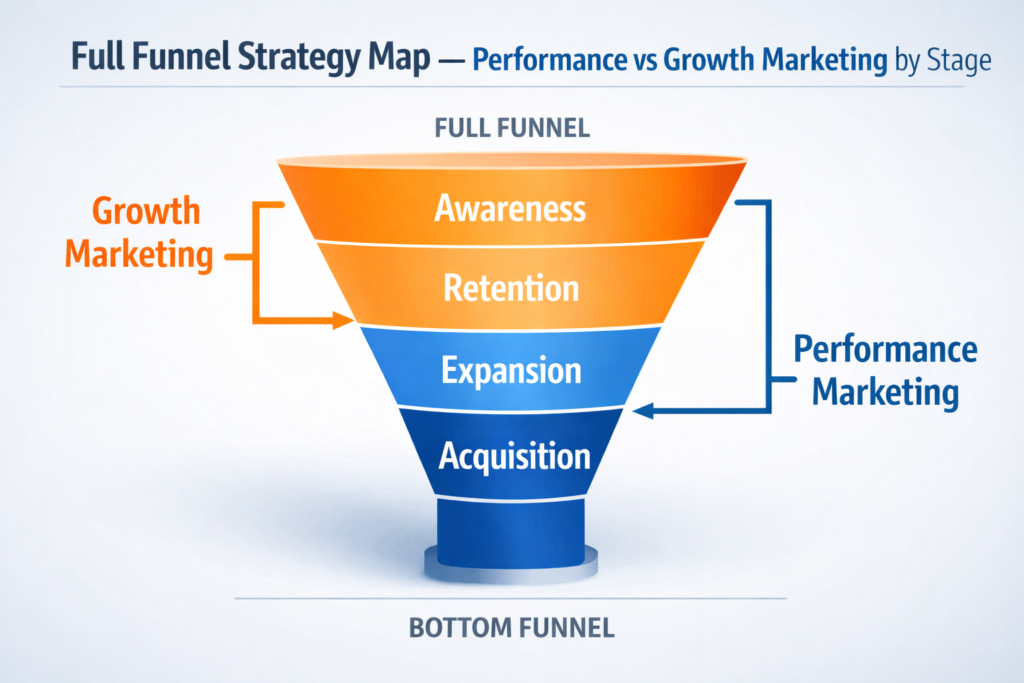
The most reliable way to assign performance marketing or growth marketing investment is to map each to the stage of the buyer journey where it creates the most leverage.
Performance marketing dominates the bottom of the funnel
At the decision stage when a buyer is actively comparing options, searching branded or product-specific terms, or responding to retargeting performance marketing captures intent that already exists. Paid search, comparison site advertising, and affiliate referral programs are optimised for this moment.
A well-structured funnel strategy relies on performance channels to convert the demand that growth channels create. Removing performance marketing from the bottom of the funnel without a strong organic replacement leaves revenue on the table.
Growth marketing creates and sustains upper-funnel demand
Awareness, consideration, and education the stages that precede purchase intent are where growth marketing investment has the most durable impact. SEO content, thought leadership, community building, and product-led acquisition models introduce audiences to a brand before they are searching for a solution.
Forrester’s Lifecycle Revenue Marketing research found a roughly ten-percentage-point gap in revenue plan attainment between organizations with advanced lifecycle marketing capability and those without. The gap exists because growth systems improve how performance traffic converts after acquisition they are multipliers, not replacements. Explore how Adclickr structures full-funnel strategy across both marketing approaches.
Quick-reference: which strategy fits each funnel stage
| Funnel Stage | Primary Strategy | Key Channels |
|---|---|---|
| Awareness | Growth | SEO, content, community, social organic |
| Consideration | Growth | Email nurture, webinars, comparison content |
| Intent | Performance | Branded search, retargeting, affiliate |
| Conversion | Performance | Paid search, partner programs, CRO |
| Retention | Growth | Lifecycle email, onboarding, product-led loops |
| Expansion | Growth | Upsell sequences, referral programs, community |
Budget Signals: What Your Spend Mix Reveals About Your Strategy
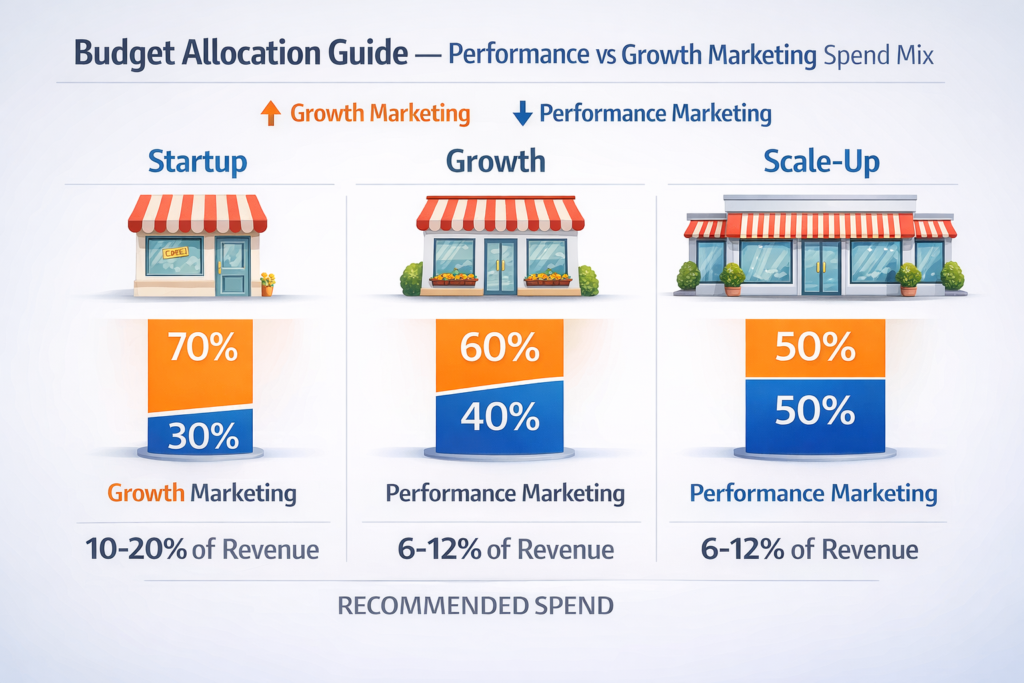
Budget allocation is the most honest signal of where an organisation actually sits on the performance marketing vs growth marketing spectrum. Stated strategy and funded strategy are frequently different things.
How to read your current budget position
Research from Gartner’s marketing benchmark data shows growth-oriented companies allocating roughly 8.6% of revenue to marketing, while non-growth organisations average closer to 5.7%. Within those totals, the composition matters as much as the absolute figure.
- Under 6% of revenue with 80%+ in paid channels: Heavy performance mode. Efficient for predictable lead generation but vulnerable to CAC inflation and channel saturation
- 7–10% of revenue with meaningful content, product, or brand investment: Actively building growth capacity. Returns compound over subsequent quarters
- Over 70% of budget in short-term operational spend: A data-driven marketing audit of attribution quality is worth running before scaling further measurement gaps at this investment level hide significant waste
Measurement distrust amplifies performance marketing risk
Forrester’s 2024 B2B measurement research found that a substantial share of marketing leaders do not fully trust their own attribution systems. Scaling performance spend without reliable attribution does not increase revenue it increases dashboards that look positive while obscuring actual impact.
5 Decision Rules for Choosing the Right Marketing Strategy
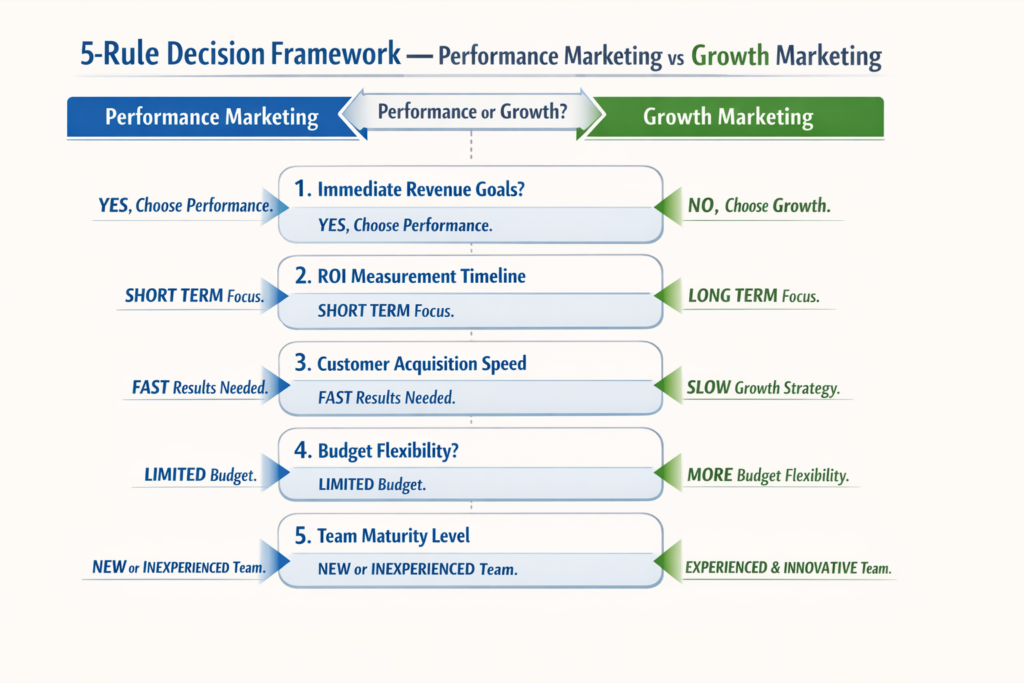
The five rules below are designed to replace opinion with structured criteria. Each one addresses a specific decision variable. Work through them sequentially, and the right emphasis for your current planning cycle will surface without a debate.
Let your revenue horizon set the primary emphasis
Organisations needing to close revenue within 90 days should lead with performance marketing paid acquisition, affiliate, and partner programs are architected for speed. Organisations building toward multi-quarter ARR targets should weight growth marketing higher, where content, SEO, and lifecycle systems reduce long-term dependence on bought traffic. This converts the choice into a sequencing decision rather than a permanent commitment.
Audit measurement quality before scaling anything
Neither strategy performs reliably on broken attribution. Performance marketing inflates vanity metrics when revenue traceability is absent. Growth marketing cannot demonstrate lifecycle ROI without connected data across acquisition, onboarding, and retention touchpoints. Run a measurement audit first. Deloitte’s RevOps research confirms that organizations with mature revenue operations infrastructure scale both marketing approaches with significantly more confidence.
Match strategy to how buyers in your category actually decide
Categories with short, intent-heavy purchasing journeys suit performance marketing’s capture model. Categories involving multi-stakeholder evaluation, extended comparison periods, or high switching costs suit growth marketing’s education and trust-building model. B2B SaaS, enterprise services, and regulated industries typically require growth marketing to create the conditions in which performance marketing can convert efficiently.
Use organic content to reduce performance marketing’s cost ceiling
Paid acquisition cost rises with market competition this is structural, not a channel management problem. Content and SEO investment builds a demand source that is not subject to auction dynamics. HubSpot’s 2025 data shows SEO-driven leads closing at substantially higher rates than outbound equivalents. Building organic capacity now reduces the performance marketing budget required to hit future revenue targets. For support building an organic demand engine, see Adclickr’s content marketing services.
Assess team capability before committing to either approach fully
Performance marketing demands specialists in channel management, bid strategy, creative testing, and attribution modelling. Growth marketing demands cross-functional coordination across content, product, data, and lifecycle teams. Choosing a strategy your team cannot execute produces worse outcomes than choosing a simpler strategy well. The Content Marketing Institute’s 2024 benchmarks show that teams directly connecting content output to revenue metrics invest more intentionally and produce better results a readiness signal worth measuring before allocating budget.
Building a Blended Model: When Both Strategies Work Together
The most durable marketing systems do not choose one approach they sequence them deliberately. Performance marketing funds near-term revenue while growth marketing builds the assets that reduce future performance costs.
How a blended data-driven marketing model works in practice
In the early phases of a campaign or product launch, performance marketing leads. Paid channels generate rapid feedback on audience response, messaging, and conversion rates. This data informs growth marketing investment showing which content topics convert, which audience segments have the highest retention potential, and where the onboarding funnel loses the most value.
As growth marketing assets mature ranked content, referral loops, lifecycle sequences the revenue share attributable to paid channels should decrease as a percentage. CAC from organic sources falls. The performance marketing budget can either hold steady while producing more revenue or redirect toward new market acquisition. This is the compounding advantage that data-driven marketing teams optimise toward. Explore how Adclickr’s growth marketing program integrates with performance channels for clients in SaaS, ecommerce, and B2B services.
Signs a blended model is working
- Organic traffic share grows quarter on quarter without replacing paid revenue.
- CAC from paid channels stabilises or declines as organic referrals increase.
- Lifecycle metrics retention rate, expansion revenue, referral volume improve alongside acquisition metrics.
- Attribution data shows multiple touchpoints contributing to conversion, not a single paid click.
AI is accelerating growth marketing timelines
Semrush data shows a significant portion of marketers reporting improved ROI when AI tools support content production and SEO workflows. Growth marketing’s historically slower ramp is compressing making the case for earlier investment strong.
Frequently Asked Questions
Performance marketing focuses on paid channels with measurable outcomes like clicks or sales. Growth marketing spans the full lifecycle, using SEO, content, and automation to build long-term, compounding demand.
Performance marketing delivers fast, measurable ROI in the short term. Growth marketing delivers stronger long-term ROI through lower CAC, higher-quality leads, and compounding traffic over time.
Startups should begin with performance marketing to validate demand and generate revenue. Once proven, they can invest in growth marketing like SEO and content for scalable, long-term acquisition.
Performance marketing targets bottom-funnel users ready to convert. Growth marketing builds awareness, nurtures users, and drives retention, creating demand that performance channels later capture and convert efficiently.
You need accurate conversion tracking, reliable attribution models, CAC tracking by channel, and strong alignment between marketing and sales to ensure campaigns drive real revenue, not just misleading metrics.
What works best by industry
- Local business → Google Ads + local SEORelated Resources from Adclickr
- Ecommerce → Start with ads, then SEO + email
- SaaS → Growth marketing (content + lifecycle)
Adclickr designs data-driven marketing programmes that align performance marketing and growth marketing to your revenue timeline, team capacity, and measurement infrastructure.
Get a Free Strategy Audit | Contact Us.

About the author
Ujjwal Kumawat
I specialize in SEO, website development, Google Ads and online business growth strategies. Through my blogs, I share practical insights, marketing tips and proven strategies to help businesses improve their online visibility, generate more leads and grow faster in the digital space.