Most marketing teams don’t lack ideas they lack execution capacity. Managing content production, paid campaigns, SEO decisions, and attribution all compete for limited human attention. AI marketing strategy solves this by shifting repetitive, high-volume tasks to machines, allowing teams to focus on strategic and creative decisions.
It enhances, not replaces, human judgment. This guide explains how to build a scalable AI marketing strategy, covering growth opportunities, SEO automation, data-driven systems, and practical implementation across key campaign areas.
What AI Marketing Strategy
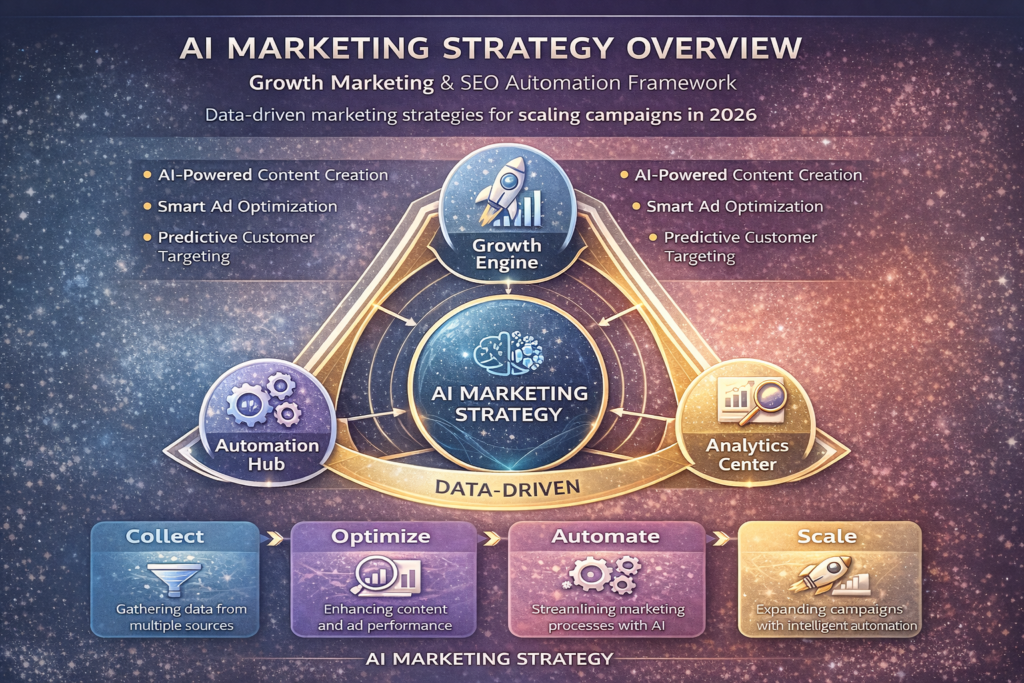
An AI marketing strategy is not a single tool or a single channel. It is an architectural decision about where machine learning, automation, and predictive systems take over from manual processes and where human judgment remains the irreplaceable input.
The three layers of AI in marketing
- Automation layer: Rules-based processes that execute repetitive tasks without manual intervention email send scheduling, bid adjustments, social posting, report generation. This layer frees human time from mechanical work.
- Intelligence layer: Machine learning models that identify patterns in large datasets and surface insights no manual analysis could produce at the same speed audience segment discovery, churn prediction, content performance forecasting.
- Generation layer: Generative AI systems that produce content variations, creative concepts, keyword research outputs, and copy at scale compressing the production cycle between strategy and execution.
An effective AI marketing strategy deliberately combines all three layers. Teams that use only the automation layer miss the intelligence advantage. Teams that invest in generation without the automation foundation create volume without distribution infrastructure.
Top AI Marketing Tools
| Category | Tool | Use Case | Pricing |
|---|---|---|---|
| Content | ChatGPT | Blog writing, ideas | Free / Paid |
| SEO | Surfer SEO | Content optimization | Paid |
| Ads | Meta AI | Ad targeting | Paid |
| Mailchimp AI | Email automation | Free / Paid | |
| Analytics | Google Analytics | Data tracking | Free |
What distinguishes AI marketing from standard digital marketing
| Dimension | Standard Digital Marketing | AI Marketing Strategy |
| Content production | Manual one piece at a time | AI-assisted variants generated at scale from a single brief |
| Audience targeting | Demographic parameters set manually | Behavioural patterns identified automatically from first-party data |
| SEO research | Keyword tools reviewed by analysts | Automated gap analysis and opportunity scoring across thousands of terms |
| Campaign optimisation | Periodic manual review | Continuous automated adjustment based on real-time signal |
| Attribution | Periodic analyst-run model | Always-on attribution connected to live performance data |
Understanding how AI processes and transforms content informs how to deploy the generation layer effectively. See Adclickr guide on how AI converts text and images into video.
SEO Automation: How AI Scales Organic Search Without Scaling Headcount
SEO automation is one of the highest-leverage applications of AI marketing strategy organic search is high-value and resource-intensive. A well-executed SEO programme requires continuous keyword research, content auditing, technical monitoring, internal link management, and performance reporting.
What SEO automation changes
- Keyword opportunity scoring at scale: AI evaluates keyword lists of thousands of terms, scoring each on search intent alignment, competition level, and relevance to existing content a process that takes days manually.
- Automated technical monitoring: Crawl errors, Core Web Vitals regressions, page speed deteriorations, and schema markup issues are flagged in real time discovered in periodic manual audits.
- Content gap identification: AI analyses competitor content coverage against a site’s existing pages, surfacing topics with search demand that the site does not address prioritised by traffic potential and keyword difficulty.
- Internal link recommendation: Machine learning identifies which existing pages should link to newly published content and which internal link gaps are reducing PageRank distribution across the site.
A structured technical SEO audit remains the foundation that automation builds on. See Adclickr technical SEO audit checklist for the systematic baseline check that AI monitoring extends.
The limits of SEO automation
SEO automation handles volume and pattern recognition. It does not replace editorial judgment about what content genuinely serves audience needs, strategic decisions about which topics align with business goals, or creative quality assessment of what makes content worth sharing.
For brands in specialised sectors, SEO automation must account for sector-specific search behaviour. Adclickr SEO guide for healthcare websites covers how intent-based automation differs in compliance-sensitive environments.
SEO performance scaling AI-driven organic investment is covered in how to know if your SEO is working a prerequisite step.
Data-Driven Marketing Infrastructure: What AI Requires to Function
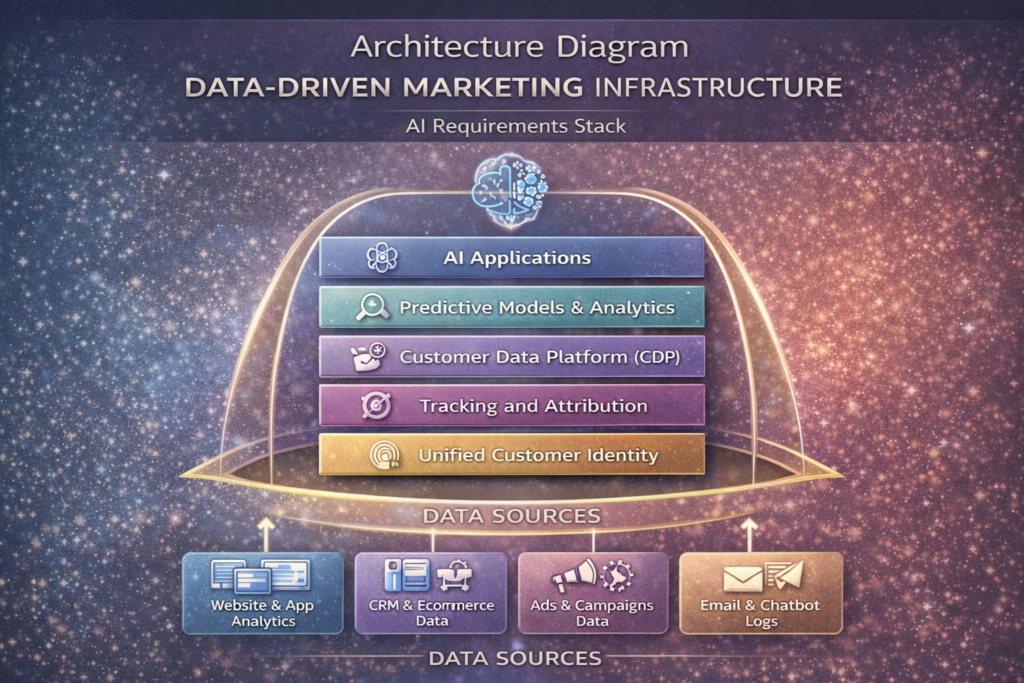
AI marketing tools perform in direct proportion to the quality of the data they operate on. A predictive model trained on incomplete or inconsistent customer data produces unreliable predictions. Investing in AI capability, the data infrastructure must be verified.
The four data requirements AI marketing depends on
- Verified conversion tracking: Every significant customer action must be tracked reliably across all channels. Gaps in conversion data produce gaps in model accuracy.
- Unified customer identity: First-party customer records must be deduplicated and connected across touchpoints AI systems see the full customer journey channel-specific fragments.
- Sufficient signal volume: Machine learning models require minimum data volumes to produce statistically valid outputs. Volume thresholds vary by use case and must be assessed model deployment.
- Clean historical data: Predictive models trained on data containing tracking errors or duplicate records produce forecasts that reflect those errors. A data quality audit is a prerequisite for meaningful AI marketing investment.
Schema markup is one of the structural data signals that improves how AI search systems interpret and index content. See Adclickr complete schema markup guide for technical implementation guidance.
Growth Marketing Applications: Where AI Creates Compounding Returns
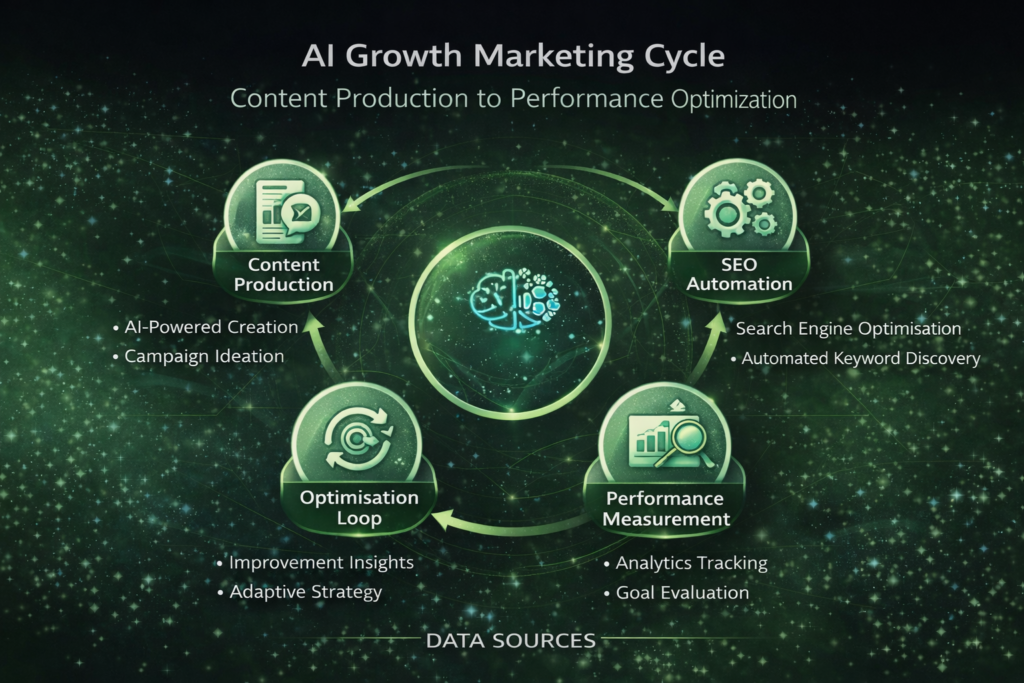
Growth marketing is the discipline of building marketing systems where each campaign cycle produces learnings that improve the next one. AI accelerates this compounding cycle by compressing the feedback loop between action and insight.
Content-driven growth at AI scale
The growth marketing advantage of AI content production is not volume it is iteration speed. A team that can publish a topic cluster, measure which pages gain traction, and update underperforming pages within the same month operates at a fundamentally different learning velocity than a team on a six-week content cycle.
Content length decisions significantly affect both ranking performance and user engagement. AI can model optimal length by topic see Adclickr guide on how to identify the right content length for the research behind these decisions.
Social channel growth with AI assistance
Social media growth marketing benefits from AI in caption generation, posting time optimisation, hashtag and keyword selection, and engagement pattern analysis. AI tools identify which content formats are producing the strongest reach signals before a human team would recognise the pattern from aggregate data.
For brands growing through Instagram, AI-assisted keyword and caption optimisation produces measurable reach improvements. See how to select the right keywords for Instagram SEO for tactical implementation.
See how to create an SEO-optimised Instagram caption for AI-assisted caption strategy.
Reputation and review management with AI
AI-assisted review response tools allow brands to acknowledge and respond to customer reviews at scale without the delay of manual workflows. Response patterns trained on brand voice produce consistent, on-brand replies flagging reviews that require escalation to a human team member.
See Adclickr guide on responding to reviews with AI in mind for how AI-assisted review management integrates with growth marketing reputation strategy.
Industry Applications and Scaling AI Marketing Across Sectors
Enterprise and multi-location brands
Enterprise brands running campaigns across multiple markets benefit from AI’s ability to produce localised content variants, manage geo-targeted paid campaigns, and consolidate performance reporting across territories into a single dashboard. The same AI content brief can generate market-specific variations that reflect local search intent without requiring separate content teams for each territory.
For enterprise brands building AI marketing capability across multiple locations, see Adclickr enterprise digital marketing services for how AI strategy scales at the enterprise level.
Franchise brands have specific multi-location AI marketing challenges. Adclickr franchise digital marketing ROI strategies covers coordinated AI deployment across franchise networks.
Logistics, healthcare, and sector-specific applications
Sector-specific AI marketing requires compliance guardrails built into content generation workflows healthcare content cannot make clinical claims, logistics marketing must reflect actual service capability. AI generation tools configured with sector-specific constraints produce compliant output at scale without requiring manual compliance review of every piece.
For logistics brands deploying AI-assisted SEO, see Adclickr SEO guide for logistics and transportation websites for sector-specific keyword and content strategy.
Risks, Quality Controls, and the Future of AI Marketing
Where AI marketing strategy creates new risks
- AI-generated content without editorial review can produce factually inaccurate claims, particularly in technical or regulated categories where precision is a trust signal
- Automated bid systems optimising toward proxy metrics rather than actual revenue can increase spend efficiently while producing diminishing returns on genuine business outcomes
- Predictive models trained on historical bias reproduce that bias at scale audience exclusions and inclusion criteria require regular human audit
- Over-automation of brand voice produces consistency at the cost of authenticity the human element that differentiates a brand from its AI-assisted competitors
AI Marketing Budget Allocation Guide
- 40% → Paid ads (AI optimization)
- 30% → Content & SEO (AI content tools)
- 20% → Automation (email, CRM)
- 10% → Analytics & testing
Essential quality controls for AI marketing deployments
- Factual accuracy review for all AI-generated content before publication, with particular rigour in regulated or technical categories
- Periodic human audit of automated campaign decisions to verify that AI optimisation is producing genuine business outcomes rather than metric improvements that do not translate to revenue
- Bias audits on predictive models at minimum quarterly frequency to identify audience exclusions reflecting historical errors
- Brand voice guidelines implemented as constraints in generation tools, not as post-production corrections
Technical site performance directly affects how AI marketing content is indexed and surfaced by search systems. See Adclickr site speed optimisation guide for the technical infrastructure that supports AI-driven content performance.
Core Web Vitals performance affects both search ranking and user engagement with AI-generated content. See Adclickr Core Web Vitals optimisation guide for technical benchmarks.
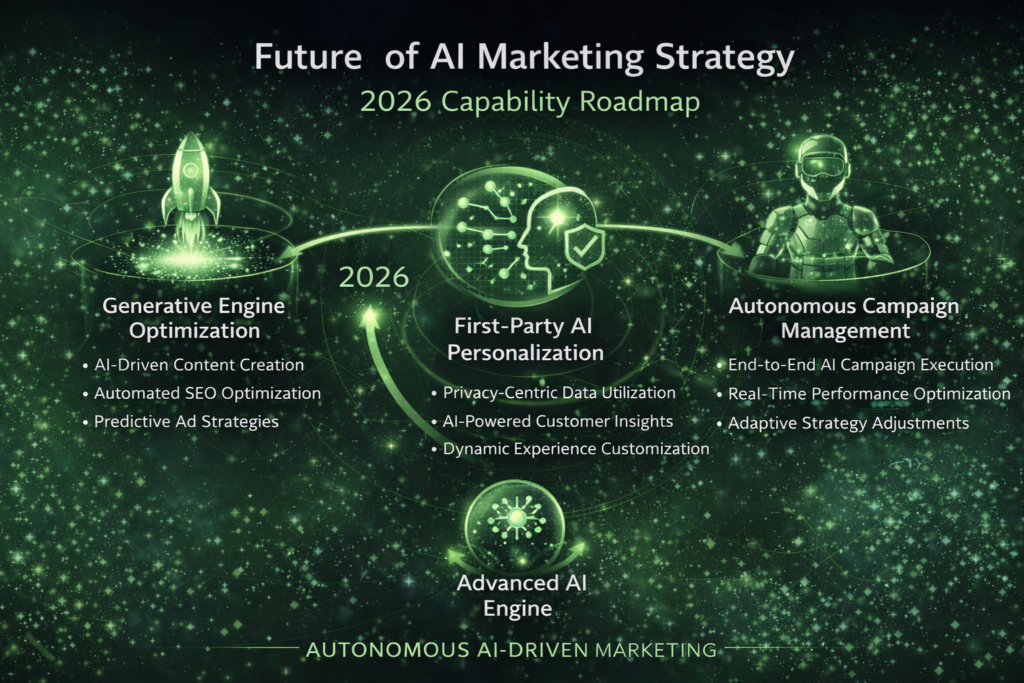
Three trends defining AI marketing strategy in 2026 and beyond
- Generative engine optimisation: As AI-powered search platforms serve answers directly, optimising content for citation by these systems becomes as important as optimising for traditional organic ranking. GEO requires structured data, authoritative sourcing, and semantic depth.
- First-party AI personalisation: As third-party data sources continue to restrict, AI systems trained on first-party customer data become the primary personalisation infrastructure. Brands that built first-party data collection at scale hold a compounding advantage as this shift accelerates.
- Autonomous campaign management: AI systems that identify new audience opportunities, propose creative directions, and adjust channel mix based on market signals will progressively reduce the manual work of campaign management concentrating human involvement at the strategy and quality layer.
Generative engine optimisation is one of the most significant emerging shifts in AI marketing strategy. See Adclickr guide to geo-generative engine optimisation for how to position content for AI-powered search surfaces.
What Makes This AI Strategy Different?
This AI strategy stands apart by enabling businesses to scale operations without the need to continuously expand their workforce. Instead of relying on headcount, it leverages the powerful combination of automation and artificial intelligence to handle tasks smarter and faster, reducing overhead while maximizing output.
At its core, every decision is driven by data — not guesswork. This means campaigns, content, and customer interactions are constantly optimized based on real insights, ensuring resources are always directed where they deliver the most impact.
What truly sets this approach apart is its unified methodology. Rather than treating SEO, paid advertising, and lifecycle marketing as separate channels, it integrates all three into one cohesive system. Each element feeds and amplifies the others, creating a self-reinforcing growth engine.
The result? Sustainable, scalable growth that works smarter — not harder — giving businesses a lasting competitive edge in an increasingly AI-driven world.
Frequently Asked Questions
AI marketing strategy uses automation, machine learning, and generative AI to scale execution, improve personalisation, and enable continuous optimisation, unlike manual, slower traditional digital marketing workflows.
AI automates keyword research, detects technical issues in real time, identifies content gaps, and optimises internal linking, enabling faster, continuous SEO improvements beyond manual analysis.
It requires accurate conversion tracking, unified customer data, sufficient data volume, and clean historical datasets to ensure AI models generate reliable insights and predictions.
AI accelerates testing and learning cycles, improves audience targeting, and enhances attribution accuracy, helping teams optimise campaigns faster and drive more efficient, compounding growth results.
Risks include inaccurate content, biased predictions, poor optimisation toward proxy metrics, and loss of brand voice, requiring human oversight, audits, and strong quality control processes.
Begin with data audits, prioritise automating repetitive tasks, deploy automation first, then intelligence and generative tools, and measure success using business outcomes like revenue and acquisition cost.
Conclusion: AI Marketing Strategy as a Compounding Capability
An AI marketing strategy built on solid data infrastructure and deployed sequentially does not just make existing campaigns more efficient. It changes the rate at which a marketing organisation learns and learning rate is the compound interest of marketing performance.
Every AI-assisted campaign cycle produces more data, more reliably attributed, than the one before it. Each iteration of content testing produces a clearer picture of what resonates with which audience. Each predictive model trained on a larger, cleaner dataset produces more accurate forecasts. The teams that start this compounding cycle earliest accumulate the largest advantage over time.
The entry point does not require a complete infrastructure overhaul. Start with the highest-leverage automation: one SEO automation tool, one AI content production workflow, one data-driven marketing attribution model. Verify the data foundation. Measure business outcomes, not tool outputs. Expand from what works.
For brands building this capability with expert strategic and technical support, Adclickr AI marketing and SEO services provide the infrastructure for scaling AI-driven growth marketing across channels.
Contacts | Free SEO Report | All Services

About the author
Ujjwal Kumawat
I specialize in SEO, website development, Google Ads and online business growth strategies. Through my blogs, I share practical insights, marketing tips and proven strategies to help businesses improve their online visibility, generate more leads and grow faster in the digital space.