Campaigns that miss revenue targets rarely fail because of weak creative; they fail when decisions aren’t grounded in evidence. Choices like channel selection, audience definition, message sequencing, and budget allocation determine whether campaigns generate value or waste resources. Data-driven marketing ensures these decisions rely on real audience behavior, verified attribution, and measurable outcomes.
It is not just a tool or platform, but an operational standard applied across the entire funnel. This guide explains how to build that standard using first-party data, AI-driven strategies, omnichannel coordination, and reliable measurement to deliver consistent, accountable results.
What Data-Driven Marketing Actually Means
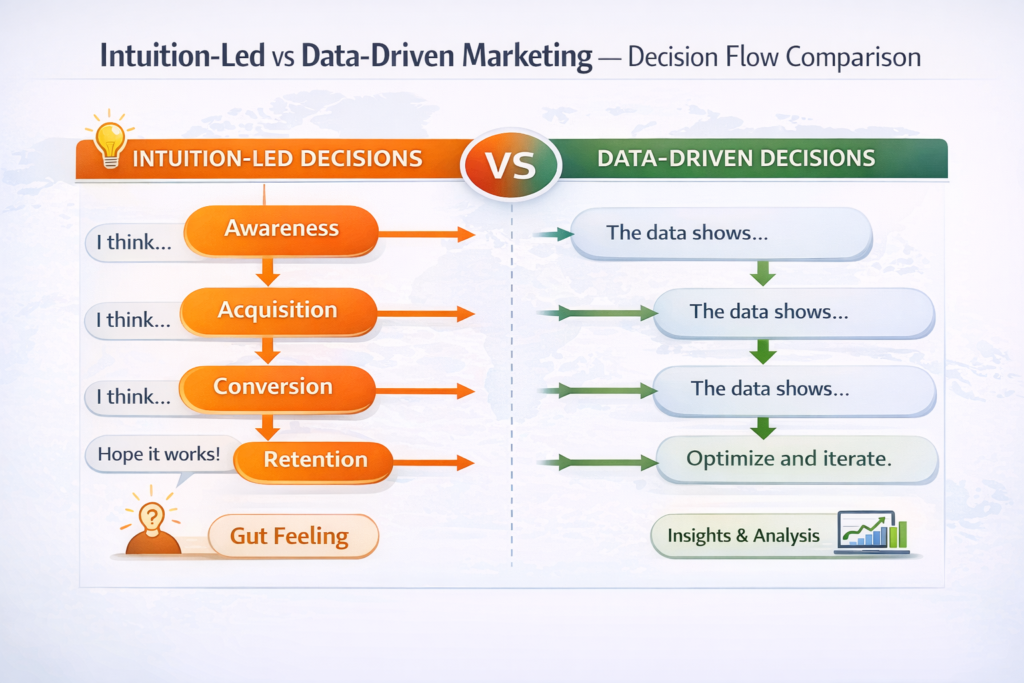
Strip away the jargon and data-driven marketing describes one thing: making decisions based on what audiences actually do, not what marketers assume they will do. Every stage of the funnel strategy is shaped by real behavioral signals rather than educated guesswork.
The practical distinction matters. Many teams collect data and report on it after the fact. A genuinely data-driven approach feeds insight into decisions before campaigns launch, adjusts spend allocations as performance signals emerge, and connects outcomes back to the specific variables that drove them.
How it differs from intuition-led marketing
| Dimension | Data-Driven Marketing | Intuition-Led Marketing |
| Targeting | Audience segments built from verified behavioural data | Broad demographics based on assumed fit |
| Budget allocation | Directed toward channels with measured attribution | Distributed by habit or historical preference |
| Creative decisions | Validated through structured testing | Selected by internal preference or trend |
| Campaign adjustments | Made in real time from live performance signals | Made post-campaign from aggregated reports |
| Success definition | Connected to revenue outcomes and LTV | Measured by impressions, clicks, or reach |
Five Ways Data-Driven Marketing Operates Across the Funnel
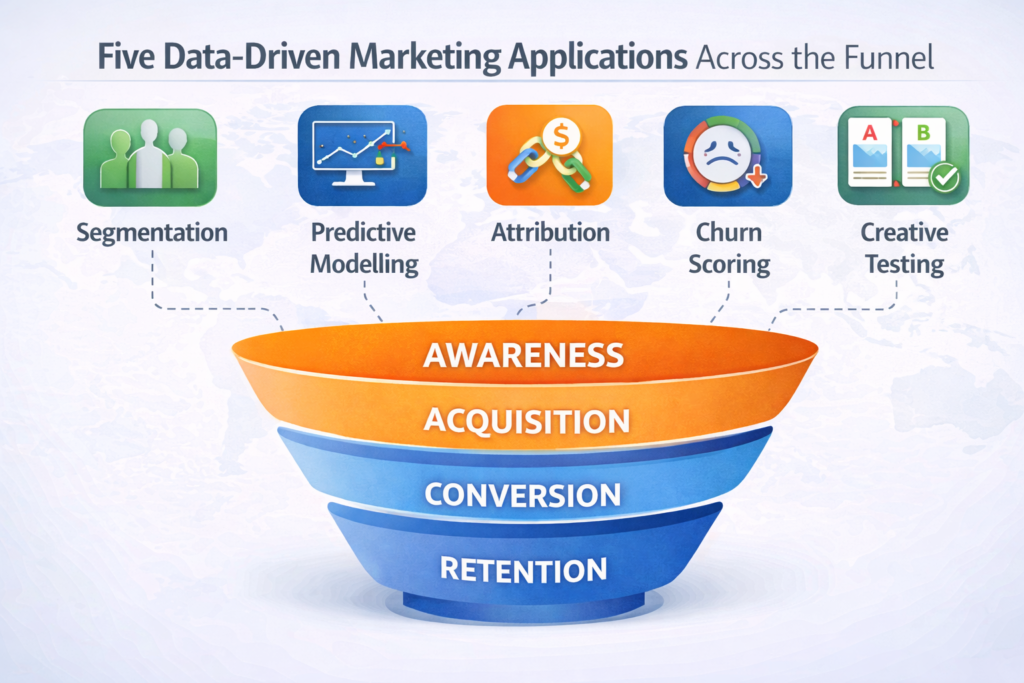
Knowing what data-driven marketing is matters less than knowing how it works in practice. These five applications show how insight becomes action at specific funnel stages.
Audience segmentation connected to message relevance
Purchase history, content consumption patterns, and engagement sequences reveal what different audience groups actually value. When segments are built from this behavioural layer rather than from demographic assumptions, message relevance rises and response rates follow.
Predictive modelling for demand anticipation
Machine learning models trained on historical conversion data surface which prospects are most likely to act and when. Ecommerce brands, this shapes inventory and promotional timing. For B2B teams, it prioritises sales outreach toward accounts showing buying signals.
For a broader view of how AI transforms these workflows, see Adclickr guide on how AI converts text and images into video.
Multi-touch attribution for honest ROI accounting
Single-touch attribution models systematically overvalue the final interaction and undervalue everything that built the relationship before it. Multi-touch frameworks distribute credit across the full sequence of exposures, making it possible to see which channel combinations drive the strongest outcomes.
Churn probability scoring for retention investment
Engagement velocity, support ticket frequency, and usage pattern changes all carry predictive value for customer retention. Scoring customers on churn probability allows teams to target intervention precisely rather than applying blanket win-back campaigns to everyone who has not engaged recently.
Creative performance testing as a growth system
Systematic A/B and multivariate testing converts creative decisions from subjective choices into measurable ones. Each test generates data that improves the next iteration, creating a compounding creative advantage over teams that operate on instinct.
Structuring content for maximum impact also requires understanding length and format. See Adclickr guide on how to identify the right content length for practical benchmarks.
Omnichannel Marketing: Connecting Data Across Every Touchpoint
Omnichannel marketing is data-driven marketing applied at the channel coordination level. Rather than managing paid search, email, social, and content as independent programmes, an omnichannel strategy uses shared data to present a coherent experience as the customer moves between them.
What omnichannel marketing requires from a data perspective
- A unified customer identifier that persists across channels typically a CRM record or customer data platform profile
- Real-time event tracking that updates audience membership as behaviour changes
- Cross-channel attribution that reflects how combinations of touchpoints drive conversion
- Suppression logic that prevents the same message reaching the same person redundantly across channels
For brands in specialised sectors, omnichannel data infrastructure needs to account for specific audience behaviour patterns. Adclickr SEO guide for healthcare websites illustrates how this applies in a compliance-sensitive environment.
AI Marketing Strategy: Where Machine Intelligence Meets Campaign Execution
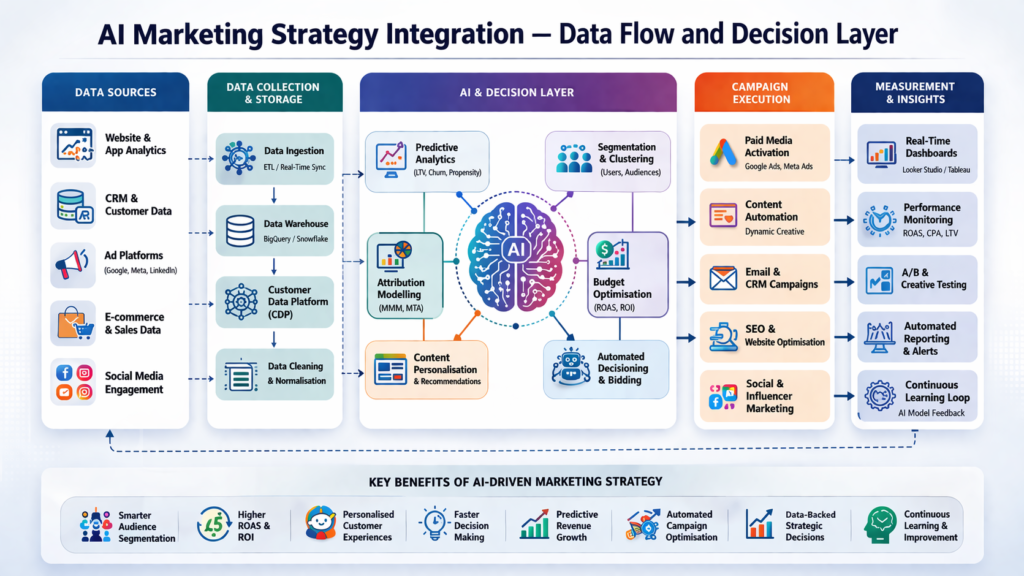
AI marketing strategy is the application of machine learning and automation to marketing decisions that previously required manual analysis. It does not replace strategic judgment it compresses the time required to gather evidence and act on it.
Where AI delivers the clearest performance gains
- Audience modelling: AI identifies high-value prospect clusters from large datasets faster than manual segmentation
- Content personalisation: dynamic content systems serve different messages to different users based on real-time behavioural context
- Bid optimisation: automated bidding responds to conversion probability signals no manual manager can process at the same speed
- Anomaly detection: AI flags performance drops, attribution breaks, and traffic quality issues before they consume meaningful budget
AI is also reshaping how brands appear in search. Adclickr guide to geo-generative engine optimisation explains how AI-generated answer surfaces are changing visibility for location-based brands.
The measurement infrastructure AI depends on
AI models are only as reliable as the data they are trained on. Before investing in AI marketing tools, confirm that conversion tracking is verified across all channels and that attribution models are calibrated against actual revenue rather than proxy metrics.
A structured SEO audit identifies gaps in your measurement infrastructure. See Adclickr technical SEO audit checklist for a systematic approach.
The Six-Phase Data-Driven Marketing Implementation Framework
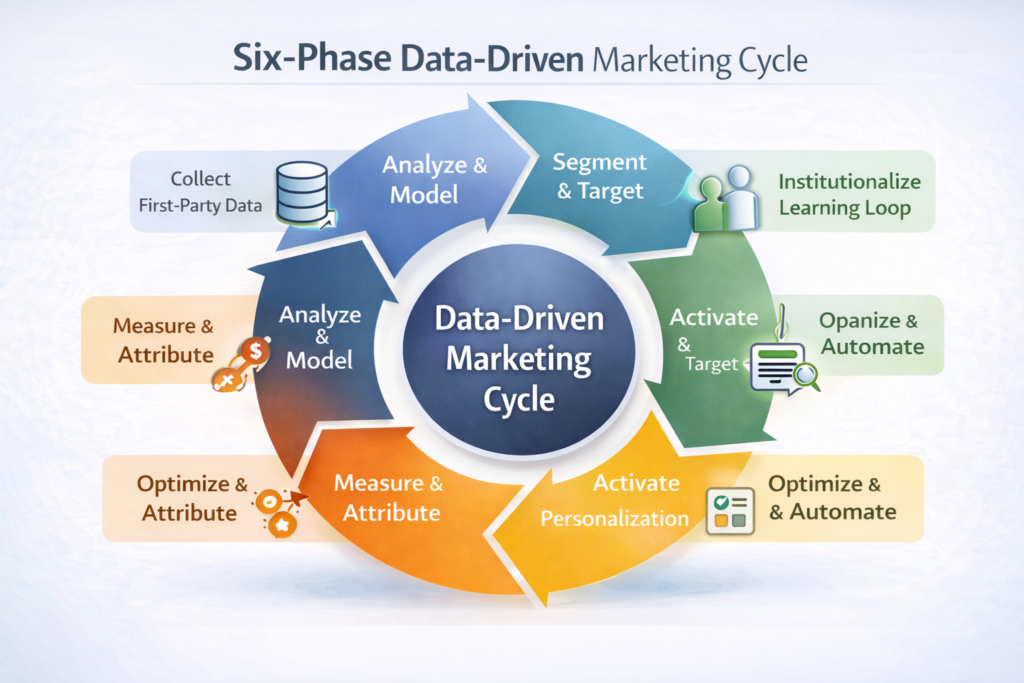
Implementing data-driven marketing is a continuous cycle, not a one-time project. The six phases below create a structure for ongoing improvement.
- Establish your first-party data foundation First-party data collected from your website, CRM, email platform, and product analytics is the most reliable input for every downstream decision. Centralize it into a single customer view using a customer data platform before investing in any analytical layer.
- Define the metrics that connect to revenue Before running analysis, agree on which metrics predict revenue outcomes. Conversion rate, customer lifetime value, CAC by channel, and cohort retention rates are revenue-adjacent. Impressions and open rates are not unless a verified relationship to revenue has been established for your specific context.
- Build your analysis and attribution capability Choose tools that surface actionable insight rather than aggregate data for display. Attribution models should be validated against closed revenue. For a complete view of technical performance affecting data quality, run a structured audit using the Adclickr technical SEO for website performance framework.
- Monitor performance with appropriate frequency Real-time monitoring catches anomalies. Trend analysis requires longer windows typically four to eight weeks to separate signal from natural variance. Confusing the two leads to premature optimisations that interrupt campaigns before they have gathered sufficient data.
- Institutionalise the learning loop The compounding advantage of data-driven marketing comes from making each cycle faster and more informed. Document what worked, what failed, and why. Build shared knowledge that allows different team members to build on previous experiments.
Industry Applications: How Different Sectors Activate Data
The principles of data-driven marketing are consistent across sectors. The variables, data sources, and measurement priorities differ significantly by vertical.
E-commerce
Browsing abandonment sequences, post-purchase replenishment timing, and product affinity modelling are the highest-leverage applications. Brands that connect their product catalogue to audience behaviour data serve recommendations matching actual purchasing intent.
B2B and enterprise services
Account-based data allows sales and marketing to coordinate around the same buying signals. Content consumption history, event attendance, and pricing page visits are all signals that a B2B data-driven strategy can use to prioritise outreach and personalise nurture sequences.
For enterprise-scale businesses, aligning data across multiple markets requires a coordinated digital strategy. See Adclickr enterprise digital marketing services for how this is structured at scale.
Franchise and multi-location brands
Localized data is the primary asset for franchise marketing. National campaigns need to be adjusted based on regional performance signals what converts in one market may underperform in another based on local competitive dynamics.
Adclickr franchise digital marketing ROI strategies guide covers how to build data-driven campaigns balancing national brand consistency with local performance optimisation.
Healthcare and regulated industries
Compliance constraints shape what data can be collected and how it can be activated. First-party, consent-based data becomes the primary source. Content performance data carries outsized value when paid targeting options are restricted.
Benefits, Risks, and Future Trends
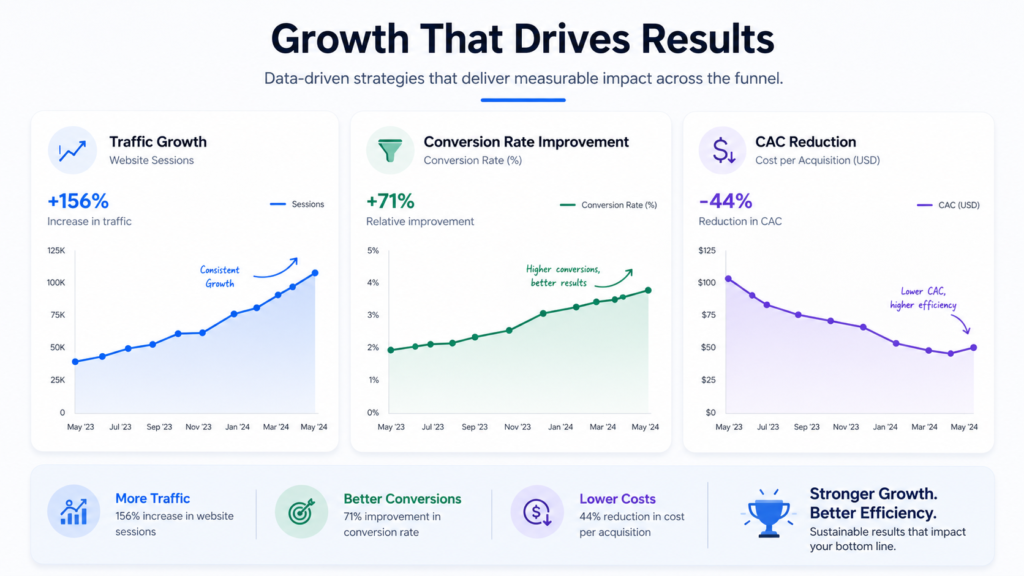
The compound advantages of a data-driven approach
- Budget allocation becomes increasingly precise spend follows verified performance rather than allocation habit
- Audience understanding deepens over time as behavioural data accumulates across campaigns and cohorts
- Creative output improves systematically because testing results are documented and applied to future work
- Reporting becomes more credible because results connect to revenue outcomes rather than activity metrics
Where data-driven marketing creates new risks
- Over-optimisation toward short-term conversion metrics at the expense of brand equity and long-term demand
- Attribution model selection that flatters certain channels without reflecting actual customer behaviour
- Data privacy non-compliance as first-party collection expands without a corresponding governance framework
- Analysis paralysis waiting for perfect data before making decisions that need sufficient data, not perfect data
Understanding how schema markup supports data-driven SEO visibility is a practical starting point. See Adclickr complete schema markup guide for implementation guidance.
Three trends shaping the next phase of data-driven marketing
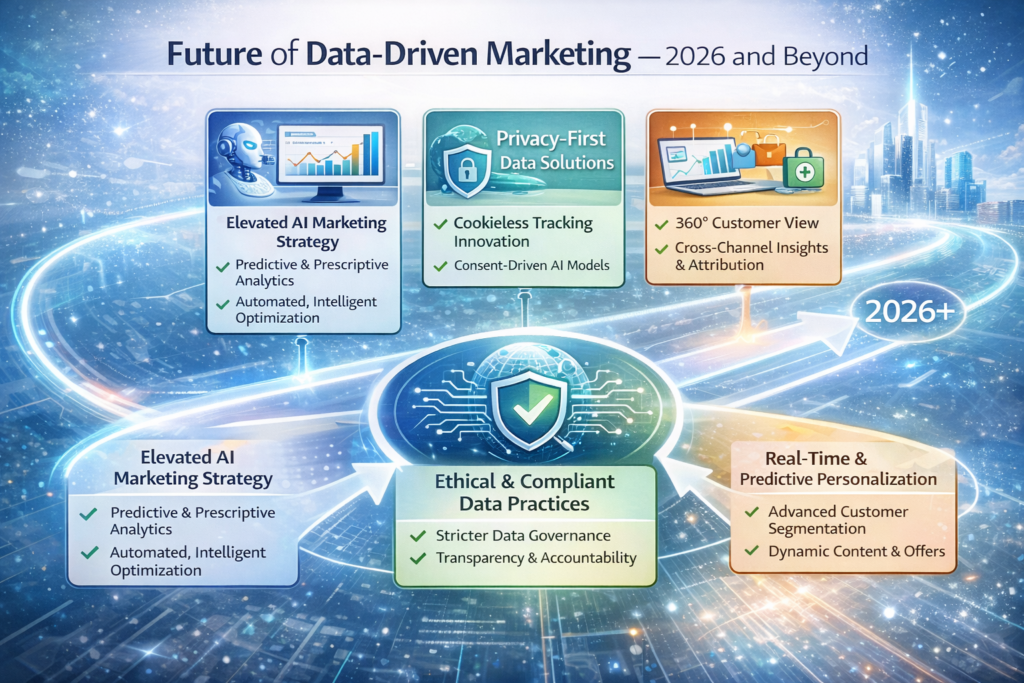
- Privacy-first data infrastructure: As third-party cookies phase out and consent regulations expand, first-party data collected with clear value exchange becomes the primary competitive moat. Brands that built this infrastructure early will have durable advantages.
- Generative AI in campaign production: AI tools are compressing the time between insight and execution. Copy variations, audience segment briefs, and creative concepts can now be generated from data inputs, reducing the lag between what the data suggests and what goes live.
- Unified marketing intelligence platforms: The next evolution beyond dashboards platforms that not only aggregate data but surface prioritised recommendations based on what the data pattern actually suggests the team should do next.
Case Study Example: Trading Education Company
Client: Metaverse Trading Academy
Website: https://metaversetradingacademy.in/
Problem
- Low conversions from website
- Not ranking on Google (not in top 10)
- Low traffic from search engines
- Needed more sales from PPC campaigns
Action
- Performed full SEO audit + strategy
- Improved website structure for better user experience
- Ranked keywords on Google first page
- Ran targeted PPC campaigns (Display + Facebook)
- Conducted A/B testing on:
- Pricing plans
- Lead forms
- Built a modern, responsive website
- Used data tracking + regular optimization
Result
- +130% growth in SEO traffic
- 4,500+ users per month increase
- ₹0.43 CPC (low-cost PPC performance)
- Improved conversion rate (via A/B testing)
- Higher leads and sales from SEO + PPC
Simple Summary (for quick readers)
- Problem: Low traffic + low conversions
- Action: SEO + PPC + A/B testing + website improvement
- Result: 2x+ growth in traffic and conversions in ~60 days
Data-Driven Marketing Stack
| Function | Tool | Purpose |
|---|---|---|
| Analytics | Google Analytics | Track users |
| CRM | HubSpot | Manage leads |
| Ads | Google Ads | Paid campaigns |
| SEO | Ahrefs | Keyword research |
| Dashboard | Looker Studio | Reporting |
Campaign Results (Example)
- Client: Ecommerce brand (Artshaili)
- Before:
- Conversion rate: 1.2%
- CAC: ₹2,000
- After (3 months):
- Conversion rate: 2.8%
- CAC: ₹1,200
Frequently Asked Questions
Data-driven marketing uses real audience and performance data to guide targeting, messaging, and budgeting decisions, replacing assumptions with measurable insights that continuously improve campaign effectiveness.
It improves ROI by allocating budget to high-performing channels, testing creatives before scaling, and using accurate attribution to reduce waste and focus on revenue-driving activities.
Multichannel marketing uses multiple platforms independently, while omnichannel marketing connects them through shared data, ensuring consistent messaging and seamless customer experience across all touchpoints.
AI marketing uses machine learning to analyze data, automate decisions, and optimize campaigns at scale, while traditional marketing relies on slower, manual analysis and human decision-making.
Brands should prioritize website behavior, email engagement, CRM journey data, and product usage, combining signals across touchpoints to build accurate, unified customer profiles.
Regulations limit third-party data use, making consent-based first-party data essential. Brands must prioritize compliant data collection, storage, and usage to maintain effective personalization and targeting strategies.
Conclusion: Data-Driven Marketing as a Compounding Advantage
Every campaign a data-driven team runs generates evidence. That evidence improves targeting, creative, attribution, and budget allocation for the next campaign. Over time, this creates an advantage that compounds not because the team gets lucky more often, but because they learn faster when things go wrong.
The entry point is simpler than most brands assume. Start with a clean first-party data foundation. Agree on the metrics that connect to revenue. Design your next campaign as a structured experiment with a defined hypothesis. Then let what you learn shape the one after it.
For brands ready to accelerate this process, Adclickr digital marketing services provide the strategic and technical infrastructure needed to move from intuition-led to evidence-led marketing across every channel.

About the author
Ujjwal Kumawat
I specialize in SEO, website development, Google Ads and online business growth strategies. Through my blogs, I share practical insights, marketing tips and proven strategies to help businesses improve their online visibility, generate more leads and grow faster in the digital space.