A funnel can look healthy steady traffic, decent click-through rates, consistent spend and still bleed thousands in lost revenue monthly. The damage hides between stages: browsers who don’t click, leads who don’t convert, buyers who never return.
A funnel audit pinpoints exactly where these gaps are, why they exist, and what to fix first. Using journey analysis and diagnostic data, it traces every step from first impression to post-purchase loyalty.
Here are ten signs your funnel is underperforming and how to fix each one.
What a Funnel Audit Actually Examines
A funnel audit is not a traffic report or a channel performance review. It is a user journey analysis that examines the complete path a customer takes from the moment they first encounter the brand through awareness, consideration, conversion, and post-purchase engagement and identifies where that journey breaks down.
The four funnel stages a full audit covers
- Awareness stage: How effectively is the brand capturing attention in search, social, and paid channels? Are the right audiences being reached, and are initial engagement signals click-through rates, impressions, reach aligned with traffic volume targets?
- Consideration stage: Once visitors arrive on the site or landing page, are they engaging with content at the depth needed to build purchase confidence? High bounce rates, low time-on-page, and poor scroll depth are all consideration-stage leak signals.
- Conversion stage: Where in the checkout, lead form, or sign-up process are users abandoning? Conversion stage leaks are often the most quantifiable and the fastest to fix, but they are also frequently symptoms of problems that begin earlier in the funnel.
- Retention and expansion stage: How many customers return? What is the repurchase rate? Are loyalty mechanisms email sequences, personalised offers, loyalty programmes producing measurable uplift in customer lifetime value?
A funnel audit sits alongside other diagnostic processes, including SEO and technical audits. See Adclickr guide on how to perform an SEO audit for the parallel technical layer that affects funnel performance at the traffic acquisition stage.
Signs Your Funnel Is Leaking
The following signs cover the most common and most revenue-significant funnel leaks. Each is presented with its primary diagnostic signal and the first fix to apply. A full funnel audit will identify which combination of these signs is present in your specific funnel.
1. Traffic & Engagement Issues
High Traffic, Low Engagement — Audience Mismatch
Sessions rise but time-on-page is under 30 seconds and bounce rate exceeds 75%.
Fix: Align traffic intent with landing page content. Avoid sending broad search traffic to product-specific pages.
Strong CTR, Weak Conversion — Landing Page Disconnect
Clicks are strong but conversions fall below 2%.
Fix: Ensure message match between ad and landing page. Deliver the promised value immediately with clear headlines and CTAs.
2. Conversion Friction Points
Cart or Form Abandonment Above 70%
Users drop off during checkout or form completion.
Fix: Reduce fields, add trust signals, and enable guest checkout to remove friction.
MQL-to-SQL Conversion Below 10%
Leads don’t meet sales criteria.
Fix: Rebuild lead scoring using actual conversion data, not assumed behaviors.
3. Content & Channel Performance
Email Open Rates Below 20%
Low engagement reduces reactivation potential.
Fix: Segment lists, clean inactive users, and personalise subject lines.
Organic Traffic Not Converting
Traffic lacks purchase intent.
Fix: Match content to intent informational pages capture leads, transactional pages drive conversions.
Paid CAC Increasing
Costs rise without audience growth.
Fix: Expand audiences using lookalikes and refresh ad creatives regularly.
4. Retention & Technical Gaps
High First Purchase, Low Repeat Rate
Customers don’t return.
Fix: Build a post-purchase email journey starting within 24 hours.
Poor Page Speed (Core Web Vitals)
Slow pages cause early exits.
Fix: Optimise load time, reduce scripts, and improve layout stability.
No Attribution Visibility
Performance can’t be measured accurately.
Fix: Implement multi-touch attribution with verified tracking across all channels.
Quick-Reference Funnel Audit Checklist
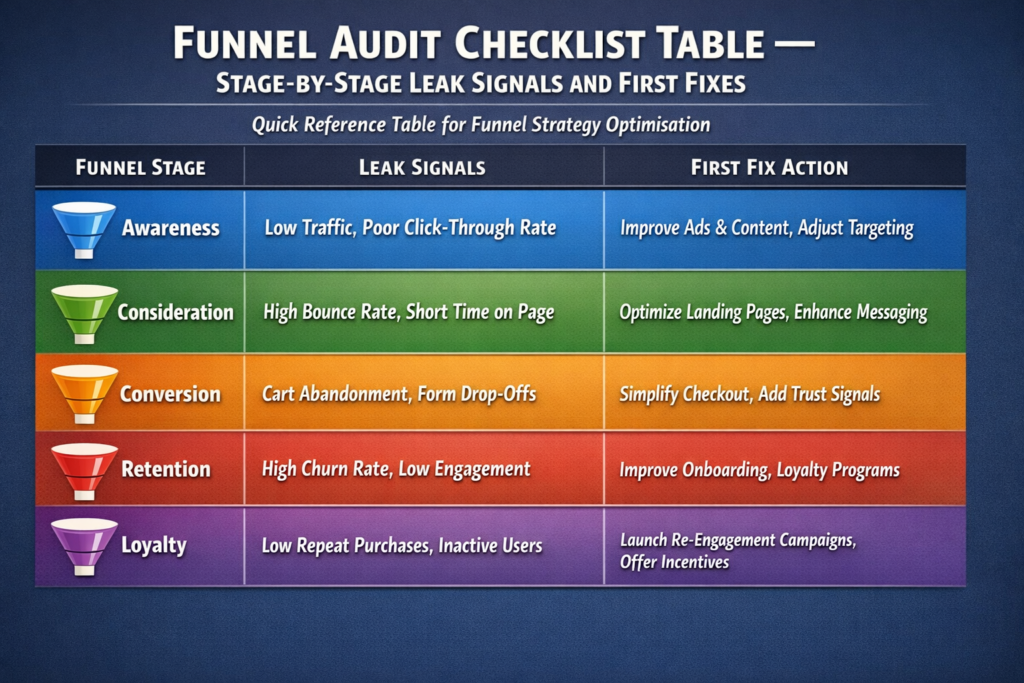
Use this table as a rapid diagnostic reference during a funnel audit. Each row maps a funnel area to its primary warning signal and the first fix to apply before deeper investigation.
| Leak Area | Primary Signal | First Fix |
| Awareness — traffic quality | High sessions, high bounce rate | Check traffic source vs. intent alignment |
| Awareness — ad relevance | Good CTR, poor landing page conversion | Audit message match between ad and page |
| Consideration — engagement | Low time-on-page, high exit rate on content | Add content depth and internal CTAs |
| Consideration — content intent | Organic traffic not converting | Map content to buyer journey stage |
| Conversion — friction | Cart or form abandonment above 70% | Reduce steps; add trust signals at exit point |
| Conversion — email nurture | Open rates below 20% | Segment list; match subject to interest |
| Lead quality — MQL-to-SQL | Sales pipeline conversion below 10% | Rebuild scoring from closed-won data |
| Paid — audience saturation | CAC rising with flat audience size | Expand to lookalike audiences; refresh creative |
| Retention — repeat purchase | High first-purchase, low LTV | Build post-purchase email sequence from day one |
| Technical — site performance | Core Web Vitals failing on funnel pages | Fix LCP, CLS, FID per PageSpeed report |
| Attribution — measurement | No cross-channel revenue traceability | Implement multi-touch attribution model |
How to Run a Funnel Audit: Six-Phase Process
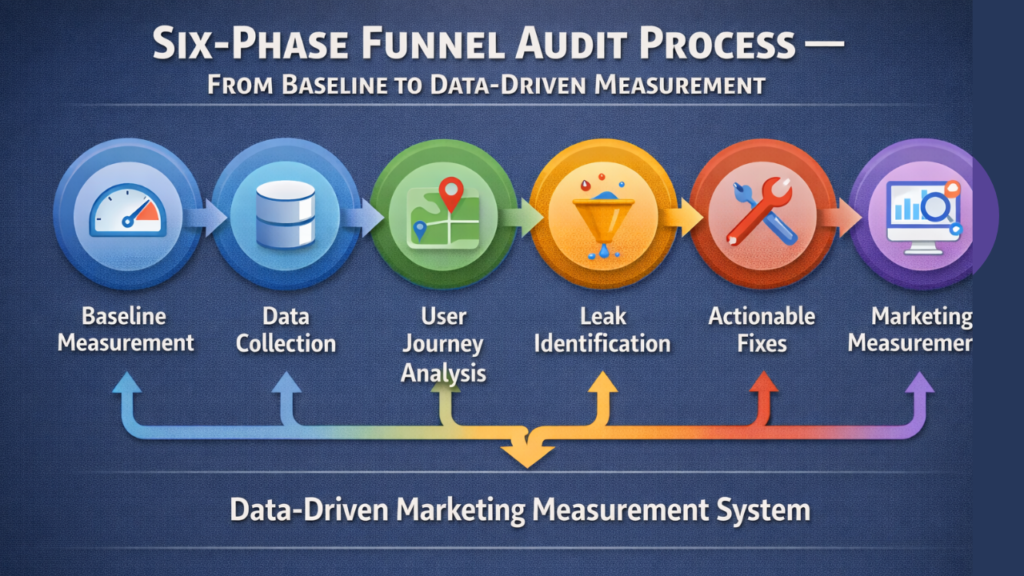
A funnel audit is most effective when it follows a consistent diagnostic sequence. Running phases out of order attempting conversion optimisation before diagnosing traffic quality, for instance produces fixes that address symptoms rather than root causes.
Phase 1: Define the funnel boundaries and measure current conversion rates
Before diagnosing leaks, document the expected funnel path for your specific business model and measure the actual conversion rate at each stage boundary. This baseline reveals which stage has the largest absolute revenue impact from improvement and determines where the funnel audit should focus first.
Understanding whether your current SEO and traffic acquisition is performing correctly is a prerequisite before auditing downstream funnel stages. See how to know if your SEO is working for the diagnostic framework.
Phase 2: Segment traffic by source and map to funnel stage entry point
Different traffic sources enter the funnel at different stages with different intent levels. Paid traffic from branded search typically enters close to conversion. Informational organic traffic enters at the consideration stage. Social traffic often enters at awareness. Segmenting conversion data by traffic source reveals whether low conversion rates are a funnel problem or a traffic quality problem which require completely different solutions.
Phase 3: Run user journey analysis on highest-exit pages
Session recording, heatmap analysis, and scroll depth data reveal where users leave pages and what they interact with before exiting. This is the most direct form of user journey analysis and consistently identifies specific friction points that aggregate metrics obscure.
Technical page performance directly affects user journey completion. See Adclickr site speed optimisation guide and
Adclickr Core Web Vitals optimisation guide for the technical fixes that improve funnel completion rates at the page performance level.
Phase 4: Audit the conversion architecture
Review the specific elements of each conversion step form length, CTA copy, trust signal placement, page load time at the conversion point, mobile usability at the decision stage. Conversion architecture audits produce the fastest measurable improvements of any funnel audit phase because the fixes are specific and implementable without content production cycles.
Schema markup on key funnel pages improves both click-through rates from search and AI-generated answer inclusion. See Adclickr complete schema markup guide for implementation guidance on product, FAQ, and review schema across funnel pages.
Phase 5: Diagnose the post-conversion retention funnel
The highest-value funnel improvement in most businesses is not converting more first-time buyers it is converting first-time buyers into repeat purchasers. Map the current post-purchase email sequence, loyalty programme touchpoints, and cross-sell mechanisms. Identify the time between first and second purchase for customers who do return, and build retention sequences designed to capture that behaviour systematically rather than leaving it to chance.
Phase 6: Build a data-driven marketing measurement system
A funnel audit that does not produce a connected measurement architecture will need to be repeated because the same leaks will re-emerge without a system in place to detect them. This phase involves connecting traffic data, conversion event tracking, CRM data, and revenue attribution into a reporting structure that flags funnel stage deterioration as it occurs rather than after it has compounded.
For a comprehensive overview of data-driven marketing measurement frameworks, see Adclickr digital marketing strategies guide which covers the measurement architecture that supports ongoing funnel strategy optimisation.
Funnel Audit for Specific Business Models
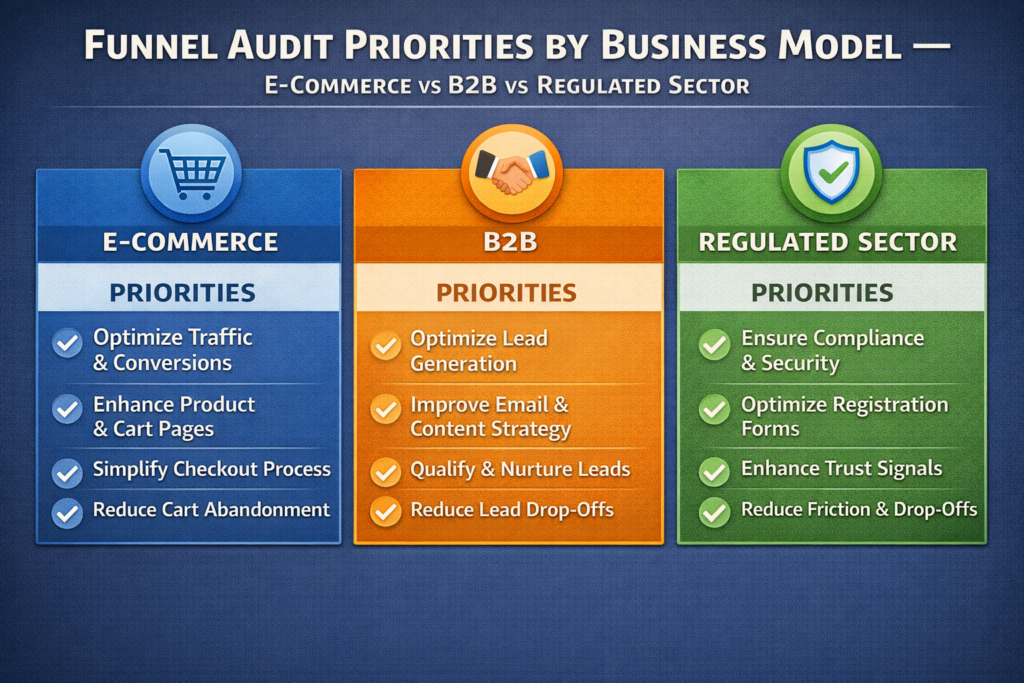
E-commerce funnel audit priorities
E-commerce funnels typically lose the most revenue at cart abandonment (Sign 3), repeat purchase failure (Sign 8), and product page engagement (Signs 1 and 2). This strategy should prioritise cart recovery sequences, post-purchase email automation, and product page content depth before investing in traffic acquisition improvements.
Image optimisation on product pages directly affects both organic ranking and on-page conversion. See Adclickr guide on image alt text and SEO optimisation for the technical and SEO considerations that affect e-commerce product page performance.
B2B lead generation funnel audit priorities
B2B funnels typically leak most at MQL-to-SQL conversion (Sign 5), content-to-lead form conversion (Sign 6), and attribution gaps (Sign 10). This funnel strategy benefits most from lead scoring model review, content upgrade mechanisms on high-intent pages, and cross-channel attribution that connects marketing activity to closed-won revenue at the CRM level.
For enterprise and franchise B2B brands managing complex multi-market funnels, see Adclickr enterprise digital marketing services for the funnel strategy frameworks applied at enterprise scale.
Healthcare and regulated sector funnel audit priorities
Regulated sector funnels face specific constraints compliance requirements on content claims, restrictions on retargeting, and E-E-A-T requirements that affect search visibility. Funnel audits in these sectors must evaluate compliance alignment alongside conversion performance, as content that drives conversion but violates sector regulations creates risk that outweighs the revenue gain.
Healthcare brands running funnel strategies require sector-specific audit frameworks. See Adclickr SEO guide for hospitals and healthcare websites for the compliance-aware funnel strategy that healthcare digital marketing requires.
Integrating Funnel Audit Findings into an Ongoing Funnel Strategy
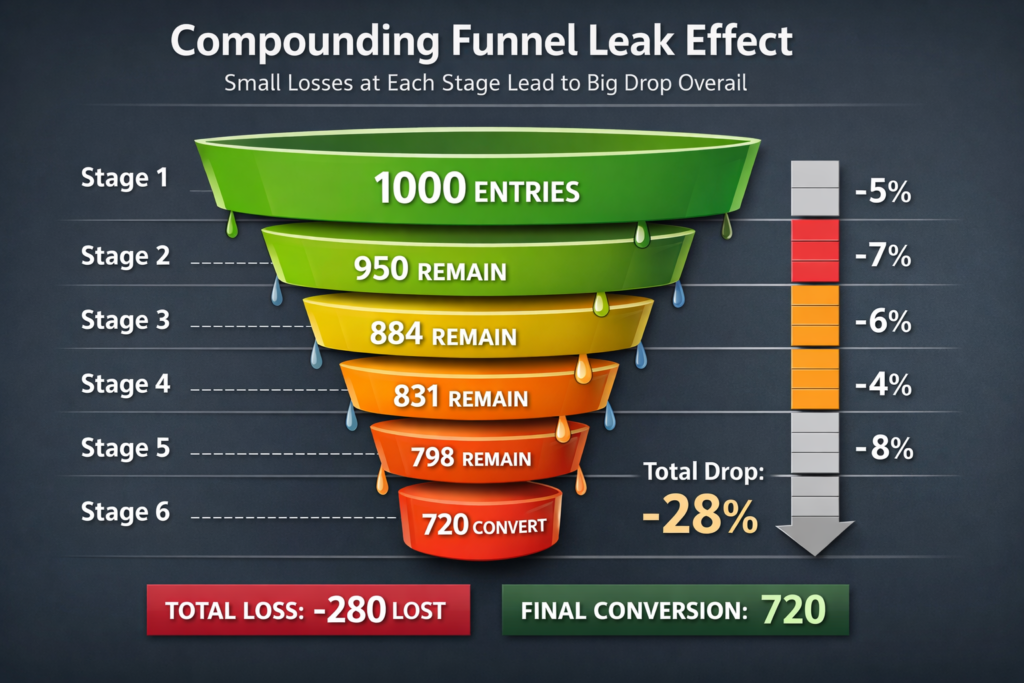
A funnel audit is most valuable not as a one-time diagnostic exercise but as the foundation of an ongoing funnel strategy that monitors leak signals continuously and acts on them before they compound.
Building continuous funnel monitoring
- Stage-level conversion rate dashboards: Track conversion rates at each funnel boundary on a weekly cadence. Drops of more than 10% week-on-week at any stage trigger an immediate investigation into what changed new traffic source, template modification, technical regression, or seasonality.
- Cohort-based retention tracking: Monitor the repurchase behaviour of each monthly acquisition cohort over a 90-day window. Cohorts that underperform against the baseline indicate either a traffic quality change at acquisition or a post-purchase experience deterioration.
- Attribution report calibration: Review attribution model accuracy quarterly by comparing model-attributed revenue to actual CRM-verified revenue by channel. Discrepancies indicate tracking gaps or model misconfiguration that will distort future investment decisions.
SEO automation tools can monitor organic traffic and conversion signals continuously, reducing the manual overhead of funnel monitoring at scale. See Adclickr SEO automation guide for the automation infrastructure that supports ongoing funnel strategy monitoring.
For brands managing content funnels across large content inventories, a regular content audit identifies pages that are attracting traffic but failing to convert and those that were converting but have declined. See Adclickr content audit guide for the methodology.
Frequently Asked Questions
A funnel audit diagnoses conversion stages from awareness to retention, identifying drop-offs, unlike general reviews that assess channels separately without tracking full customer journeys.
Common signs include high traffic but low engagement, poor conversions, high abandonment, low email opens, non-converting organic traffic, and rising acquisition costs across channels.
It maps actual user paths using tools like heatmaps and session recordings to find where users exit, enabling targeted fixes based on behavior, not assumptions.
A funnel audit diagnoses current performance issues, while funnel strategy plans future structure and optimization; audits inform strategies with real user data insights.
Quarterly audits are ideal, with weekly monitoring; after major changes, focused audits should occur within weeks to catch issues early and prevent compounded revenue loss.
Key tools include analytics platforms, heatmaps, search console, email analytics, CRM systems, and attribution tools to track and connect user behavior across the funnel.
Conclusion: Funnel Audit as a Compounding Revenue Recovery Tool
A leaking funnel does not announce itself. It drains quietly a few percentage points of conversion lost at the consideration stage, a post-purchase sequence that never runs, an attribution model that misses half the revenue-generating interactions. Each of these drains individually may seem acceptable. Together, they compound into a significant and preventable revenue gap.
For brands ready to run a comprehensive funnel audit with expert support across SEO, paid channels, and conversion optimisation, Adclickr digital marketing services provide the strategic and technical infrastructure for identifying and fixing funnel leaks at scale.

About the author
Ujjwal Kumawat
I specialize in SEO, website development, Google Ads and online business growth strategies. Through my blogs, I share practical insights, marketing tips and proven strategies to help businesses improve their online visibility, generate more leads and grow faster in the digital space.