Are you wasting hours every week because you lack the right social media marketing tools for your business?
Most brands manage social media reactively. They post manually, check metrics sporadically, and have no system for scaling what works. The right social media marketing tools change everything. They eliminate repetitive tasks, surface performance insights, and allow you to create and publish content at scale without sacrificing quality.
This guide covers every major tool category you need in 2026, from scheduling and analytics through to AI-powered content creation, monitoring, and paid social management.
What Are Social Media Marketing Tools?
Social media marketing tools are software platforms that help brands plan, create, publish, monitor, and measure their social media activity. They cover every stage of the social content lifecycle. Some tools focus on one function like scheduling or analytics. Others provide all-in-one solutions covering multiple disciplines in a single dashboard.

The best social media marketing tools save time, reduce errors, and produce better decisions from better data. Manual social media management plateaus quickly as content volume grows. Tools remove that ceiling by automating repetitive tasks while keeping humans focused on strategy and creative quality.
For businesses building digital marketing strategies across multiple channels, social media tools integrate with email, paid advertising, and SEO workflows. This integration creates the unified omnichannel marketing strategy that consistently outperforms isolated channel management.
Why the Right Tools Matter for Growth
Consistency is the most important factor in social media growth. Brands that post consistently outperform those that post sporadically regardless of individual content quality. Social media scheduling tools make consistency achievable without requiring daily manual effort. You plan once and the tool publishes on your schedule automatically.
Data without interpretation produces no improvement. Social media analytics tools turn raw engagement numbers into actionable insights. They reveal which content formats perform best, which posting times drive the most engagement, and which platforms deliver the strongest return for your specific audience.
Performance marketing vs growth marketing principles apply equally to social media investment. Performance-focused brands use tools to measure every post against conversion outcomes. Growth-focused brands use tools to build audience reach that compounds over time. Both approaches require dedicated tooling to execute at scale.
Best Social Media Scheduling Tools
Hootsuite
Hootsuite is one of the most widely used social media scheduling tools for teams and agencies. It supports scheduling across Facebook, Instagram, X, LinkedIn, Pinterest, and YouTube from one dashboard. Its bulk scheduling feature allows uploading hundreds of posts at once from a CSV file.
Hootsuite’s Best Time to Publish feature analyses your historical engagement data. It recommends the optimal posting windows for each connected account. This removes guesswork from scheduling decisions and consistently improves organic reach for brands that apply the recommendations.
Buffer
Buffer is the preferred social media publishing tool for solo creators and small teams. It prioritises simplicity over feature depth. The queue-based scheduling system makes adding and reordering planned content fast and intuitive. Buffer’s free tier covers three social accounts with up to ten queued posts each.
Sprout Social
Sprout Social combines scheduling with advanced social media analytics tools and team collaboration features. Its publishing calendar provides a visual overview of all planned content across platforms. For agencies managing multiple client accounts, Sprout’s approval workflows prevent unauthorised content from publishing without sign-off.
Best Social Media Analytics Tools
Sprout Social Analytics
Sprout Social’s analytics module is among the most comprehensive available in any mid-market social media analytics tool. It tracks post performance, audience growth, engagement rate, and competitor benchmarking across every connected platform. Its premium plan includes sentiment analysis on brand mentions.
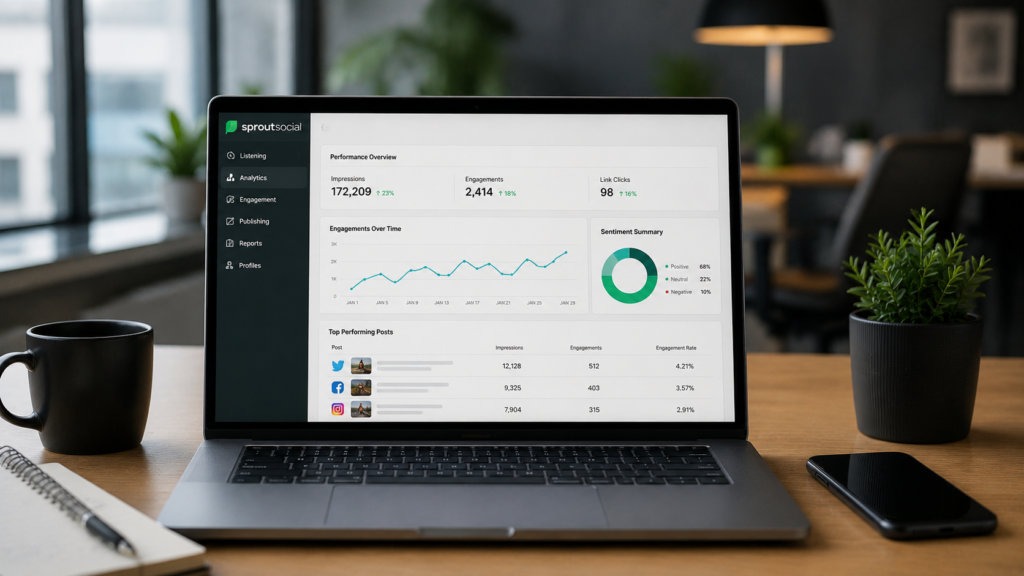
Understanding which content resonates most with your audience requires consistent data collection over time. Data-driven marketing frameworks applied to social media analytics transform raw engagement numbers into content strategy decisions that compound in effectiveness each month.
Native Platform Analytics
Every major social platform provides native analytics at no cost. Facebook Insights, Instagram Professional Dashboard, LinkedIn Analytics, and YouTube Studio each reveal performance data specific to that platform. Native analytics are always the most accurate source for platform-specific metrics because they come directly from the source.
Combine native platform analytics with a third-party social media reporting tool to consolidate cross-platform data in one view. Switching between five different platform dashboards to compile a weekly performance report wastes significant time that unified reporting tools eliminate completely.
Google Analytics 4
Google Analytics 4 tracks the downstream impact of social media activity on website performance. It reveals which social platforms drive website traffic, which convert visitors into leads or customers, and how social referral traffic behaves compared to other acquisition sources. According to Google Analytics Academy, connecting social media activity to website conversion data is essential for calculating true social media ROI.
Best Social Media Content Creation Tools
Canva
Canva is the most widely used social media content creation tool for non-designers. It provides thousands of social media templates sized correctly for every platform and placement. Drag-and-drop editing makes creating professional-quality graphics accessible without design skills or expensive software.
Canva’s Brand Kit feature stores your brand colours, fonts, and logos centrally. Every team member creates on-brand content automatically without accessing brand guidelines separately. The Pro plan includes background removal, premium template access, and team collaboration features that agencies use daily. Alt text on images should always be added to social media graphics for accessibility and platform SEO compliance.
Adobe Express
Adobe Express provides professional-grade social media content creation tools with direct integration into Adobe’s creative ecosystem. It is particularly strong for video creation and animated content.

For brands investing in video as their primary social format, Adobe Express’s video editing capabilities exceed what Canva provides at an equivalent price point.
CapCut for Business
CapCut has become the dominant social media content creation tool for short-form video creation targeting TikTok, Instagram Reels, and YouTube Shorts. Its AI-powered auto-caption, auto-cut, and template features dramatically reduce video editing time. Understanding how AI converts text or images into video is central to CapCut’s appeal for brands scaling video content volume without scaling production costs proportionally.
Best Social Media Automation Tools
ManyChat
ManyChat is the leading social media automation tool for Instagram and Facebook direct message automation. It automates comment responses, DM sequences, and lead generation flows triggered by specific keywords or post interactions. For ecommerce brands using Instagram shopping, ManyChat’s comment-to-DM flows convert engaged followers into buyers without manual intervention.
AI automations in social media management are transforming how brands handle audience interactions at scale. ManyChat’s AI responder feature generates contextually appropriate replies to common questions. This keeps response times fast without requiring constant human monitoring of every inbox.
Zapier for Social Media Workflows
Zapier connects your social media tools to every other platform in your marketing stack. It automates workflows between your scheduling tools, CRM, email marketing platform, and analytics dashboards. A new Instagram follower can automatically trigger a welcome email sequence. A completed lead form can trigger a Slack notification to your sales team in real time.
For teams using social media marketing alongside email marketing and facebook advertising, Zapier creates the workflow connections that allow each tool to inform the others automatically. According to Zapier’s social media automation guide, brands using automated cross-platform workflows save an average of ten hours per week on routine marketing administration tasks.
Later
Later specialises in visual social media scheduling tools for Instagram-first brands. Its visual content calendar displays your planned grid exactly as it will appear on your Instagram profile before publishing. This preview capability prevents aesthetic inconsistencies that damage brand perception. Later also includes a Linkin.bio feature that turns your Instagram profile link into a shoppable landing page.
Best Social Media Monitoring Tools
Mention
Mention is a dedicated social media monitoring tool that tracks brand mentions, competitor activity, and keyword discussions across social platforms, news sites, blogs, and forums simultaneously.
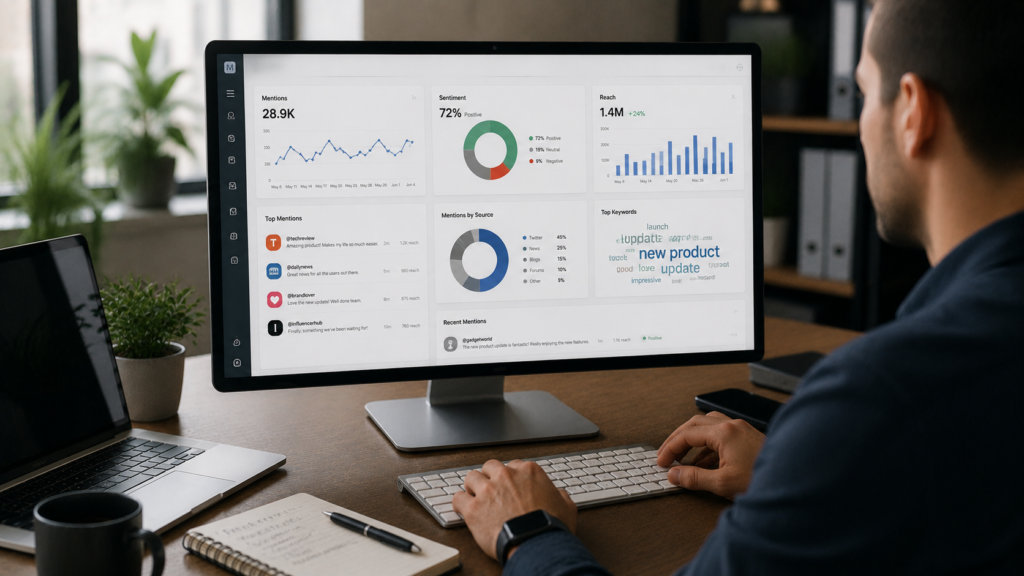
Real-time alerts notify your team when your brand is mentioned anywhere on the web. This speed allows you to join conversations and address concerns before they escalate. Brand monitoring is not just reputation management. It is competitive intelligence.
Tracking which topics generate the most engagement in your industry reveals content opportunities before they saturate your niche. AI marketing strategy frameworks increasingly rely on social monitoring data to identify emerging audience interests and shift content calendars proactively.
Brandwatch
Brandwatch is an enterprise-grade social media monitoring tool that applies AI-powered sentiment analysis to millions of social conversations. It identifies not just what people are saying about your brand but how they feel about it across different demographics, platforms, and time periods. For brands managing reputation across multiple markets, Brandwatch’s segmentation capabilities are unmatched at its price tier.
Responding to reviews with AI assistance connects to your social monitoring workflow. Brandwatch identifies critical mentions that require human response. AI tools then assist with drafting those responses at the speed and scale that busy teams require without sacrificing quality or appropriate tone.
Best Social Media Reporting Tools
DashThis
DashThis is a dedicated social media reporting tool that automatically pulls data from all major social platforms, Google Analytics, and paid advertising accounts into branded client reports. Agencies use it to produce professional weekly and monthly reports without manual data collection. Its white-label capability allows complete brand customisation of every report.
Building effective analytics reporting dashboards requires selecting the right metrics for each stakeholder. Executive stakeholders need revenue-connected metrics. Marketing managers need channel-specific performance data. DashThis supports both with separate dashboard configurations for different audience types.
Databox
Databox connects to over 70 data sources including every major social platform, Google Analytics, HubSpot, and Salesforce. It provides real-time social media reporting dashboards that update automatically as new data arrives. Its goal-tracking features allow you to set performance targets and measure progress against them in real time rather than in weekly reports.
According to Sprout Social’s reporting guide, brands that review social media performance data weekly and act on findings outperform those reviewing monthly. Automated reporting tools make weekly reviews practical without significant analyst time investment.
Best Social Media AI Tools in 2026
Social media AI tools are transforming every stage of the social content workflow. AI writing assistants like Jasper and Copy.ai generate caption drafts, post variations, and ad copy from brief prompts. AI image generators like Midjourney and DALL-E create original social graphics without photography or design resources.
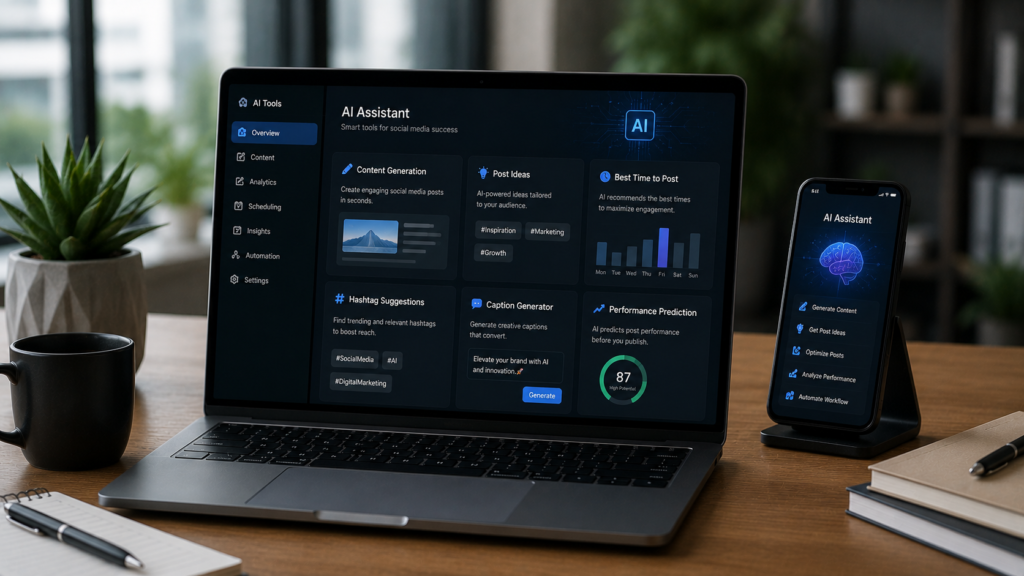
Meta’s own AI features within Ads Manager now generate ad copy variations, audience suggestions, and creative optimisation recommendations automatically. For brands running social media advertising alongside organic content, these native AI features reduce the production time required to maintain testing velocity across campaigns.
AI marketing strategy frameworks built around social media AI tools create the greatest competitive advantages for brands that combine AI efficiency with human editorial judgment. Pure AI-generated content without human review produces generic output that underperforms carefully edited content. The competitive edge comes from using AI for first drafts and automation while humans focus on strategy and quality control.
For brands investing in Instagram advertising alongside organic social content, our guide on how to create an SEO-optimised Instagram caption covers how AI caption tools can be combined with keyword strategy for maximum organic and paid reach simultaneously.
Building Your Complete Social Media Tool Stack
Matching Tools to Your Team Size
The right social media management tools combination depends on your team size, content volume, and budget. Solo creators need one scheduling tool and native analytics. Small teams benefit from adding a reporting tool and a content creation platform. Agencies and larger brands need dedicated monitoring, advanced analytics, and automation tools alongside scheduling.
Start with one tool per function rather than choosing an all-in-one platform too early. Understanding what you need from a scheduling tool before committing to an all-in-one prevents paying for features you will not use. According to Buffer’s social media tools guide, most small businesses achieve their core social media goals with three to five focused tools rather than a single comprehensive enterprise platform.
Connecting Your Social Tools to Your Broader Marketing Stack
Your social media marketing tools should connect to your CRM, email marketing platform, and website analytics. Social engagement data that does not inform your email segmentation or remarketing audiences represents missed intelligence that competitors using integrated stacks will leverage against you.

For businesses also managing facebook ads management and Google Ads management, connecting social organic performance data to paid campaign targeting improves audience precision on every paid channel. Content that performs well organically typically performs well in paid amplification because audience validation from organic data de-risks paid spend decisions.
Social media automation combined with content writing services creates the production pipeline that allows brands to maintain a consistent, high-quality social presence without proportionally scaling headcount. As Hootsuite’s social media tools resource confirms, brands with documented tool stacks and clear workflows consistently outperform those managing social media reactively without systems.
For complete social media marketing support including strategy, content creation, scheduling, and reporting, explore our full services overview to find the right combination for your business goals.
Frequently Asked Questions
Buffer for scheduling, Canva for content creation, and native platform analytics cover the core needs of most small businesses. These three tools together provide scheduling, design, and performance measurement at accessible cost without enterprise-level complexity or budget requirements.
ManyChat for DM automation, Zapier for cross-platform workflows, and Hootsuite for bulk scheduling save the most time. Together they eliminate manual posting, inbox management, and data transfer tasks that consume hours of team time weekly without producing strategic value.
Google Analytics 4 for website conversion tracking, Sprout Social for cross-platform engagement data, and native platform analytics combined provide the most complete ROI picture. These three sources together connect social activity to business outcomes that justify marketing investment decisions.
Social media AI tools generate caption drafts, post variations, and creative concepts from brief prompts. They reduce first-draft production time by up to 70 percent. Human editors then refine AI output to ensure quality, brand voice, and strategic alignment before publishing content.
Sprout Social and Hootsuite both offer robust multi-account management for agencies. Both include approval workflows, client-specific dashboards, and bulk scheduling. Sprout Social’s reporting capabilities are stronger for client reporting while Hootsuite’s bulk scheduling features suit high-volume content production requirements better.
Conclusion
The right social media marketing tools are not optional for brands competing for attention in 2026. Social media scheduling tools create consistency. The Social media analytics tools create intelligence. Social media content creation tools create quality at scale. Social media automation tools create efficiency. And social media AI tools create speed that manual workflows cannot match.
Build your tool stack by function, starting with scheduling and analytics. Add content creation and monitoring as volume grows. Connect every tool to your broader marketing stack through automation platforms like Zapier. Measure every tool’s contribution against the business outcomes that matter rather than platform engagement metrics alone.
For brands ready to combine professional tooling with expert strategy and execution, explore our complete services overview or read our digital marketing strategies guide to see how social media tools connect to every channel in your growth plan.

About the author
Ujjwal Kumawat
I specialize in SEO, website development, Google Ads and online business growth strategies. Through my blogs, I share practical insights, marketing tips and proven strategies to help businesses improve their online visibility, generate more leads and grow faster in the digital space.