Are you missing dozens of new patient enquiries each month because local seo for dentists is absent from your practice growth strategy?
Most dental practices still rely on word of mouth and outdated directory listings to attract new patients. Meanwhile, their local competitors appear at the top of Google every time someone nearby searches for a dentist. Patient search behaviour has fundamentally changed. People search before they book, compare practices on reviews, and choose the first credible result they find for terms like “dentist near me” or “emergency dentist London.”
Local SEO for dentists is the strategy that puts your practice in front of these high-intent patients at precisely the moment they are ready to book. This guide covers every step a dental practice needs to rank higher locally, attract more patients, and build a sustainable flow of new appointment bookings.
What Is Local SEO for Dentists?
Local seo for dentists is the process of optimising a dental practice’s online presence to appear prominently in geographically relevant Google search results. It covers your Google Business Profile, dental-specific and general directory citations, on-page content targeting local patient search queries, patient review generation and management, and the technical SEO foundations that allow Google to crawl and rank your practice website efficiently.
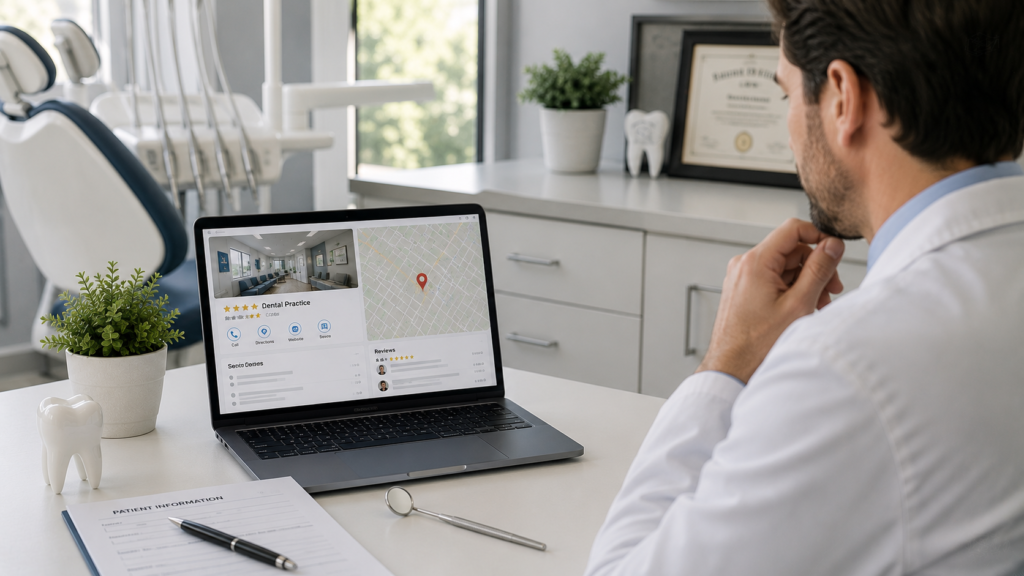
The core goal of local seo for dentists is to appear in the top three results in Google’s Local Pack and Google Maps when nearby patients search for dental services. These Local Pack positions generate the majority of clicks and calls from local dental searches. Practices in positions four or below receive dramatically fewer patient enquiries than those in the top three, regardless of how good their clinical reputation is offline.
Why Local Search Matters More Than Ever for Dental Practices
Patient behaviour has shifted decisively toward online search for healthcare provider selection. According to Google’s health search research, the vast majority of patients now use search engines to find and evaluate healthcare providers before making first contact. For dental practices, this means your Google search visibility is now your primary new patient acquisition channel whether you manage it actively or not.
Local seo business investment produces compounding returns that paid advertising cannot replicate. A dental practice consistently appearing in the Local Pack for high-intent queries like “NHS dentist near me” or “teeth whitening Manchester” builds patient familiarity over time that reduces cost per new patient acquisition month over month. For practices building digital marketing strategies with limited budgets, local SEO delivers the strongest long-term return on investment available from any marketing channel.
The Local Pack also displays your reviews, opening hours, and phone number directly in the search results. Patients can call you or get directions without ever visiting your website. This zero-click conversion capability makes Local Pack visibility uniquely valuable compared to organic search rankings alone.
Google My Business Optimisation for Dentists
Completing Your GBP Fully
Local seo google my business optimisation is the single most impactful step any dental practice can take for local visibility. Your Google Business Profile is the primary data source Google uses to populate Local Pack and Maps results for dental searches in your area. An incomplete or inaccurate GBP consistently underperforms even when your website is well-built and your clinical reputation is strong.
Complete every available GBP field without exception. Practice name, address, phone number, website URL, primary category, secondary categories, opening hours, NHS versus private status, and appointment booking link should all be accurate and fully populated. Your primary category carries the greatest weight in determining which queries your listing is eligible to appear for. “Dentist” is the correct primary category for most practices, with specialties like “cosmetic dentist” or “orthodontist” added as secondary categories where applicable.
Upload fresh, high-quality photos of your practice reception, treatment rooms, and staff regularly. Listings with recent professional images consistently receive higher click through rates from Local Pack results than those with outdated or minimal photos. Publish GBP posts covering appointment availability, service updates, and oral health tips at least twice per month to signal active management to Google’s local algorithm.
Booking Features and Attributes
Enable the appointment booking link in your GBP settings and connect it to your online booking system. This reduces friction for patients who find your listing and want to book immediately without navigating to your website first. Adding attributes such as NHS dentist, accepts new patients, wheelchair accessible, and languages spoken improves your listing’s match rate for patients filtering local search results by specific requirements.
According to Google’s GBP guidelines for healthcare, complete and actively maintained healthcare profiles are significantly more likely to appear in relevant local searches than incomplete ones. Treating your GBP as a living profile that receives regular attention rather than a one-time setup task is the defining difference between practices that dominate local dental searches and those that do not.
Local SEO Citations for Dental Practices
Local seo citations are online mentions of your practice name, address, and phone number across directories, review platforms, and dental-specific listing sites. Google cross-references these NAP mentions to verify your practice information and assess your prominence within your local dental market. Inconsistent NAP data across different platforms directly reduces your local ranking potential by undermining Google’s confidence in your business information.
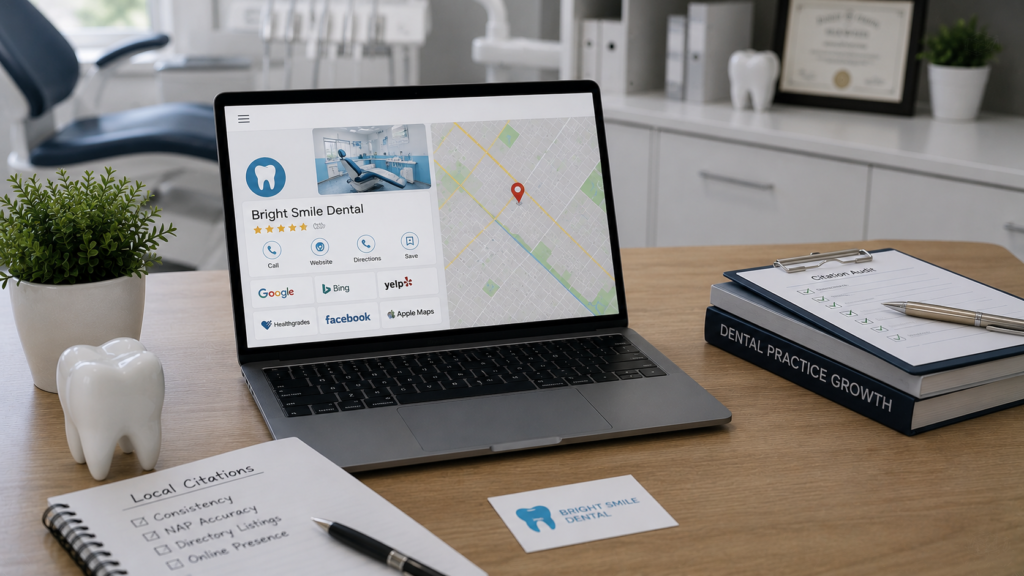
Dental practices have access to specialty-specific citation sources that carry relevance value beyond general directories. NHS Choices for NHS-registered practices, Denplan’s provider directory, the British Dental Association’s practice finder, and dental review platforms like Whatclinic and Doctify are all high-authority dental citation sources. Completing your profile on these platforms creates specialty alignment signals that pure general directory coverage cannot replicate.
Build your foundational citation tier on Google Business Profile, Bing Places, Apple Maps, Yelp, and Facebook first. After completing these highest-authority general sources, add dental-specific directories and verify that your NAP data is identical across every platform. Conduct a citation audit before building new listings because inconsistencies compound when you add new citations on top of an already inconsistent foundation.
On-Page Local SEO Strategies for Dental Websites
On-page signals tell Google which geographic areas your practice serves and which dental services your pages should rank for. Every service page should include the target city or neighbourhood in the HTML title tag, the H1 heading, and naturally within the body content. A dental practice in Birmingham offering dental implants should have a page titled “Dental Implants Birmingham” rather than a generic “Dental Implants” page without geographic context.
Create dedicated service and location pages for each treatment you offer in each area you serve. A practice covering patients from multiple nearby towns needs location-specific pages for each area with unique content addressing local patient concerns, directions, and nearby landmarks. Generic service pages without geographic targeting will not compete for city-specific patient search queries regardless of how authoritative your overall domain is.
Schema markup for dental practices should implement Dentist structured data alongside LocalBusiness schema. This provides Google with explicit information about your specialty, accepted patients, location, and opening hours in a machine-readable format that reduces ranking ambiguity for dental search queries. Mobile-first indexing compliance is essential because dental patients frequently search on mobile devices when experiencing tooth pain or dental emergencies requiring immediate local results.
Alt text on images throughout your dental website should reference treatment context and geographic relevance. A photo of your practice waiting room should use descriptive alt text like “waiting room at [Practice Name] dental practice in [City]” rather than a generic file name. These details contribute to your overall local relevance signals and improve accessibility simultaneously. Our guide on image alt text optimisation covers best practices for healthcare website image optimisation in detail.
Keyword Research for Dental Local SEO
Finding the Right Patient Search Terms
Local seo keyword research for dental practices begins with identifying the specific treatment and geographic combinations your local patients use when searching. These terms combine your treatment types with geographic modifiers including city names, neighbourhoods, and proximity phrases. An orthodontist in Leeds should target terms like “orthodontist Leeds,” “Invisalign Leeds,” “braces for adults Leeds,” and “emergency orthodontist near me Leeds.”
Use Google Keyword Planner filtered to your local area to validate search volumes for your target keyword combinations. Keyword search volume data localised to your city reveals which treatment and location combinations generate meaningful patient search volume in your specific market versus which only appear valuable nationally. Keyword research for seo applied to dental practice keywords should prioritise treatment terms with clear booking intent over purely informational dental health queries.
Content That Builds Trust and Local Authority
Blog content addressing common patient concerns builds topical authority and earns the healthcare backlinks that strengthen your local prominence signals. Content covering topics like “what to expect at your first dental implant consultation,” “NHS versus private dentistry in [City],” and “how to prepare for teeth whitening” attracts patients who are researching before booking and introduces them to your practice during their consideration phase.
Content writing services specialising in healthcare content create medically accurate, patient-friendly copy that satisfies Google’s E-E-A-T requirements for health content while serving genuine patient information needs. Local seo strategies for content creation at dental practices should balance treatment conversion pages with informational content that builds long-term geographic authority and organic patient discovery.
Patient Reviews and Local Ranking Signals
Patient reviews are among the most powerful local seo ranking factors for dental practices. Review quantity, recency, sentiment distribution, and your response rate each contribute independently to your local prominence signals. Dental practices with larger volumes of recent, positive reviews consistently rank above competitors with weaker review profiles in competitive local dental searches.

Implement a systematic review request process for every completed appointment. Send a review request by SMS or email within 24 hours of the appointment while the positive experience is freshest in the patient’s memory. Use compliant, policy-adherent request language that invites honest feedback rather than specifically soliciting positive reviews. Never offer discounts or gifts in exchange for reviews as this violates Google’s review policies and NHS advertising standards.
Responding to reviews with AI assistance allows busy dental practice managers to maintain consistent, professional response practices at scale without diverting significant clinical administration time. Responding to every patient review, positive or critical, demonstrates active engagement to Google and builds the social proof that influences new patient decisions. According to BrightLocal’s annual consumer review research, healthcare and dental practices are among the verticals where online review volume and sentiment most strongly influence consumer decision making before initial contact.
Local SEO Ranking Factors Specific to Dentistry
Dental practices face the same local seo ranking factors as other local businesses, but Google applies heightened quality evaluation to healthcare content under its E-E-A-T framework. Experience, Expertise, Authoritativeness, and Trustworthiness signals carry extra weight for dental websites because the information and services they provide directly affect patient health decisions.
Authoritativeness signals for dental practices include GDC registration numbers displayed prominently on your website, CQC registration details for English practices, professional association memberships such as the British Dental Association, and institutional affiliations with dental schools or hospitals. Practices whose website content is attributed to named, credentialled clinicians outperform those with anonymous content in dental local search results.
Trustworthiness signals include HTTPS implementation, clear privacy policies compliant with GDPR and healthcare data regulations, transparent fee structures, and accurate, current information across every online platform where your practice is listed. These trust signals interact with your local seo citations to create a comprehensive credibility profile that Google evaluates when ranking dental providers in local results. Practices similar to those described in our seo for hospitals guide benefit from the same E-E-A-T framework applied consistently across all healthcare content.
Technical SEO Foundations for Dental Websites
Technical SEO issues suppress local dental rankings by preventing Google from efficiently crawling and indexing your practice pages. A technical seo audit should be the foundational step of any dental local SEO engagement, identifying crawl errors, indexing blocks, duplicate content issues, and performance problems before on-page and off-page strategies are built on top of a broken technical foundation.
Core Web Vitals performance directly affects your local organic rankings as a page experience signal. Dental practices with slow loading pages or unstable layout shifts consistently underperform against equivalent competitors with faster, more stable mobile experiences. Site speed optimisation improvements that achieve green scores for Largest Contentful Paint and Cumulative Layout Shift produce measurable local ranking improvements in competitive dental markets.
Canonical tags must be correctly implemented on dental service pages to prevent duplicate content issues between similar treatment pages or between location-specific versions of the same service. Technical seo for website performance reviews conducted quarterly catch new technical issues before they compound into ranking drops. For dental practices running on WordPress, our WordPress website development services ensure platform configuration supports both performance and local SEO compliance from the foundational level.
Running a Local SEO Audit for Your Dental Practice
A local seo audit for a dental practice systematically evaluates every ranking signal affecting your current local search performance. It begins with GBP completeness and accuracy, moves through NAP citation consistency across dental and general directories, reviews on-page treatment and location targeting, assesses patient review profile health, and evaluates the technical foundations that determine how efficiently your pages are indexed and ranked.

Common audit findings for dental practices include GBP categories set to generic “medical clinic” rather than “dentist,” NAP data that differs between the GDC directory and local business listings, no dedicated location pages for secondary practice sites, patient review volumes significantly below the local competitive average, and missing Dentist schema markup on treatment pages. Each of these issues has a clear fix that produces measurable ranking improvement within 60 to 90 days of implementation.
Use a technical seo audit checklist alongside a local SEO audit framework to ensure every component is covered systematically. Analytics reporting dashboards that consolidate GBP insights, Search Console local query data, and website appointment conversion analytics provide the complete picture needed to evaluate audit improvement impact accurately over time.
Measuring and Improving Your Local SEO Performance
Knowing how to know if your seo is working for your dental practice requires tracking the right metrics consistently rather than monitoring vanity numbers disconnected from patient acquisition outcomes. Monitor your Local Pack keyword rankings weekly for your priority treatment and location keyword combinations. Track GBP insights monthly for search views, direction requests, phone calls, and website clicks from your listing.
Set up analytics reporting dashboards that combine GBP insights with Google Search Console query data and website appointment form conversions. Rising Local Pack impressions with flat call volumes typically indicate a GBP listing quality or review issue. Rising calls with flat organic website traffic suggest strong GBP performance but an opportunity to improve organic landing page conversion rates. Each metric pattern points clearly to the specific next optimisation priority.
For local seo for dentists managed professionally alongside broader digital marketing strategies, structured monthly performance reviews aligned with patient acquisition KPIs ensure your SEO investment is evaluated against the business outcomes that matter. As Moz’s local SEO research consistently shows, dental practices that track local performance metrics monthly and adjust their strategies based on data consistently outperform those managing local SEO reactively without measurement discipline.
For practices also investing in social media marketing or email marketing to nurture existing patient relationships, connecting these channels to your local SEO performance data creates a unified patient acquisition picture. Our omnichannel marketing strategy framework covers how local SEO and paid and social channels work together rather than in isolation. As Search Engine Land’s local SEO guide confirms, dental practices combining organic local SEO with complementary paid and social channels consistently achieve lower patient acquisition costs than single-channel approaches.
Frequently Asked Questions
Local seo for dentists optimises your practice’s online presence to appear in Google’s Local Pack when nearby patients search for dental services. It attracts new patients by placing your practice at the top of results for high-intent searches like “dentist near me” or “emergency dentist” in your area.
Local seo google my business optimisation ensures your dental practice appears in the Local Pack for relevant nearby searches. A complete GBP with accurate information, strong patient reviews, and regular posts signals active management and generates direct phone calls and appointment bookings from patients searching for local dental services.
The most important local seo citations for dentists include Google Business Profile, NHS Choices for NHS practices, Whatclinic, Doctify, the BDA practice finder, Bing Places, and Apple Maps. Healthcare-specific directories reinforce your dental specialty category alignment and carry relevance signals that general directories cannot provide.
Patient reviews directly influence your dental practice’s Google local prominence score through review quantity, recency, and average rating. Practices with consistent recent reviews outrank competitors with older or fewer reviews. Your review response rate also contributes positively to prominence signals in competitive local dental search results.
Run a full local seo audit for your dental practice every six months. Monthly monitoring of GBP insights and Search Console local query data between full audits catches declining trends early. Fast-growing competitive dental markets or practices that have recently moved or changed contact details may need more frequent review cycles.
Conclusion
Local seo for dentists is the highest-return digital marketing investment most dental practices can make because it directly targets patients at the moment they are actively searching for dental care nearby. GBP completeness, citation consistency, on-page treatment and location targeting, patient review generation, E-E-A-T signals, and solid technical foundations together build the local visibility that converts searches into booked appointments.
Start with GBP optimisation and citation consistency, as these produce the fastest measurable improvements at the lowest effort cost. Build on that foundation with dedicated location and treatment pages. Layer in review generation as an ongoing process. And conduct a local seo audit every six months to catch new gaps before they become ranking problems.
For dental practices ready to build a professional local seo for dentists strategy with specialist support, explore our complete services overview or read our guide on seo for hospitals and healthcare websites to understand how local SEO connects to every element of your practice’s digital growth plan.

About the author
Ujjwal Kumawat
I specialize in SEO, website development, Google Ads and online business growth strategies. Through my blogs, I share practical insights, marketing tips and proven strategies to help businesses improve their online visibility, generate more leads and grow faster in the digital space.