
Are you missing clients who are actively searching for help because local seo for therapists is not part of your practice growth strategy?
Most therapists build their client base through word of mouth and psychology directories alone. Yet the majority of people seeking therapy today begin with an online search. They type “therapist near me” or “anxiety counsellor London” into Google and choose from the first results they see. If your practice does not appear there, those potential clients will book with someone else.
Local SEO for therapists is the strategy that puts your name in front of people. Those who are already looking for the help you provide. This guide covers every step a therapy practice needs to take to rank locally. It attract the right clients, and build a sustainable client waitlist through organic search.
What Is Local SEO for Therapists?
Local seo for therapists is the process of optimising a therapy practice’s. The online presence to appear prominently in Google’s local search results. As when potential clients search for mental health support in their geographic area. It includes Google Business Profile optimisation, therapy-specific and general directory citations. As on-page content targeting local client search queries, online review management. As the technical SEO foundations that allow Google to crawl and rank your practice website effectively.

The primary outcome of local seo for therapists is consistent visibility in the Local Pack and Google Maps. The results for high-intent therapy searches in your area. People searching for “CBT therapist Birmingham” or “counsellor near me” are ready to reach out to a practitioner. Appearing in the top three Local Pack results for these searches. It is often the difference between a full appointment book and an under-utilised practice calendar.
Why Local Search Matters for Therapy Practices
People seeking therapy often search online at their most vulnerable. They want a therapist who is close, credible, and available. The local search results they see in that moment carry enormous influence over which practice they contact first. According to Google’s health and wellness search research, a significant and growing proportion of patients and clients. This use local search to find mental health support providers before booking.
Local seo business investment for therapy practices compounds in value over time in ways that paid advertising cannot replicate. A practice consistently appearing in the Local Pack for relevant therapy. The searches builds familiarity and trust with local clients before they make first contact. For therapists building digital marketing strategies on limited budgets. The local SEO delivers the most sustainable client acquisition return available from any marketing channel.
The Local Pack displays your practice name, review rating, location, and phone number directly in search results. Potential clients can call to enquire without visiting your website at all. This zero-click accessibility makes Local Pack visibility uniquely powerful for therapy practices. As where ease of initial contact significantly affects whether a struggling individual follows through with their intention to seek help.
Google My Business Optimisation for Therapists
Completing Your GBP Fully and Accurately
Local seo google my business optimisation is the most impactful single step any therapist can take for local search visibility. Your Google Business Profile is the primary data source. Google uses to populate Local Pack and Maps results for therapy searches in your area. An incomplete or inaccurate GBP consistently underperforms even when your website is professionally designed and your clinical reputation is strong.
Complete every available GBP field without exception. Practice name, address or service area, phone number, website URL, primary therapy category, secondary speciality categories. Also appointment booking link should all be accurate and fully populated. Your primary category is the most critical field for determining which local queries your listing is eligible to appear for. A CBT therapist should select the most specific available category. As “psychotherapist” or “counsellor” rather than a generic “health practitioner” option.
If you see clients from a home office or online-only practice, configure your GBP. The service area business rather than a business with a publicly displayed address. This protects your privacy while still enabling Google to serve your listing to local searchers within your defined service area. Upload professional photos of your therapy space. There is appropriate and publish GBP posts at least twice monthly to maintain active profile signals.
Managing Your GBP for Multiple Therapy Specialities
Therapists offering multiple treatment modalities can add secondary categories to their GBP to improve visibility across different therapy search queries. A therapist offering CBT, EMDR, and relationship counselling should use primary and secondary categories that collectively cover each modality type.
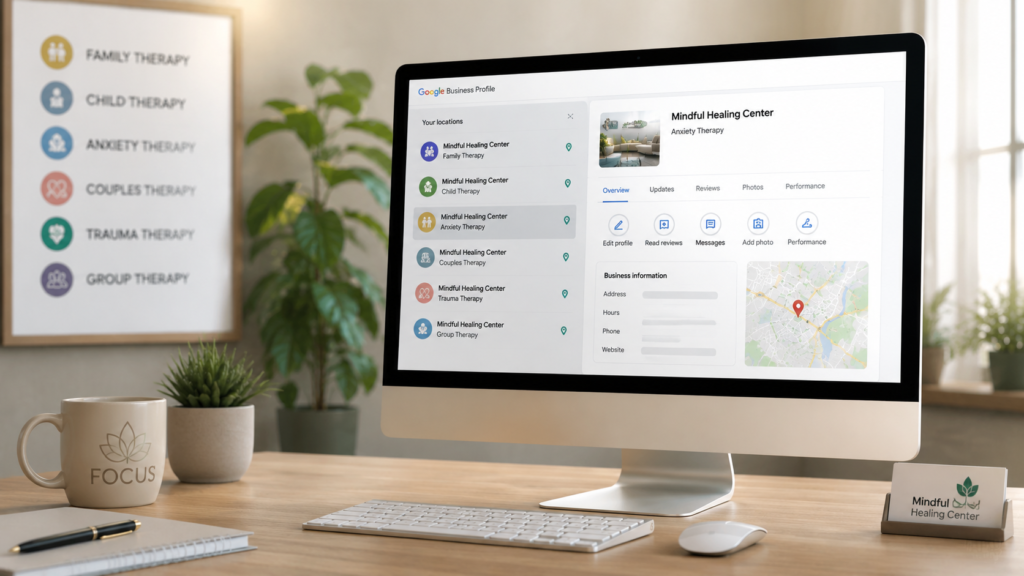
According to Google’s GBP guidelines for healthcare professionals>, multiple secondary categories can be added to reflect the breadth of services offered without conflicting with your primary category selection.
For therapists operating from multiple consulting rooms or working across different clinic sites, our multi-location seo guide covers the GBP architecture required to rank each location independently without creating the citation conflicts that frequently affect therapy practitioners working across multiple venues.
Local SEO Citations for Mental Health Professionals
Local seo citations for therapists are online mentions of your practice name, address or service area, and phone number across directories, professional body listings, and mental health-specific platforms. Google cross-references this information to verify your practice details and assess your prominence within your local mental health services market. Inconsistent data across platforms directly reduces your local ranking potential.
Therapy practices have access to specialist citation sources that carry strong relevance signals for mental health searches. Psychology Today’s therapist directory, Counselling Directory, BACP’s therapist finder, UKCP’s member directory, COSCA for Scottish practitioners, and the British Psychological Society’s find a psychologist tool are all high-authority therapy-specific citation platforms. Completing your profile fully on each relevant platform creates category alignment signals that general directory citations cannot replicate for mental health searches.
Build your foundational citation tier on Google Business Profile, Bing Places, Apple Maps, and Facebook first. After completing these highest-authority general sources, add therapy-specific directories and verify that your contact information is identical across every platform. Conduct a local seo audit to identify inconsistencies before building new listings, since adding new citations on top of inconsistent existing ones compounds the ranking suppression rather than resolving it.
On-Page Local SEO for Therapy Practice Websites
On-page signals tell Google which geographic areas your practice serves and which therapy types your pages should rank for. Every service page should include the target city or region in the HTML title tag, the H1 heading, and naturally within the body content. A therapist in Bristol specialising in anxiety treatment should have a page titled “Anxiety Therapist Bristol” rather than a generic “Anxiety Treatment” page without geographic context.
Create dedicated therapy type and location pages for each modality you offer and each area you serve. A therapist offering CBT, couples counselling, and grief therapy from a Bristol practice targeting clients across North Somerset should create separate location-relevant pages for each service. Generic service pages without geographic targeting will not compete for city-specific therapy search queries regardless of your domain’s overall authority.
Schema markup for therapy practices should implement MedicalOrganization or Therapist structured data alongside LocalBusiness schema where appropriate. This gives Google explicit information about your therapy specialties, location, and qualifications in a machine-readable format that reduces ranking interpretation ambiguity. Mobile-first indexing compliance is essential because many people searching for therapy do so on mobile devices at emotionally driven moments, making your mobile experience a direct ranking input.
Alt text on images throughout your therapy website should reflect professional and geographic context. A photo of your therapy room should carry descriptive alt text like “therapy consultation room at [Practice Name] in [City]” rather than a generic file name reference. These small details contribute to your local relevance signals and improve accessibility simultaneously.
Keyword Research for Therapy Local SEO
Finding the Terms Clients Actually Use
Local seo keyword research for therapy practices identifies the specific therapy type and geographic combinations potential clients use when searching for mental health support.

These terms combine your therapy modality with geographic modifiers including city names, neighbourhoods, and proximity phrases. A trauma therapist in Edinburgh should target terms like “trauma therapist Edinburgh,” “EMDR therapist Edinburgh,” “PTSD counsellor Edinburgh,” and “trauma counselling near me Edinburgh.”
Use Google Keyword Planner filtered to your local area to validate search volumes for your target keyword combinations. Keyword search volume data localised to your city reveals which therapy type and location combinations generate meaningful search activity in your specific market. Keyword research for seo applied to therapy keywords should prioritise consultation-seeking queries over purely informational mental health questions, as the former drives appointment contact while the latter attracts readers without immediate booking intent.
Creating Content That Builds Trust Before First Contact
Blog content addressing common client concerns builds topical authority and helps potential clients feel understood before they make contact. Content covering topics like “what to expect from your first CBT session,” “signs you might benefit from therapy,” and “how to choose the right therapist in [City]” attracts clients in the research phase and introduces them to your practice with warmth and expertise.
Content writing services specialising in mental health content create empathetic, accurate copy that satisfies Google’s E-E-A-T requirements while genuinely addressing client concerns. Local seo examples from high-performing therapy practice websites consistently show that combining conversion-focused location pages with trust-building informational content produces both stronger rankings and higher appointment request rates from organic search traffic.
Client Reviews and Local Ranking Signals for Therapists
Client reviews are among the most powerful local seo ranking factors for therapy practices in competitive local mental health searches. Review quantity, recency, and sentiment each contribute independently to your local prominence signals. Practices with stronger review profiles consistently rank above equivalent practitioners with fewer or older reviews in competitive local therapy searches.
Review requests in therapy require particular sensitivity. Many clients prefer not to leave public reviews because doing so implicitly discloses that they have sought mental health support. This is entirely understandable and should be respected. When clients do voluntarily offer to leave a review, a simple polite direction to your Google Business Profile is appropriate. Never pressure clients for reviews or make review requests feel like an expectation of the therapeutic relationship.
Responding to reviews with AI assistance allows therapy practices to maintain professional, warm response practices at scale without diverting significant clinical time to marketing administration. Respond to every public review while maintaining strict client confidentiality. Never confirm or acknowledge clinical details in public responses. According to BrightLocal’s consumer review research, healthcare and counselling services are among the sectors where review quality and response professionalism most strongly influence whether potential clients make initial contact.
Local SEO Ranking Factors in the Mental Health Sector
Mental health content falls under Google’s Your Money or Your Life category, meaning Google applies heightened quality evaluation under its E-E-A-T framework. Experience, Expertise, Authoritativeness, and Trustworthiness signals carry extra weight for therapy websites because the information and services they provide directly affect client wellbeing and mental health outcomes.

Authoritativeness signals for therapy practices include BACP, UKCP, BPS, or COSCA membership logos and registration numbers displayed prominently on your website, links to your professional body registration pages, clinical supervision credentials, and clearly attributed practitioner biographies that detail your training, qualifications, and therapeutic approach. Practices with named, credentialled therapists prominently featured consistently outperform those with anonymous or uncredentialled web content in local mental health search results.
Trustworthiness signals include HTTPS implementation, a clear privacy policy referencing GDPR compliance and data handling for sensitive health information, transparent fee structures, and clear information about your cancellation policy and ethical framework. These trust signals interact with your local seo citations to create the comprehensive credibility profile that Google evaluates when ranking therapy practitioners in local results. Our broader coverage of seo for hospitals explores E-E-A-T requirements in detail across healthcare sectors that share these elevated quality standards.
Technical SEO Foundations for Therapy Websites
Technical SEO issues suppress local therapy rankings by preventing Google from efficiently crawling and indexing your practice pages. A technical seo audit should be the foundation of any new local SEO engagement for a therapy practice, identifying crawl errors, indexing blocks, and performance problems before on-page and off-page strategies are implemented on top of a broken technical base.
Core Web Vitals performance directly affects your local organic rankings as a Google page experience signal. Therapy websites with slow loading times or unstable layout shifts consistently underperform against equivalent competitors with better technical performance scores. Site speed optimisation improvements that achieve good scores for Largest Contentful Paint and Cumulative Layout Shift produce measurable local ranking improvements in competitive therapy markets.
Canonical tags must be correctly implemented across your therapy type and location pages to prevent duplicate content issues between similar pages targeting different geographic areas with equivalent content structures. Technical seo for website performance reviews conducted quarterly catch emerging technical issues before they compound into ranking drops. For therapy practices built on WordPress, our WordPress website development services configure platforms for both performance and local SEO compliance from the foundational level.
Running a Local SEO Audit for Your Therapy Practice
A local seo audit for a therapy practice systematically evaluates every ranking signal affecting your current local search performance. It begins with GBP completeness and accuracy, moves through NAP citation consistency across therapy-specific and general directories, reviews on-page therapy type and location targeting, assesses client review profile health, and evaluates the technical foundations that determine how efficiently your pages are indexed and ranked.
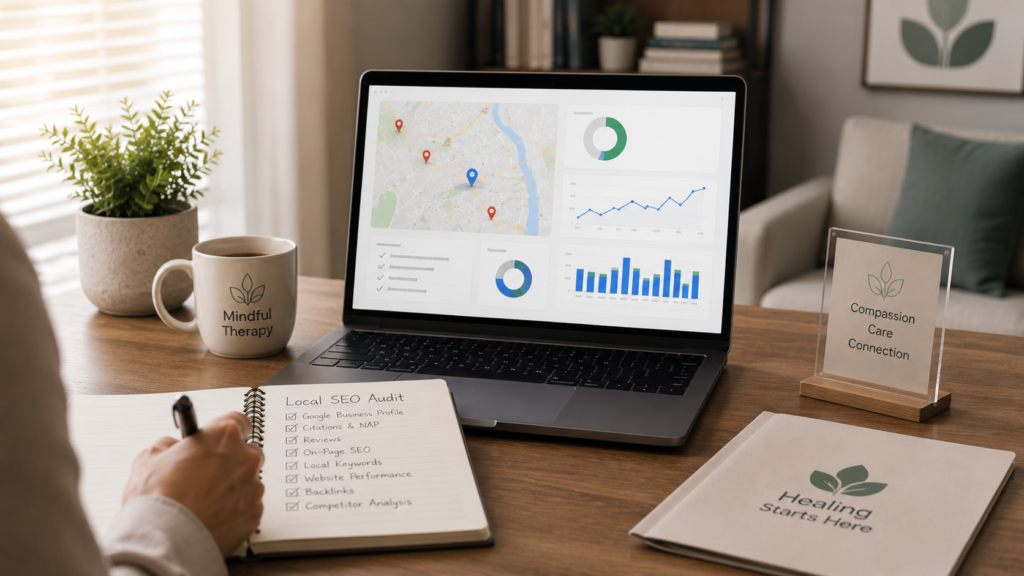
Common local seo examples of audit findings for therapy practices include GBP categories set to overly generic health practitioner options, NAP data differing between BACP directory listings and local business directories, no dedicated location pages for secondary clinic venues, client review volumes below the local competitive average, and missing structured data on therapy service pages. Each of these findings has a clear implementable fix that produces measurable ranking improvement within 60 to 90 days.
Use a technical seo audit checklist alongside a dedicated local SEO audit framework to ensure every component is covered systematically. Analytics reporting dashboards that consolidate GBP insights, Search Console local query data, and website appointment enquiry conversion metrics provide the complete performance picture needed to evaluate audit improvement impact accurately over time. Understanding how to know if your seo is working requires establishing these measurement baselines before any changes are made.
Working With a Local SEO Consultant as a Therapist
When Professional Support Delivers the Strongest Returns
A qualified local seo consultant with healthcare and mental health sector experience brings knowledge of therapy-specific citation sources, E-E-A-T requirements for mental health content, and the competitive landscape of local therapy searches in your area. Most solo therapists and small group practices lack the marketing resource to implement systematic local SEO alongside their clinical caseload. A specialist consultant fills this gap efficiently without requiring significant time from the practitioner.
Professional support becomes particularly valuable for therapists in competitive urban markets, for group practices expanding to multiple locations, and for practitioners whose audit reveals complex technical issues or significant citation inconsistencies that require specialist tools and expertise to resolve correctly.
For therapy practices also investing in social media marketing or email marketing to nurture prospects and maintain community engagement, a consultant who connects local SEO to the broader omnichannel marketing strategy creates more coherent cross-channel client acquisition. As Search Engine Land’s local SEO research confirms, combining organic local SEO with complementary channels consistently reduces overall client acquisition cost for professional service practices. Our guide on what is seo service provides further context on what professional SEO support involves for solo and small practices evaluating whether to bring in external expertise.
Frequently Asked Questions
Local seo for therapists optimises your practice’s online presence to appear in Google’s Local Pack when nearby clients search for mental health support. It attracts new clients by placing your practice prominently in high-intent local therapy searches at the moment people are ready to reach out for help.
Local seo google my business optimisation ensures your therapy practice appears in the Local Pack for relevant local searches. A complete, actively maintained GBP with professional information and genuine client reviews generates direct phone enquiries and website visits from potential clients searching for a therapist in your area.
The most important local seo citations for therapists include Google Business Profile, Psychology Today’s therapist directory, Counselling Directory, BACP’s therapist finder, UKCP member directory, Bing Places, and Apple Maps. Professional body directories carry high relevance signals because they reinforce your mental health specialty category alignment for local search results.
Client reviews directly influence your therapy practice’s local prominence through review quantity, recency, and average rating. More recent positive reviews improve Local Pack ranking position. Responding professionally to every review also strengthens your prominence signals, even though many therapy clients prefer not to leave public reviews due to privacy considerations.
Hire a local seo consultant when your practice is absent from Local Pack results for your primary therapy search terms, when competitor practices consistently outrank you despite equivalent qualifications, or when your audit reveals citation conflicts or technical issues that require specialist tools and structured expertise to resolve effectively.
Conclusion
Local seo for therapists is one of the highest-return investments a therapy practice can make for sustainable client acquisition. GBP completeness, citation consistency, therapy type and location page targeting, sensitive review generation, E-E-A-T authority signals, and solid technical foundations together build the local visibility that converts nearby searches into booked initial consultations.
Prioritise GBP optimisation and citation consistency first. Build dedicated therapy type and location pages. Layer in review generation as an ongoing sensitive process. And conduct a local seo audit every six months to identify new gaps before they become entrenched ranking problems.
For therapy practices ready to build a professional local seo for therapists strategy with specialist support, explore our complete services overview or read our digital marketing strategies guide to understand how local SEO connects to every element of your practice growth plan.

About the author
Ujjwal Kumawat
I specialize in SEO, website development, Google Ads and online business growth strategies. Through my blogs, I share practical insights, marketing tips and proven strategies to help businesses improve their online visibility, generate more leads and grow faster in the digital space.