Are you wasting budget on facebook ads management that delivers clicks but not profitable results?
Most businesses running Facebook ads experience a familiar frustration. Initial campaigns show promise, then costs rise, results plateau, and the return on ad spend quietly erodes. Effective facebook ads management is not about spending more but about making smarter, data-driven decisions at every stage of your campaign lifecycle.
This guide covers every critical lever for improving ROI and reducing ad costs, from campaign structure and audience strategy through to creative testing, retargeting, and performance measurement that actually connects to revenue.
What Is Facebook Ads Management?
Facebook ads management is the ongoing process of planning, launching, monitoring, and optimising paid advertising campaigns across Meta’s advertising platform, which includes Facebook, Instagram, and the Audience Network. It encompasses audience targeting, creative development, bid strategy, budget allocation, A/B testing, and performance reporting across every campaign objective from awareness through to purchase and retention.
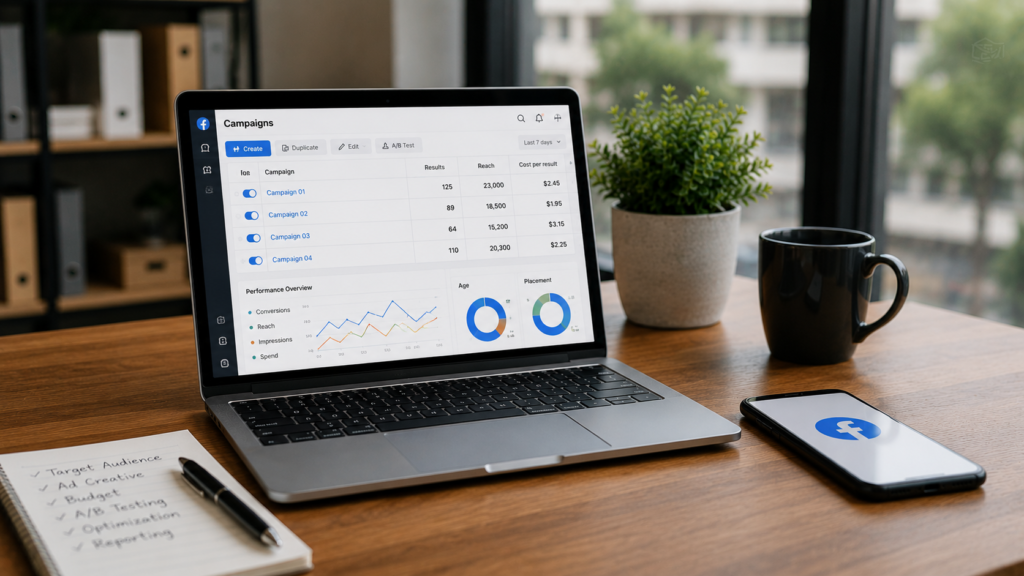
The core goal of professional facebook ads management is maximising return on every dollar invested in the platform. This requires continuous optimisation rather than a launch-and-leave approach. Facebook’s auction-based delivery system means that campaign performance changes constantly as audience competition, creative fatigue, and seasonal demand fluctuate. Skilled management responds to these changes before they erode your return on ad spend.
For businesses building comprehensive digital marketing strategies, Facebook advertising sits within a broader paid social ecosystem alongside Instagram advertising and other channels. Managing all platforms with a unified audience and creative strategy consistently produces stronger results than managing each in isolation.
Why Facebook Advertising Management Requires Ongoing Optimisation
The Dynamics of Meta’s Advertising Auction
Facebook’s advertising platform operates through a real-time auction that evaluates your ad’s bid, estimated action rate, and ad quality score simultaneously. Winning placements is not purely about spending more. An ad with strong relevance and high predicted engagement can win placements over a higher-bid competitor with lower quality signals.
This auction dynamic means facebook advertising management must focus on quality signals alongside bid strategy. Improving your ad’s relevance score, predicted conversion rate, and creative engagement directly reduces your cost per result. Understanding this mechanism is what separates advertisers who scale profitably from those who simply increase budgets and watch returns diminish.
Performance marketing vs growth marketing principles apply directly to Facebook campaign decisions. Performance-focused facebook ads management prioritises measurable short-term conversion outcomes. Growth-focused management invests in awareness and audience building that delivers compounding returns over longer timeframes. Balancing both approaches within a single account architecture is the hallmark of mature facebook campaign management.
Why Ad Costs Rise Without Active Management
Facebook ad costs increase predictably without active management intervention. Creative fatigue occurs when the same audience sees the same ad repeatedly, causing click through rates to decline and costs to rise. Audience saturation occurs when your targeting pool has been exhausted by repeated exposure, leaving only lower-intent viewers receiving your ads.
Active facebook ads optimization prevents both problems by rotating creative regularly and expanding audiences before saturation occurs. According to Meta’s official advertising guidance, monitoring frequency metrics and refreshing ad creative are the primary tools for maintaining cost efficiency in ongoing campaigns.
Campaign Structure That Supports Scalable ROI
The Importance of a Clean Account Architecture
A well-structured Facebook ad account is the foundation of effective facebook campaign management. Campaigns should be organised by objective, with each campaign containing ad sets that target distinct audience segments. Mixing objectives within campaigns or audiences within ad sets creates data confusion that makes optimisation decisions unreliable.
Use separate campaigns for each stage of your marketing funnel. Top of funnel awareness campaigns target cold audiences. Middle of funnel consideration campaigns target engaged audiences who have interacted with your brand. Bottom of funnel conversion campaigns target warm audiences with high purchase intent. This separation allows budget allocation to reflect the different value and volume of each funnel stage.
Running a funnel audit checklist analysis on your existing account structure reveals where budget is being misallocated between funnel stages. Many accounts over-invest in cold traffic conversion campaigns while under-investing in the retargeting campaigns that convert existing engaged audiences at significantly lower cost per acquisition.
Budget Allocation Across Campaign Objectives
Effective budget allocation in facebook ads management reflects the relative efficiency of each funnel stage for your specific business. Retargeting campaigns consistently produce lower cost per acquisition than cold traffic campaigns because they reach audiences who already know your brand. Allocating disproportionate budget to retargeting relative to its audience size is a consistently high-return decision.
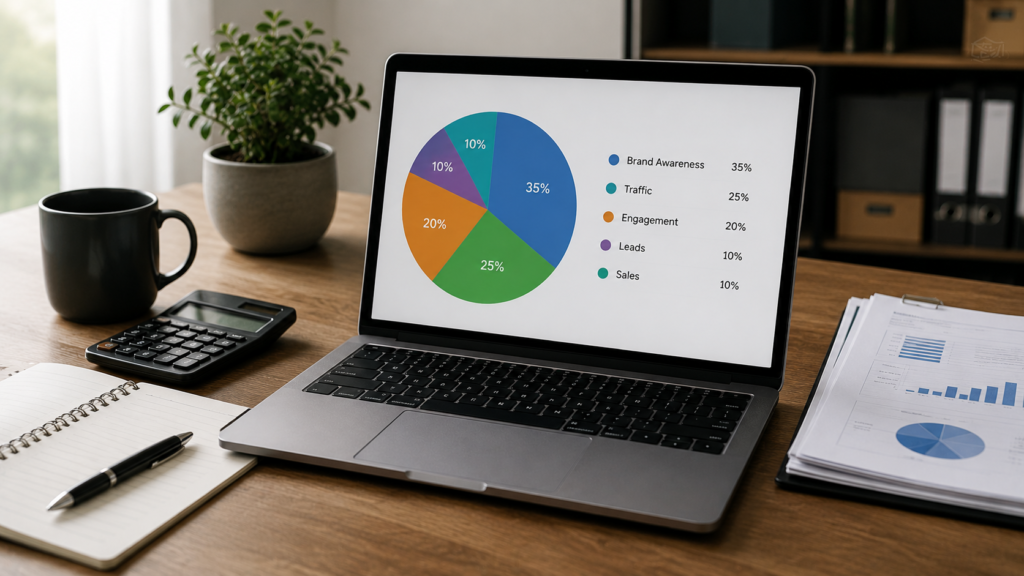
Use campaign budget optimisation at the campaign level to allow Meta’s algorithm to distribute budget dynamically toward the best-performing ad sets within each campaign. This reduces the manual budget reallocation work required and allows the algorithm to respond to real-time performance signals faster than any human review cycle can match.
Audience Strategy for Facebook Campaign Management
Building Cold Audiences That Convert
Cold audience targeting for facebook campaign management begins with detailed interest-based and behavioural targeting that closely matches your ideal customer profile. Layering multiple interest categories narrows your audience to users with the highest probability of converting rather than reaching broad interest groups that waste budget on low-intent viewers.
Lookalike audiences built from your existing customer data consistently outperform interest-based targeting for conversion objectives. A 1 percent lookalike of your highest-value customers gives Meta’s algorithm a precise behavioural profile to match against its user database. This targeting approach often delivers 30 to 50 percent lower cost per acquisition than equivalent interest-based targeting in established accounts.
For businesses targeting multiple geographic markets, geo-targeted SEO insights reveal which locations drive the highest conversion intent organically. Applying the same geographic intelligence to your Facebook audience targeting improves cold campaign efficiency before any ad spend is committed.
Custom Audience Segmentation for Personalised Messaging
Custom audiences from website visitors, video viewers, lead form completions, and customer lists allow highly personalised ad messaging that resonates with each segment’s specific relationship with your brand. A visitor who viewed your pricing page receives different messaging than a visitor who only read a blog post.
This segmentation precision is the core of effective facebook retargeting ads strategy. The more precisely your ad message matches the specific action a custom audience member previously took, the higher your relevance score and predicted conversion rate will be. Higher predicted conversion rates win auctions at lower bids, directly reducing your cost per result.
Creative Optimisation and Ad Fatigue Prevention
What Drives Creative Performance on Facebook
Ad creative is the single variable with the highest impact on Facebook campaign performance at any given audience and bid level. Creative determines whether users stop scrolling, engage with your message, and take the action you want. Even perfect audience targeting produces poor results when paired with weak creative.
Effective facebook ads optimization treats creative as a continuous testing process rather than a one-time production task. Test one variable at a time across ad sets. Isolate image versus video, different headline angles, various call to action phrasings, and different offer framings to identify which creative elements drive the strongest performance for each audience segment.
AI automations now support creative testing at scale through dynamic creative optimisation, which automatically combines multiple headlines, images, and descriptions to discover the highest-performing combinations faster than manual testing allows. Understanding how AI converts text or images into video content is increasingly relevant for advertisers scaling creative production without proportionally scaling production costs.
Managing Ad Frequency and Creative Refresh Cycles
Monitor your ad frequency metric weekly for every active campaign. When frequency for a given audience exceeds three to four impressions per user per week, engagement typically begins declining and costs begin rising. Refreshing creative before frequency triggers creative fatigue maintains cost efficiency without requiring audience expansion.

Build a creative calendar that schedules new ad variations every two to three weeks for your most active campaigns. Content writing services can support the copywriting requirements of consistent creative refresh cycles. Maintaining a library of tested creative assets reduces the time required to rotate new ads into active campaigns when frequency signals indicate a refresh is needed.
Facebook Lead Generation Ads: Capturing Buyers Efficiently
Facebook lead generation ads use Meta’s native lead form format to capture contact information without requiring users to leave the Facebook platform. Because the form pre-fills with data from the user’s Facebook profile, friction is dramatically lower than equivalent landing page forms. This lower friction typically produces higher lead volumes at lower cost per lead than traffic campaigns driving to external landing pages.
The trade-off is lead quality. Native lead form leads are easier to submit and therefore attract a broader range of intent levels than users who navigate to a landing page and complete a full form. Compensate for this by designing lead forms with qualifying questions that filter for genuine intent before submission. Adding one or two specific qualifying questions to your lead form significantly improves the sales-readiness of leads captured at modest cost increases.
Connect your lead generation ads to email marketing automation sequences that nurture leads immediately after form submission. Speed to follow-up is the single strongest predictor of lead conversion rate. Automated email and whatsapp marketing sequences that trigger within minutes of lead capture consistently outperform manual follow-up that occurs hours or days later.
Facebook Retargeting Ads: Converting Warm Audiences
Facebook retargeting ads target users who have already interacted with your brand through website visits, video views, app activity, or engagement with your Facebook or Instagram content. These audiences convert at dramatically higher rates than cold audiences because they already have familiarity and some level of interest in your brand.
Effective facebook retargeting ads strategy segments retargeting audiences by recency and depth of engagement. Users who visited your checkout page in the last seven days receive different, more urgent messaging than users who read a blog post 30 days ago. Recency-based segmentation ensures your retargeting budget concentrates on the highest-intent audiences first.
Dynamic product ads automatically show retargeting audiences the specific products they viewed on your website, personalising the ad experience without requiring manual creative production for each product. For ecommerce businesses managing large catalogues, dynamic ads are the most scalable and consistently high-performing retargeting format available. Pair dynamic retargeting with a strong conversion rate optimisation strategy on your landing pages to ensure the traffic retargeting sends to your site converts as efficiently as possible.
Facebook Ads Optimization: Bidding and Budget Strategy
Choosing the Right Bidding Strategy
Meta offers several bidding strategies that serve different campaign objectives and budget situations. Lowest cost bidding allows Meta’s algorithm to find the cheapest conversions available within your audience and budget. It is the recommended starting point for most new campaigns because it gives the algorithm maximum flexibility to learn what works before constraints are applied.
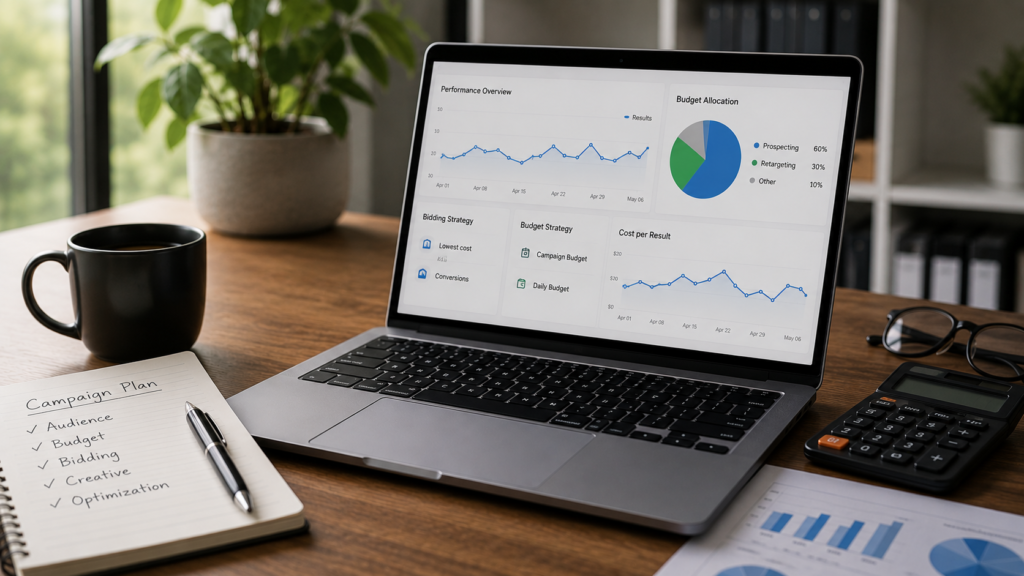
Cost cap bidding sets a maximum acceptable cost per result, preventing the algorithm from generating conversions above your defined threshold. This strategy is appropriate once you have sufficient conversion data from lowest cost campaigns to set a reliable cost cap target. Switching to cost cap too early limits delivery before the algorithm has enough data to optimise effectively.
As WordStream’s Facebook advertising research consistently highlights, bidding strategy mismatches with campaign maturity stage are among the most common and costly errors in facebook ads management. Matching your bidding approach to your campaign’s data maturity level significantly improves delivery efficiency.
Scaling Budgets Without Destroying Performance
Scaling Facebook campaign budgets requires a measured approach that avoids disrupting the algorithm’s learned optimisation patterns. Increasing campaign budgets by more than 20 percent in a single adjustment typically resets the learning phase, temporarily degrading performance while the algorithm reoptimises for the new budget level.
Scale by increasing budgets in increments of 15 to 20 percent every three to five days. This allows the algorithm to adapt to each budget level before the next increase is applied. Horizontal scaling through launching new ad sets targeting fresh audience segments alongside proven existing ad sets is often more effective than vertical budget increases alone for maintaining cost efficiency at higher spend levels.
Measuring ROI Across Your Facebook Ads Services
The Metrics That Actually Connect to Revenue
Effective facebook ads services measurement focuses on metrics that connect directly to revenue outcomes rather than vanity metrics that look impressive but do not reflect business performance. Reach, impressions, and page likes tell you nothing about whether your campaigns are generating profitable returns.
The metrics that matter are cost per acquisition, return on ad spend, customer lifetime value relative to acquisition cost, and contribution margin per campaign. Analytics reporting dashboards that surface these revenue-connected metrics alongside standard Meta campaign metrics give decision-makers the complete picture required for confident budget allocation decisions. Data-driven marketing frameworks ensure every measurement decision connects to a specific business outcome rather than platform-specific engagement metrics that Meta’s own reporting emphasises.
How to know if your SEO is working principles apply equally to paid social. You need baseline metrics, consistent tracking infrastructure, and defined success benchmarks established before campaigns launch. Without these foundations, optimisation decisions are reactive rather than strategic. According to Sprout Social’s Facebook advertising benchmarks, average click through rates and cost per click vary significantly by industry, making industry-specific benchmarks essential for evaluating whether your campaign performance represents genuine opportunity or a systemic problem requiring structural changes.
Working With a Facebook Advertising Agency
What a Professional Facebook Advertising Agency Provides
A qualified facebook advertising agency brings three things that most in-house teams lack: platform expertise developed across many accounts, access to beta features and direct Meta support, and the testing velocity that comes from managing substantial collective ad spend. These advantages compound over time, particularly in competitive auction environments where marginal efficiency improvements produce significant cost advantages at scale.

When evaluating a potential agency for your facebook ads services, ask specifically about their creative testing process, reporting cadence, and how they connect Facebook campaign performance to your broader omnichannel marketing strategy. An agency that cannot clearly explain their creative testing methodology or reporting framework is unlikely to deliver the systematic optimisation that distinguishes professional management from basic campaign administration.
As Neil Patel’s Facebook advertising guide emphasises, the most important quality in any Facebook advertising partner is a commitment to systematic testing and measurement rather than relying on intuition or platform defaults. For businesses also running Google Ads management alongside Facebook campaigns, an agency managing both channels provides unified audience intelligence that improves targeting precision on every platform simultaneously.
For sellers also managing social media management and social media automation alongside paid advertising, a full-service partner ensures your organic and paid social strategies reinforce rather than contradict each other. Connecting paid Facebook campaign data with social media marketing insights reveals which content themes resonate most with your audience before paid budget is invested.
Frequently Asked Questions
Facebook ads management is the ongoing process of planning, launching, optimising, and reporting on paid campaigns across Meta’s advertising platform. It includes audience targeting, creative testing, bid strategy, budget allocation, retargeting setup, and performance measurement that connects campaign results directly to revenue outcomes.
Reducing facebook advertising costs requires improving your ad relevance score through better creative and tighter audience targeting. Refreshing creative before fatigue sets in, using lookalike audiences built from high-value customers, and prioritising retargeting campaigns consistently lower cost per acquisition across most account types.
A minimum of 1000 to 2000 dollars per month is recommended for meaningful facebook campaign management data. Smaller budgets limit the algorithm’s ability to exit the learning phase and generate statistically reliable conversion data for confident optimisation decisions across different audiences and creative variations.
Facebook lead generation ads capture contact information through a native Meta form without requiring users to visit an external website. This reduces friction and typically lowers cost per lead. However, lead quality is often lower than traffic campaigns because the easier submission process attracts a broader range of buyer intent levels.
Hiring a facebook advertising agency makes sense when your monthly ad spend exceeds 3000 dollars, when in-house results have plateaued despite optimisation attempts, or when you lack the time to conduct systematic creative testing and audience expansion alongside your other business responsibilities.
Conclusion
Effective facebook ads management requires continuous, data-informed optimisation across campaign structure, audience strategy, creative quality, bidding approach, and performance measurement simultaneously. No single tactic produces sustained ROI improvement. The compounding effect of small, consistent improvements across every variable is what separates profitable accounts from those that waste budget on diminishing returns.
Invest in clean campaign architecture from the start. Build audience segmentation that reflects your marketing funnel stages. Test creative systematically and refresh it before fatigue degrades performance. And measure everything against revenue outcomes rather than platform engagement metrics that do not connect to business growth.
For businesses ready to build a complete facebook advertising management strategy alongside a broader paid and organic growth system, explore our full services overview or read our enterprise growth strategy guide to understand how Facebook advertising connects to every channel in your growth plan.

About the author
Ujjwal Kumawat
I specialize in SEO, website development, Google Ads and online business growth strategies. Through my blogs, I share practical insights, marketing tips and proven strategies to help businesses improve their online visibility, generate more leads and grow faster in the digital space.