Are you running an online store that is invisible on Google while your competitors capture all the organic sales?
Ecommerce SEO is the strategy that moves your product, category, and store content. As from buried in search results to the positions that generate consistent, purchase‑intent traffic — without paying for every single click.
This complete guide covers every element of ecommerce SEO strategy, from keyword research to technical foundations. This explains exactly how to choose the right ecommerce SEO service to drive sustainable growth for your online store.
What Is Ecommerce SEO?
Ecommerce SEO is the process of optimising an online store so its product pages, category pages, and supporting content rank. This prominently in search results for the queries potential buyers use when looking for products. It combines keyword research, on-page optimisation, technical performance, and content creation into one unified strategy. Also designed to attract purchase-intent organic traffic without relying on paid advertising.
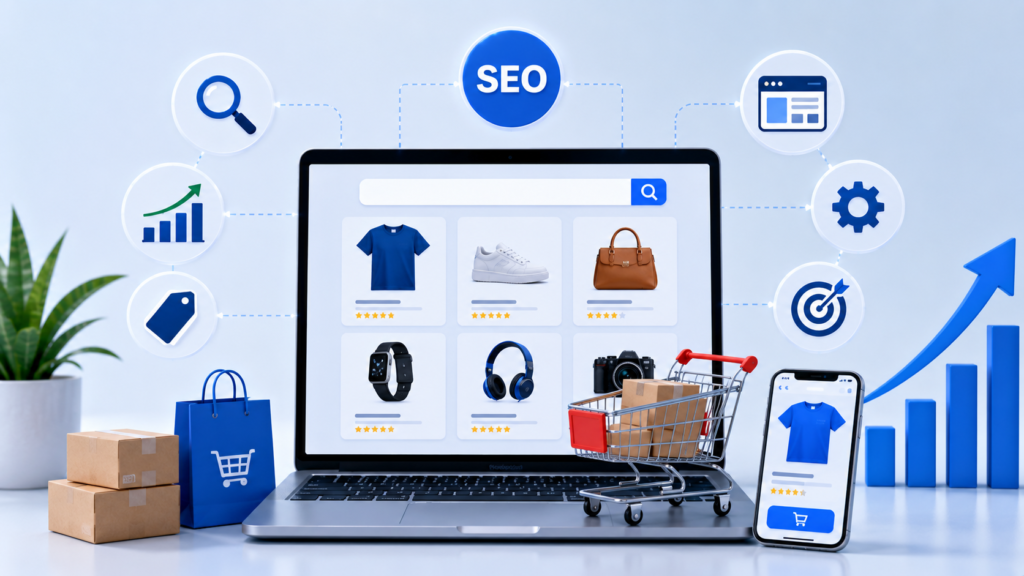
The goal of ecommerce SEO is not just visibility. It is qualified visibility that converts. A product page ranking for “buy leather wallet for men online” places your store in front of someone. This has already decided they want to make a purchase and is evaluating where to buy it. That intent distinction is what makes organic search one of the highest-converting traffic channels for any online retailer.
Businesses looking to reduce dependence on eCommerce PPC while building a sustainable long-term revenue channel. This will find that ecommerce SEO delivers compounding returns that paid advertising cannot replicate. Every product page that achieves a strong organic ranking continues generating qualified traffic without an ongoing per-click cost.
What Is an Ecommerce Website?
An ecommerce website is an online platform that enables businesses to sell products or services directly to customers through the internet. It includes product listings, category navigation, shopping cart functionality, secure payment processing, and order management systems. This together facilitate the complete purchase journey without requiring physical interaction between buyer and seller.
Ecommerce websites range from single-product stores to multi-category retailers with thousands of products across dozens of departments. Common platforms include Shopify, WooCommerce, Magento, and custom-built solutions. Each platform has specific technical SEO implications that directly affect how well product and category pages can be optimised. Stores selling through Amazon alongside their own site face an additional layer of marketplace‑specific optimisation.
Stores built through professional eCommerce development with SEO architecture considered from the beginning. This consistently outperform those where optimisation is treated as an afterthought. The URL structure, navigation hierarchy, canonical tag implementation, and page speed foundations. This established during development determine how effectively every subsequent SEO activity performs.
Why Ecommerce SEO Strategy Is Different
Standard SEO frameworks built for content sites and service businesses do not translate directly to ecommerce environments. Understanding what makes this strategy distinct is essential before investing in any optimisation work.
Scale creates complexity. An ecommerce website with 5,000 products generates 5,000 product pages, each requiring unique optimisation. Systematic processes replace manual page-by-page work at this scale. By which is why these services require different tooling and expertise than content site optimisation.
Duplicate content is endemic. Product variants, colour filters, size selectors, sorting parameters, and pagination all generate duplicate or near-duplicate URLs that dilute ranking authority. Managing these requires canonical tag strategy, robots.txt configuration, and faceted navigation controls that go beyond anything standard SEO addresses.
Purchase intent is the priority. A buyer searching ‘red leather ankle boots size 7’ is significantly closer to purchasing than someone searching ‘types of boots.’ A strong ecommerce SEO strategy targets transactional keywords at every stage of the product discovery. This journey, not just the final purchase search.
Thin content undermines rankings. Short product descriptions copied from manufacturer specifications are classified as thin content by Google. Stores with thousands of thin product pages consistently underperform in search regardless of their domain authority.
For ecommerce businesses operating across multiple markets or locations. In our international SEO strategy guide and multi-location SEO guide provide the expanded frameworks. This needed to scale visibility across geographic markets without cannibalising rankings.
Family Keywords Every Ecommerce SEO Expert Targets
A complete ecommerce website SEO strategy encompasses the full keyword landscape surrounding your store and products. These are the family keyword clusters every ecommerce SEO expert and strategist works with:

Service-oriented keywords: ecommerce SEO service, ecommerce SEO services, ecommerce SEO marketing, ecommerce SEO service India, ecommerce SEO package
Agency and consultant keywords: ecommerce SEO company, best ecommerce SEO agency, best ecommerce SEO agencies, ecommerce SEO consultant, ecommerce SEO expert, ecommerce SEO experts, ecommerce SEO strategist
Strategy keywords: ecommerce SEO strategies, ecommerce website SEO strategy, ecommerce website SEO services, SEO in ecommerce, e commerce website SEO
Checklist and audit keywords: ecommerce SEO checklist, ecommerce website optimisation, product page SEO, category page optimisation
All of these keyword clusters should be naturally integrated into your service pages. As blog content, and meta data to build topical authority across the complete this subject area.
Keyword Research for Online Stores
Every ecommerce SEO campaign begins with keyword research because every subsequent decision, which pages to build. As how to structure categories, what to include in product descriptions, depends on understanding how your target buyers actually search. The same core research process applies here as in any keyword research project, adapted for purchase‑intent modifiers.
Transactional keywords are the highest-priority targets for product pages. These are searches where the buyer intends to purchase, using modifiers like buy, price, cheap, best, online, and specific product attributes. Examples include “buy running shoes online India,” “best wireless earbuds under 5000,” and “leather office chair price.”
Commercial investigation keywords target buyers actively comparing options. Examples include “best gaming laptop 2026,” “top-rated air purifiers India,” and “Adidas vs Nike running shoes.” Category pages and comparison content serve these queries effectively.
Informational keywords build topical authority and bring prospective buyers into your store during early research. A sporting goods store ranking for “how to choose running shoes for flat feet” attracts buyers at the beginning. The journey and positions the store as a trusted resource when they are ready to purchase.
Understanding how to identify the right content length for each keyword type ensures your product descriptions. The category content match the depth Google is currently rewarding for each specific query in your niche.
Ecommerce Website SEO Strategy: Site Architecture
Site architecture is the structural foundation of ecommerce website SEO strategy. It determines how authority flows through your store. As how efficiently search engines discover all your pages, and how quickly shoppers find what they are looking for.
The flat architecture principle states that every important page should be reachable within three clicks from the homepage. Deep URL structures that bury product pages five or six levels from the homepage signal to Google that those pages have low importance, regardless of their actual content quality.
Logical category hierarchy organises products in a way that matches how buyers search. A clothing store might use Homepage to Clothing to Women to Dresses to Wedding Dresses as a logical path that serves both navigation and SEO simultaneously.
Faceted navigation management prevents the duplicate content explosion created when filter combinations generate thousands of near-identical URLs. Managing these through canonical tags and selective indexing is one of the most technically important these tasks for stores with complex filtering. A dedicated canonical tag strategy prevents filter and sort parameters from splitting ranking signal across duplicate URLs.
Internal linking distributes authority from high-traffic pages to products and categories that need ranking support. Featuring relevant cross-sells, related products, and category breadcrumbs throughout the shopping experience benefits both conversions and SEO simultaneously.
For online stores built on WordPress with WooCommerce, WordPress website development that integrates SEO architecture at the theme level ensures navigation, URL structure, and internal linking are optimised consistently across the entire catalogue. For stores needing a complete custom solution, custom website development builds every technical element of the SEO foundation to specification.
On-Page SEO for Product and Category Pages
Product pages and category pages are the commercial core of any ecommerce website. Optimising them correctly is directly responsible for ranking performance and revenue outcomes.

Product page optimisation requires unique, detailed descriptions that go beyond manufacturer copy. Each description should include the primary target keyword, specific product attributes, buyer benefits, and answers to the questions shoppers most commonly ask before purchasing. Quality descriptions of 200 to 400 words for standard products and 500 to 800 words for high-value competitive products consistently outperform thin listings.
Category page optimisation is often more impactful than individual product optimisation because category pages target broader commercial keywords with higher search volume. A category page that includes introductory content, buying guidance, and filtered navigation with keyword-integrated text consistently outranks bare product grid pages.
Meta titles should include the primary keyword and a differentiating value statement. A product meta title like “Men’s Leather Bifold Wallet | Slim, Handmade, Available in 6 Colours” outperforms a generic title like “Wallet” for both rankings and click-through rates.
Image alt text on every product image should describe the product specifically including colour, material, and key features. A complete guide to image alt text for SEO covers the exact implementation approach for ecommerce product images at scale.
Customer reviews on product pages serve dual SEO purposes. They generate fresh, unique content that updates regularly and naturally incorporate the long-tail search language real buyers use, often including phrases that formal product descriptions miss entirely.
Website design services that prioritise both conversion and SEO simultaneously ensure product page layouts present content in formats that both Google and buyers find compelling, maximising the return from every optimisation investment.
Technical SEO for Ecommerce Websites
Technical SEO is the foundation that determines whether all your product page optimisation and content work actually translates into search rankings.
Page speed is both a direct ranking factor and a revenue driver. Every additional second of load time measurably reduces ecommerce conversion rates. Our comprehensive site speed optimisation guide covers every technical improvement that delivers the greatest performance gains for online stores.
Core Web Vitals measure real-world user experience… per Google’s Core Web Vitals guidance, failing them actively suppresses rankings across all product pages. Our Core Web Vitals optimisation guide provides specific fixes for the issues most commonly affecting ecommerce websites.
Crawl budget management is critical for large catalogues. Understanding exactly how crawl budget is allocated across your catalogue is the first step to fixing this. Stores with thousands of product pages and poorly managed filter URLs waste crawl budget on low-value URL combinations instead of new inventory and updated category pages. A thorough technical SEO audit identifies every crawl inefficiency and provides a clear prioritised fix list.
Schema markup for ecommerce includes Product schema with price, availability, and review data that enables rich results… following Google’s product structured data guidelines. Our schema markup complete guide covers every schema type relevant to ecommerce stores and their implementation across major platforms. For WordPress‑based stores, implementing this correctly usually means working through your theme’s schema settings directly.
For stores that want a complete view of their current technical health, a full SEO audit provides a systematic evaluation of every technical factor affecting organic performance.
Ecommerce SEO Marketing and Content Strategy
Ecommerce SEO marketing extends your store’s organic reach beyond direct product searches to the informational queries buyers research before purchasing.

Buying guides targeting commercial investigation keywords build authority and capture buyers earlier in their decision journey. A sporting goods store publishing a complete guide to choosing running shoes targets buyers who are actively researching, positioning the store as a trusted advisor whose product recommendations carry credibility.
Comparison content targeting versus-format searches captures high-intent buyers who have narrowed their choices. These pages rank for valuable commercial keywords and convert at high rates because they reach buyers very close to purchasing.
Trend and seasonal content planned around peak demand periods drives traffic surges during the highest-converting windows. A gift guide published four weeks before peak season captures organic traffic when purchase intent is highest.
Professional content writing services specialised in ecommerce content ensure buying guides, product comparisons, and category descriptions are written for both conversion and search visibility simultaneously.
Social media marketing amplifies ecommerce content to build brand awareness among buyers who are not yet searching but sit within the demographic most likely to become customers. Social media management maintains consistent brand presence across platforms that influence purchase decisions throughout the customer journey.
Email marketing nurtures existing customers and past visitors through segmented sequences that bring buyers back to the store for repeat purchases, supporting the loyalty stage of your ecommerce growth strategy. Connecting all channels through an omnichannel marketing strategy ensures every touchpoint reinforces organic visibility rather than operating in isolation.
Link Building for Ecommerce SEO
Backlinks from relevant, authoritative websites remain one of the strongest ranking signals for ecommerce pages competing in crowded product categories.
Product PR and reviews from bloggers, content creators, and industry publications generate high-quality links alongside direct referral traffic from relevant audiences.
Supplier and brand partnerships where authorised retailers are listed on brand websites provide highly relevant links that carry strong contextual authority for your product categories.
Data-driven content such as original product surveys, price trend reports, and category analyses attracts links from journalists and publications looking for citable statistics.
A thorough backlink audit reveals your current link profile, identifies toxic links suppressing rankings, and shows which competitor backlink patterns represent the best opportunities for your specific market position.
How to Choose the Best Ecommerce SEO Agency
Selecting the right ecommerce SEO company or agency is a significant decision that directly determines how quickly your store achieves meaningful organic growth.

Look for demonstrated ecommerce expertise. The best ecommerce SEO agencies understand the specific challenges of product page optimisation at scale, faceted navigation management, and the technical complexity of large catalogues. Generic SEO agencies without ecommerce case studies rarely deliver results at this level.
Evaluate their ecommerce SEO services scope. A complete ecommerce SEO service covers technical auditing, on-page optimisation, content strategy, link building, and performance reporting. Partial services that address only one area rarely move rankings significantly.
Ask for an ecommerce SEO checklist approach. The best ecommerce SEO consultant relationships begin with a systematic audit against a comprehensive checklist that reveals exactly where your store is leaving organic revenue on the table.
Assess reporting transparency. Ecommerce SEO package pricing should be tied to clear deliverables and reporting that connects organic search activity to revenue outcomes rather than vanity metrics.
Our ecommerce SEO company in Delhi NCR provides complete ecommerce SEO services designed specifically for the unique challenges of Indian ecommerce markets, combining technical expertise with content strategy and local search visibility across all major Indian cities and regions.
For businesses evaluating whether their current approach is delivering results, our guide on how to know if your SEO is working provides a practical diagnostic framework for assessing ecommerce SEO performance against the metrics that actually matter.
Ecommerce SEO Checklist
Use this checklist to evaluate your store’s current ecommerce SEO status:
Keyword and Content Unique product descriptions of 200 words or more on every product page. Category pages with introductory keyword-integrated content. Buying guides targeting commercial investigation keywords. Meta titles and descriptions optimised for click-through rate.
Technical Page speed scores passing Core Web Vitals thresholds on mobile. HTTPS security across all pages including checkout. Canonical tags managing duplicate product variant URLs. XML sitemap submitted to Google Search Console. Structured data schema on product pages showing price and availability.
Architecture All important pages reachable within three clicks from homepage. Logical category hierarchy matching how buyers search. Internal links connecting related products, categories, and content. Faceted navigation parameters managed to prevent duplicate indexing.
Authority Backlinks from relevant industry publications and partners. Customer reviews actively collected and displayed on product pages. Brand presence on social platforms linking back to store.
AI SEO tools automate significant portions of this checklist evaluation, identifying technical issues, content gaps, and optimisation opportunities faster than manual review processes allow.
Measuring Ecommerce SEO Performance
Ecommerce SEO measurement connects organic search activity directly to revenue outcomes rather than traffic alone.
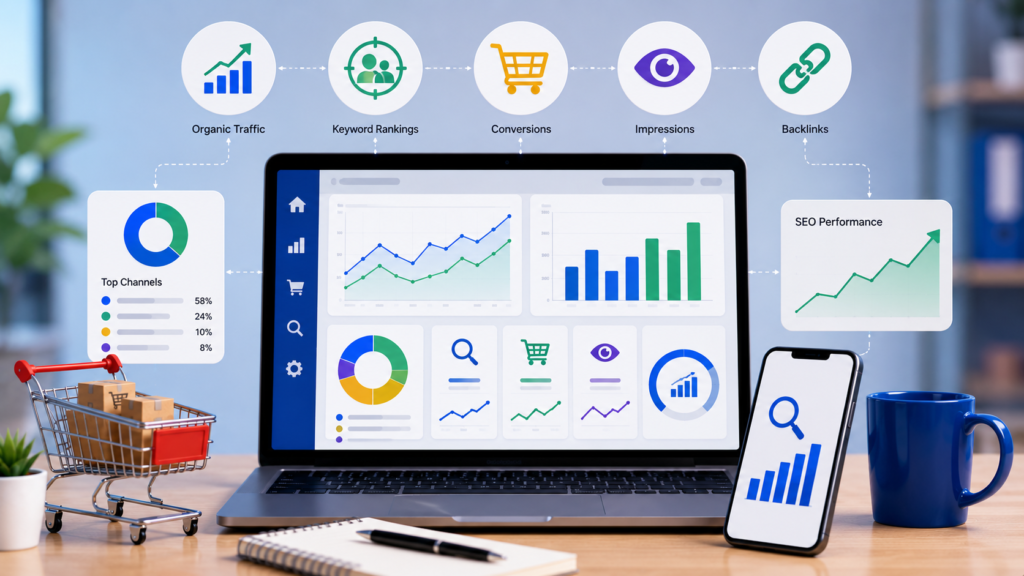
Organic revenue is the primary success metric. Track purchases attributed to organic search sessions through GA4 ecommerce conversion tracking to directly connect SEO investment to business outcomes.
Keyword ranking movement for priority product and category keywords shows whether optimisation work is translating into improved search positions for your highest-revenue terms.
Organic traffic by product category reveals which areas of your catalogue are gaining search visibility and which need additional content or technical investment.
Click-through rate from search results indicates whether your meta titles and product schema rich results are compelling enough to earn clicks for the positions you already hold.
Analytics and reporting dashboards consolidate all performance data into a real-time view that gives ecommerce teams clarity on which SEO activities are driving revenue and where the highest-return optimisation opportunities remain.
Data-driven marketing approaches that tie every ecommerce SEO investment to measurable revenue outcomes ensure budget is allocated to the activities with the strongest proven return rather than distributed across tactics based on assumption.
For enterprise ecommerce businesses managing complex organic search strategies across multiple product lines or markets, enterprise SEO provides the framework and tooling needed to measure and improve ecommerce SEO performance at scale.
Frequently Asked Questions
Ecommerce SEO optimizes product, category, and content pages so stores rank for buyer search queries, driving high-intent organic traffic that converts into sales without per-click ad costs.
An ecommerce website lets businesses sell online via product listings, shopping carts, secure payments, and order management—together enabling a complete digital purchase journey for customers.
Most stores see ranking gains in three to six months; category pages rank faster than products. Competitive niches may need six to twelve months for measurable growth.
Category pages and high-traffic product pages are highest priority because they target commercial and transactional keywords with the greatest purchase intent. Homepage optimisation, buying guide content, and technical foundations all support the performance of these core commercial pages throughout the catalogue.
Yes. Ecommerce SEO services and paid advertising are most effective when used together. Paid ads provide immediate visibility while organic rankings build. Over time, strong SEO reduces cost per acquisition by generating a growing share of revenue from organic traffic that carries no per-click cost.
Product, Offer, Aggregate Rating, and Breadcrumb List schema together give Google the price, availability, review data, and category path needed to show rich results for a product page.
Both can rank well. WooCommerce gives more direct control over URL structure and page‑level code, while Shopify offers faster default page speed with less manual configuration required.
AI shopping agents read structured Product and Offer schema directly from a page, so accurate, complete, and consistently updated structured data is what makes a product discoverable to them.
Conclusion
Ecommerce SEO is the most sustainable revenue strategy available to online retailers in 2026. While paid advertising delivers immediate traffic at rising costs, organic search builds a compounding asset that consistently generates qualified buyer traffic and decreasing cost per acquisition over time.
The strategy is clear: research the keywords your buyers use at every stage of their purchase journey, build a site architecture that makes every product discoverable within three clicks, optimise product and category pages with unique content and complete metadata, fix the technical issues that prevent Google from crawling your catalogue efficiently, and build the authority signals that position your store as the most trusted resource in your product niche.
Whether you are looking for ecommerce SEO services for a growing store, searching for the best ecommerce SEO agency for a large catalogue, or evaluating your first ecommerce SEO package as a new retailer, the principles in this guide apply at every scale.
Explore our complete ecommerce SEO services or read our digital marketing strategies guide to understand how organic search fits within a full-channel ecommerce growth plan.

About the author
Ujjwal Kumawat
I specialize in SEO, website development, Google Ads and online business growth strategies. Through my blogs, I share practical insights, marketing tips and proven strategies to help businesses improve their online visibility, generate more leads and grow faster in the digital space.