What if you could discover exactly what your target audience is searching for using the best keyword research free tools without spending a single rupee?
You can. Free keyword research tools have become genuinely powerful over the past few years, and many of the options available today rival paid subscriptions for day-to-day keyword discovery tasks.
Whether you are just starting your SEO journey or looking to supplement your paid tools with free alternatives, this complete list covers every reliable option, what each one does well, and which situations each tool suits best.
Why Free Keyword Research Tools Matter
Every SEO campaign, content strategy, and paid advertising plan begins with keyword research. Understanding what your target audience types into Google before you create any content is the difference between attracting the right visitors and publishing into a void.

Professional keyword research tools like Ahrefs and SEMrush provide exceptional depth of data, but their monthly costs put them out of reach for many small businesses, freelancers, and individuals learning SEO for the first time. Free keyword research tools fill this gap by providing access to the most essential data points: search volume, keyword suggestions, and search intent signals, without any subscription cost.
The free options available today are significantly more capable than they were even three years ago. Several provide genuine search volume data, keyword difficulty estimates, and competitive analysis features that were exclusively the domain of paid tools until recently.
Using free SEO keyword research tools strategically allows businesses at every budget level to make data-driven content decisions. Combined with strong SEO services and consistent content production, free tools provide everything needed to build and execute an effective organic search strategy.
What to Look for in a Free Keyword Research Tool
Before reviewing specific tools, understanding what makes a free keyword research tool worth using helps you evaluate each option against your actual needs.
Keyword suggestion quality. The tool should expand your seed keywords into relevant related terms and long-tail variations that reflect how real users search.
Search volume data. Accurate or directionally accurate monthly search volume data is essential for prioritising which keywords to target first.
Keyword difficulty or competition data. Understanding how competitive a keyword is determines whether it is realistic for your website to rank for it.
Search intent signals. The best free tools show what type of content is currently ranking for each keyword, helping you match your content format to Google’s preferences.
Query limit generosity. Some free tools limit searches to five or ten per day, which makes them impractical for real keyword research workflows. The tools in this list are selected for their usability within free tier limits.
Understanding these criteria connects directly to the broader keyword research process covered in our complete digital marketing strategies guide.
The Best Free Keyword Research Tools
1. Google Search Console
Best for: Understanding what keywords your site already ranks for
Google Search Console is the single most important free SEO keyword research tool available to any website owner. For a full breakdown of every report and filter available, see Search Console’s own documentation. It shows exactly which queries are generating impressions and clicks for your pages, the average position you hold for each keyword, and the click-through rate those positions are generating.

Unlike discovery tools that suggest new keywords, Search Console reveals the keywords where you already have organic presence. This makes it invaluable for identifying which existing pages have ranking potential that has not been fully capitalised on, and which keywords are generating impressions but very few clicks due to low CTR. Cross‑checking this against your actual keyword search volume elsewhere confirms whether a query is worth prioritising.
For any website, Search Console should be the first tool checked before any keyword research session. Knowing where you already stand informs every other research decision. Monitoring these metrics through analytics and reporting dashboards alongside Search Console data gives a complete picture of organic keyword performance.
Free limitations: No keyword suggestions, no competitor data, only data for your own verified property.
2. Google Keyword Planner
Best for: Accurate search volume data and keyword ideas from Google’s own database
Google Keyword Planner is the official keyword research tool within Google Ads and is completely free to use with a Google Ads account. It provides search volume ranges, competition levels, and keyword suggestions directly from Google’s advertising data, making it one of the most accurate sources of search volume information available.
The tool accepts seed keywords and URLs as inputs, generating hundreds of related keyword suggestions with monthly search volume estimates. For businesses also running Google Ads management campaigns, Keyword Planner serves double duty by informing both organic keyword targeting and paid campaign keyword selection simultaneously.
Free limitations: Volume data is shown in ranges rather than exact numbers unless you have an active campaign. Competition data reflects paid advertising competition rather than organic SEO difficulty.
3. Google Trends
Best for: Understanding keyword trend direction and seasonal demand patterns
Google Trends is a free SEO keyword research tool that shows how search interest in any keyword has changed over time. Rather than providing absolute search volume, it shows relative interest on a scale of 0 to 100, making it ideal for comparing multiple keywords and understanding seasonal fluctuations.
For content planning, Google Trends reveals whether a keyword is growing, declining, or stable in search demand. A keyword with rising trend data represents a stronger long-term investment than one with declining interest regardless of its current search volume. It also shows geographic breakdowns of search interest, which is directly relevant for geo-targeted SEO strategies where regional demand patterns determine content priorities.
Free limitations: No absolute search volume data, no keyword difficulty scores.
4. Google Search Autocomplete and People Also Ask
Best for: Discovering long-tail keywords and question-based queries for free
Google Search itself is an underrated free keyword research tool. Typing a seed keyword into Google and reviewing the autocomplete suggestions shows the most common extensions of that query that real users are actively searching for right now. These suggestions update dynamically based on actual search behaviour, making them more current than any third-party database.
The People Also Ask box and related searches at the bottom of search results pages provide additional long-tail keyword ideas and question-based queries. These are particularly valuable for content writing services planning blog content, FAQ sections, and informational articles that target specific questions.
Free limitations: No volume data, no difficulty scores. Requires manual review of suggestions.
5. Ahrefs Free Keyword Generator
Best for: Getting keyword ideas with difficulty scores without a paid subscription
Ahrefs provides a free keyword generator tool that accepts a seed keyword and returns up to 150 keyword ideas with keyword difficulty scores and search volume estimates. Unlike Ahrefs’s paid platform which provides unlimited data, the free tool is limited to a set number of results but provides genuine keyword difficulty data that most other free tools do not offer.
The free generator works for Google, Bing, YouTube, and Amazon searches, making it useful for keyword research across multiple platforms. For businesses running eCommerce SEO campaigns that extend to Amazon product listings, this multi-platform capability provides particular value at zero cost.
Free limitations: Limited to approximately 150 results per search, no historical data, no SERP analysis.
6. Ubersuggest Free Version
Best for: Beginner-friendly keyword research with domain-level competitor analysis
Ubersuggest by Neil Patel provides a limited but functional free version that offers keyword suggestions, search volume data, SEO difficulty scores, and paid difficulty estimates. It also includes domain-level overview data showing which keywords competitors rank for.

The free version allows a limited number of daily searches, making it suitable for focused research sessions rather than large-scale keyword discovery. Its interface is accessible to beginners unfamiliar with more technical SEO tools, and the keyword ideas section provides content suggestions alongside keyword data.
For teams beginning their SEO journey and learning how to align keyword research with their conversion rate optimisation strategy, Ubersuggest provides enough functionality to make meaningful progress without any upfront investment.
Free limitations: Three searches per day on the free plan, limited historical data, limited competitor analysis.
7. AnswerThePublic Free Version
Best for: Generating question-based and preposition keywords for informational content
AnswerThePublic visualises search questions around any topic, organising keyword suggestions into categories based on who, what, where, when, why, and how queries. It is one of the best free keyword research tools for identifying the specific questions your target audience is asking before they find an answer.
These question-based keywords are particularly valuable for FAQ sections, blog content, and featured snippet targeting. Every question keyword represents a direct opportunity to answer a query that real users are actively asking. For social media marketing teams, these questions also provide ready-made content ideas for posts, reels, and educational content that addresses real audience curiosity.
Free limitations: Three searches per day on the free plan, export requires a paid subscription.
8. Keyword Surfer Chrome Extension
Best for: Seeing keyword data directly in Google search results without switching tools
Keyword Surfer is a free Chrome extension that overlays search volume data directly onto Google search result pages. When you search for any query in Google, Keyword Surfer displays the monthly search volume for that query alongside similar keyword suggestions in a sidebar, all without leaving the Google results page.
This makes it exceptionally efficient for rapid keyword validation. Rather than copying keywords into a separate tool, you see volume data in real time as you browse search results. It also shows estimated traffic data for ranking domains, providing competitive intelligence as you research.
Free limitations: Data accuracy varies compared to Google Keyword Planner, no keyword difficulty scores in the free version.
9. Wordtracker Free Version
Best for: Discovering niche keyword opportunities with intent-filtered suggestions
Wordtracker offers a limited free version that provides keyword suggestions with search volume data and competition metrics. Its strength lies in surfacing niche and long-tail keywords that broader tools sometimes miss. The interface organises keywords by intent categories, helping users identify which terms are informational versus commercial without manual analysis.
For local SEO services campaigns targeting specific geographic markets, Wordtracker’s ability to surface localised long-tail variations provides value beyond what generic keyword planners generate for location-specific queries.
Free limitations: Ten free searches daily, limited to a small number of keyword results per search.
10. Moz Keyword Explorer Free Version
Best for: Monthly keyword research with priority scores combining volume and difficulty
Moz Keyword Explorer provides a free version with ten queries per month. Each query generates keyword suggestions with Moz’s proprietary Priority score, which combines search volume, keyword difficulty, and click-through rate opportunity into a single metric that simplifies keyword selection for beginners.
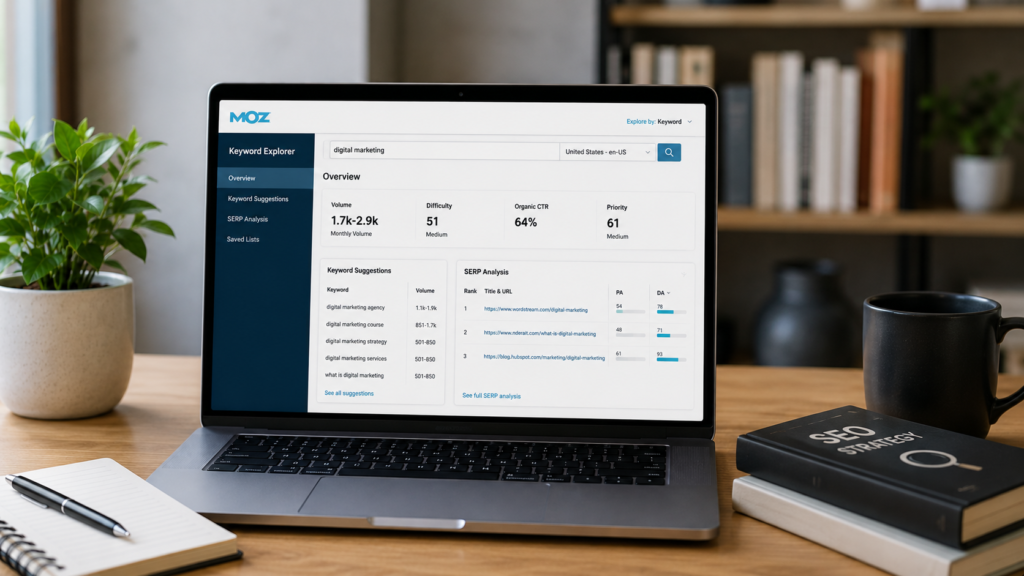
The Priority score is particularly useful for website owners who are not yet comfortable interpreting multiple keyword metrics simultaneously. Rather than weighing volume against difficulty independently, the Priority score ranks keywords by overall opportunity in one number.
Free limitations: Ten queries per month on the free plan, limited to 1,000 keyword suggestions per query.
11. Also Asked
Best for: Mapping the complete question landscape around any topic for free
Also Asked generates a visual map of the questions Google’s People Also Ask feature shows for any seed query. It reveals how questions branch and relate to each other, showing the complete landscape of audience curiosity around any topic.
This tool is invaluable for planning comprehensive content that addresses a topic fully enough to satisfy both readers and Google’s quality evaluators. For AI SEO strategies designed to appear in AI-generated answers, comprehensive topic coverage revealed by AlsoAsked supports the topical authority signals that AI search systems use to select content for citation.
Free limitations: Three free searches per day, visual export requires a paid plan.
12. Bing Webmaster Tools
Best for: Free keyword data pulled directly from Bing’s own search index
Bing Webmaster Tools includes a built-in keyword research feature that most marketers overlook because it sits inside a webmaster platform rather than a standalone tool. It returns search volume and related term suggestions sourced from Bing’s own query data, giving a second data source that doesn’t depend on Google at all. For a full walkthrough of using Bing’s own free keyword data, see our dedicated guide.
Since Bing still accounts for a meaningful share of desktop search traffic, and its data also powers Yahoo and DuckDuckGo results, checking keyword volume here can surface opportunities that Google-only research misses entirely. It pairs well with Google Search Console: comparing where a site ranks on each engine for the same query often reveals gaps worth targeting.
Free limitations: Requires a verified Bing Webmaster Tools account, smaller search volume overall than Google-based tools, less third-party documentation and community support.
How to Use Free SEO Keyword Research Tools Effectively
Getting maximum value from free keyword research requires using multiple tools together rather than relying on any single one. Each tool fills specific gaps in what others provide. For a deeper primer on the fundamentals behind every step here, see our complete beginner’s guide to keyword research.
Start with Google Search Console to understand your current keyword position. This tells you where you already have organic presence and which pages have untapped ranking potential.
Use Google Keyword Planner to validate search volume for your target keywords and discover related terms from Google’s own database.
Google Trends to verify that your target keywords have stable or growing search demand before investing content production time in them.
Use AnswerThePublic or AlsoAsked to generate question-based long-tail keywords for informational content and FAQ sections.
Use Ahrefs Free Keyword Generator or Ubersuggest to get keyword difficulty estimates that help prioritise which keywords to target first.
Combining these tools provides a complete free keyword research workflow that delivers enough data for effective strategy without any subscription cost. This process supports the broader content audit framework that ensures existing content is as well-targeted as new content being planned.
For businesses working through a technical SEO audit alongside keyword research, ensuring that target keyword pages are technically capable of ranking is as important as the keyword selection itself.
Free Keyword Research vs Paid Tools
Free keyword research tools provide enough capability for most small businesses and individual content creators. The primary limitations of free tools compared to paid alternatives are data depth, search limits, and competitive intelligence features.

Paid tools like Ahrefs and SEMrush provide unlimited searches, historical trend data, complete SERP analysis, competitor gap analysis, and rank tracking capabilities that free tools cannot match. For agencies, established businesses, and high-volume content operations, the investment in paid tools delivers significant efficiency and competitive intelligence advantages. As For bloggers specifically, the free‑tool workflow differs slightly for bloggers from ecommerce or local‑business research.
For businesses beginning their SEO journey, free tools combined with consistent content execution produce genuine ranking results. The best ecommerce SEO agencies and professional search engine marketing teams typically use paid tools for strategic planning while practitioners use free tools for day-to-day content keyword validation.
Knowing how to know if your SEO is working is as important as the tools you use to plan it. Tracking keyword ranking movement through Google Search Console after implementing keyword research decisions confirms whether your tool choices and targeting decisions are translating into actual ranking improvements.
For businesses whose SEO needs have grown beyond what free tools support, enterprise SEO strategies require the comprehensive data infrastructure that paid tool suites provide. The transition from free to paid tools is typically warranted when content production volume, competitive market pressure, or multi-location targeting complexity exceeds what free tier limits can support.
AI-Powered Free Keyword Research Tools
A newer category of free keyword research support comes from AI chat tools like ChatGPT and Claude. These tools don’t pull real search volume or ranking data, so they aren’t a replacement for Google Keyword Planner or Search Console. What they’re genuinely useful for is speed: turning a single seed topic into dozens of clustered subtopics, question variations, and long-tail phrasings in seconds, work that would otherwise take multiple passes through Answer The Public or manual autocomplete digging. This complements the AI SEO writing tools increasingly used alongside keyword discovery.
This makes AI chat tools a strong first step in a keyword workflow rather than a final one. A practical sequence looks like this: ask an AI tool to brainstorm topic clusters and likely user questions around a seed keyword, then run the strongest candidates through Google Keyword Planner or Search Console to confirm they have real, validated search demand before committing content production time to them.
Because AI tools have no access to live search data, any volume or difficulty figures they generate should be treated as unverified and checked against an actual data source. Used this way, as an ideation layer rather than a data source, AI chat tools add real efficiency to the free keyword research process without introducing bad data into content decisions.
Comparison Table: Best Free Keyword Research Tools
| Tool | Best For | Daily Limit | Volume Data | Difficulty Score |
|---|---|---|---|---|
| Google Search Console | Existing keyword data | Unlimited | Yes (your site) | No |
| Google Keyword Planner | Volume validation | Unlimited | Yes (ranges) | No |
| Google Trends | Trend direction | Unlimited | Relative only | No |
| Ahrefs Free Generator | Keyword ideas with difficulty | Limited | Yes | Yes |
| Ubersuggest Free | Beginner research | 3 per day | Yes | Yes |
| AnswerThePublic | Question keywords | 3 per day | No | No |
| Keyword Surfer | In-SERP data | Unlimited | Yes | No |
| Moz Keyword Explorer | Priority scoring | 10 per month | Yes | Yes |
| AlsoAsked | Question mapping | 3 per day | No | No |
| Google Autocomplete | Long-tail discovery | Unlimited | No | No |
Frequently Asked Questions
Google Keyword Planner and Ubersuggest are the best starting points for beginners. Keyword Planner provides accurate volume data directly from Google. Ubersuggest adds keyword difficulty scores and competitor insights in a beginner-friendly interface that makes interpretation straightforward.
Yes. Google Search Autocomplete, People Also Ask results, and the Related Searches section at the bottom of Google results pages provide free keyword insights with no tool required. These sources reflect real-time search behaviour and reveal long-tail variations and question-based queries immediately.
Free tools vary in accuracy. Google Search Console and Google Keyword Planner use Google’s own data and are highly accurate. Third-party free tools like Ubersuggest and Ahrefs Free Generator provide directionally accurate data that is sufficient for strategic decisions even if individual numbers differ slightly from paid sources.
Using three to four complementary tools together provides the best results. Combine Google Search Console for existing keyword data, Google Keyword Planner for volume validation, AnswerThePublic or AlsoAsked for question keywords, and Ahrefs Free Generator or Ubersuggest for difficulty scores to cover all essential research needs.
Upgrade when free tool daily limits consistently prevent you from completing research tasks, when you need competitor keyword gap analysis, when you require rank tracking for multiple keywords simultaneously, or when your content volume and competitive market require the depth of data that only paid platforms provide.
Yes, as a brainstorming supplement. AI chat tools can cluster topics and suggest question‑based keywords quickly, but they don’t provide real search volume, so pair them with Google Keyword Planner or Search Console for actual data.
Yes. Bing Webmaster Tools includes a free keyword research feature with search volume and related term suggestions pulled from Bing’s own search data, useful alongside Google‑focused tools.
Conclusion
Free keyword research tools in 2025 are more capable than ever. Google’s own free suite, comprising Search Console, Keyword Planner, Trends, and Search Autocomplete, provides a complete foundation for keyword discovery and validation at zero cost. Third-party free options like Ahrefs Free Keyword Generator, Ubersuggest, AnswerThePublic, and AlsoAsked extend this foundation with difficulty scores, question keyword mapping, and platform-specific suggestions.
The most effective approach combines several tools to cover different aspects of the research process. Use Google Search Console to understand where you stand. Google Keyword Planner to validate volumes. Use question-based tools to discover long-tail opportunities. Use free difficulty score tools to prioritise wisely.
Keyword research for free is entirely viable for websites at every stage of growth. The limitation is not the tools. It is the discipline to apply what the tools reveal consistently across every piece of content you produce.
For businesses ready to go beyond free tools into a fully managed keyword research and SEO strategy, explore our SEO services or read our complete guide on how to perform an SEO audit to understand how keyword research fits within a comprehensive organic search strategy.

About the author
Ujjwal Kumawat
I specialize in SEO, website development, Google Ads and online business growth strategies. Through my blogs, I share practical insights, marketing tips and proven strategies to help businesses improve their online visibility, generate more leads and grow faster in the digital space.