Are you struggling to rank locally because you misunderstand the core local seo ranking factors Google uses?
Most business owners invest time and money into their website without ever addressing the signals Google actually weighs for local search placement. Local search operates differently from organic search. Google evaluates proximity, relevance, and prominence simultaneously to decide which businesses appear in the Local Pack and Google Maps results.
Understanding local seo ranking factors in depth is the difference between appearing on page one for high-intent local searches and being invisible to buyers in your own neighbourhood. This guide covers every major factor, how they interact, and what you can do to improve your local visibility in 2026.
What Are Local SEO Ranking Factors?
Local SEO ranking factors are the signals Google evaluates to determine which businesses appear in local search results for geographically relevant queries. These factors span your Google Business Profile, website content, citation consistency, customer reviews, backlink profile, and user engagement behaviour. Each factor contributes to how Google assesses your business’s relevance, proximity, and trustworthiness for a specific local search.

Understanding these factors is the foundation of any effective local seo services strategy. Google’s local algorithm differs meaningfully from its organic ranking algorithm. A business can rank in the Local Pack without ranking organically for the same keyword, and vice versa. Mastering both requires a clear understanding of which signals influence each type of placement independently.
The Three Pillars of Local SEO Google Rankings
Relevance, Proximity, and Prominence
Google’s local search algorithm evaluates every business listing against three primary pillars. Relevance measures how well your business listing matches the intent behind a searcher’s query. Proximity measures how close your business location is to the searcher’s physical position at the time of search. Prominence measures how well-known and authoritative your business appears based on signals from across the web.
Local seo google rankings reflect the intersection of all three pillars simultaneously. A business that scores highly on relevance and prominence but sits geographically far from the searcher will still rank below a closer, moderately optimised competitor. Understanding this interplay prevents sellers from over-investing in one pillar while neglecting the others.
For businesses with multiple locations, balancing all three pillars across each location is particularly complex. Our multi-location seo guide covers the specific strategies required to rank each location independently without creating duplicate content or citation conflicts between branches.
Google Business Profile Optimisation
Why GBP Is the Single Most Important Local Ranking Signal
Your Google Business Profile is the most influential single element among all local seo ranking factors. It is the direct source of data Google uses to populate your Local Pack listing, Knowledge Panel, and Google Maps presence. An incomplete or inaccurate GBP consistently underperforms even when every other local signal is strong.
Completing every available field in your GBP is the first priority. Business name, address, phone number, website URL, business category, opening hours, and service area must all be accurate and complete. The primary business category carries particular weight in determining which queries your listing is eligible to appear for. Choosing the most specific and accurate primary category available in your niche significantly improves your relevance score for target queries.
Regular GBP posts, photo uploads, and Q and A management signal to Google that your listing is actively maintained. Google’s algorithm favours active, frequently updated profiles over static ones when ranking is close between competitors. According to Google’s official GBP help documentation, complete and accurate profiles are more likely to be matched to relevant searches across Google Search and Maps.
GBP Features That Influence Rankings
Products and services sections allow you to describe your specific offerings with keyword-rich content directly within your GBP. Filling these sections comprehensively gives Google additional relevance signals beyond your business category alone. Attributes, such as accessibility features, payment methods, and amenity details, improve your listing’s match rate for filtered local searches.
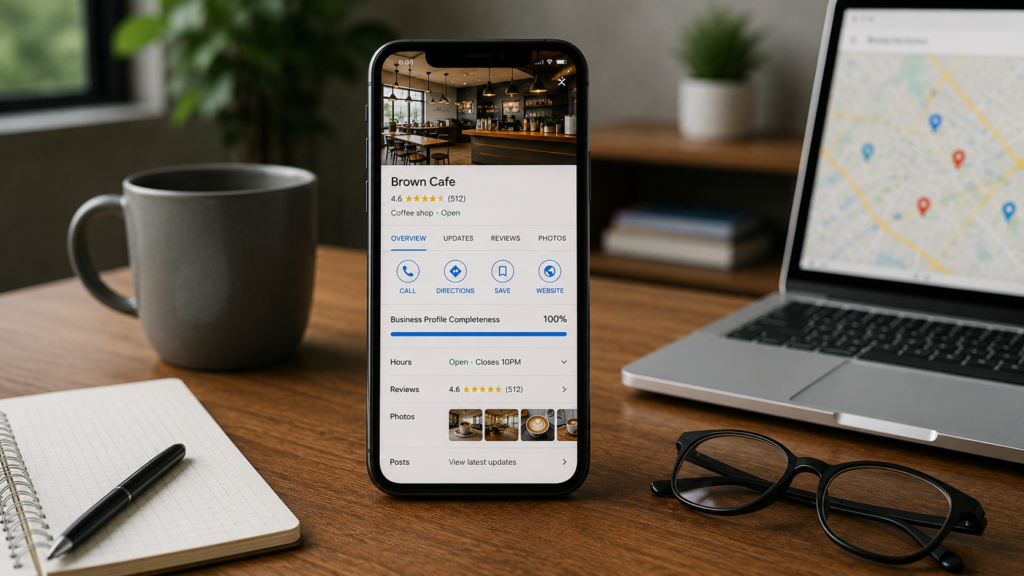
Messaging, booking integrations, and menu features each add engagement touchpoints that improve user interaction signals from your GBP. Higher engagement rates from your GBP listing positively affect your prominence score over time.
Local SEO Citations and NAP Consistency
What Local SEO Citations Are and Why They Matter
Local seo citations are any online mentions of your business name, address, and phone number, collectively called NAP data. They appear in business directories, review platforms, social media profiles, and industry-specific listing sites. Google cross-references citation data across the web to verify that your business information is consistent and trustworthy.
Inconsistent NAP data confuses Google’s local algorithm and reduces your prominence score. A business listed as “Smith Plumbing Ltd” in one directory and “Smith Plumbing” in another creates a data conflict that undermines citation value. Auditing and correcting NAP inconsistencies across your citation profile is one of the highest-return activities in any local seo audit process.
Building and Managing Your Citation Profile
Priority citations come from high-authority general directories. Google Business Profile, Bing Places, Apple Maps, Yelp, Facebook, and industry-specific directories relevant to your niche form the foundation of a strong citation profile. These sources carry the highest individual citation authority and should be completed and verified before building secondary citations.
Secondary citations come from regional and niche-specific directories, local news sites, and community platforms. Volume matters less than authority and consistency at this level. According to Moz’s local ranking factors research, citation consistency across authoritative sources remains one of the top signals in Google’s local prominence evaluation. A technical seo audit should include a citation consistency review as a standard component for any local business client.
On-Page Signals for Local SEO
On-page optimisation signals remain a significant component of local seo ranking factors, particularly for ranking in organic local results that appear beneath the Local Pack. Your website must communicate clear geographic relevance signals to Google through structured content, schema markup, and technical SEO foundations.
Every page targeting a local keyword should include the target city or region in the title tag, H1 heading, and naturally within the body content. A dedicated location page for each area you serve provides Google with explicit geographic relevance signals for multiple markets simultaneously. For businesses serving multiple locations, our geo-targeted seo guide covers how to structure location pages that rank without duplicating content across similar service area pages.
Schema markup for local businesses provides structured data that helps Google understand your business type, location, opening hours, and service areas with precision. LocalBusiness schema applied correctly reduces the ambiguity Google faces when classifying your business for local search results. Mobile-first indexing compliance is also critical because the majority of local searches occur on mobile devices, making your mobile experience a direct ranking input.
Core Web Vitals performance affects your local organic rankings because Google uses page experience signals as tiebreakers between otherwise equivalent local competitors. Site speed optimisation is therefore not a technical nice-to-have but a direct local ranking input for businesses competing in established local markets.
Reviews and Their Impact on Local Rankings
How Reviews Function as a Local Ranking Signal
Customer reviews are among the most powerful local seo ranking factors in Google’s prominence evaluation. Review quantity, review velocity, review sentiment, and your responsiveness to reviews each contribute independently to your local ranking signals. Businesses with larger volumes of recent, positive reviews consistently rank above competitors with fewer or older reviews in competitive local queries.

Google uses review content as a relevance signal alongside your GBP category and website keywords. When customers mention specific services, products, or locations in their reviews, those mentions reinforce your relevance for queries containing those terms. Encouraging customers to describe their experience in specific terms naturally enriches your review content’s keyword relevance value.
Responding to every review, both positive and negative, demonstrates active engagement to Google and builds trust with prospective customers simultaneously. Understanding how to respond to reviews with AI assistance allows businesses to maintain consistent, thoughtful response practices at scale without excessive manual time investment.
Review Platforms Beyond Google
While Google reviews carry the most direct ranking weight, reviews on platforms like Yelp, Trustpilot, Facebook, and industry-specific review sites contribute to your overall prominence signals. Diversifying your review presence across multiple platforms reduces your dependence on any single platform’s algorithm changes and strengthens your overall online reputation profile.
For healthcare businesses and other regulated industries, managing reviews requires additional care around compliance and patient privacy considerations. Our guide on seo for hospitals and healthcare websites covers review management in regulated contexts specifically.
Local SEO Keyword Research and Content Strategy
Finding the Right Local Keywords
Local seo keyword research identifies the specific phrases local buyers use when searching for your products or services in your area. These phrases typically combine a service or product term with a geographic modifier such as a city name, neighbourhood, or “near me” qualifier. Identifying these combinations systematically and targeting them through dedicated content is what separates locally visible businesses from those relying on generic national keywords.
Use a combination of keyword research for seo tools and Google Search Console data to identify local keyword opportunities. Search Console reveals which local queries already drive impressions to your website, highlighting quick wins where small optimisation improvements can move pages from position 8 to position 3. Understanding keyword search volume patterns for local terms helps you prioritise which keywords deserve dedicated page investment versus which can be addressed within existing service pages.
Creating Content That Supports Local Rankings
Local content strategy goes beyond service pages targeting geographic terms. Blog content covering local topics, community involvement, local events, and area-specific guides builds geographic relevance signals that service pages alone cannot establish. This content also earns local backlinks from community organisations, local news outlets, and area business associations naturally.
Digital marketing strategies for local businesses should include a content calendar that balances service-focused conversion pages with informational local content that builds topical authority in your area. The marketing funnel for local buyers typically starts with informational content and ends on service pages, so both content types serve essential roles in your local revenue generation system.
Backlinks and Local Authority Building
Backlinks remain a significant prominence signal in local seo ranking factors. However, local link quality differs from national SEO link quality. A link from a local newspaper, regional business association, city government directory, or community organisation carries outsized local relevance value compared to a generic national directory link of similar domain authority.

Building local backlinks requires genuine community presence. Sponsoring local events, contributing to local business associations, partnering with complementary local businesses, and being cited in local press coverage each generate the geographically relevant links that improve your local prominence score. A backlink audit specifically evaluating the geographic relevance of your existing link profile reveals whether your backlink strategy is contributing to local prominence or only to national organic authority.
For franchise businesses building local authority across multiple geographic markets, our franchise seo playbook covers link building strategy at scale without creating footprint patterns that could trigger algorithmic scrutiny across location-specific pages.
Behavioural Signals and Engagement Metrics
How User Behaviour Influences Local Rankings
Behavioural signals from how users interact with your GBP listing and website contribute to your local rankings as engagement-based prominence indicators. Click through rate from local search results, direction requests from Google Maps, phone call clicks from your GBP, and time spent on your website after a local search click all send positive engagement signals that Google interprets as evidence of genuine local relevance.
Improving your GBP listing’s visual appeal directly increases click through rate from the Local Pack. High quality photos, complete business information, and recent positive reviews each increase the probability that a searcher will click your listing over a competitor’s. Image alt text optimisation on your website also contributes to the visual search signals that support GBP photo indexing.
How to know if your seo is working in a local context requires monitoring GBP insights alongside website analytics. GBP insights reveal how many searches triggered your listing, how many users clicked for directions, and how many called directly from your profile. These engagement metrics complement organic ranking data in a complete local performance picture.
How to Conduct a Local SEO Audit
The Local SEO Audit Process
A local seo audit systematically evaluates every ranking factor affecting your current local search performance. It begins with GBP completeness and accuracy, moves through NAP citation consistency, reviews on-page optimisation of location-targeted pages, assesses review profile health, and evaluates backlink quality and geographic relevance.
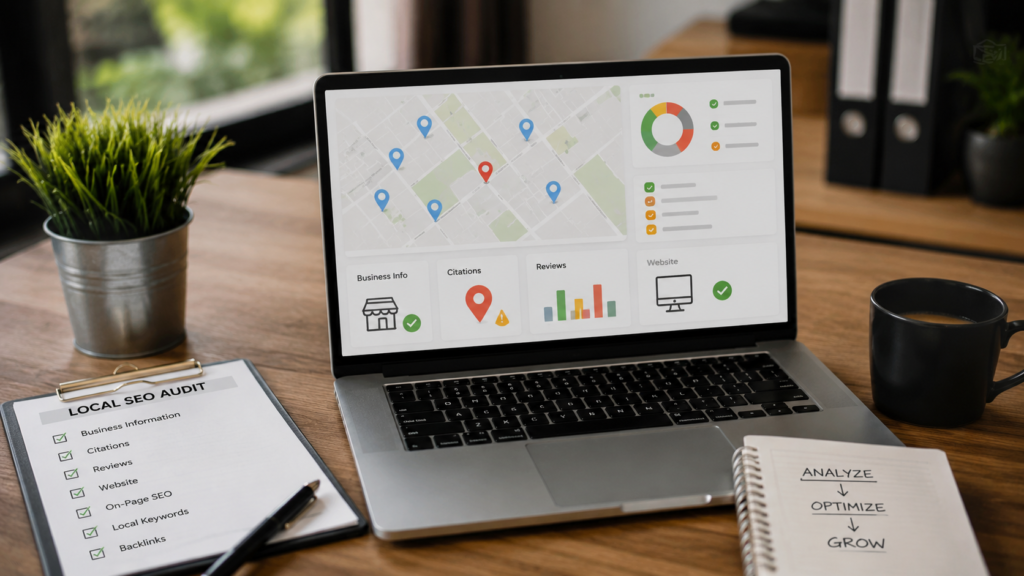
Use a local seo checker tool to identify citation inconsistencies, duplicate GBP listings, and missing structured data across your local presence. Platforms like BrightLocal and Whitespark provide specialised local audit capabilities that general SEO tools do not include. Regular audits every six months ensure new citation inconsistencies, outdated GBP information, and declining review velocity are identified before they compound into ranking drops.
A local seo ranking checker allows you to monitor your position in Local Pack results for your target keywords across different geographic points within your service area. Local rankings vary significantly depending on the searcher’s location relative to your address, so checking rankings from multiple geographic points provides a more accurate picture than a single ranking check from your business address.
For businesses planning to scale local visibility across multiple markets, connecting audit insights to a broader omnichannel marketing strategy ensures local SEO investments align with your overall customer acquisition approach across every channel. According to Whitespark’s annual local search ranking factors survey, GBP signals, review signals, and on-page signals consistently rank as the top three factor groups influencing Local Pack placement. As Search Engine Land’s local SEO guide confirms, treating these three groups as interconnected rather than independent produces the strongest cumulative ranking improvement.
For professional support implementing a complete local strategy, our seo services and local seo services cover every component from GBP optimisation and citation building through to content writing services that target high-value local keywords for your specific market.
Frequently Asked Questions
The most important local seo ranking factors are Google Business Profile completeness, NAP citation consistency, review quantity and sentiment, on-page geographic signals, and local backlink authority. GBP signals carry the highest individual weight in Local Pack ranking decisions across competitive local markets.
Local seo citations reinforce your NAP data accuracy across the web, which improves Google’s confidence in your business information. Consistent citations across authoritative directories strengthen your prominence score and directly improve your eligibility to rank in the Local Pack for relevant searches.
Most local seo strategies produce measurable ranking improvements within 60 to 90 days for less competitive markets. Highly competitive local markets may require four to six months of consistent optimisation across GBP, citations, reviews, and on-page signals before significant Local Pack movement occurs.
A local seo audit evaluates your GBP completeness, citation consistency, on-page local signals, review profile, and backlink quality. It identifies specific gaps suppressing your local rankings and produces a prioritised action plan for systematic improvement across every major local ranking factor category.
Local seo keyword research focuses on geographic modifier combinations specific to your service area. It identifies city and neighbourhood level search terms your local buyers use rather than national volume terms. These local combinations typically have lower competition and higher purchase intent than their generic national equivalents.
Conclusion
Mastering local seo ranking factors requires consistent attention across multiple interconnected signals rather than optimising one element in isolation. Your Google Business Profile, citation consistency, on-page geographic signals, review profile, and local backlink authority each contribute to the three pillars of relevance, proximity, and prominence that Google uses to rank local results.
Conduct regular local seo audits to identify gaps before they become ranking problems. Use local seo keyword research data to ensure every page targets terms your local buyers actually use. And treat your local seo strategies as a long-term investment that compounds in value as your citation profile, review volume, and local authority grow together over time.
For businesses ready to build a comprehensive local search presence, explore our complete services overview or read our digital marketing strategies guide to understand how local SEO connects to every channel in your growth plan.

About the author
Ujjwal Kumawat
I specialize in SEO, website development, Google Ads and online business growth strategies. Through my blogs, I share practical insights, marketing tips and proven strategies to help businesses improve their online visibility, generate more leads and grow faster in the digital space.