Is your business invisible in local search because you have never run a proper local seo audit?
Most local businesses invest in their website without ever systematically evaluating the signals that actually determine local search visibility. A local seo audit examines every factor Google uses to rank. The businesses in the Local Pack, Google Maps, and local organic results. It identifies gaps in your Google Business Profile, NAP citation consistency. Also on-page content, technical SEO foundations, review profile health, and backlink authority.
This guide walks you through every stage of a complete local seo audit. The tools required at each step, and how to turn audit findings into a prioritised action plan. Which produces measurable ranking improvements.
What Is a Local SEO Audit?
A local seo audit is a systematic evaluation of all the signals that influence your business’s visibility in Google’s local search results. It covers your Google Business Profile completeness and accuracy, citation consistency across online directories, on-page geographic targeting signals, technical website health, keyword targeting strategy, customer review profile, and the quality of local backlinks pointing to your domain.
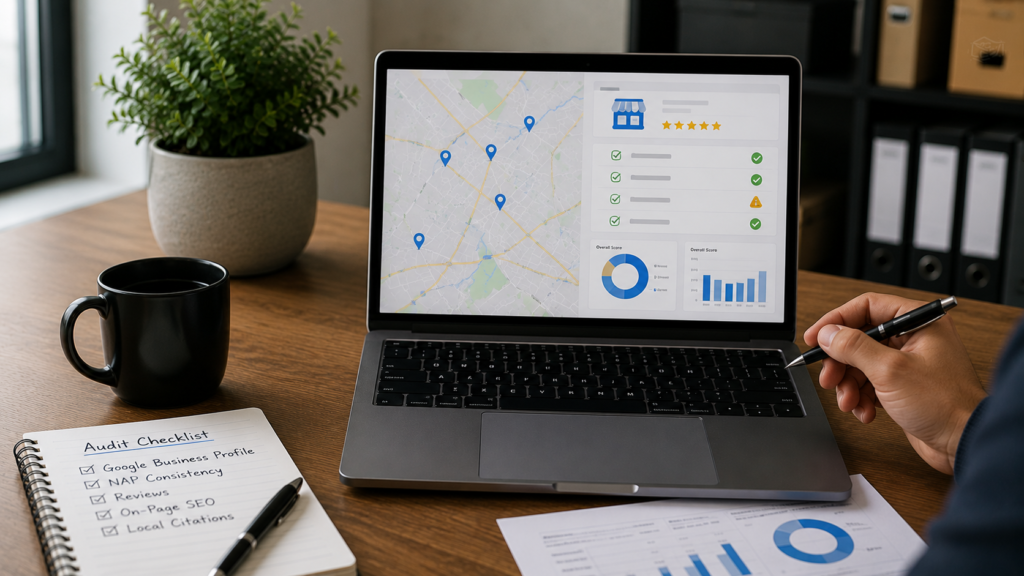
The purpose of a local seo audit is to identify specific, fixable gaps that are suppressing your rankings in the Local Pack and local organic results. Without a structured audit process, local SEO improvements are guesswork rather than targeted interventions. A complete audit produces a prioritised list of actions ranked by their likely impact on local visibility, allowing you to allocate effort and budget where it produces the strongest returns.
Why Running a Local SEO Audit Matters
Local search is intensely competitive in almost every industry and geography. Buyers searching for local services are typically at the bottom of the marketing funnel and ready to make immediate purchasing decisions. Appearing in the top three Local Pack results for your primary service keywords directly translates into phone calls, direction requests, and website visits from buyers with high commercial intent.
Local seo google rankings do not stay static. Competitor activity, algorithm updates, citation changes, and review accumulation all shift your relative position continuously. Regular local seo audits catch ranking declines before they become entrenched problems and identify new opportunities created by competitor weaknesses or algorithm changes that favour different signals.
For businesses building comprehensive digital marketing strategies, a local seo audit provides the diagnostic foundation that every other local marketing investment builds on. Spending on advertising or content without first correcting the fundamental local SEO gaps an audit reveals is an inefficient use of marketing budget.
Step One: Google Business Profile Audit
Checking Completeness and Accuracy
Your Google Business Profile is the single most influential element in local search visibility. Begin your local seo audit by verifying that every available GBP field is completed accurately. Business name, address, phone number, website URL, primary and secondary business categories, opening hours, service area, and business description must all be present and correct.
Your primary business category carries more weight in determining search query eligibility than any other single GBP field. Evaluate whether your current primary category is the most specific and accurate option available in Google’s category database for your type of business. Switching to a more precise primary category frequently produces immediate improvements in relevance for high-intent local queries.
Check your GBP for duplicate listings, which occur when multiple listings exist for the same business address. Duplicate listings split your review signals and citation authority across multiple profiles, weakening the prominence signals of each individual listing. Google’s own GBP guidelines provide clear instructions for identifying and resolving duplicate listing issues.
Evaluating GBP Engagement Signals
Review your GBP post history, photo library, and Q and A section as part of your audit. Profiles with regular posts, frequent photo uploads, and answered questions signal active management to Google’s algorithm. Inactive profiles with outdated information or minimal photos consistently underperform actively maintained profiles in competitive local markets.
Check your GBP insights data for search query performance, direction requests, phone call clicks, and website clicks. These engagement metrics reveal how well your current profile is performing and establish baseline benchmarks against which your post-audit improvements can be measured. Understanding how to know if your seo is working requires these baseline measurements before any changes are implemented.
Step Two: NAP and Local SEO Citations Audit
What Your Citation Audit Should Cover
Local seo citations are mentions of your business name, address, and phone number across online directories, review platforms, and other websites. Google cross-references citation data from multiple sources to verify your business information is consistent and trustworthy. Inconsistencies in how your NAP data appears across different platforms directly reduce your prominence score and local ranking potential.
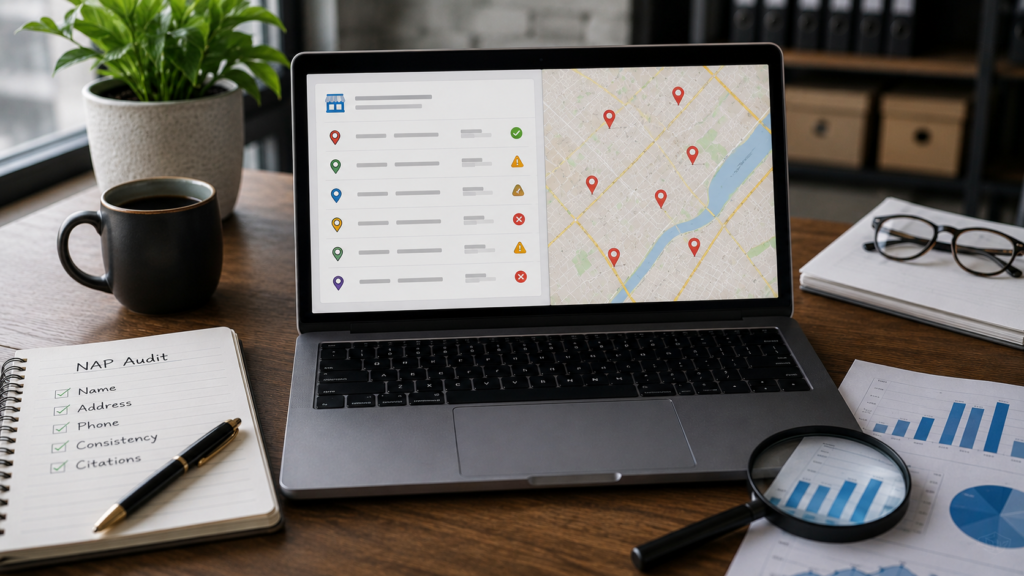
Your citation audit should identify every significant directory listing for your business and check each one for accuracy against a single, authoritative version of your NAP data. Common inconsistencies include abbreviated versus spelled-out street names, old phone numbers not yet updated after a number change, and slight business name variations between platforms.
Use a dedicated local citation tool or local seo checker to automate the discovery and comparison process. Manual citation auditing across dozens of directories is time-consuming and prone to missing listings. Tools like BrightLocal, Whitespark, and Moz Local identify your existing citation profile, flag inconsistencies, and reveal missing citations on authoritative directories your competitors are listed on.
Priority Citation Sources to Audit
Audit your presence on the highest-authority general directories first. Google Business Profile, Bing Places for Business, Apple Maps, Yelp, Facebook, and Yellow Pages form the foundational citation tier. Errors on these platforms carry more weight than inconsistencies on smaller secondary directories because their authority contribution to your prominence score is proportionally larger.
After auditing general directories, review industry-specific directories relevant to your niche. Healthcare businesses should check Healthgrades and Zocdoc. Legal businesses should audit Avvo and FindLaw. Home services businesses should review Angi and Houzz. According to Moz’s local ranking factors research, niche-specific citation sources carry relevance value beyond their individual domain authority because they signal category alignment to Google’s local algorithm.
Step Three: On-Page Local SEO Audit
On-page signals tell Google which geographic areas your business serves and which local keywords your pages should rank for. Your on-page local seo audit evaluates title tags, H1 headings, body content, schema markup, and internal linking structure across your key service and location pages.
Every page targeting a local keyword should include the target city or region in the page title tag, the H1 heading, and naturally within the body content. Run your most important service pages through a local seo ranking checker to establish their current ranking positions before making on-page changes. This creates a clear before-and-after comparison for evaluating the impact of your optimisation work.
Check whether you have dedicated location pages for each area you serve. Generic service pages without geographic targeting signals rank poorly for location-specific queries. For businesses serving multiple cities or regions, our geo-targeted seo guide covers how to structure location pages that rank without duplicating content problematically across similar pages.
Schema markup for local businesses provides structured data that reduces Google’s interpretation ambiguity about your business type, location, and services. Audit whether LocalBusiness schema is correctly implemented on your homepage and key service pages. Missing or incorrectly formatted schema is one of the most frequently found technical gaps in local business on-page audits.
Step Four: Technical SEO Audit for Local Businesses
Technical SEO issues affect local rankings in two ways. They impair Google’s ability to crawl and index your pages correctly, and they create poor user experiences that reduce the engagement signals Google uses as local quality indicators. Your technical seo audit should cover crawlability, mobile performance, page speed, and structured data implementation.
Mobile-first indexing compliance is critical for local businesses because the majority of local searches originate on mobile devices. Google uses the mobile version of your site as the primary version for indexing and ranking. A site that performs poorly on mobile loses local ranking potential regardless of how well it is optimised on desktop.
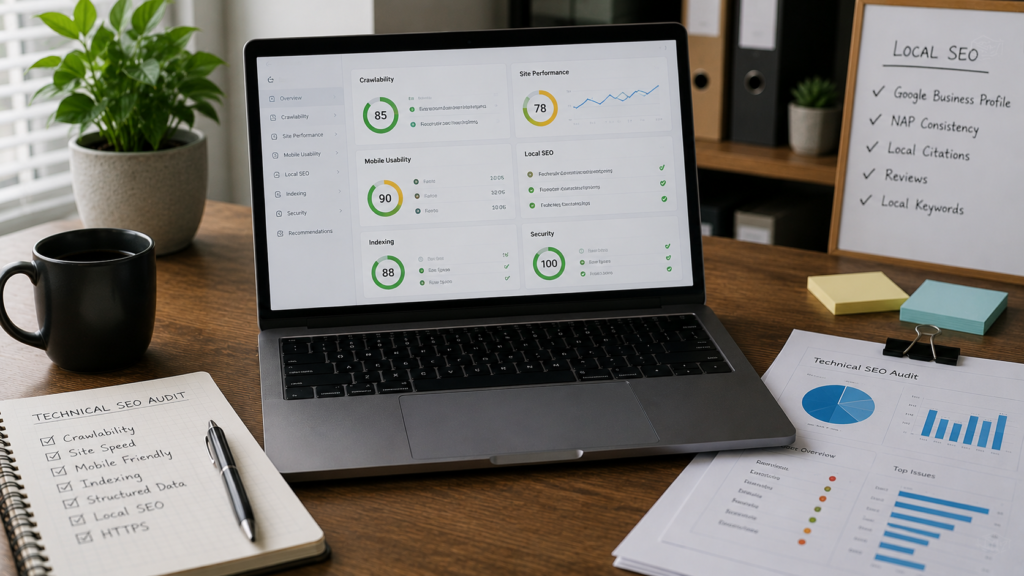
Core Web Vitals scores directly affect your local organic rankings as part of Google’s page experience signals. Audit your Largest Contentful Paint, Cumulative Layout Shift, and Interaction to Next Paint scores using Google Search Console and PageSpeed Insights. Site speed optimisation improvements that bring your scores into the good range provide a measurable ranking benefit in competitive local markets.
Check for canonical tag issues that might be causing Google to index the wrong version of your location pages. Duplicate content between location pages is a common technical problem for businesses serving multiple areas from pages that are too similar in structure and content. Canonical tags and unique location-specific content together resolve this issue cleanly.
Review your technical seo for website performance more broadly, checking for broken internal links, redirect chains, missing meta descriptions, and crawl errors flagged in Google Search Console. These issues may seem minor individually but compound to create a poor technical foundation that limits how effectively Google can index and rank your local content.
Step Five: Local SEO Keyword Research Audit
Evaluating Your Current Keyword Targeting
Local seo keyword research identifies the specific geographic and service term combinations your target buyers use when searching locally. Your keyword research audit evaluates whether your current page targeting aligns with the actual search terms generating local demand in your market.
Pull your current keyword data from Google Search Console to see which queries are generating impressions for each of your pages. Identify pages ranking in positions 6 to 15 for valuable local keywords. These pages represent quick-win optimisation opportunities where modest on-page improvements can move them into the top five results. Understanding keyword search volume patterns for your local terms helps you prioritise which pages deserve the most immediate attention.
Use keyword research for seo tools to identify local keyword opportunities your site is not currently targeting at all. Competitor keyword gap analysis reveals terms your local competitors rank for that your site has no content addressing. These gaps represent the highest-priority content creation opportunities identified by your audit.
Mapping Keywords to Pages
A complete local keyword research audit produces a keyword-to-page map that assigns every target local keyword to a specific existing or planned page. This mapping prevents keyword cannibalisation, where multiple pages compete for the same keyword and split your ranking signals. Each valuable local keyword should have one clearly designated target page optimised to rank for it.
For businesses in specialised industries, our guides on seo for hospitals and seo for logistics and transportation cover industry-specific local keyword patterns that general keyword research tools may not surface effectively.
Step Six: Review Profile Audit
Your review profile audit evaluates the quantity, recency, sentiment distribution, and platform diversity of your customer reviews. Reviews function as local seo ranking factors across both the GBP prominence evaluation and the relevance signals they provide through keyword-rich review content.
Audit your review velocity over the past 90 days. A business consistently receiving new reviews signals to Google that it is actively serving customers, which positively affects prominence scores. A business whose last review is several months old appears stagnant. Identify any periods of review velocity decline and investigate whether they correlate with changes in your customer communication processes.
Check your response rate and response quality for existing reviews. Google rewards businesses that actively engage with customer feedback. Responding to reviews with AI assistance allows businesses to maintain consistent, thoughtful response practices at scale. As BrightLocal’s consumer review research consistently shows, response rate and recency of reviews are among the most influential factors in how prospective customers evaluate local businesses before making contact.
Audit your review presence across platforms beyond Google. Yelp, Facebook, Trustpilot, and industry-specific review sites each contribute to your overall online reputation signals. Diversifying your review presence reduces platform dependency and strengthens your prominence profile across multiple high-authority sources simultaneously.
Step Seven: Backlink and Authority Audit
Local backlink quality differs from national SEO link quality. A backlink audit for local businesses should evaluate not just domain authority but also geographic relevance. Links from local newspapers, regional business associations, city government directories, community organisations, and local event sponsors carry outsized local prominence value.
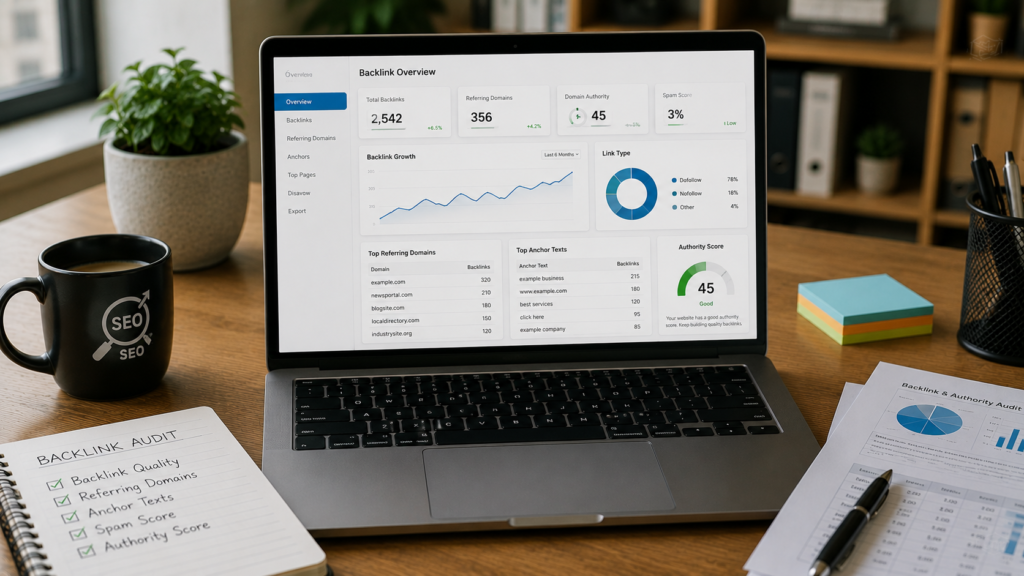
Audit whether your current backlink profile contains geographically relevant links or only generic national directory links. A business with strong domain authority links but few geographically relevant links may still underperform in local search against a lower-authority competitor with strong local link signals.
Identify local link opportunities your competitors have earned that you have not. Look for local event sponsorships, community organisation memberships, and local press coverage opportunities that could generate geographically relevant inbound links organically. For franchise businesses building local authority across multiple markets, our franchise seo playbook covers location-specific link building at scale.
Local SEO Tools and Tips for Auditing
The Essential Tool Stack
A complete local seo tools and tips toolkit for auditing combines free and paid platforms that each cover specific audit areas more effectively than any single tool alone.
Google Search Console is free and provides the most accurate data available about which queries your site ranks for, which pages have indexing issues, and which Core Web Vitals scores need improvement. It is the essential starting point for any local seo audit regardless of budget.
BrightLocal provides specialised local audit capabilities covering citation tracking, GBP audit, local rank tracking, and review monitoring in a single platform. It is the most widely used dedicated local SEO tool among agencies and in-house SEO professionals.
Moz Local automates citation distribution and monitoring across major directories and provides a citation consistency score that simplifies the NAP audit process. According to Moz Local’s platform documentation, businesses using automated citation management maintain higher NAP consistency scores over time than those managing citations manually.
Screaming Frog handles the technical crawl component of your audit, identifying broken links, redirect chains, missing meta tags, and duplicate content issues across your entire site. Pair it with Google PageSpeed Insights for a complete technical SEO audit picture.
Ahrefs or SEMrush cover backlink audit and competitor keyword gap analysis. Both platforms reveal which local keywords your competitors rank for that your site is not targeting, surfacing the content opportunities your audit should prioritise most urgently. As Ahrefs’s local SEO guide explains, competitor analysis is one of the fastest ways to identify proven keyword and content opportunities in any local market.
How to Prioritise Your Audit Findings
Building Your Post-Audit Action Plan
A thorough local seo audit typically surfaces more issues than can be addressed simultaneously. Prioritising your findings by likely ranking impact and implementation effort ensures your first actions produce the strongest immediate improvements.
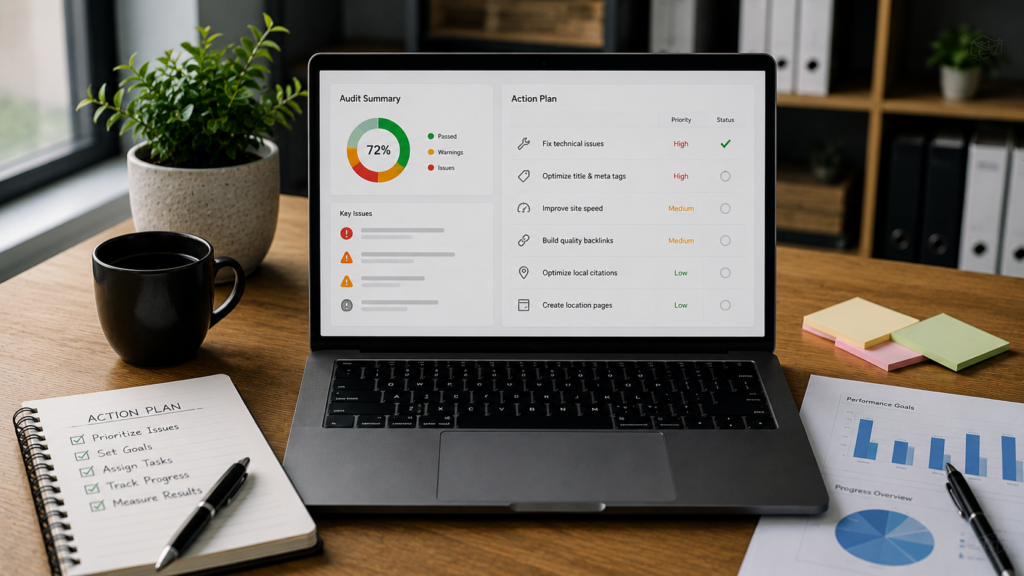
Fix GBP accuracy issues and NAP inconsistencies first. These are typically quick to correct and carry high ranking impact. Technical issues blocking crawlability or producing poor mobile experience come next. Keyword targeting gaps and content creation opportunities follow as medium-term priorities. Backlink building and review generation are longer-term ongoing activities that compound in value over time.
Set up analytics reporting dashboards before implementing any changes so you can measure the impact of each improvement clearly. Track your local keyword rankings weekly using a dedicated local seo ranking checker to monitor progress across your target queries. Schedule your next local seo audit for six months after completing your first round of fixes.
For businesses requiring professional audit support, our seo services and local seo services cover every audit component from GBP optimisation and citation management through to on-page content and technical SEO improvements in a structured engagement.
For businesses managing multiple locations, our multi-location seo guide covers how to scale the audit process across all locations without creating the citation conflicts and duplicate content issues that frequently affect multi-branch businesses.
Frequently Asked Questions
A local seo audit systematically evaluates your Google Business Profile, NAP citation consistency, on-page geographic signals, technical SEO health, keyword targeting, review profile, and local backlink quality. It produces a prioritised action plan for improving your visibility in Google’s Local Pack and local organic search results.
Most local businesses benefit from a full local seo audit every six months. Fast-changing competitive markets or businesses that recently moved, rebranded, or changed phone numbers should audit more frequently. Monthly citation monitoring and GBP health checks between full audits prevent small issues from compounding into ranking problems.
A complete audit requires Google Search Console for ranking and technical data, BrightLocal or Moz Local for citation auditing, Screaming Frog for technical crawl analysis, and Ahrefs or SEMrush for backlink and keyword gap analysis. Google PageSpeed Insights is also essential for evaluating Core Web Vitals performance.
Local seo citations contribute to your Google prominence score by verifying your business information across authoritative directories. Inconsistent NAP data discovered during a citation audit directly suppresses your local rankings. Correcting inconsistencies is typically one of the fastest and highest-impact actions your audit produces.
A basic local seo audit is achievable independently using free tools like Google Search Console and BrightLocal’s free tier. However, a comprehensive audit covering technical SEO, backlink analysis, and competitor gap analysis typically requires paid tools and specialist interpretation that a professional local seo services provider delivers more efficiently.
Conclusion
A structured local seo audit is the most efficient investment any local business can make before spending on advertising, content, or website redesign. It reveals exactly which signals are suppressing your rankings and which fixes will produce the greatest improvement per unit of effort invested.
Work through the seven audit steps in sequence. Fix GBP and citation issues first, address technical and on-page gaps next, and build review generation and local link building into your ongoing monthly activities. Treat your audit as a recurring process rather than a one-time project. Local search is dynamic and your audit cadence should reflect that reality.
For businesses ready to implement a complete local SEO strategy, explore our full services overview or read our digital marketing strategies guide to see how local SEO connects to every channel in your growth plan.

About the author
Ujjwal Kumawat
I specialize in SEO, website development, Google Ads and online business growth strategies. Through my blogs, I share practical insights, marketing tips and proven strategies to help businesses improve their online visibility, generate more leads and grow faster in the digital space.