Are you using local seo for restaurants effectively enough to fill your tables every day?
Local seo for restaurants is the most important digital marketing investment a food business can make. Restaurant searches are among the most location-driven queries on the entire internet. People searching “biryani near me” or “best cafe in Jaipur” are hungry and ready to eat right now. Without strong restaurant local seo, your competitors capture these high-intent searchers first.
Every week without local seo optimisation is revenue leaving through the door. For any restaurant building complete digital marketing strategies, local seo is the foundation that drives consistent daily foot traffic from online searches.
How Restaurant Local SEO Works
Restaurant local seo works by optimising your online presence to appear prominently when nearby diners search for food. Google evaluates three factors when ranking local businesses. Relevance measures how well your restaurant matches a search query. Distance measures how close you are to the person searching. Prominence measures how trusted and well-known your restaurant appears across the web.
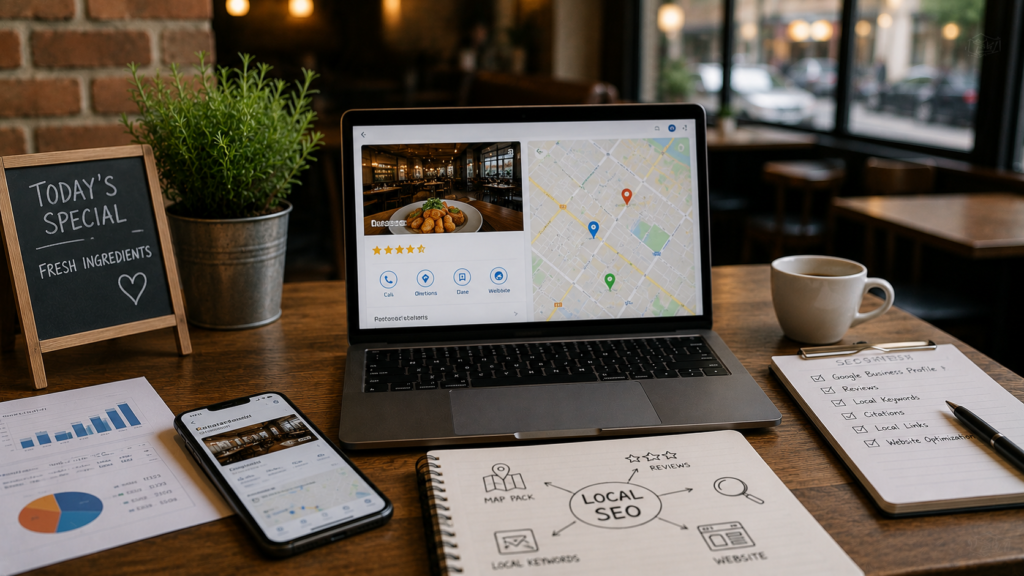
For restaurants, local seo google my business optimisation is the single most impactful starting point. Your Google Business Profile controls how your restaurant appears in the Map Pack, Google Maps, and local search results. A complete, active, and review-rich GBP consistently outperforms competitors with weak profiles.
According to Think With Google’s local search research, 84 percent of searches for restaurants happen on mobile devices. Mobile visibility through local seo is non-negotiable for food businesses in 2026.
Setting Up Google Business Profile for Restaurant Local SEO
Your Google Business Profile is the most powerful restaurant local seo tool available. A complete GBP drives more calls, direction requests, and reservations than any other local signal.
Complete these essential GBP elements for maximum restaurant local seo impact:
Business Name. Use your exact trading name without keyword additions. Google penalises keyword-stuffed business names in reviews and profile data.
Primary Category. Choose the most specific restaurant category available. Use “Indian Restaurant,” “Pizza Restaurant,” or “Coffee Shop” rather than the generic “Restaurant” category alone.
Secondary Categories. Add relevant secondary categories for each cuisine type or service you offer. This broadens the range of search queries your profile appears for.
Address and Phone Number. Use your exact physical address consistently across all platforms. Local seo citations consistency depends on this information matching exactly everywhere online.
Menu. Upload your full menu with descriptions and prices. Google displays menu information directly in search results for restaurants. This drives click-through rates significantly higher than profiles without menu information.
Photos. Upload at least 10 high-quality food photos immediately. Add 3 to 5 new food and interior photos every week consistently. Restaurants with more photos receive significantly more views than those with minimal visual content.
Posts. Create weekly GBP posts featuring daily specials, seasonal menus, upcoming events, and limited-time offers. Active posting signals a current and well-managed business.
Booking Integration. Enable online reservation functionality if you use a supported reservation system. Direct booking from Google reduces friction between search and customer acquisition.
Local SEO Keyword Research for Restaurants
Effective local seo for restaurants starts with understanding exactly how nearby diners search. Restaurant keyword research combines food types with geographic modifiers and intent signals.
Target these keyword categories for your restaurant local seo strategy:
Cuisine plus location keywords. Examples include “North Indian restaurant in Jaipur” and “Chinese food delivery in Malviya Nagar.” These high-intent searches represent diners actively choosing where to eat.
Occasion keywords. Examples include “birthday dinner restaurant Jaipur” and “anniversary dinner near Connaught Place.” Occasion keywords attract higher-value table bookings with larger group sizes.
Near me keywords. “Restaurant near me,” “biryani near me,” and “breakfast near me” drive enormous daily local traffic. Optimise your GBP and website for these queries with strong location signals.
Delivery keywords. “Pizza delivery in [neighbourhood]” and “food delivery near me” attract online order customers. Include delivery coverage areas on your website with location-specific landing pages.
Understanding keyword research for SEO principles helps you identify which specific keyword combinations your local competitors are ranking for but you are not yet targeting.
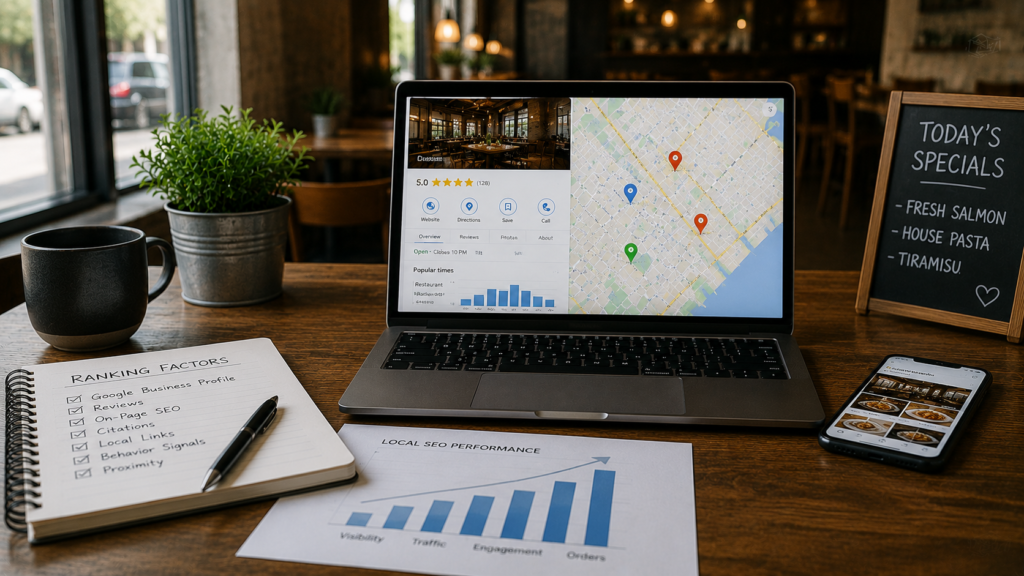
Local SEO Ranking Factors for Restaurants
Understanding local seo ranking factors specific to restaurants helps prioritise your optimisation efforts where impact is highest.
Review Volume and Quality
Customer reviews are the most powerful local seo ranking factor for restaurants. Restaurants with more reviews and higher average ratings consistently outrank lower-rated competitors. Google uses review signals to determine trustworthiness and relevance for food searches.
Develop a systematic review generation process:
- Ask for a Google review immediately after positive guest comments at the table.
- Place QR codes linking to your Google review page on table cards and receipts.
- Send WhatsApp follow-ups to delivery customers requesting reviews after completed orders.
- Train all service staff to mention Google reviews at the end of positive dining experiences.
Our guide on responding to reviews with AI in mind covers how to respond efficiently to all reviews at scale. Responding professionally to negative reviews is particularly important for restaurant reputation management.
NAP Consistency Across Local SEO Citations
Local seo citations are mentions of your restaurant’s Name, Address, and Phone number across the internet. Citation consistency across platforms is a direct local seo ranking factor. Inconsistent information confuses Google’s local algorithm and suppresses rankings.
Ensure your restaurant information matches exactly across:
- Google Business Profile is your primary citation source.
- Zomato and Swiggy for Indian food delivery platform citations.
- JustDial for local business directory presence.
- Tripadvisor for tourism and visitor searches in your area.
- Facebook Business Page for social platform citation consistency.
GBP Activity and Engagement
Active GBP management signals to Google that your restaurant is engaged and current. Inactive profiles consistently rank below those that post, update menus, and respond to reviews regularly.
Restaurant Local SEO Examples: Proven Strategies That Work
Real-world local seo examples demonstrate which strategies produce the most significant restaurant search improvement.
Example 1: Mumbai Street Food Restaurant. A Mumbai pani puri restaurant uploaded 30 food photos, added their complete menu with pricing, and implemented a WhatsApp review request system. Within six weeks their Map Pack position improved from unranked to position two for “pani puri near me” in their neighbourhood.
Example 2: Jaipur Fine Dining. A Jaipur fine dining restaurant created occasion-specific landing pages for anniversary dinners, birthday celebrations, and corporate events. They targeted keywords like “romantic dinner in Jaipur” and “private dining room Jaipur.” Their organic restaurant reservations from these pages increased by 60 percent in three months.
Example 3: Bangalore Breakfast Cafe. A Bangalore cafe added their full breakfast menu to Google Business Profile, responded to every review within 4 hours, and posted a photo of their daily specials every morning. Their GBP views doubled within two months of consistent daily posting activity.
These local seo examples show that consistent GBP activity combined with targeted review generation produces measurable results faster than most other local seo strategies.
Website Optimisation for Local SEO for Restaurants
Your restaurant website must reinforce the same local relevance signals as your GBP. Website optimisation is the second most important component of restaurant local seo after Google Business Profile management.
Create Location-Specific Pages
Create dedicated pages for every neighbourhood, area, or city you serve. A restaurant in Jaipur should have pages targeting searches like “restaurant in Malviya Nagar Jaipur” and “dinner in Civil Lines Jaipur.” Each page should include location keywords naturally throughout the content.
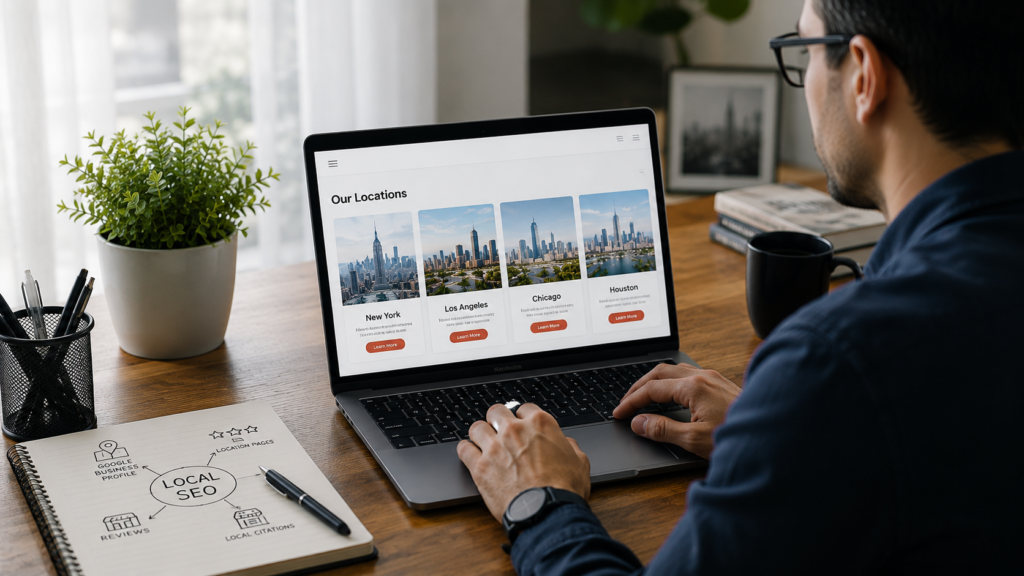
For restaurant chains operating multiple locations, our multi-location SEO guide covers the complete architecture for managing location-specific pages without duplicate content issues.
Optimise Your Menu Page
Your online menu is one of your highest-traffic website pages. Include cuisine keywords naturally in menu descriptions. Use the actual names customers search for. If you serve “Rajasthani Dal Baati,” include that exact phrase in your menu descriptions.
Applying keyword search volume research to menu item naming helps identify which dish names receive the most monthly searches. Use the most searched variations in your menu descriptions.
Implement Restaurant Schema Markup
Restaurant schema markup communicates your business details to Google in structured format. Implement these schema types for maximum local seo benefit:
- Restaurant schema with cuisine type, price range, and opening hours.
- Menu schema linking to your full menu with categories and items.
- Review schema displaying your star rating in search results.
Our schema markup complete guide covers Restaurant schema implementation with complete code examples applicable to any restaurant website.
Mobile Optimisation Is Critical
Nearly all restaurant searches happen on mobile devices. Your website must load in under three seconds on mobile connections. A slow mobile restaurant website loses customers at the search result before they ever visit.
Google’s mobile-first indexing uses your mobile site to determine all rankings. Our site speed optimisation guide covers every technical improvement that affects mobile loading performance and local rankings.
Social Media Integration with Restaurant Local SEO
Social media amplifies restaurant local seo by driving branded searches and building the online presence signals that Google’s algorithm values.
Instagram advertising for restaurants drives targeted local awareness among food lovers in your geographic area. Instagram food content generates high engagement rates that build brand search volume. Branded search volume is a local seo ranking factor.
Facebook advertising targeting local geographic audiences promotes your restaurant to diners who have not yet discovered you organically. Combining local Facebook ads with strong restaurant local seo creates a unified customer acquisition system.
WhatsApp marketing campaigns for restaurants drive repeat visits from existing customers. Send weekly menus, special offers, and event announcements directly to your customer database. SMS marketing services extend this reach to customers who prefer text over messaging apps.
Social media management ensures consistent posting frequency across Instagram, Facebook, and Google Business Profile. Consistency in social posting correlates with improved local search visibility.
Understanding your marketing funnel helps position social media as an awareness channel that feeds your restaurant local seo strategy. Social creates awareness; local seo captures diners when they search.
Local SEO Business Strategy for Restaurant Chains
Restaurant chains face unique local seo business challenges. Each location needs individual GBP management, location-specific website pages, and separate citation profiles. Managing these at scale requires systematic processes.

For franchise restaurant operations, our franchise SEO playbook covers how to scale local seo across multiple restaurant locations efficiently. The guide addresses centralised versus decentralised management models for franchise local seo.
Geo-targeted SEO strategies help restaurant chains capture local demand in every market they operate in. Each market has unique search patterns and competitor profiles requiring location-specific keyword research.
Measuring Restaurant Local SEO Performance
Tracking your restaurant local seo performance requires monitoring specific metrics connected to diner acquisition outcomes.
Track these key metrics monthly:
- Google Business Profile views, direction requests, phone calls, and website clicks from GBP.
- Local keyword ranking positions for your primary cuisine and location combinations.
- Review count growth and average star rating changes.
- Organic website sessions from local search traffic in Google Analytics.
- Reservation conversions from organic search compared to paid channels.
Connecting restaurant local seo data to analytics and reporting dashboards provides unified visibility across all marketing channels. This enables accurate attribution of reservations and orders to specific local seo activities.
Knowing how to know if your SEO is working gives restaurant owners and marketing managers the diagnostic framework needed to evaluate whether their local seo investment is delivering measurable results.
According to BrightLocal’s consumer review research, restaurants are among the most review-read business categories. 94 percent of diners read online reviews before choosing a restaurant. Reviews are the most leveraged local seo investment for any food business.
Frequently Asked Questions
Local seo for restaurants is the process of optimising your online presence to appear prominently when nearby diners search for food. It improves your Google Maps ranking, captures high-intent searches, and drives more walk-in customers and online orders.
Google Business Profile is the single most important element of restaurant local seo. It controls your Map Pack position, displays your menu and photos, and collects the reviews that influence both rankings and diner decision-making before they choose where to eat.
Ask every satisfied diner for a review immediately after a positive experience. Place QR code review cards on tables and receipts. Send WhatsApp follow-ups to delivery customers. Train all staff to mention Google reviews when guests express satisfaction about their experience.
Yes. Each restaurant location needs its own Google Business Profile, location-specific website page, and citation profile. Managing each location individually ensures proper local relevance signals for the specific area each location serves.
Most restaurants see measurable local seo improvements within four to eight weeks of consistent GBP optimisation and review generation. Competitive Map Pack positions typically require two to four months. Social media integration accelerates branded search growth alongside organic ranking improvements.
Conclusion
Local seo for restaurants is the most cost-effective customer acquisition strategy available to food businesses. Every nearby diner who searches for food is a potential customer. The restaurants appearing first in their search results capture the majority of this daily, high-intent traffic.
Start with your Google Business Profile. Complete it fully. Post daily specials, new photos, and updates weekly. Build a systematic review generation process that requests Google reviews from every satisfied diner. Optimise your website for local keywords with cuisine and location combinations.
Combine these restaurant local seo foundations with an active social media presence, a mobile-optimised website, and proper schema markup. The compounding effect of these activities consistently builds lasting local search dominance for restaurants that execute them with discipline.
For professional restaurant local seo support, explore our local SEO services or review our complete services overview.
According to SinglePlatform’s research on diner decision making, 81 percent of diners search online before visiting a restaurant for the first time. Restaurant local seo is the investment that ensures your business is what they find.
According to Search Engine Journal’s restaurant local SEO guide, restaurants that actively manage their GBP and generate consistent reviews grow their local search visibility faster than any competitor relying solely on organic website SEO.

About the author
Ujjwal Kumawat
I specialize in SEO, website development, Google Ads and online business growth strategies. Through my blogs, I share practical insights, marketing tips and proven strategies to help businesses improve their online visibility, generate more leads and grow faster in the digital space.