Is your Marketing Funnel attracting traffic but failing to convert customers before they ever make a purchase?
The problem is almost always a broken or incomplete marketing funnel. Every business has one, whether it was built deliberately or not. The question is whether yours is designed to convert, or leaking potential revenue at every stage.
This guide covers everything you need to know about the marketing funnel: what it is, how each stage works, which strategies belong where, and how to measure results at every level.
What Is a Marketing Funnel?
A marketing funnel is a model that describes the complete journey a potential customer takes from first discovering your brand to making a purchase and becoming a loyal advocate. It maps every stage of the relationship between a business and its customers, showing how broad awareness at the top narrows into a smaller group of paying customers at the bottom.
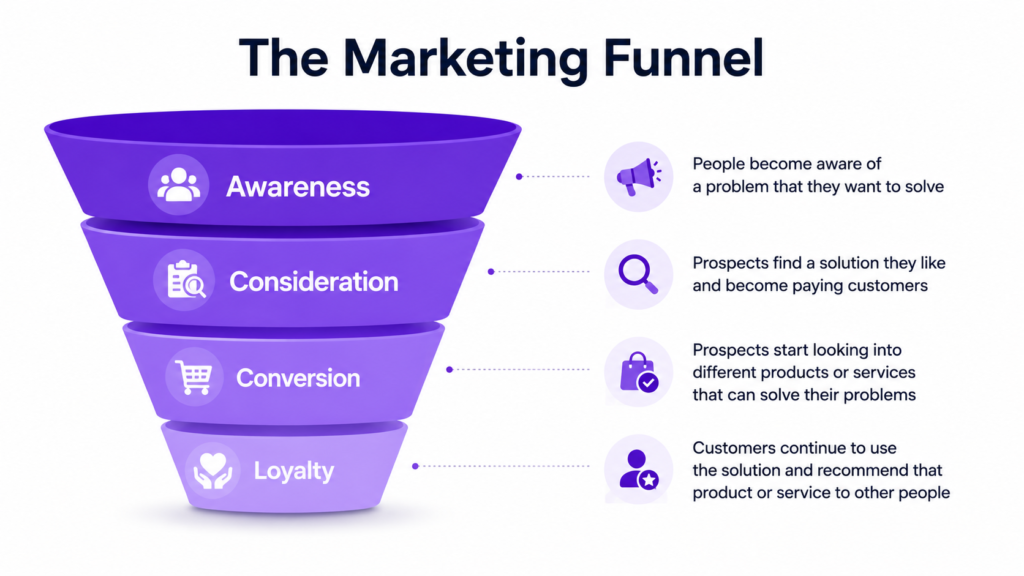
The funnel shape is deliberate. At the widest point, many people become aware of your brand. As they move through consideration and evaluation, some drop off. Only the most motivated and well-matched prospects reach the conversion stage and become customers. The goal of funnel marketing is to maximise how many of the right people make it through each stage.
Understanding what the marketing funnel is helps businesses stop guessing and start building structured, measurable strategies. Rather than throwing budget at random channels, every activity maps to a specific stage and a specific goal.
For any business running SEO services, paid advertising, or content marketing, the funnel is the strategic framework that ties every channel together into a coherent customer journey.
Why Marketing Funnels Matter
Marketing funnels matter because they reveal exactly where your customer journey breaks down. Without a funnel model, most businesses focus all their energy on awareness-level activity while neglecting the middle and bottom stages where customers actually decide to buy.
A well-structured marketing funnel:
Helps you understand your audience at each stage and deliver the right message at the right moment. A prospect who has just discovered your brand needs different content than someone comparing you against competitors.
Identifies leaks in your customer journey. If large numbers of people visit your website but very few sign up or enquire, your middle-of-funnel content is the problem. The funnel makes this visible.
Improves marketing efficiency. When every piece of content, every ad, and every email is assigned to a funnel stage, budget allocation becomes data-driven rather than intuitive.
Supports both lead generation and lead nurturing simultaneously. The top of the funnel attracts new leads. The middle nurtures them. The bottom converts them. A business investing only in awareness activity is essentially filling a leaking bucket.
The marketing funnel also connects naturally to your conversion rate optimisation strategy. Every improvement to your funnel, whether it is a better landing page, a stronger email sequence, or more compelling social proof, directly improves the percentage of visitors who become customers.
The Evolution of the Marketing Funnel and AIDA
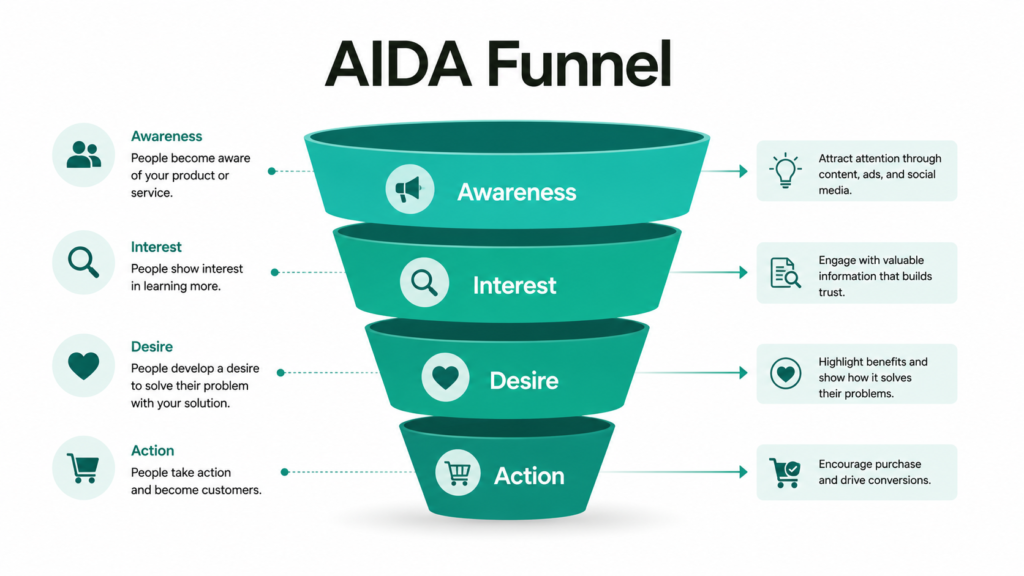
The marketing funnel concept originated in 1898 when advertising advocate E. St. Elmo Lewis created the AIDA model. Despite being over 125 years old, the core logic of AIDA still underpins every modern funnel framework.
Marketing Funnel AIDA breakdown:
Awareness is when a potential customer first learns your brand, product, or service exists. They may not yet know they need what you offer.
Interest is when they engage with your brand and begin exploring what you do. They subscribe, follow, browse, or consume content.
Desire is the evaluation and consideration phase where they compare options, read reviews, and decide whether you are the right solution for their specific need.
Action is the conversion moment. They purchase, sign up, or enquire. The decision has been made.
Modern funnel models extend AIDA by adding loyalty and advocacy stages after the initial purchase, reflecting the reality that retaining a customer is significantly more cost-effective than acquiring a new one. On average it costs a business five times more to acquire a new customer than to retain an existing one, which is why the post-purchase stages of the funnel deserve as much strategic attention as the acquisition stages.
Marketing Funnel Two Stages Explained
Most businesses work with a four-stage marketing funnel that maps directly to the customer decision journey.
Stage 1: Awareness (Top of Funnel)
At the awareness stage, your goal is simple: be found by the right people. Prospects at this stage may not know they have a problem your product solves, or may not know your brand exists. Your job is to introduce yourself through channels where your ideal customers already spend their time.
Content at this stage is educational and informative rather than promotional. Blog posts, social media content, YouTube videos, SEO-driven articles, and paid display advertising all serve an awareness function.
Stage 2: Consideration (Middle of Funnel)
At the consideration stage, prospects know they have a problem and are actively researching solutions. They are comparing options, reading reviews, watching product demonstrations, and evaluating which brand best meets their needs.
This is where trust-building content becomes critical. Case studies, comparison guides, webinars, detailed product pages, and customer testimonials all help prospects move from curiosity to confidence. Your email marketing sequences play a central role here, nurturing leads who have shown interest but are not yet ready to buy.
Marketing Funnel other Two Stages Explained
Stage 3: Conversion (Bottom of Funnel)
At the conversion stage, prospects are ready to make a decision. They need a final reason to choose you over competitors. Strong landing pages, clear calls to action, social proof, limited-time offers, and a frictionless purchase experience all directly affect your conversion rate.
This is also where Google Ads management and retargeting campaigns deliver their highest return, reaching prospects who have already visited your site or engaged with your content but have not yet converted.
Stage 4: Loyalty and Advocacy
Post-purchase, your goal shifts to retention and referral. Satisfied customers who receive great service and ongoing value become repeat buyers and brand advocates who refer new customers organically. Loyalty programs, regular communication, exceptional aftercare, and community-building all support this stage.
Types of Marketing Funnels
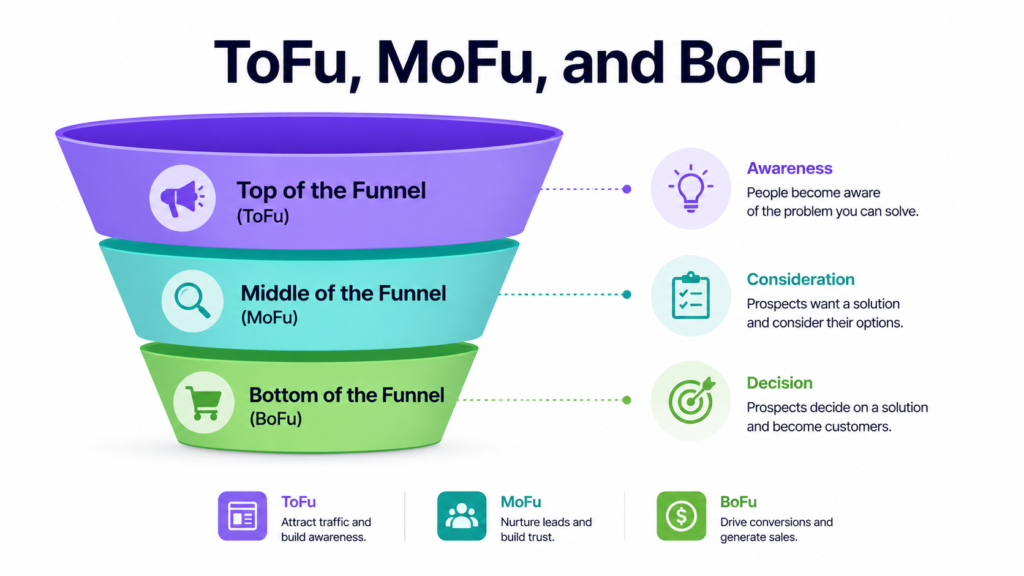
Basic Three-Stage Funnel (TOFU, MOFU, BOFU)
The simplest model divides the funnel into top of funnel (TOFU), middle of funnel (MOFU), and bottom of funnel (BOFU). This model works well for businesses getting started with funnel strategy because it is easy to assign content, campaigns, and budgets to each of the three clear zones.
AIDA Marketing Funnel
The classic AIDA model provides four stages aligned to the psychological journey of a buyer. It is particularly useful for planning marketing messages that shift a prospect through each emotional and rational step of the decision process.
Granular Five-Stage Funnel
More sophisticated businesses extend the funnel to five stages: Awareness, Consideration, Conversion, Loyalty, and Advocacy. This model is most appropriate for brands with complex buying cycles, high-value products, or strong community and referral components. It reflects the reality that the customer relationship should continue and deepen long after the first sale.
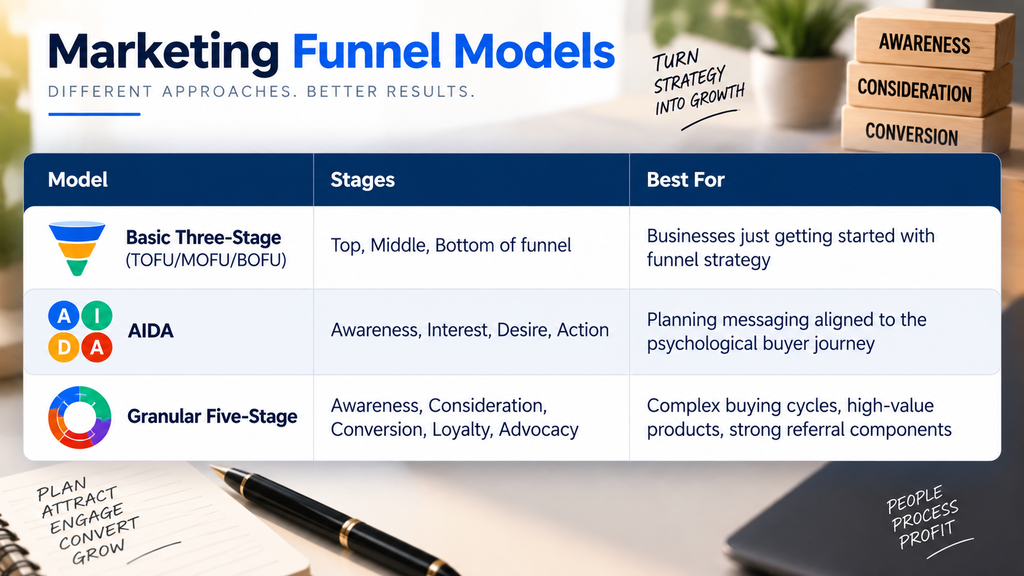
The right funnel model for your business depends on your sales cycle length, average order value, and the complexity of your customer decision journey.
Top of Funnel Strategies
Content marketing and SEO are the most sustainable top-of-funnel channels. By targeting informational keywords your prospects are searching for early in their journey, Solid keyword research at this stage ensures you’re targeting terms your prospects are actually searching, not just terms you assume they use. It attract relevant traffic from Google that has not yet heard of your brand. Increasingly, this discovery also happens without a click at all — through AI-generated answers in tools like Google’s AI Overviews, ChatGPT, and Perplexity. Structuring top-of-funnel content to be clearly quotable and well-sourced supports both traditional SEO and this emerging answer-engine visibility. For businesses with multiple locations or local audiences, local SEO services ensure your brand appears in the geographic searches most relevant to your prospects. It supports both traditional SEO and this emerging answer-engine visibility.
Social media marketing drives awareness through shareable content, brand storytelling, and community engagement. Platforms like Instagram, Facebook, and LinkedIn each serve different audience segments, making channel selection a function of where your ideal customer spends their time.
Paid awareness campaigns through Facebook advertising and display networks reach audiences who would not discover you organically, extending your reach to lookalike audiences modelled on your best existing customers.
Middle of Funnel Strategies
Email nurture sequences are the most effective middle-of-funnel tool for most businesses. Once a prospect has joined your list, a structured sequence of educational and trust-building emails moves them progressively closer to conversion.
Reviews and reputation management matter enormously at this stage. Prospects actively seek social proof before committing. Responding thoughtfully to reviews, as discussed in responding to reviews with AI in mind, helps build the trust that moves hesitant prospects forward.
Social media management keeps your brand present and responsive during the extended consideration periods that characterise higher-value purchases.
Bottom of Funnel Strategies
Landing pages optimised for conversion, clear calls to action, and reduced purchase friction are the priority at the bottom of the funnel. Running a funnel audit checklist helps identify specific points where qualified prospects are dropping off before completing a purchase.
Retargeting through search engine marketing re-engages people who visited your site without converting. These audiences have already shown intent and typically convert at significantly higher rates than cold traffic.
Urgency and scarcity messaging, testimonials from customers in similar situations to the prospect, and comparison content that positions your brand favourably against alternatives all support final conversion decisions.
Marketing Funnel for Lead Generation
The marketing funnel is the backbone of any effective lead generation strategy. At the top, lead generation means attracting relevant traffic through SEO, paid ads, and social media. In the middle, it means capturing contact information through lead magnets, gated content, and newsletter sign-ups. At the bottom, it means converting those captured leads into paying customers through targeted outreach, retargeting, and personalised offers.
WhatsApp marketing and SMS marketing services have become powerful mid-to-lower funnel lead nurturing channels, particularly for markets where messaging apps are the primary communication tool. Direct, personalised messages to warm leads convert at substantially higher rates than broad awareness campaigns.
For eCommerce businesses, marketing funnel lead generation connects directly to revenue. Every improvement in how the funnel captures and nurtures leads translates into measurable sales growth. Businesses running eCommerce PPC campaigns should map every ad group and campaign to a specific funnel stage to ensure budget is working across the full customer journey rather than concentrated only at the conversion level.
Digital Marketing Funnel: How Online Channels Fit In
The digital marketing funnel applies the traditional funnel model to online channels, where customer journeys are non-linear and data-rich. Unlike offline marketing, every digital channel generates measurable data that reveals exactly how prospects are moving through your funnel.
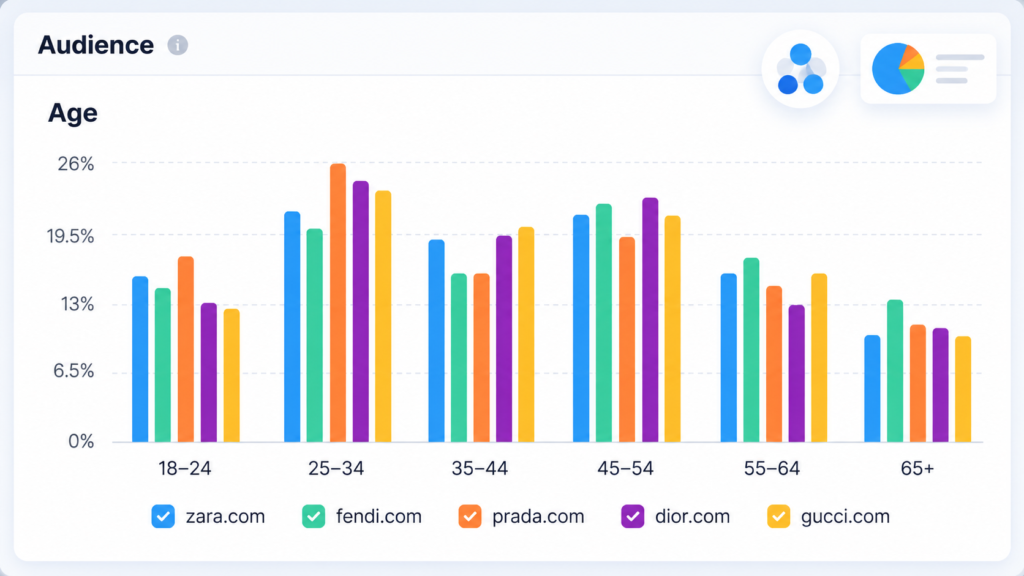
Key digital funnel characteristics:
Customers can enter the funnel at any stage. Someone who finds your brand through a Google search for a specific product review may already be at the consideration stage, bypassing awareness entirely. A prospect who clicks a retargeting ad may be moments from converting.
Multiple channels work simultaneously. A prospect might discover your brand through an Instagram post, read a blog article, join your email list, receive a nurture sequence, and then click a retargeting ad before finally purchasing. A strong digital marketing funnel coordinates all of these touchpoints rather than treating them as isolated activities.
Data enables continuous optimisation. Unlike traditional marketing where funnel performance was difficult to measure, digital channels provide real-time visibility into where prospects drop off, which content moves them forward, and which channels deliver the highest lifetime value customers.
Your data-driven marketing approach should assign specific KPIs to each funnel stage, track them consistently, and use the data to reallocate budget toward the highest-performing channels and content at each level.
An effective omnichannel marketing strategy ensures your brand delivers a consistent and coordinated experience across every digital touchpoint, regardless of which channel a prospect uses to engage with you.
The Marketing Funnel in the Age of AI Search
A growing share of research now happens inside AI assistants like ChatGPT, Gemini, and Perplexity, long before a prospect ever visits a brand’s website or social channels. This shifts top-of-funnel strategy beyond traditional SEO alone: businesses now need visibility inside AI-generated answers themselves, not just search engine results pages. Investing in answer engine optimization alongside AI SEO ensures your brand is discoverable at the exact moment prospects are forming their first impression, even before they click through to any single source.
Marketing Funnel Builder: How to Build Yours
Building a marketing funnel from scratch follows a clear process regardless of your industry or business size.
Step 1: Define your ideal customer at each stage. Different prospects need different messages at different stages. Create specific buyer personas for top-of-funnel, middle-of-funnel, and bottom-of-funnel audiences. Their questions, objections, and motivations differ significantly at each stage.
Step 2: Audit your existing content and campaigns. Map everything you currently produce to a funnel stage. Most businesses discover they have a disproportionate amount of awareness-level content and a significant gap in consideration-stage material.
Step 3: Build content and campaigns for every stage. Create or commission content that serves each stage specifically. Top-of-funnel content should be educational. Middle-of-funnel content should be comparative and trust-building. Bottom-of-funnel content should address final objections and make purchasing easy.
Step 4: Set up lead capture and nurturing. Every top-of-funnel tactic should connect to a mechanism for capturing lead information, whether it is an email opt-in, a free trial, a quote request, or a consultation booking.
Step 5: Implement tracking and measurement. Assign metrics to each funnel stage and track them consistently. Without measurement, funnel optimisation is impossible.
For businesses without the internal resources to build and manage a full-funnel strategy, working with a digital marketing agency that understands the complete funnel from awareness to loyalty delivers faster results than managing individual channels in isolation.
Marketing Funnel Examples
eCommerce brand funnel: A customer discovers the brand through an Instagram ad featuring a product that solves a specific problem (awareness). They visit the website, browse several product pages, and join the email list for a discount code (consideration). They receive a nurture email sequence featuring customer reviews and product demonstrations, then click a retargeting ad and complete a purchase (conversion). Post-purchase emails with care tips and a loyalty discount encourage a second purchase within 60 days (loyalty).
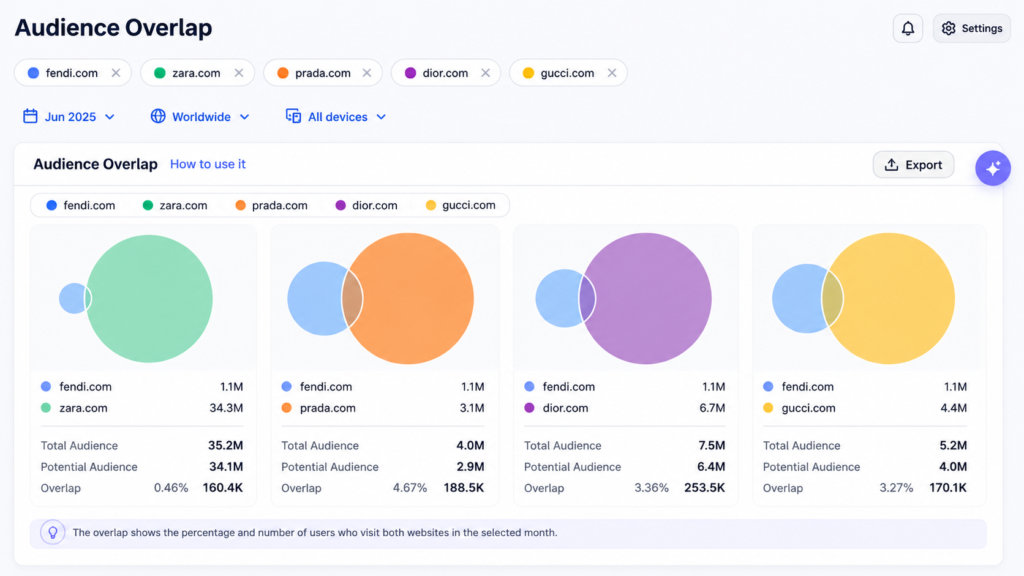
B2B software funnel: A prospect searches Google for a solution to a business problem and finds a detailed blog post (awareness). They download a related guide, joining the email list (consideration). They attend a webinar, request a product demo, and receive a personalised proposal (conversion). Ongoing account management, a customer community, and regular product updates build long-term retention and referrals (advocacy).
Local service business funnel: A local customer searches for a service near them and finds the business through Google Maps and organic search results (awareness). They read Google reviews and visit the website to review case studies and pricing (consideration). They book a consultation through the website contact form (conversion). Post-service follow-up emails and a referral incentive encourage reviews and word-of-mouth referrals (advocacy).
Marketing Funnel Metrics
Tracking the right metrics at each funnel stage reveals exactly where your funnel is performing and where it is leaking. For a full stage-by-stage breakdown of where funnels typically break down, our funnel audit checklist walks through the diagnostic process.
| Funnel Stage | Key Metrics |
|---|---|
| Top of Funnel | Organic traffic, impressions, reach, click-through rate, social media followers |
| Middle of Funnel | Email subscribers, time on page, bounce rate, review ratings, content downloads |
| Bottom of Funnel | Conversion rate, cost per acquisition, return on ad spend, revenue |
| Loyalty and Advocacy | Repeat purchase rate, customer lifetime value, referral rate, Net Promoter Score |
Connecting funnel metrics to your analytics and reporting dashboards gives you a real-time view of funnel health and flags problems before they become expensive. Regular reporting against these metrics is what separates businesses that improve their funnel continuously from those that run the same underperforming campaigns indefinitely.
Frequently Asked Questions
A strategy guiding potential customers through structured stages from brand awareness to purchase and loyalty using tactics tailored to each stage.
Awareness, consideration, conversion, and loyalty are the main stages; some models add advocacy, where satisfied customers recommend your brand.
A marketing funnel covers the full customer journey; a sales funnel focuses on lower stages where sales teams close prospects.
Look for disproportionate drop-offs between stages high traffic but low sign-ups, or high cart adds but low purchases signal specific leaks.
B2C decisions are faster and individual; B2B involves multiple stakeholders, longer evaluations, and needs more educational, trust-building mid-funnel content.
A good MQL-to-SQL conversion rate is typically 13–25%, with ~20% a solid benchmark, varying by industry and lead scoring accuracy.
AI search tools like ChatGPT and Google AI Overviews compress awareness and consideration into one step, reducing top-of-funnel website traffic.
Yesnprospects still move through awareness, consideration, and conversion; AI tools change how they discover and research options, not whether the underlying funnel stages exist.
External Resources
For further reading on marketing funnel strategy and measurement, these authoritative external resources provide additional depth:
Harvard Business Review: Branding in the Digital Age explores how the traditional purchase funnel has evolved in the digital era and why the post-purchase loyalty loop now matters as much as initial acquisition.
Think With Google: Micro-Moments explains how customer decision-making now happens in brief, intent-driven moments across multiple devices and channels, and what this means for funnel strategy.
Nielsen Norman Group: The Conversion Funnel provides a UX research perspective on how website design and user experience decisions affect customer movement through each stage of the funnel.
Conclusion
The marketing funnel is not a set-and-forget framework. It is a living model of your customer journey that should be continuously audited, measured, and improved. Businesses that treat their funnel as a strategic priority rather than a theoretical concept see compounding improvements across every metric from traffic and lead generation through to revenue and customer lifetime value.
Whether you are building your first funnel or optimising an existing one, the principles remain the same: attract the right people at the top, nurture them through the middle with trust-building content and communication, convert them with a compelling offer and frictionless experience, and retain them through exceptional post-purchase value.
Every channel you invest in, from social media advertising and paid search to content writing and email, should be mapped to a specific funnel stage with specific goals and measurable outcomes. That is what transforms marketing spend from a cost centre into a predictable revenue engine.

About the author
Ujjwal Kumawat
I specialize in SEO, website development, Google Ads and online business growth strategies. Through my blogs, I share practical insights, marketing tips and proven strategies to help businesses improve their online visibility, generate more leads and grow faster in the digital space.