What actually works when you need to increase domain authority without paying for low-quality links?
Many businesses understand that Domain Authority scores matter for competitive analysis but struggle to move their scores meaningfully over time. The challenge is that increase domain authority tactics that work require sustained, strategic effort across multiple interconnected disciplines simultaneously.
Quick fixes like link farms and directory spam do not produce lasting improvements and often trigger algorithm penalties that suppress rankings. This guide covers the proven, step-by-step approach to improving your domain authority score sustainably over a realistic timeframe.
What Domain Authority Score Measures and Why It Matters
Domain authority score is Moz’s proprietary prediction of how likely a website is to rank in search results. It calculates from one to one hundred on a logarithmic scale. The score considers the quantity and quality of unique referring domains, the authority those linking domains carry, and overall backlink profile diversity.
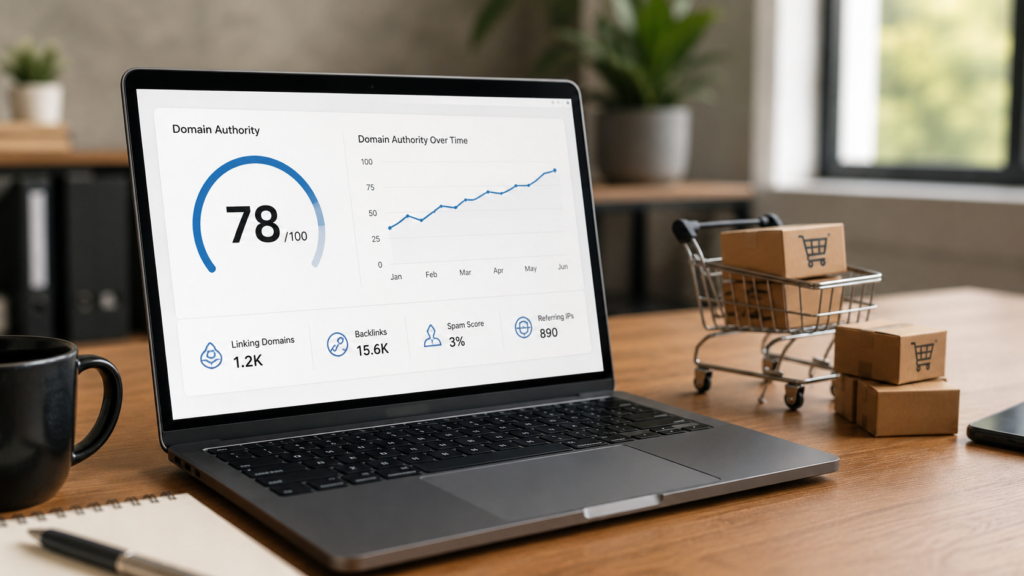
Understanding what the score measures clarifies why increase domain authority strategies must focus on earning quality external links from diverse, credible sources rather than gaming easy metrics. The logarithmic scale means improvements become progressively harder at higher score ranges, so realistic timelines depend significantly on where you currently start.
For businesses building digital marketing strategies, treating Domain Authority improvement as a twelve to twenty-four month programme rather than a quick fix produces the most realistic expectations and sustainable results consistently.
How to Improve Domain Authority Through Quality Link Building
Why Referring Domain Diversity Matters Most
The most direct answer to how to improve domain authority is consistently earning backlinks from new, unique referring domains with meaningful authority themselves. Five hundred links from fifty different domains is worth significantly less than five hundred links from five hundred different domains of comparable quality.
This diversity signal reflects genuine endorsement from multiple independent sources. When the same low authority site links to you fifty times, Moz’s algorithm recognises diminishing returns from each additional link beyond the first. Each new unique domain adds a fresh trust signal rather than amplifying existing ones.
Finding High Quality Link Acquisition Targets
How to boost domain authority effectively requires identifying the right targets before any outreach begins. Use Ahrefs or Semrush to identify which websites link to your competitors but not to you. These competitor backlink gaps reveal sites already willing to link to content in your niche and audience, making them warmer outreach prospects than cold contacts.
Filter these targets by domain authority and topical relevance. A DA 50 website in your exact industry produces more DA improvement than a DA 70 website in a completely unrelated niche. According to Moz’s Domain Authority improvement guide, topical relevance of the linking domain correlates more strongly with meaningful authority score improvement than raw domain authority alone in many competitive verticals.
Link Building Tactics That Actually Work
Guest posting on genuine editorial publications within your industry earns contextually relevant, dofollow backlinks from established audiences. Avoid low quality guest post farms that accept any content for a fee since these provide minimal DA benefit and risk manual penalties.

Backlink audit reviews of competitor profiles often reveal resource page opportunities where your content would genuinely fit as a recommended link. Resource pages actively curate the best content on specific topics, making them receptive to outreach from genuinely valuable, relevant content sources.
Creating Link-Worthy Content Assets
Why Content Quality Determines Link Acquisition Success
The most sustainable approach to increase domain authority is creating content so genuinely valuable that links accumulate naturally without active outreach. Original research, proprietary data, comprehensive tools, and expert guides all attract editorial backlinks from journalists, bloggers, and industry publications without requiring individual outreach for each link earned.
Content writing services focused on producing data rich, citable assets consistently outperform services producing high volume generic content for link acquisition purposes. Ten excellent pages that each earn five links apiece outperform one hundred mediocre pages that earn zero links each.
Types of Content That Earn Natural Links
Statistics and research pages collect links consistently because writers need data sources to cite when making claims in their own content. Creating original survey data, compiling verified industry statistics, or analysing proprietary dataset patterns gives journalists and bloggers citable material they genuinely need.
Free tools and calculators attract links because they provide ongoing utility that other websites want to point their audiences toward. A well-built free tool in your niche can earn hundreds of organic backlinks over years of continued availability without any additional outreach investment after the initial publication.
Comprehensive ultimate guides earn links because they save writers the effort of explaining foundational concepts in their own content. When your guide is the definitive resource on a topic, industry writers naturally link to it rather than reinventing coverage that already exists in superior form elsewhere.
How to Boost Domain Authority With Technical SEO
Why Technical Health Affects DA Improvement
Technical SEO issues do not directly calculate into Domain Authority scores. However, they indirectly suppress DA improvement by making your site less crawlable, less indexable, and less linkable overall. A site with broken pages, slow load times, and poor mobile experience earns fewer organic links than a technically excellent competitor would earn for the same content quality.

Technical seo audit checklist processes should address crawlability, indexability, and core web vitals before significant link building investment begins. Every link pointing to a 404 page represents wasted link equity that could be recovered through redirect implementation.
Fixing Broken Links and Redirect Chains
Run regular crawls with Screaming Frog or similar tools to identify internal broken links and redirect chains. A 301 redirect chain passing through multiple hops loses link equity at each step. Consolidating chains into single direct redirects ensures maximum link equity transfer from every backlink pointing to redirected URLs.
Site speed optimisation affects how likely visitors arriving through backlinks are to engage with your content and potentially link to it themselves. Pages loading slowly create poor first impressions that reduce engagement signals and reduce the probability that initial visitors develop into subsequent link sources.
Consolidating Authority Through Canonical Tags
Duplicate content across multiple URLs dilutes link equity that should concentrate on a single canonical page. Implementing canonical tags correctly signals to search engines which version of similar or identical content should receive link equity accumulation from all variations.
Mobile-first indexing compliance affects how effectively Google can crawl and index your content, which indirectly affects how readily it surfaces in searches that lead to natural link discovery. Content that does not index properly for mobile cannot be discovered and linked to by mobile-first researchers and writers.
Domain Authority History: Tracking Progress Over Time
Why Tracking History Matters for Strategy
Monitoring domain authority history over time reveals whether your link building efforts are producing measurable score improvements and at what pace. Without historical tracking, you cannot distinguish periods of effective strategy from periods where effort produced no measurable improvement whatsoever.
Moz’s Link Explorer and Moz Pro both provide historical DA tracking. Ahrefs tracks Domain Rating history over time in its Site Explorer tool. Most serious SEO practitioners track their authority score monthly rather than weekly since meaningful changes occur over months rather than days.
Interpreting Score Fluctuations Correctly
Not every DA score drop indicates a problem with your own link building approach. Moz periodically recalibrates its algorithm, causing scores across all domains to shift simultaneously. These recalibrations often cause score drops or jumps that do not reflect actual changes in your link profile specifically.

How to know if your seo is working for authority building means tracking the trend over three to six month periods rather than reacting to individual monthly fluctuations. A consistent upward trend over twelve months confirms effective strategy even when individual months show temporary dips.
Get Domain Authority Improvements Through Digital PR
What Digital PR Contributes to DA Growth
Digital PR earns coverage and backlinks from national publications, industry trades, and established blogs through newsworthy story angles, expert commentary, and original research. These earned media placements consistently produce the high authority editorial backlinks that move DA scores most meaningfully.
Get domain authority improvements from digital PR faster than most other tactics because publications like national newspapers, industry magazines, and major blogs carry extremely high domain authority themselves. One placement in a DA 80 publication can contribute more to your score than fifty links from DA 20 sources.
HARO and Expert Commentary Platforms
HARO, Help a Reporter Out, connects journalists seeking expert sources with potential sources willing to provide commentary. Responding consistently to relevant journalist queries earns expert quote placements in authoritative publications with editorial backlinks included.
According to Ahrefs’s Domain Rating improvement research, websites earning regular placements in high authority publications through HARO and similar platforms consistently show faster authority score improvement than those relying solely on proactive link outreach. According to Semrush’s domain authority improvement research, diversifying your link acquisition tactics across digital PR, content assets, and broken link building produces more consistent monthly DA growth than any single tactic alone.
Internal Linking Strategies That Distribute Authority
How Internal Links Amplify External Authority
Every external backlink pointing to your domain contributes to your overall Domain Authority. But how that authority distributes across your pages depends significantly on your internal linking architecture. Technical seo for website performance includes ensuring authority earned through external backlinks reaches pages throughout your site rather than pooling only in directly linked entry pages.
Pages receiving strong external backlinks should connect to other important pages through clear internal links. This distribution spreads authority from your strongest pages throughout the site, improving the page-level authority of pages that improve your overall domain strength collectively.
Auditing Your Internal Link Structure
Content audit processes should evaluate internal linking coverage alongside content quality during regular reviews. Identify high value pages with strong topical relevance that receive few internal links from your most authoritative pages. These represent internal link opportunities that improve DA distribution without any external link acquisition required.

For ecommerce sites, ecommerce seo internal linking ensures category pages distribute authority toward product pages systematically. Category pages typically attract the strongest external links, making them the primary internal authority sources that can strengthen individual product page authority significantly.
Monitoring and Protecting Your Domain Authority Score
Regular Backlink Audits Protect Your Progress
DA improvements built over months can be suppressed by toxic backlink accumulation from spam sites. Regular backlink audit monitoring identifies low quality or suspicious links that warrant disavow consideration before they drag down your overall profile quality evaluation.
Schedule comprehensive backlink audits quarterly at minimum. Monthly monitoring of newly detected links through tools like Ahrefs Link Intersect or Semrush Backlink Audit catches potentially harmful links quickly, allowing disavow file updates before extended exposure creates measurable score deterioration.
Recovering Lost Links
Strong links can be lost when linking pages remove content, change URLs, or shut down entirely. Monitoring for lost backlinks through backlink audit tools enables recovery attempts through outreach to site owners requesting link restoration or identification of alternative pages on the same domain to redirect the lost link toward.
Analytics reporting dashboards should include DA trend tracking alongside organic traffic and ranking position data. Connecting these signals reveals whether authority improvements translate into the ranking and traffic improvements that justify your link building investment strategically.
As Search Engine Land’s domain authority improvement guide confirms, combining proactive link acquisition with defensive link monitoring consistently produces stronger long-term DA trajectory than acquisition alone without protective maintenance practices in place throughout the programme.
Frequently Asked Questions
The fastest ethical approach to increase domain authority for new websites is publishing original research or data that journalists cite, earning guest posts on high authority industry publications, and building genuine relationships with bloggers and writers who naturally link to strong content.
To improve domain authority from below 20, focus on earning backlinks from new unique referring domains rather than multiple links from single sources. Target relevant industry blogs, resource pages, and local business directories that provide genuine topical authority signals at lower competition levels.
A good domain authority score is relative to your direct competitors rather than an absolute benchmark. Research the DA of websites currently ranking for your target keywords. Your goal is matching or exceeding competitor authority scores rather than reaching any specific absolute number independent of context.
Technical fixes and internal linking improve authority distribution but cannot substitute for genuine external backlinks in improving domain authority scores. DA is fundamentally a link based metric. Technical improvements support and amplify link building results but cannot replace external link acquisition as the primary improvement mechanism.
Most websites see measurable domain authority score improvements within six to twelve months of consistent quality link building. Moving from DA 10 to DA 30 might take six to eighteen months. Higher score ranges from DA 40 to DA 60 typically require sustained effort over several years.
Conclusion
To genuinely increase domain authority requires a systematic, multi-tactic approach combining quality link acquisition, citation-worthy content assets, technical SEO health, and consistent monitoring across the full programme. There are no reliable shortcuts that produce lasting improvements without these foundational elements working together.
Track your domain authority score monthly, audit your backlink profile quarterly, and invest in creating the kind of content that earns links naturally rather than requiring manual outreach for every individual link. The compounding effect of consistent, ethical authority building produces the most durable ranking improvements available through any SEO investment.
For businesses wanting professional support implementing a complete authority building programme alongside full SEO strategy, explore our seo services or read our complete backlink audit guide to start evaluating and improving your domain authority profile systematically today.

About the author
Ujjwal Kumawat
I specialize in SEO, website development, Google Ads and online business growth strategies. Through my blogs, I share practical insights, marketing tips and proven strategies to help businesses improve their online visibility, generate more leads and grow faster in the digital space.