
Quick answer: An anchor text generator suggests or builds link text and HTML anchor code for your links. Use it to create varied, natural anchors and to audit existing ones. Keep anchors descriptive and relevant, mix branded, generic and topical text, and avoid over-optimised exact-match anchors.
Are you using the right anchor text generator to create link text that actually improves your SEO?
Most SEOs focus intensely on which pages to link to and from, but underestimate how much the visible link text affects both click behaviour and search engine interpretation. Using the wrong anchor text pattern across hundreds of internal or external links can suppress rankings despite technically correct link structure.
This guide explains what an anchor text generator does, how to use bulk and checker tools effectively, the proper HTML structure for link text, and how to build a natural anchor text profile that supports rather than hinders your SEO.
What Is an Anchor Text Generator?
An anchor text generator is a tool that creates ready-to-use HTML hyperlink code from a given URL and desired link text. You provide the destination URL and the visible text you want users and search engines to see. The tool outputs the formatted HTML anchor tag ready for pasting into your content.

Anchor text generator tools save time when creating large volumes of links manually. They eliminate syntax errors like missing quotation marks or incorrectly closed tags that would break link functionality in published content. For teams managing hundreds of internal links across large websites, bulk generation capability becomes particularly valuable.
For businesses building digital marketing strategies, understanding anchor text at both the strategic and technical level ensures that link building investment produces the intended SEO outcomes rather than unintended algorithmic penalties.
Why Anchor Text Matters for SEO
The Relevance Signal Anchor Text Sends
Anchor text communicates topical relevance to search engines. When a high authority website links to your page using “best ecommerce platform” as the visible link text, search engines interpret that as a relevance signal for that specific phrase. This helps search engines understand what your linked page is about and for which queries it should rank.
This relevance signal is powerful but also risky when manipulated. Over-optimising anchor text by repeatedly using exact-match keywords across many external links to the same page triggers Google’s Penguin filter. The algorithm penalises manipulative anchor text patterns that appear to engineer relevance rather than earn it naturally.
What Happens When Anchor Text Goes Wrong
According to Ahrefs’s anchor text research, websites penalised for over-optimised anchor text consistently show highly concentrated exact-match anchor profiles rather than the diverse, natural distributions that characterise genuine editorial linking. Recovery from these penalties requires disavow file submission and link profile remediation that can take months to take full effect.
Backlink audit processes should always include anchor text distribution analysis alongside domain authority and spam score evaluation. An otherwise high-quality link profile can still carry risk if anchor text patterns appear manipulated across significant portions of the referring links.
Using a Bulk Anchor Text Generator Effectively
When Bulk Generation Makes Sense
A bulk anchor text generator produces many formatted anchor tags simultaneously from a list of URLs and corresponding link text values. This becomes practically necessary for teams managing large-scale content production, internal link audits requiring mass updates, or link building outreach campaigns requiring unique anchor text variations for each prospect.
Bulk generators accept input as spreadsheet data or CSV files, process the URL and text pairs, and return formatted HTML for every row simultaneously. This reduces minutes of manual HTML writing per link to seconds of batch processing across an entire link list.
Maintaining Variation in Bulk Anchor Text
The most important rule when using any bulk anchor text generator is building genuine variation into your anchor text patterns before generation begins. Create multiple distinct text formulations for the same target page covering branded phrases, partial match variants, generic phrases, and exact-match terms in appropriate proportions.

Keyword research for seo data helps identify which anchor text variants carry meaningful search intent signals worth incorporating across your link building efforts. Balance these keyword-informed anchors with branded mentions and natural language phrases that reflect how genuine editorial writers would naturally reference your content.
Anchor Text Checker Tools and What They Reveal
What an Anchor Text Checker Analyses
An anchor text checker evaluates the distribution of anchor text across either your internal link structure or your external backlink profile. It reveals what percentage of links use exact-match keywords, partial match phrases, branded terms, generic anchors, and bare URLs respectively.
This distribution analysis identifies both risk and opportunity. A profile dominated by exact-match commercial keywords signals manipulation risk. A profile dominated entirely by bare URLs and generic “click here” anchors suggests missed relevance signals that more descriptive anchor text would have provided without any penalty risk.
Tools That Provide Anchor Text Analysis
Ahrefs Site Explorer provides detailed anchor text distribution reports for any domain’s backlink profile. Semrush Backlink Audit includes anchor text analysis as part of its toxic link detection workflow. Moz Link Explorer shows anchor text data alongside domain authority and spam score metrics for a complete backlink evaluation picture.
For internal linking specifically, Screaming Frog’s SEO Spider crawls your site and reports anchor text used across every internal link simultaneously. This internal anchor text checker capability helps identify pages receiving over-optimised internal anchor text that should be varied to avoid cannibalisation signals.
Link Text Generator: Creating HTML Anchor Code
The Basic HTML Anchor Structure
A link text generator outputs standard HTML anchor tag syntax. Understanding this syntax independently helps you verify that generated code is correct before pasting into published content. The basic anchor tag structure contains four key components working together.
The opening anchor tag begins with the letter a inside angle brackets. The href attribute defines the destination URL in quotation marks. The visible link text appears between the opening and closing anchor tags. The closing anchor tag mirrors the opening tag but adds a forward slash before the a.
Attributes Beyond Basic Link Text HTML
Link text HTML supports several additional attributes that affect link behaviour and SEO. The target attribute controls whether the destination opens in the same tab or a new window. The rel attribute specifies the relationship between the linking page and destination, including nofollow, sponsored, and ugc values that affect PageRank transfer and link policy compliance.

The title attribute adds hover text that appears when users pause over the link. While title attributes provide some additional context for screen readers and accessibility purposes, they carry minimal direct SEO value beyond the foundational anchor text and href attributes.
Generating Link Text HTML for Different Contexts
External links to high authority reference sources typically use descriptive anchor text that matches the referenced content accurately. Internal links between your own pages benefit from keyword-informed anchor text that reinforces topical relevance without exact-match overuse. Paid or sponsored links require the rel=”sponsored” attribute regardless of anchor text content.
Content writing services should include anchor text guidelines within their production briefs to ensure writers create appropriate link text throughout the content they produce. Ad hoc anchor text decisions by individual writers produce inconsistent patterns across large content programmes.
Link Text HTML: Writing Correct Anchor Tag Syntax
Common HTML Errors to Avoid
Several common coding errors occur when creating link text HTML manually without a generator. Missing quotation marks around URLs cause browsers to interpret the link incorrectly. Unclosed anchor tags cause all subsequent text on the page to become part of the same hyperlink. Incorrect URL formatting including spaces or special characters breaks link functionality.
A link text generator eliminates these syntax errors by constructing properly formatted code from validated inputs. This makes generators particularly valuable for non-technical content teams who need to create links without relying on web developer assistance for every link insertion.
Relative Versus Absolute URLs in Anchor Code
Internal links can use either relative or absolute URL formats. Relative URLs specify only the path portion of the URL without the domain. Absolute URLs include the full domain and path. For most CMS platforms, relative URLs are preferred for internal links as they prevent potential canonical tag issues when content is previewed or accessed from staging environments.
Mobile-first indexing compliance does not directly affect link syntax requirements, but ensuring all linked pages load correctly on mobile devices remains essential since broken mobile experiences affect the value of links pointing to those pages regardless of correct HTML structure.
Text Anchor SVG: Linking Images and Graphics
How Text Anchor SVG Differs From Standard HTML Links
Text anchor SVG linking works differently from standard HTML anchor tags. SVG uses its own anchor element within SVG markup to create clickable regions that link to URLs. Unlike HTML where text and images link using the same anchor tag structure, SVG anchors wrap graphical elements and text within the SVG coordinate system specifically.
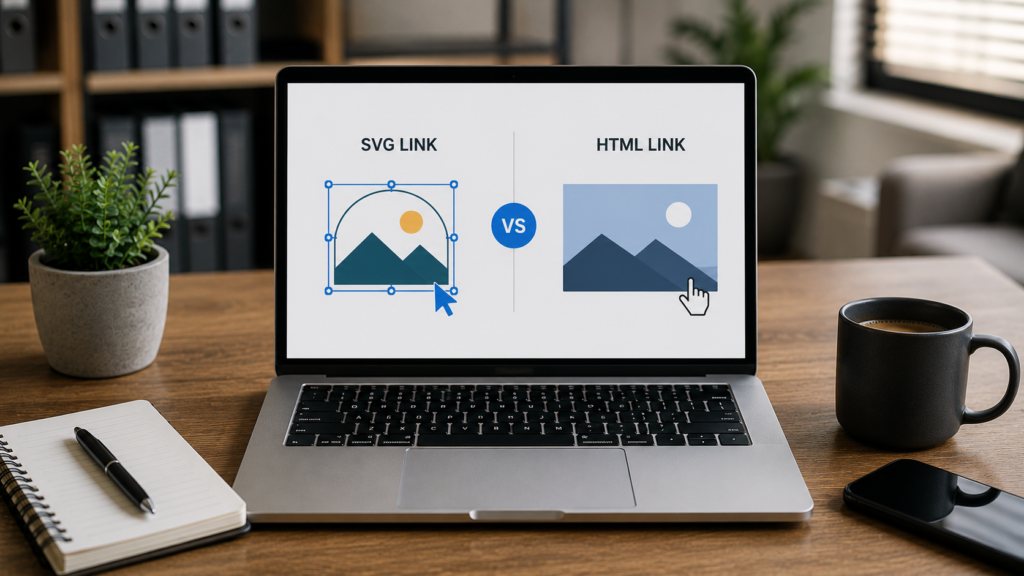
SVG text anchors are commonly used for interactive diagrams, data visualisations, and icon-based navigation elements where the visual element itself needs to be a functional hyperlink. Search engines can generally read and follow SVG links, though implementation varies between crawlers more than standard HTML links.
Accessibility Considerations for Graphic Links
When linking images, icons, or SVG elements without visible text, always provide descriptive alternative text through the alt attribute for image links or aria-label attributes for SVG links. These text alternatives communicate the link destination to screen readers and provide search engines with anchor-equivalent context for non-text links.
Alt text on images functions as the effective anchor text for image links in search engine interpretation. Optimising image alt text alongside standard anchor text ensures that links through images contribute meaningfully to your relevance signals rather than appearing as empty or generic connections.
Natural Anchor Text Profiles That Avoid Penalties
The Distribution Pattern of Natural Link Profiles
According to Moz’s anchor text analysis guide, natural external link profiles typically distribute anchor text with branded mentions forming the largest category, followed by partial match phrases, bare URLs, generic anchors, and exact-match keyword anchors forming a relatively small minority.
This distribution reflects genuine editorial behaviour. Most writers who link to external content describe the source in natural language or use the brand name rather than crafting keyword-optimised anchor text. Anchor profiles that reverse this natural distribution toward exact-match keyword dominance consistently draw algorithmic scrutiny.
Monitoring Your Anchor Text Profile Over Time
Regular backlink audit monitoring should track anchor text distribution changes over time alongside total referring domain counts. A sudden increase in exact-match keyword anchors from low quality sites often indicates negative SEO attacks or inappropriate link scheme participation that requires prompt disavow action.
How to know if your seo is working includes monitoring anchor text health alongside ranking and traffic trends. Deteriorating anchor text profiles often precede ranking drops by several weeks, meaning early detection through regular monitoring allows correction before significant traffic impact occurs.
Anchor Text Strategy for Internal Linking
Why Internal Anchor Text Strategy Matters
Internal links spread authority throughout your site while also sending topical relevance signals between connected pages. Using descriptive, keyword-informed anchor text in internal links helps search engines understand the relationship between your pages more precisely than generic “read more” or “click here” text provides.

Technical seo audit checklist processes should evaluate internal anchor text distribution as part of site architecture review. Pages receiving many internal links with identical exact-match anchor text can trigger keyword cannibalisation signals between multiple pages targeting the same topic.
Building an Internal Linking Map With Varied Anchor Text
Create a systematic internal linking map before auditing existing anchor text patterns. Define which pages should receive internal authority through prioritised linking and what anchor text variations each target page should receive across its inbound internal links.
For ecommerce sites managing hundreds of product and category pages, ecommerce seo internal linking strategy at scale benefits significantly from bulk anchor text generator capability. Maintaining variation across hundreds of links while ensuring keyword relevance throughout requires systematic planning rather than ad hoc individual link text decisions.
According to Semrush’s internal linking research, pages receiving internal links with descriptive, varied anchor text consistently achieve stronger ranking positions than equivalent pages receiving generic or identically repetitive internal anchor text patterns across all inbound links. As Search Engine Land’s anchor text SEO guide confirms, anchor text diversity remains one of the most reliable signals of genuine, editorially earned link profiles regardless of whether links are internal or external.
For businesses wanting professional support implementing anchor text strategy alongside a complete SEO programme, our seo services cover everything from technical audit and internal linking architecture through to content production and authority building systematically.
Frequently Asked Questions
An anchor text generator creates correctly formatted HTML hyperlink code from a URL and desired link text. Use it when creating many links simultaneously, managing bulk outreach campaigns, or ensuring consistent syntax across large content production teams without relying on manual HTML writing.
A bulk anchor text generator accepts spreadsheet or CSV inputs containing URL and anchor text pairs. It processes each row simultaneously and returns formatted HTML anchor tags for all entries. This reduces minutes of manual HTML work to seconds of batch processing across entire link lists.
An anchor text checker should reveal your full distribution across exact-match keyword anchors, partial match phrases, branded mentions, generic text, and bare URLs. Natural profiles show branded and generic anchors dominating with a small percentage of keyword anchors, indicating editorially earned rather than manipulated links.
The basic anchor tag uses opening and closing anchor tags with the href attribute containing the URL in quotation marks and visible link text between the tags. A link text generator eliminates syntax errors automatically. Always verify generated code includes properly closed tags and correctly formatted URL attributes.
Text anchor SVG uses SVG markup anchor elements to create clickable links on graphical elements within SVG images and diagrams. Unlike standard HTML links, SVG anchors wrap graphical elements within the SVG coordinate system. Always include aria-label attributes on SVG links to provide search engines and screen readers accessible link descriptions.
Conclusion
Using the right anchor text generator and checker tools transforms link text from an afterthought into a strategic SEO asset. Generate properly formatted link text HTML efficiently, audit your distribution through an anchor text checker regularly, and maintain the natural variation that protects your profile from algorithmic scrutiny.
Apply the same discipline to internal linking that you bring to external link building. Varied, descriptive anchor text throughout your site architecture builds the topical relevance signals that help search engines understand your content relationships accurately.
For businesses wanting professional support connecting anchor text strategy to a complete SEO programme, explore our seo services or read our backlink audit guide to evaluate and improve your current link profile today.

About the author
Ujjwal Kumawat
I specialize in SEO, website development, Google Ads and online business growth strategies. Through my blogs, I share practical insights, marketing tips and proven strategies to help businesses improve their online visibility, generate more leads and grow faster in the digital space.