Do you know how anchor text actually influences your Google rankings every day?
Anchor text is the clickable, visible text inside a hyperlink that connects one page to another. It tells both users and search engines what the destination page is about. Getting that right in seo strengthens your internal linking, improves backlink relevance, and protects you from algorithmic penalties.
This guide covers that meaning, every type, best practices, and common mistakes. For brands building digital marketing strategies, this strategy is a foundational element of both on-page and off-page SEO performance.
What Is Anchor Text
This is the direct answer most readers want immediately here. It is the visible, clickable words inside a hyperlink. It is the text a reader sees and clicks rather than the raw URL.

According to Google’s official guidance on links and anchor text, it helps Google understand the topic of the page being linked to. Descriptive this gives Google clearer relevance signals than generic text like “click here.”
The HTML behind it looks like this:
html
<a href="https://www.example.com/seo-guide/">complete SEO guide</a>
The phrase “complete SEO guide” is the anchor text. The href value is the destination URL.
Anchor Text Meaning: How It Works in SEO
Understanding anchor text meaning in context helps you apply it more strategically.
When a page links to another page using descriptive it, search engines read that text as a relevance signal. A link with the it “backlink strategies” tells Google the destination page covers backlink strategies specifically. This signal accumulates across all links pointing to a page.
According to Moz’s anchor text SEO guide, it is one of the most important off-page ranking factors Google evaluates. A well optimised this profile strengthens topical authority across your entire domain.
Our keyword research guide explains how target keyword research informs smarter that selection for internal and external links.
Types of Anchor Text in SEO
There are seven distinct types of anchor text in seo, each carrying different signals.
Exact Match Anchor Text
Exact match anchor text uses the precise keyword you want the destination page to rank for. A link with the text “ecommerce SEO” pointing to an ecommerce SEO page is an exact match.
This type sends the strongest keyword relevance signal. However, overusing exact match that in backlinks can trigger Google’s over-optimisation penalties. Use it sparingly in external link building while applying it more freely in internal links.
Partial Match Anchor Text
Partial match that includes the target keyword alongside other words. “Best strategies for ecommerce SEO in 2026” is a partial match for an ecommerce SEO page.
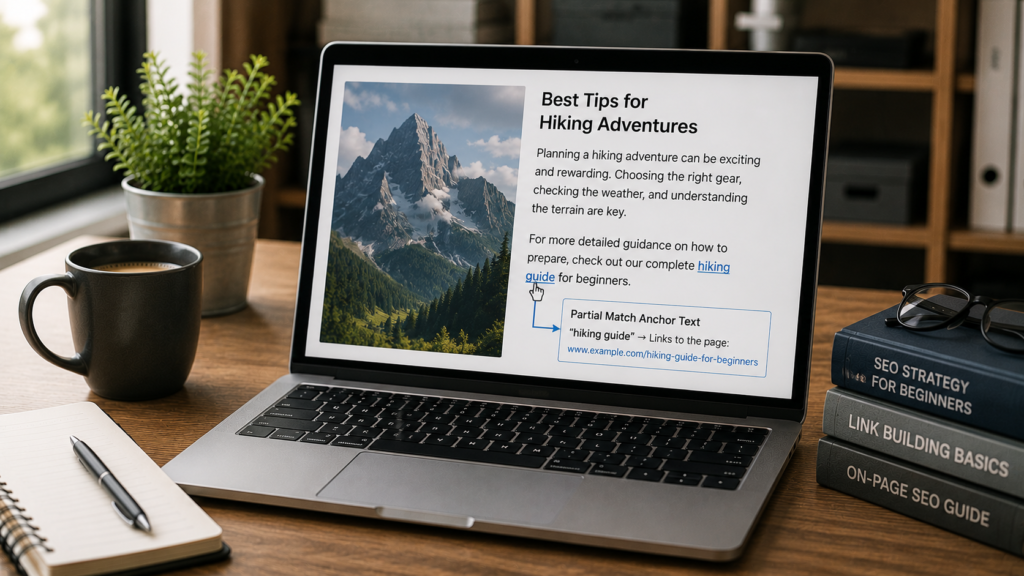
This type looks more natural than exact match. It still sends clear keyword relevance signals while avoiding the unnatural patterns Google penalises in manipulative backlink schemes.
Branded Anchor Text
Branded anchor text uses your company or brand name as the clickable text. “Adclickr SEO services” linking to your homepage is a branded anchor example.
Branded anchors are the safest type for external link building. They build brand authority without triggering keyword stuffing penalties. A healthy backlink profile includes a significant proportion of branded anchor text.
Naked URL Anchor Text
Naked URL anchor text shows the URL itself as the clickable element. “https://example.com/seo-guide/” used as visible link text is a naked URL anchor.
This type appears naturally in citations, forum posts, and some editorial contexts. It carries no direct keyword signal but contributes to domain authority normally.
Generic Anchor Text
Generic anchor text uses non-descriptive phrases like “click here,” “read more,” “visit website,” or “learn more.” This type tells search engines nothing about the destination page topic.
Avoid using generic this in your internal linking strategy. It wastes an opportunity to send relevance signals to pages you want to rank. Users also find descriptive anchor text more helpful for navigation.
Image Anchor Text
When a linked image carries an alt attribute, that alt text functions as the anchor text for the link. Applying alt text on image elements that describe the destination page improves the SEO value of image links.
Our image alt text implementation guide covers how to write alt text that serves both accessibility and SEO simultaneously.
LSI and Related Keyword Anchor Text
LSI anchor text uses semantically related terms rather than exact keyword phrases. Linking to your ecommerce SEO page with the anchor text “product page optimisation” is an LSI anchor example.

This type builds topical relevance naturally. It mimics how real editorial links appear across the web and reduces the appearance of manipulative linking patterns.
How Anchor Text Affects Google Rankings
Anchor text in seo affects rankings through two primary mechanisms working together.
Relevance signalling. Every link with descriptive is votes for what the destination page is about. A page receiving many links with similar anchor text builds strong topical authority for that topic. Google uses this accumulated signal when determining which pages deserve to rank for specific queries.
Anchor text distribution. Google evaluates the overall pattern of this pointing to a domain or page. According to Ahrefs’s anchor text analysis guide, a natural anchor text profile contains a mix of branded, partial match, naked URL, and generic anchors alongside occasional exact match links.
An unnaturally over-optimised profile dominated by exact match anchors raises algorithmic red flags. Google’s Penguin algorithm update specifically targets manipulative that patterns.
Our backlink audit guide explains how to review and clean up an anchor text profile that may have been harmed by past link building practices.
SEO Anchor Text Best Practices
Follow these best practices to build relevance signals safely and effectively.
Use descriptive text that reflects the destination page. Every internal link is an opportunity to tell Google what a page covers. Descriptive these anchor text performs this function far better than generic alternatives.
Vary your profile for external links. No natural editorial linking pattern uses the same exact keyword repeatedly across all links. Mix branded, partial match, and related term anchors throughout your external link building.
Prioritise exact match for internal links more freely. Internal links do not trigger the same over-optimisation penalties as external links. Using precise keywords in internal anchor text is standard best practice for site-wide SEO.
Match anchor text to user intent. Good anchor text also helps users understand where a link will take them before clicking. This improves user experience alongside search relevance signals.

Avoid keyword stuffing in anchor text. Cramming multiple keywords into a single these phrase looks unnatural. Keep that concise and relevant to the single most important topic of the destination.
According to Semrush’s anchor text best practices guide, descriptive internal anchor text consistently improves crawl efficiency and page discovery alongside relevance signalling.
Our content audit guide includes reviewing internal those patterns as part of a comprehensive site-wide link optimisation audit.
Anchor Text Link Building: External Links
Anchor text strategy for external link building requires different thinking than internal linking.
Natural editorial links from quality websites rarely use keyword-perfect for those. A journalist linking to your ecommerce guide is more likely to use your brand name or a contextual phrase than your exact target keyword.
Focus your external link building on earning contextually relevant links rather than controlling anchor text precisely. When you do have input into anchor text (such as in guest posts or partner agreements), use partial match or branded variations rather than exact match repeatedly.
According to Ahrefs’s external link anchor guidance, brand name anchors should typically represent the largest single category in any healthy backlink profile. This mirrors the natural link building patterns Google trusts most.
For our eCommerce SEO clients, we build anchor text profiles that balance keyword relevance with natural variety across every link acquisition strategy.
Internal Anchor Text Strategy
Internal linking uses anchor text to distribute relevance and authority across your own site.
Every time you link from one page to another internally, you are sending topical relevance signals through the anchor text you choose. A blog post that links to your SEO services page using the anchor text “our SEO services” sends a clear service page relevance signal.
Plan your internal anchor text strategy deliberately. Identify which pages you want to rank for specific keywords. Then ensure links pointing to those pages from other site pages use relevant, descriptive anchor text consistently.
For large sites, a site-wide internal linking audit reveals orphaned pages and anchor text inconsistencies. Our technical SEO audit checklist includes internal anchor text review as a standard audit item.
For ecommerce sites with thousands of product and category pages, our eCommerce SEO service implements systematic internal anchor text optimisation across all page types.
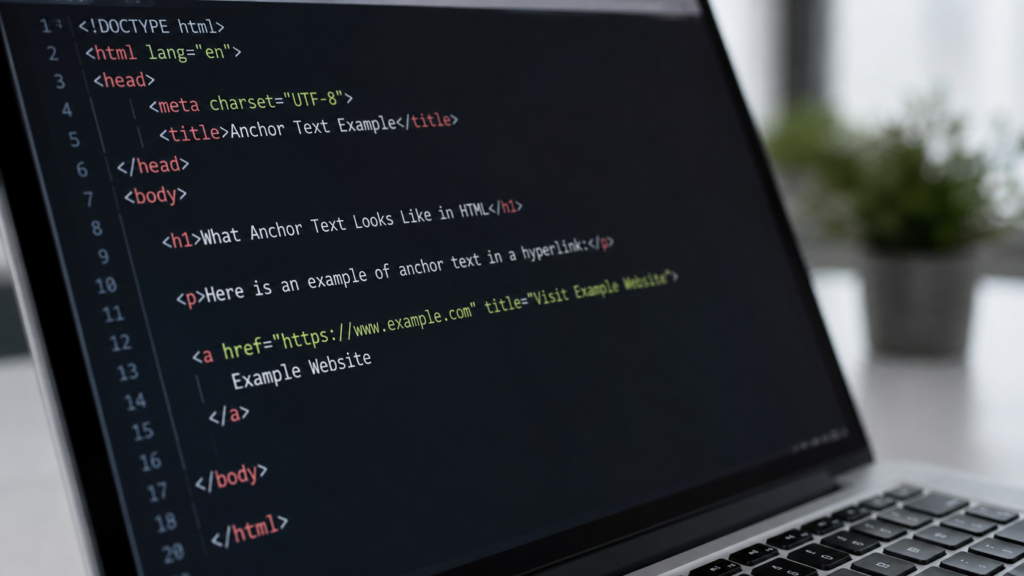
What Anchor Text Looks Like in HTML
Understanding the HTML structure behind anchor text helps technical teams implement it correctly.
A basic these link uses the HTML anchor element with an href attribute:
html
<a href="/keyword-research-guide/">keyword research guide</a>
For external links that should open in a new tab:
html
<a href="https://www.example.com/seo-guide/" target="_blank" rel="noopener noreferrer">complete SEO guide</a>
For links with additional SEO attributes:
html
<a href="/backlink-guide/" rel="nofollow">backlink building strategies</a>
The rel=”nofollow” attribute tells Google not to pass ranking signals through this link. Use it for paid links, user generated content, and untrusted external links.
Our JavaScript SEO guide covers how JavaScript-rendered anchor text links can be missed by crawlers and how to ensure they are correctly parsed.
Anchor Text and Google Penalties
Manipulative these patterns have triggered Google penalties since the Penguin algorithm update.
According to Google’s link quality guidelines, artificially inflating the number of links using keyword-rich anchor text from low quality sources violates their spam policies. Unnatural those patterns are one of the clearest signals of manipulative link schemes.
Warning signs of a problematic anchor text profile include:
Over 50 percent of external backlinks using exact match keyword anchors.
Sudden spikes in links with identical anchor text from many different sources.
Links using anchor text that does not match the content surrounding them on the linking page.
If you suspect your site has been penalised due to past link building, our backlink audit guide covers how to identify toxic links and disavow them through Google Search Console.
Checking Your Anchor Text Profile
A regular anchor text link check reveals whether your backlink profile looks natural to Google.
Use tools like Ahrefs, SEMrush, or Moz to export a complete list of your external backlinks with their associated anchor text. Sort by this frequency to identify over-represented exact match phrases.

Also check internal anchor text using a crawl tool like Screaming Frog. Identify pages that receive only generic anchors when they should be receiving descriptive ones. Find pages with inconsistent have pointing to the same destination.
Google Search Console also provides partial backlink data under the Links section. While incomplete compared to third-party tools, it shows the most prominent anchor texts pointing to your site.
Our how to perform an SEO audit guide integrates anchor text profile review into the broader technical audit workflow.
For brands using SEO services, that auditing should be a standard quarterly deliverable rather than an annual exercise.
Anchor Text for Different Page Types
Anchor text strategy adapts based on the type of page being linked to and from.
Homepage links. Brand name or branded keyword combinations work best as its when linking to homepages. This matches the natural way most external sites reference brand homepages.
Service pages. Descriptive partial match anchors work best for service page links. “Our SEO services” or “professional SEO solutions” outperforms generic “click here” text significantly.
Blog posts. Exact topic descriptions work well for blog post anchors. “How to do keyword research” linking to a keyword research guide is clear and descriptive.
eCommerce product pages. Product name plus key attribute combinations work best. “Blue running shoes men’s” as anchor text for a specific product page sends precise relevance signals.
Our local SEO strategies guide covers how this in local citation links affects Google Business Profile and map pack ranking signals.
Frequently Asked Questions
It is the visible, clickable words inside a hyperlink. Search engines read it to understand what the destination page is about.
It sends relevance signals to search engines about the destination page topic. Too much exact match that can trigger ranking penalties.
Branded anchor text is the safest for external links. It builds authority without risking over-optimisation algorithmic penalties.
Mix branded, partial match, naked URL, and generic anchor types. Avoid overusing exact match keyword anchors in your external backlink profile.
Yes, internal that carries less penalty risk than external. Use descriptive exact match anchors internally to improve topical relevance signals.
Conclusion
Anchor text is one of the most important signals in both on-page and off-page SEO. Used correctly, it strengthens topical relevance, guides crawl efficiency, and helps both users and search engines understand your site structure. Used incorrectly, it triggers algorithmic penalties that suppress rankings regardless of content quality.
For internal links, use descriptive exact match anchors freely to distribute relevance across your site. For external link building, maintain a natural mix of branded, partial match, and contextual anchors. Audit your this profile regularly to catch over-optimisation before it causes ranking damage.
Pair strong that strategy with other technical fundamentals like canonical tags, Core Web Vitals, and mobile first indexing readiness for the most complete SEO foundation.
Explore our complete services overview to see how we help brands build these strategies that improve rankings without triggering penalties.

About the author
Ujjwal Kumawat
I specialize in SEO, website development, Google Ads and online business growth strategies. Through my blogs, I share practical insights, marketing tips and proven strategies to help businesses improve their online visibility, generate more leads and grow faster in the digital space.