
Every day, millions of consumers search for products and services using phrases like ‘near me,’ ‘in [city name],’ or ‘open now.’ These are not abstract searches — they represent buyers with immediate purchase intent, actively looking for businesses exactly like yours. The challenge for multi-location brands, franchises, and regional businesses is capturing this local demand consistently across every market they serve.
A customer searching for your services in Mumbai should find you just as easily as one searching in Delhi. Without a deliberate geo-targeted SEO strategy, that consistency is nearly impossible to achieve.Geo-targeted SEO is the discipline of optimizing your digital presence to rank prominently in location-specific search results. When executed at scale, it becomes the engine behind effective local store marketing and multi-location SEO — turning organic search into a reliable, location-by-location lead generation machine.
What Is Geo-Targeted SEO? A Clear Definition
Geo-targeted SEO is the practice of optimizing digital content, website architecture, and online listings so that a business appears prominently in search results for users in specific geographic locations. Unlike broad SEO strategies that target general audiences, geo-targeted SEO is precision-focused — it connects the right business location to the right local customer at the right moment.
How Geo-Targeting Works in Search Engines
Search engines like Google use multiple signals to determine which results are most relevant to a user’s geographic location. These signals include:
- The user’s IP address and device GPS location
- Location-specific keywords within the search query (e.g., ‘dentist in Jaipur’)
- Google Business Profile proximity and relevance
- Location data embedded in website schema markup
- Local citation consistency across directories and platforms
- Historical search behavior and location-based personalization
Understanding how these signals interact is the foundation of effective store-level SEO. For a deeper technical grounding, review AdClickr’s guide to what is geo-generative engine optimization and how AI-powered search is reshaping local discovery.
Why Geo-Targeted SEO Is Essential for Multi-Location Businesses
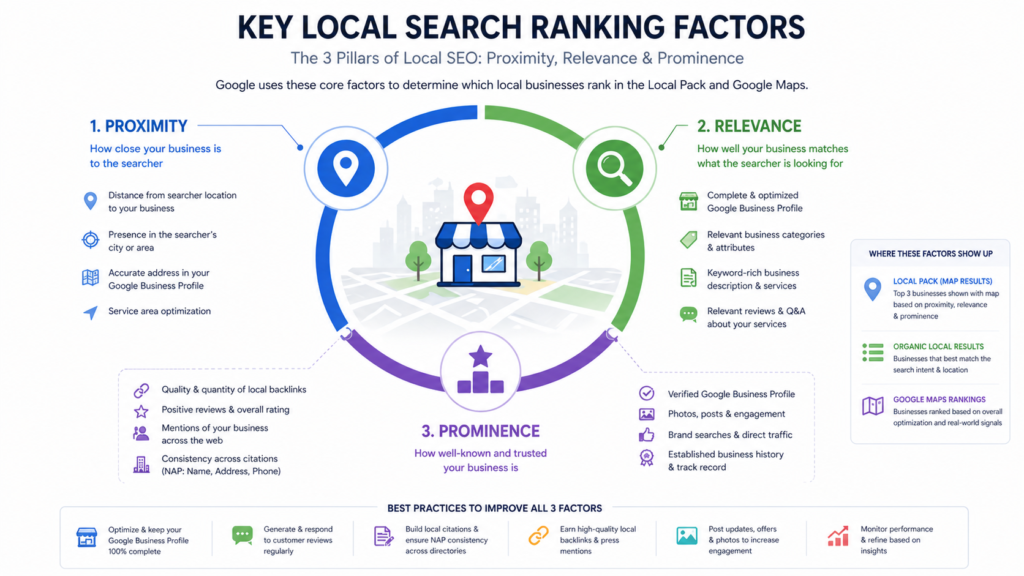
For businesses operating in multiple cities, states, or regions, geo-targeted SEO is not optional — it is the fundamental difference between being found and being invisible in each local market.
The Real Cost of Ignoring Local Search Optimization
When multi-location businesses fail to invest in geo-targeted SEO, the consequences are measurable and significant:
- Reduced Local Visibility: Lost leads to locally-optimized competitors who rank in the local pack
- Increased Ad Spend: Higher customer acquisition costs as paid advertising fills the gap left by absent organic traffic
- Brand Inconsistency: Inconsistent brand experience as customers in different markets encounter different levels of online visibility
- Reputation Gaps: Weakened review profiles as individual locations fail to generate and manage local reviews systematically
- Poor Conversion Rates: Underperforming location pages that fail to convert visitors because they lack local relevance
These are not theoretical risks. They are the daily reality for brands without a structured multi-location SEO strategy. Explore how franchise digital marketing ROI strategies can quantify and solve these gaps.
Building a Geo-Targeted SEO Strategy: Step by Step
Developing an effective geo-targeted SEO strategy requires a structured, systematic approach. The following framework provides a proven roadmap for capturing local demand in every market you serve.
Step 1: Conduct a Location-Level SEO Audit
Before building or optimizing, you need a clear picture of where each market currently stands. A thorough location-level audit examines:
- Current organic rankings for target keywords in each city or region
- Google Business Profile completeness and accuracy for each location
- Existing location page quality, content uniqueness, and technical health
- Local citation consistency across key directories
- Review volume, recency, and average rating per location
A comprehensive technical SEO audit is the essential starting point. Without this baseline, it is impossible to prioritize resources effectively or measure future progress.
Step 2: Define Geographic Target Markets
Not all markets are equally valuable. Prioritize geographic targets based on:
- Population density and total addressable market size
- Existing business presence and current SEO performance
- Competitor landscape intensity in each location
- Historical conversion data from each region
- Strategic growth priorities for the business
Step 3: Develop Location-Specific Keyword Maps
Each target market requires its own keyword map. This means identifying the specific search queries that customers in that location use — not generic service keywords, but hyper-local variations that reflect how people in that city or neighborhood actually search.
For example, rather than targeting only ‘pest control services,’ a geo-targeted keyword map for Delhi would include ‘pest control in South Delhi,’ ‘termite treatment in Lajpat Nagar,’ and ‘cockroach removal near Saket.’ This granularity is what separates store-level SEO from generic digital marketing.
Optimizing Location Pages for Maximum Local Impact
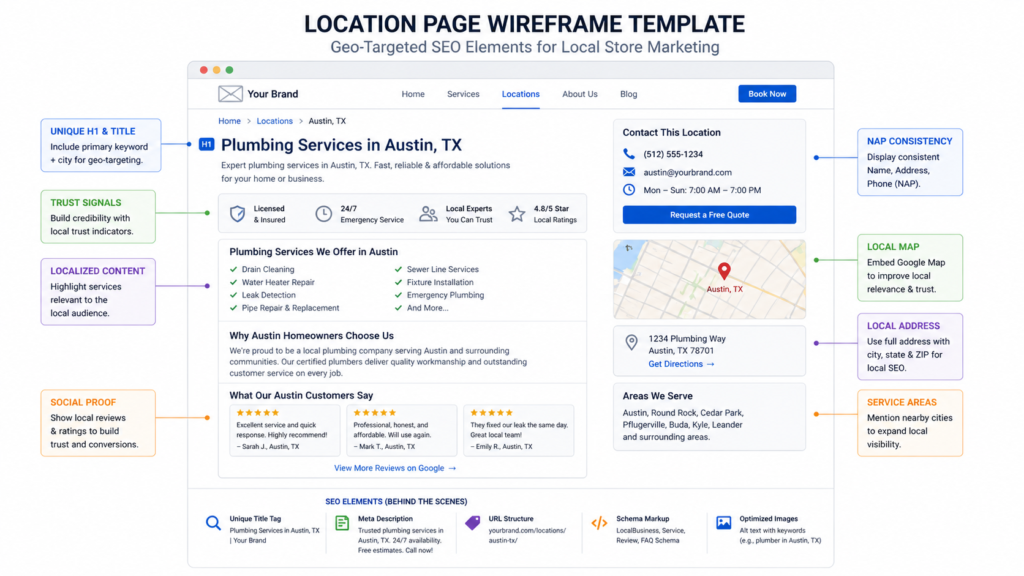
Location pages are the cornerstone of any geo-targeted SEO strategy. When built correctly, they serve as highly targeted landing pages that capture local search demand and convert visitors into customers.
The Anatomy of a High-Converting Location Page
| Page Element | SEO & Conversion Best Practice |
| Title Tag & H1 | Include primary keyword + city name (e.g., ‘Pest Control in South Delhi’) |
| Unique Body Content | 200+ words of locally-relevant, non-duplicate content per location |
| NAP Block | Consistent Name, Address, Phone Number — matching all directories |
| Embedded Map | Google Map embed for the specific location address |
| Schema Markup | LocalBusiness schema with all location-specific fields populated |
| Local Reviews | Curated customer testimonials from that specific location |
| Location-Specific CTA | Call-to-action referencing the local area and service availability |
Implementing proper schema markup on every location page is one of the highest-impact technical actions available. Review AdClickr’s complete guide to schema markup to structure your location data correctly for rich results and AI-powered search visibility.
Google Business Profile: Your Most Powerful Geo-Targeting Tool
No geo-targeted SEO strategy is complete without a fully optimized Google Business Profile for every location. GBP is the primary driver of local pack rankings — the coveted map results that appear at the top of location-based searches.
GBP Optimization Priorities for Multi-Location Brands
- Claim and verify every location individually — unverified listings lose ranking eligibility
- Select the most precise primary business category available
- Write a unique, keyword-rich business description for each location
- Upload fresh, location-specific photos regularly (interior, exterior, team, products)
- Maintain 100% accurate NAP data matching your website and all directories
- Actively generate and respond to reviews at every location
- Use GBP posts to share location-specific offers, events, and announcements
Review management is a critical component of local authority building. Learn how responding to reviews with AI in mind can improve both your GBP ranking signals and customer trust at every location.
Local Citations and NAP Consistency at Scale
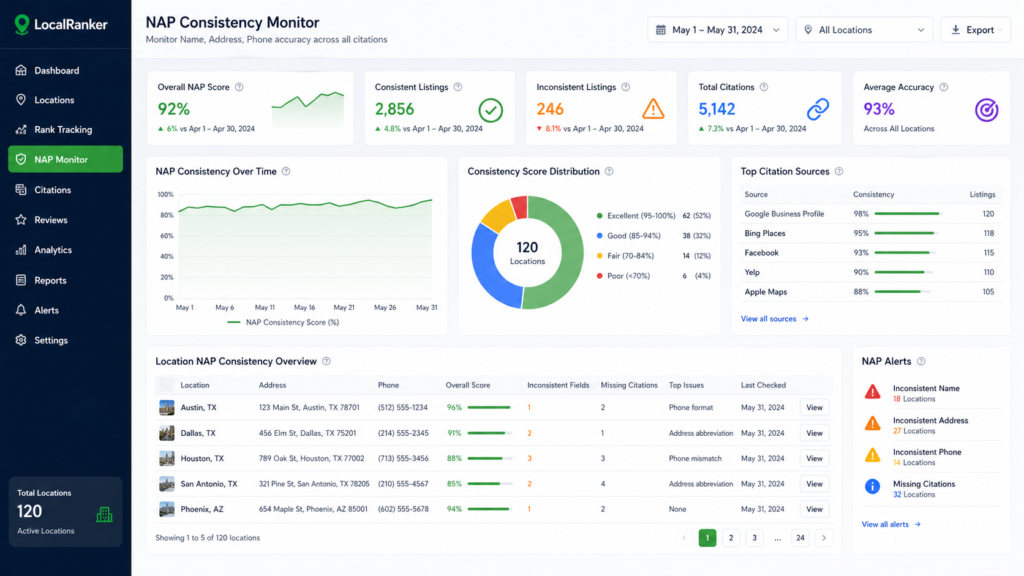
Local citations — mentions of your business name, address, and phone number across online directories, platforms, and websites — are a foundational ranking signal for geo-targeted SEO. For multi-location businesses, managing citation consistency at scale is one of the most operationally demanding aspects of local search optimization.
Priority Citation Sources for Multi-Location Businesses
- Google Business Profile (primary citation anchor)
- Bing Places for Business
- Apple Maps Connect
- Industry-specific directories (e.g., Justdial, Sulekha, IndiaMART for Indian markets)
- Local chamber of commerce and business association listings
- Aggregator platforms (data syndication reaches hundreds of directories simultaneously)
Any inconsistency in NAP data — even minor variations like ‘St.’ versus ‘Street’ — can dilute local ranking signals and confuse both search engines and potential customers. Systematic citation auditing and correction should be performed quarterly across all locations.
Technical SEO for Geo-Targeted Performance
Strong technical foundations amplify the effectiveness of every other geo-targeted SEO effort. Without proper technical setup, even the best content and citation strategy will underperform.
Technical SEO Priorities for Geo-Targeted Sites
- Page Speed: Location pages must load in under 3 seconds on mobile devices — speed is a direct ranking factor for local searches
- Mobile Optimization: The majority of local searches occur on smartphones; full mobile responsiveness is non-negotiable
- Crawl Budget Management: For sites with hundreds of location pages, ensure crawl budget is allocated efficiently so all pages are indexed
- Hreflang Implementation: For businesses serving multiple language markets, hreflang tags prevent international geo-targeting errors
- Structured Data: LocalBusiness, OpeningHours, and GeoCoordinates schema markup improve both rankings and rich result eligibility
Optimizing your site’s technical performance is covered in depth in AdClickr’s guides to technical SEO for website performance and Core Web Vitals optimization — both essential resources for multi-location site owners.
Additionally, improving site speed across location pages can directly increase both rankings and revenue, particularly for high-intent local searches where users expect immediate results.
Content Strategy for Geo-Targeted SEO: Creating Local Relevance at Scale
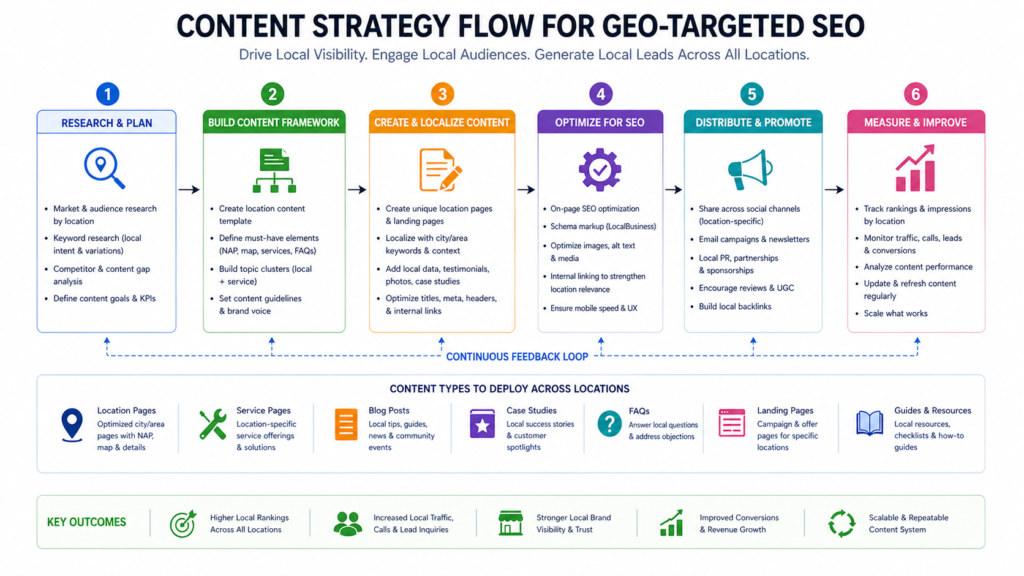
Content is what transforms a technically sound location page into a genuinely useful resource for local customers. For geo-targeted SEO, the content challenge is creating authentic local relevance across potentially hundreds of locations without resorting to low-quality, templated content.
Content Approaches That Scale Without Sacrificing Quality
- Local Event and Seasonal Content: Create location-specific blog posts tied to local events, festivals, or seasonal concerns relevant to each market
- Neighborhood Guides: Develop area guides that position each franchise or branch as a knowledgeable local resource
- Local Customer Stories: Feature testimonials and case studies from verified customers in each specific location
- Market-Specific FAQs: Address questions that vary by location, such as local regulations, regional climate factors, or area-specific service needs
- Community Partnership Content: Highlight local sponsorships, charity work, and business partnerships to build authentic local authority
Understanding how to identify the right content length for location pages ensures your content meets both user expectations and search engine quality thresholds — neither too thin to rank nor so long that local intent is diluted.
Measuring Geo-Targeted SEO Success: Metrics That Matter
Geo-targeted SEO performance must be measured at the location level, not just at the aggregate domain level. A strong overall traffic trend can mask individual locations that are underperforming in their local markets.
Location-Level KPIs for Geo-Targeted SEO
- Local Pack Ranking Position per location and target keyword
- Organic traffic volume for each individual location page
- GBP impressions, clicks, calls, and direction requests per location
- Conversion rate from location page visits to contact form submissions or calls
- Review growth rate and average rating per location
- Citation accuracy score across all monitored directories
Tracking these KPIs consistently enables data-driven decisions about where to focus resources and which locations need strategic intervention. Learn how to know if your SEO is working with actionable metrics that reveal true performance at both the local and network level.
Advanced Geo-Targeted SEO: AI, Automation, and the Future of Local Search
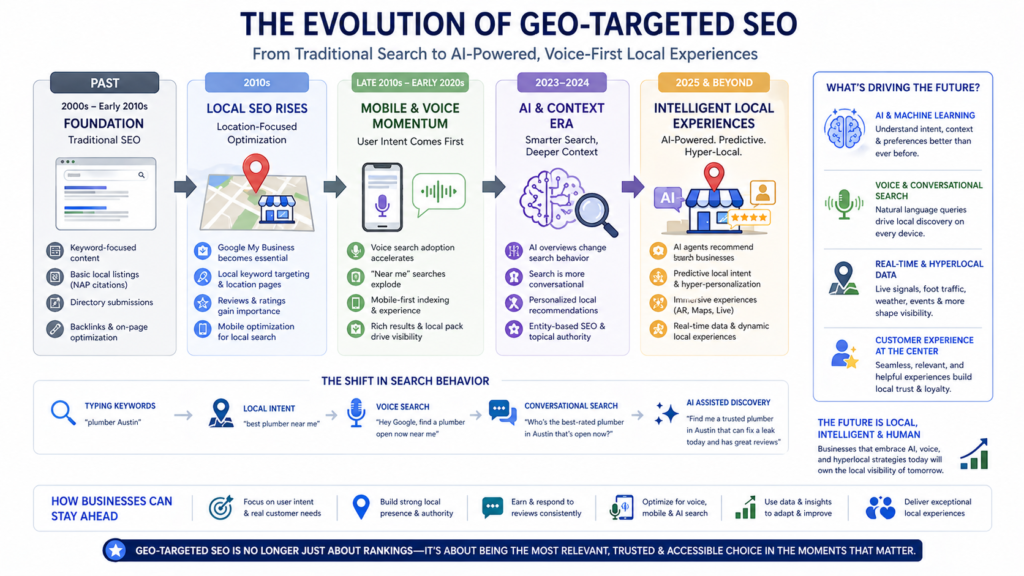
The landscape of geo-targeted SEO is evolving rapidly. AI-powered search platforms, voice search, and generative engine optimization are reshaping how local businesses are discovered — and how they need to optimize.
Emerging Trends Shaping the Future of Local Search
- AI-Powered Local Search: Platforms like Google’s Search Generative Experience (SGE) are synthesizing local business information into direct answers, making schema markup and structured data more important than ever for geo-targeted visibility.
- Voice Search and Conversational Queries: Voice searches are inherently local and conversational. Optimizing for natural language patterns and question-based queries is essential for capturing this growing segment.
- Zero-Click Local Results: Map packs, knowledge panels, and direct answer boxes mean many local searches resolve without a website click — making GBP optimization a standalone revenue driver.
- Hyper-Personalized Local Results: Search engines are delivering increasingly personalized results based on individual search history, making review volume and recency more influential than ever.
- Automation at Scale: AI-assisted content generation, automated citation management, and programmatic GBP updates are making store-level SEO manageable even for brands with hundreds of locations.
Leveraging SEO automation tools allows multi-location brands to maintain quality and consistency at scale — a competitive advantage that compounds over time.
Frequently Asked Questions (FAQs)
Geo-targeted SEO optimizes a business for specific locations using local pages, GBP listings, content, schema, and citations, helping search engines deliver geographically relevant results.
Geo-targeted SEO is more strategic and scalable, focusing on specific markets with location-based keywords, content, and tracking, while general local SEO targets broader location visibility.
Each business location or service area needs a unique page with local content, keywords, NAP details, schema markup, and map embeds to ensure strong geo-targeted rankings.
Initial improvements may appear within 30–60 days. Stronger ranking and traffic growth typically take 3–6 months, while competitive markets may require 6–12 months.
NAP consistency means identical business name, address, and phone across platforms. Inconsistencies confuse search engines, weaken trust, and reduce local ranking performance significantly.
Conclusion: Capture Every Local Market with Geo-Targeted SEO
Geo-targeted SEO is the most powerful tool available to multi-location businesses for capturing local demand consistently across every market they serve. When executed with discipline and scale, it transforms organic search into a reliable engine of local store marketing, franchise lead generation, and sustainable business growth.
The brands winning in local search today are those that treat every location as a distinct digital entity — with its own optimized page, verified GBP listing, localized content, and active review profile — all unified under a coherent multi-location SEO strategy.
Whether you operate 5 locations or 500, the principles are the same: understand your local markets, optimize for geo-specific intent, build technical credibility, and measure performance location by location. Ready to get started? Explore AdClickr’s franchise SEO services, enterprise SEO solutions, and enterprise digital marketing services — or claim your free SEO report to see exactly where each of your locations stands today.

About the author
Ujjwal Kumawat
I specialize in SEO, website development, Google Ads and online business growth strategies. Through my blogs, I share practical insights, marketing tips and proven strategies to help businesses improve their online visibility, generate more leads and grow faster in the digital space.