Does your Domain Authority actually influence your Google rankings every month?
Domain Authority is a third-party score predicting how well a website ranks in search engines. It was created by Moz and scores websites from 1 to 100 on a logarithmic scale. Higher scores mean stronger predicted ranking ability against competitors in search results. This guide explains DA meaning, how it is calculated, and how to improve it.
For brands building digital marketing strategies, understanding DA helps prioritise SEO investment and benchmark competitive positioning accurately.
Domain Authority Meaning: A Complete Definition
This is the direct answer most readers want immediately here. DA meaning is straightforward: it is a predictive score, not a Google ranking factor. Moz’s algorithm calculates it using multiple link-related signals.
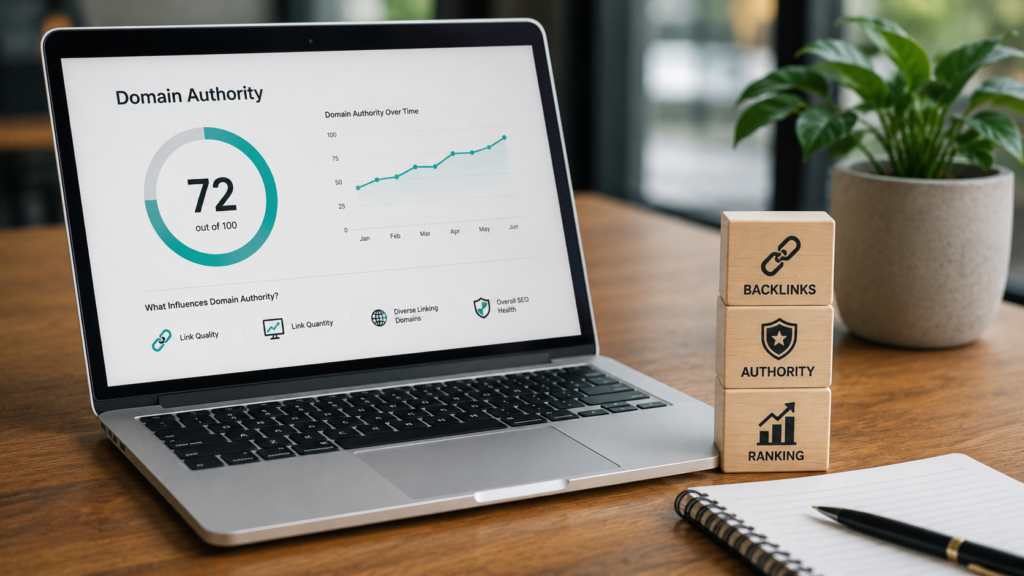
According to Moz’s official Domain Authority guide, DA was created to compare the relative strength of different websites against each other. A new website starts near DA 1 and grows toward 100 as it earns more and better backlinks.
The critical point most marketers miss: Google does not use DA. It is a Moz metric, not a Google metric. However, a higher DA generally correlates with stronger actual ranking performance in practice.
How Domain Authority Is Calculated
Domain Authority in SEO uses a machine learning model to predict ranking strength.
According to Moz’s DA calculation methodology, the score incorporates linking root domains, the total number of links, and MozRank and MozTrust signals. It also accounts for the quality and relevance of linking domains, not just quantity.
The scale is logarithmic, not linear. Moving from DA 20 to DA 30 is far easier than moving from DA 70 to DA 80. Competing websites shift their own DA scores constantly, which means your score can drop even without losing any links.
Our backlink audit guide covers how to evaluate the quality of your existing link profile, which is the core input driving your DA score.
Domain Authority vs Page Authority
Domain authority and page authority are related but distinct metrics measuring different things.
DA measures the overall predicted ranking strength of an entire domain. Page Authority measures the predicted ranking strength of a single specific page. Both use the same 1 to 100 scale and similar calculation methodology.
According to Ahrefs’s analysis of da metrics</a>, most SEO professionals now use multiple authority metrics alongside DA when evaluating competitive positioning. Ahrefs’s Domain Rating and Semrush’s Authority Score serve similar predictive functions.
When evaluating guest posting opportunities or link building targets, check both the DA of the site and the Page Authority of the specific page where your link will appear.
What Is a Good Domain Authority Score
Domain Authority scores are relative, not absolute, when evaluating performance.
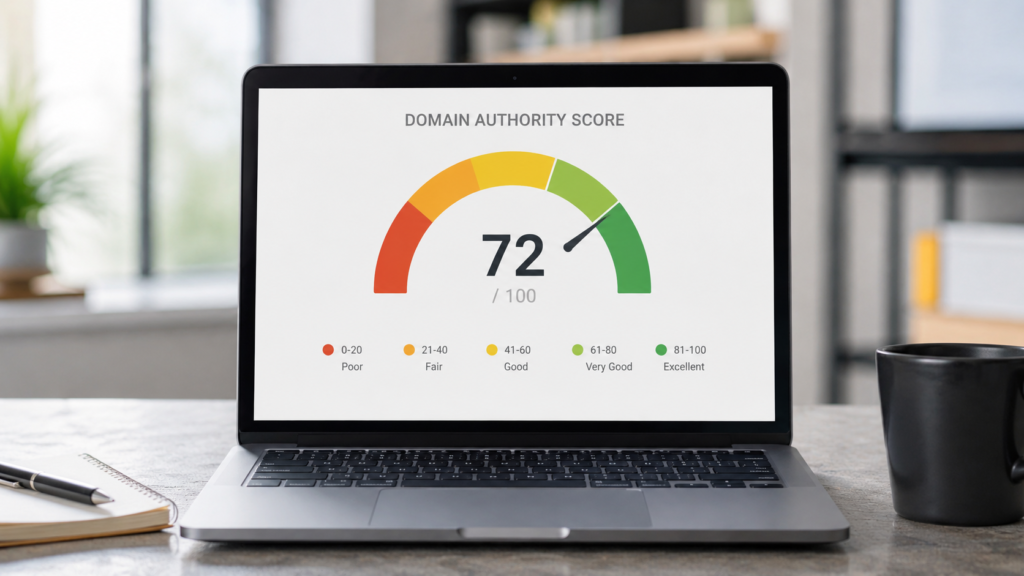
A DA score that is strong in one industry may be weak in another. A local plumber competing in a small city might rank well with DA 20. A SaaS company competing for national software keywords might need DA 60 to compete effectively.
According to Moz’s score interpretation guidance, always compare your DA against direct competitors rather than against some ideal benchmark. If your three closest competitors have DA 35, DA 38, and DA 42, your goal is to reach or exceed that range.
General benchmarks as a starting reference point:
DA 1 to 20 is considered low authority. New websites typically start here.
DA 21 to 40 is considered moderate authority. Most established small businesses fall here.
DA 41 to 60 is considered good authority. Mid-size companies and niche leaders fall here.
DA 61 to 80 is considered high authority. Established industry publishers reach this range.
DA 81 to 100 is considered very high authority. Major news sites, Wikipedia, and government sites live here.
Why Domain Authority in SEO Matters
Domain Authority in SEO provides a useful competitive benchmarking tool despite not being a direct Google signal.
When two pieces of equally good content compete for the same keyword, the page from the stronger domain almost always wins. The stronger domain has accumulated more trust signals and authority over time. DA approximates this trust accumulation in a single comparable number.
Our how to know if your SEO is working guide explains how to track multiple SEO signals together, with DA as one component of a broader performance picture.
For link building prospecting, DA helps quickly filter which websites are worth approaching for guest posts or backlink opportunities. A link from a DA 60 website carries far more weight than a link from a DA 15 website, all else being equal.
DA vs Ahrefs Domain Rating vs Semrush Authority Score
Three major tools provide similar domain-level authority metrics, each using different methodology.
Moz DA uses MozRank, MozTrust, and linking root domains as primary inputs. Updated monthly and available through the free Moz Bar extension.
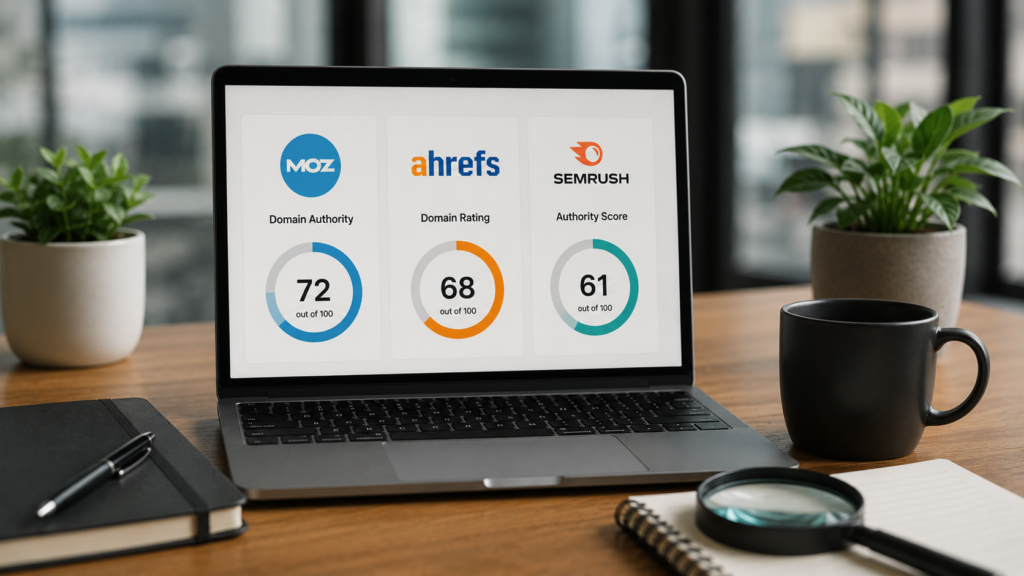
Ahrefs Domain Rating uses the quality and quantity of a website’s backlink profile. According to Ahrefs’s Domain Rating methodology guide, it specifically weights the number of unique referring domains and the DR of those referring domains. Updated continuously as Ahrefs crawls the web.
Semrush Authority Score combines backlink data with organic search performance signals. It incorporates website traffic data alongside link profile quality in its calculation.
For most practical SEO decisions, checking all three provides a more complete picture. Significant disagreements between scores sometimes signal paid link manipulation or unusual link patterns worth investigating further.
Our technical SEO audit checklist includes reviewing authority metrics from multiple tools as part of a comprehensive competitive analysis step.
How to Check Your Domain Authority
Checking your Domain Authority is quick and available through several free tools.
Moz Bar Chrome Extension. The free Moz Bar shows Domain Authority and Page Authority directly in your browser as you browse any website. No account required for basic DA checks.
Moz Link Explorer. Enter any domain at moz.com/link-explorer for a detailed view of DA, linking domains, top pages, and anchor text distribution.
Ahrefs Free Backlink Checker. Ahrefs provides free Domain Rating checks for any website through their free tools section.
Semrush Free Authority Score Check. Semrush allows limited free authority score checks through their domain overview tool.
Bulk DA Checking Tools. Several third-party tools allow bulk DA checking across dozens or hundreds of domains simultaneously. This is useful for link prospecting and competitor research at scale.
For our eCommerce SEO clients, we track DA trends monthly alongside organic traffic to confirm whether authority building efforts are translating into ranking improvements over time.
Factors That Increase Domain Authority
Building Domain Authority requires a systematic approach to earning high-quality backlinks.
Total number of unique referring domains. The single most important factor is how many different websites link to you. One thousand links from ten websites is far less valuable than one thousand links from one thousand different domains.

Quality of linking domains. Links from high-authority, relevant websites carry exponentially more weight than links from low-authority or irrelevant sites. A single link from a DA 80 news publication outweighs dozens of links from DA 10 directory sites.
Relevance of linking domains. Links from websites in your industry or niche carry stronger contextual relevance signals. A tech company earns more authority from tech publication links than from unrelated directories.
Link diversity. Healthy backlink profiles include links from diverse sources including news sites, industry blogs, resource pages, partner sites, and directories. Homogeneous link profiles from one link type raise algorithmic suspicion.
Content quality and linkability. High quality original content earns natural links organically over time. Research, data, tools, and comprehensive guides attract links far more consistently than basic blog posts.
Our content audit guide identifies which existing pages have the strongest link attraction potential for focused content improvement efforts.
Why Your Domain Authority Dropped
A dropping Domain Authority score causes concern even when your actual Google rankings remain stable.
The most common reason for a DA drop is that competing websites earned more or better links than you during the same period. Because DA is relative and constantly recalculated, improvements by competitors can lower your score without you losing anything.
Other causes of DA drops include:
A major link building effort by a competitor lifting their score above yours.
Moz updating its algorithm, which happens periodically and can recalibrate scores across all websites.
Loss of high-value backlinks from authoritative sites that removed or changed their content.
Discovery of previously uncrawled links now being counted for competitors.
According to Semrush’s guide to understanding authority score drops, a DA drop without a corresponding drop in actual organic traffic or rankings is usually not cause for alarm.
Our enterprise SEO clients track multiple authority metrics together, ensuring one metric’s movement does not cause disproportionate concern about overall SEO performance.
How to Improve Domain Authority
Improving Domain Authority requires sustained, systematic link building alongside technical SEO health.
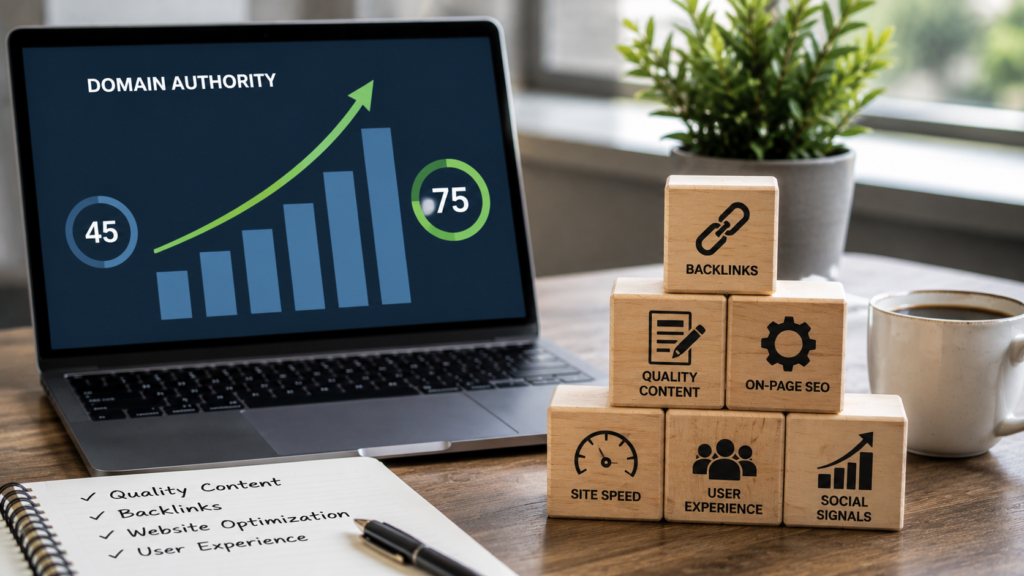
Step one: Audit and clean your existing backlink profile. Remove or disavow toxic links that dilute your DA score. Our backlink audit guide covers this process in full.
Step two: Create genuinely linkable content. Original research, comprehensive guides, data visualisations, and free tools consistently attract natural backlinks from quality sources.
Step three: Execute a consistent outreach strategy. Guest posting, digital PR, and strategic partnership development earn links from authoritative domains systematically over time.
Step four: Build internal linking strength. Strong internal link structures distribute PageRank more efficiently across your site, improving the overall ranking potential of every page. Our technical SEO audit checklist covers internal linking audits as part of technical health reviews.
Step five: Fix technical SEO foundations. Crawl errors, broken links, and slow page speeds all indirectly affect DA by reducing the quality signals associated with your domain. Our site speed optimisation guide covers technical performance improvements that support overall SEO health.
Step six: Monitor progress monthly. Track DA trends monthly, not weekly. Month-to-month DA movement is often noise. Meaningful DA growth happens over six to twelve month periods for most domains.
Domain Authority for Local SEO
Local businesses benefit from Domain Authority improvements even while competing primarily in local search results.
According to Moz’s local SEO authority context, even modestly high DA gives local businesses a competitive edge in map pack rankings and local organic search results. Local citations, local press mentions, and community links all contribute to Domain Authority growth alongside local SEO signals.
Our local SEO services strategy integrates link building alongside Google Business Profile optimisation and citation building for comprehensive local authority growth.
For local businesses across different sectors, our guides on local SEO for restaurants, local SEO for lawyers, and local SEO for dentists cover sector-specific authority building approaches.
Domain Authority for Ecommerce Sites
Ecommerce sites face unique Domain Authority challenges due to their complex URL structures and large page counts.
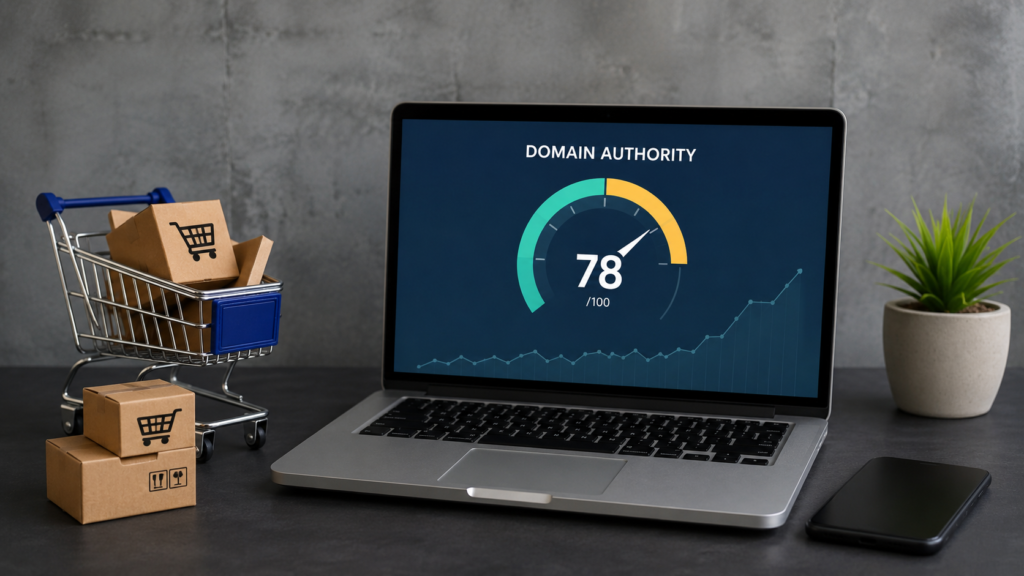
Product and category pages rarely attract natural backlinks on their own. Most ecommerce DA growth comes from linking to informational content like buying guides, product comparisons, and expert reviews that naturally attract links. Those pages then pass authority through internal links to commercial product and category pages.
Our eCommerce SEO service builds this content-driven authority strategy alongside technical optimisation for online stores.
For ecommerce brands running ecommerce PPC campaigns alongside organic SEO, Domain Authority growth reduces long-term paid acquisition costs as organic traffic compounds from improved rankings.
Frequently Asked Questions
It is a Moz score from 1 to 100 predicting how well a website ranks in search engines. Higher scores indicate stronger authority.
No, Google does not use Domain Authority. It is a Moz metric, but it correlates with actual ranking strength. Improve it through quality backlinks.
Compare your score to direct competitors, not a universal benchmark. Reaching or exceeding competitor scores in your specific niche is the realistic goal.
Competitors probably earned more links recently. Moz algorithm updates also cause recalibrations. Organic traffic stability matters more than short-term DA fluctuations.
Meaningful Domain Authority growth typically takes six to twelve months of consistent link building. Logarithmic scaling makes higher scores progressively harder to achieve.
Conclusion
Domain Authority is a valuable benchmarking tool for competitive SEO analysis even though Google does not use it directly. Understanding domain authority meaning helps you prioritise link building, evaluate guest posting opportunities, and measure authority growth over time relative to competitors.
The path to higher Domain Authority follows a clear sequence: clean your existing backlink profile, create genuinely linkable content, execute systematic outreach, and maintain strong technical SEO foundations. Track progress over six to twelve month periods rather than month to month for a realistic picture.
Always compare your Domain Authority against direct competitors in your specific niche. A score that makes you competitive in your market matters far more than chasing an arbitrary absolute number.
Pair Domain Authority growth with strong digital marketing strategies across all channels. Explore our complete services overview to see how we help brands build the authority needed to compete and rank consistently.

About the author
Ujjwal Kumawat
I specialize in SEO, website development, Google Ads and online business growth strategies. Through my blogs, I share practical insights, marketing tips and proven strategies to help businesses improve their online visibility, generate more leads and grow faster in the digital space.