How do you find accurate keyword search volume without spending a fortune on premium tools?
Understanding how many people search for any given term is fundamental to every content and advertising decision you make. Too many SEOs skip volume validation entirely and target keywords based on intuition alone, then wonder why content fails to attract meaningful traffic.
This guide explains exactly how keyword search volume works, the best free and paid tools for checking it accurately, how to track keyword search ranking over time, and how to use volume data to drive smarter content decisions across every channel you manage.
What Is Keyword Search Volume?
Keyword search volume is the average number of times a specific term gets searched within a defined time period, typically monthly. Tools calculate this figure from historical search data, producing either exact numbers or volume ranges depending on the platform and your account type.

Keyword search volume is a directional indicator rather than a precise prediction. Actual monthly searches fluctuate based on seasonality, news events, and algorithm updates. The number you see represents an average across multiple months rather than a guaranteed future traffic figure for any specific month ahead.
For businesses building digital marketing strategies, understanding volume helps prioritise where to invest content production budget. A high volume keyword signals genuine audience demand worth addressing. A low volume keyword might still deserve targeting if intent and conversion potential justify the effort involved.
Why Keyword Search Volume Matters for SEO
Connecting Volume to Business Outcomes
Volume alone never determines whether a keyword is worth targeting. A ten thousand monthly search term with extreme competition and low buyer intent rarely justifies the effort required to rank for it. A three hundred search term with low difficulty and direct commercial intent often produces far stronger revenue outcomes for the same effort invested.
Keyword research for seo should always evaluate volume alongside keyword difficulty, search intent, and competitive context. These four factors together determine whether any given keyword represents a realistic, valuable opportunity given your current domain authority and content production capacity.
Volume Trends Matter as Much as Raw Numbers
A keyword showing five thousand monthly searches today but declining fifteen percent each month is less attractive than a two thousand search term growing steadily. Google Trends reveals this directional context that snapshot volume tools cannot show alone, helping you invest in keywords with growing rather than shrinking demand.
Keyword research decisions informed by trend data consistently outperform those based on static snapshot volume figures from single point-in-time measurements. This directional layer prevents committing significant content resources to topics actively losing audience interest over time.
How to Do a Keyword Search Volume Check
Step One: Choose Your Research Platform
A keyword search volume check starts by selecting the right tool for your specific situation. Google Keyword Planner provides the most authoritative free volume data. Paid platforms like Ahrefs and Semrush provide more precise figures with additional competitive context data that free tools cannot match.

Step Two: Enter Your Target Keywords
Input your seed keywords or specific target terms into the tool. Most platforms allow bulk input of dozens of keywords simultaneously, saving significant time compared to checking terms individually. Always include both exact match and natural language variants since search engines now handle these similarly.
Step Three: Apply Geographic and Language Filters
Filter volume data by your specific target market rather than using global or national defaults when your business serves a specific region. Local seo keyword research specifically requires location filtered volume data since national figures significantly overstate demand for businesses serving limited geographic areas.
Step Four: Record and Organise Results
Export your volume data into a spreadsheet alongside keyword difficulty scores and intent classifications. This organised format makes comparative analysis and prioritisation decisions significantly faster than reviewing results within tool interfaces one keyword at a time.
Step Five: Cross-Reference Across Multiple Sources
Single tool volume estimates contain error margins that cross-referencing reduces meaningfully. When Google Keyword Planner, Ahrefs, and Semrush all indicate similar volume ranges for a keyword, confidence in that estimate is substantially higher than when tools show significant disagreement.
Best Keyword Search Volume Finder Tools
Google Keyword Planner
Google Keyword Planner remains the most authoritative free keyword search volume finder because it draws directly from Google’s advertising database rather than modelling estimates from external data. Access requires a free Google Ads account. Active advertisers see precise monthly figures while non-advertisers see broader ranges.
According to Google’s official Keyword Planner help documentation, volume figures represent average monthly searches from the previous twelve months, providing a reasonably stable baseline rather than a single month snapshot that seasonal fluctuations would distort significantly.
Ahrefs Keywords Explorer
Ahrefs Keywords Explorer provides exact monthly search volume estimates alongside click-through rate data, keyword difficulty scores, and traffic potential figures. The traffic potential metric shows estimated traffic for a page ranking number one for that keyword, often revealing that high volume keywords attract far fewer clicks than their raw search numbers suggest.
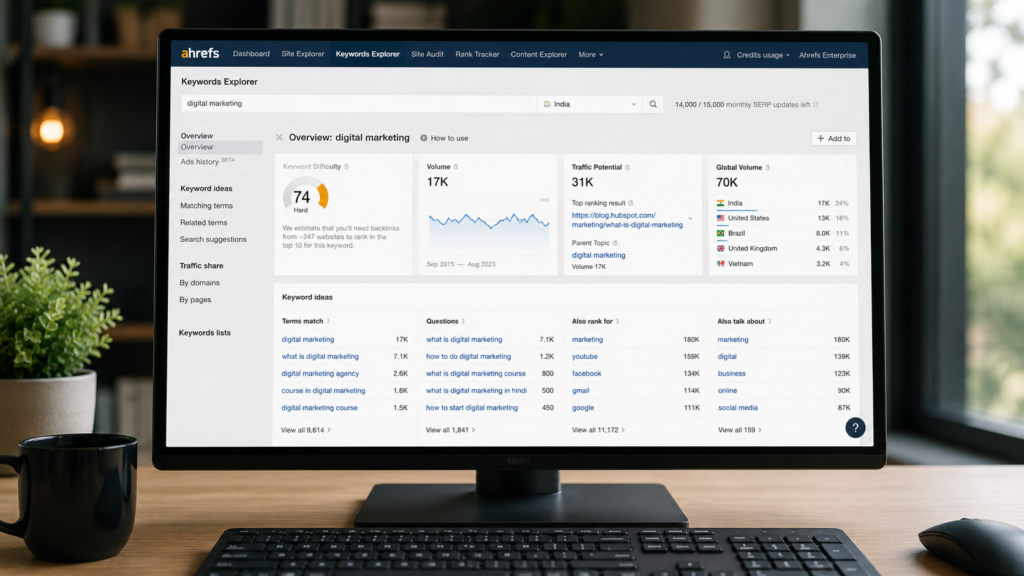
Keyword research for blogging particularly benefits from Ahrefs’s click data since many high volume informational queries now receive answers directly within Google’s search results through featured snippets and AI Overviews, meaning ranking number one delivers far less traffic than historical click-through rate norms would predict.
Semrush Keyword Overview
Semrush provides volume, keyword difficulty, competitive density, and cost-per-click estimates within a single keyword overview report. Its Keyword Magic Tool expands any seed term into hundreds of related keywords with individual volume data, enabling rapid expansion of your initial keyword list across topic clusters.
For businesses planning ecommerce seo campaigns, Semrush’s intent classification feature automatically labels keywords by commercial, informational, navigational, and transactional intent types, saving significant manual classification time during large-scale research projects.
Google Search Console
Google Search Console provides volume adjacent data in the form of actual impression counts for your existing website. Impressions tell you how often Google showed your site for specific queries without revealing the broader market demand for those terms. This site-specific data complements market-wide volume estimates from dedicated tools.
For how to know if your seo is working, Search Console data is uniquely valuable because it reflects your actual performance rather than market estimates. Comparing Search Console impression data against external volume estimates reveals your current capture rate and where the biggest opportunity gaps exist.
Keywords Everywhere
Keywords Everywhere is a browser extension that overlays volume, cost-per-click, and competition data directly onto Google search results pages. Its paid credit system provides affordable access to precise volume data without requiring full subscriptions to enterprise platforms. Free tier users see keyword suggestions without volume figures.
Understanding Keyword Search Ranking and How to Track It
What Keyword Search Ranking Tells You
Keyword search ranking refers to your page’s position in search results for any specific query. Position one to three captures the majority of available clicks for most queries. Position four to ten still captures meaningful traffic. Positions eleven onwards receive minimal direct traffic in most categories.

Tracking ranking over time reveals whether your optimisation efforts are producing measurable results. Consistent upward movement indicates your content and technical improvements are working as intended. Stagnant or declining rankings signal that competitor content quality or authority is outpacing your own improvements.
Tools for Tracking Keyword Search Ranking
Google Search Console provides free ranking data for your own website within a ninety day rolling window. It shows average position for each query generating impressions, allowing you to identify both your strongest ranking terms and your closest-to-ranking opportunities in positions four through fifteen.
Dedicated rank tracking platforms like SE Ranking, AccuRanker, and Semrush Position Tracking check your specific keyword rankings daily and chart movement over time. These tools allow you to set up custom keyword lists rather than only seeing queries Google has already associated with your pages organically.
Analytics reporting dashboards that combine ranking data with traffic and conversion data provide the complete performance picture. Ranking improvement that does not translate into traffic or conversion improvement signals a title tag or meta description problem rather than a content quality or technical issue specifically.
Keyword Search Traffic: What Volume Actually Predicts
The Gap Between Volume and Actual Clicks
Keyword search traffic your content receives is almost always lower than raw search volume suggests. Position one typically captures twenty to thirty percent of available clicks, not one hundred percent. SERP features like featured snippets and AI Overviews further reduce clicks by answering queries directly within search results without requiring any click at all.
Calculating Realistic Traffic Estimates
Estimate realistic traffic potential by multiplying keyword volume by your expected position’s click-through rate for that query type. Informational queries with featured snippets produce lower CTRs than commercial queries. Ahrefs and Semrush both provide traffic potential estimates that account for these adjustments automatically, making them more reliable planning inputs than raw volume multiplied by idealised CTR assumptions.
Keyword Search for Website Traffic Growth
Identifying Your Best Volume Opportunities
Keyword search for website traffic growth requires finding the intersection of reasonable volume, achievable difficulty, and strong intent alignment. This intersection is more valuable than any single factor evaluated alone.

Start by identifying terms where existing pages rank between positions four and fifteen for reasonable volume keywords. These represent your fastest path to meaningful traffic increases since content already exists and has demonstrated relevance to Google’s algorithm.
New content should target keywords with meaningful volume and difficulty below your domain’s current competitive capacity. Systematically working through quick wins before long-term targets maximises both short-term gains and long-term positioning simultaneously.
Keyword Search Tool for Amazon and Marketplace Research
Why Amazon Keywords Differ From Google Keywords
Keyword search tool for amazon research requires understanding that Amazon’s search system operates through different signals than Google. Amazon keyword volume reflects buyer intent nearly exclusively since virtually every Amazon search involves someone considering a purchase rather than conducting general research.
Amazon seo keyword research prioritises high intent commercial terms that directly match product categories. Long tail specificity often outperforms shorter generic terms on Amazon because the platform’s algorithm rewards relevance to purchase intent more heavily than pure volume signals that Google’s broader algorithm weighs differently.
Tools Supporting Amazon Keyword Volume Research
Helium 10, Jungle Scout, and Ahrefs all provide amazon keyword research data including Amazon-specific search volume estimates. These tools pull data from Amazon’s advertising API rather than modelling from external sources, making their Amazon volume figures more reliable than general keyword tools attempting to estimate marketplace specific demand.
For sellers combining amazon advertising with organic ranking optimisation, keyword volume data informs both which terms to include in backend search fields and which terms to target in Sponsored Products campaigns simultaneously, creating a unified paid and organic keyword strategy.
Bing and Alternative Search Engine Volume
Keyword research tool Bing data provides valuable supplementary volume information for audiences where Bing holds meaningful market share. Microsoft Advertising Intelligence provides Bing-specific volume data unavailable from Google-focused tools, revealing opportunities where competition is meaningfully lower. According to Microsoft Advertising Intelligence documentation</a>, Bing-specific keywords can show dramatically different competition profiles from equivalent Google data.
Building a Volume-Based Keyword Strategy
Tiering Keywords by Volume and Difficulty
A practical volume-based keyword strategy organises targets into three tiers. High volume, high difficulty terms form aspirational long-term targets requiring sustained authority building. Medium volume, medium difficulty terms form the core of near-term content planning. Low volume, low difficulty terms with strong intent form quick win opportunities deployable immediately.
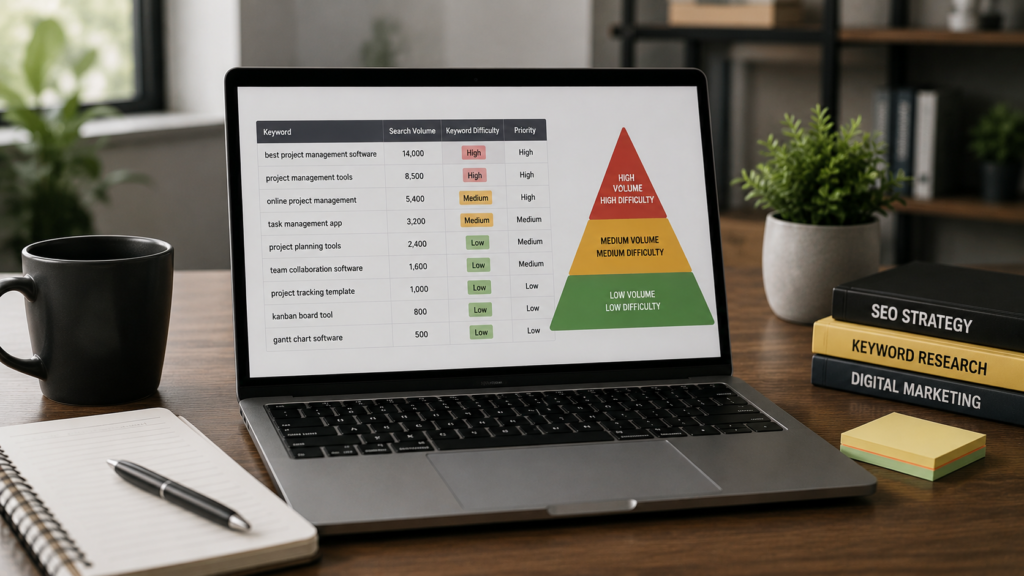
Data-driven marketing principles demand this kind of structured tiering rather than simply targeting the highest available search volumes and hoping domain authority eventually catches up with ambition. Working systematically through all three tiers simultaneously maximises both short-term traffic gains and long-term competitive positioning.
Integrating Volume Data With Content Planning
Map each target keyword to a specific planned or existing content page before beginning production. This mapping prevents cannibalisation where multiple pages compete for the same keyword, splitting ranking signals that one concentrated page should receive entirely.
Content audit processes should regularly revisit this keyword-to-page mapping as strategy evolves. Outdated maps where the assigned page no longer suits a keyword’s current intent create ranking inefficiencies that simple reassignment typically resolves quickly.
As Moz’s keyword research methodology guide explains, matching keyword intent to page content type matters more than volume alone for sustained ranking performance. According to Semrush’s keyword search volume guide, contextualising volume within the competitive landscape produces far better strategy decisions than using volume as a standalone criterion. For professional support connecting keyword data to implementation, our seo services cover the complete workflow.
Frequently Asked Questions
Keyword search volume is the average monthly number of times people search a specific term. It matters because higher volume indicates stronger audience demand, helping SEOs prioritise which keywords deserve content investment and predict how much organic traffic ranking could realistically generate.
Use Google Keyword Planner for free authoritative volume ranges by creating a Google Ads account. Combine with Ahrefs Free Keyword Generator and Google Trends for directional data. Together these free tools provide sufficient volume guidance for most content planning decisions without any paid platform subscription.
Google Keyword Planner provides the most authoritative free volume data since it draws directly from Google’s database. For more precise figures with competitive context, Ahrefs Keywords Explorer and Semrush Keyword Overview offer the strongest paid options for comprehensive keyword research workflows.
Keyword search ranking directly determines what percentage of available clicks your page captures. Position one typically receives twenty to thirty percent of clicks. Positions four through ten receive substantially less. Rankings combined with SERP feature presence ultimately determine realistic traffic more accurately than raw volume figures alone.
Yes. Amazon specific keyword volume tools like Helium 10 and Jungle Scout provide marketplace-specific search volume data reflecting actual buyer intent. This differs meaningfully from Google keyword volume since nearly all Amazon searches indicate purchase intent, making volume signals directly relevant to product listing optimisation decisions.
Conclusion
Checking keyword search volume accurately requires combining multiple tools, understanding what volume does and does not predict, and always evaluating it alongside difficulty, intent, and competitive context. Raw volume figures without this broader context consistently lead to poor targeting decisions that waste content production resources.
Track keyword search ranking consistently using Google Search Console as a free baseline alongside dedicated rank tracking tools for your priority keywords. Connect ranking movement to actual traffic and conversion data to evaluate true business impact rather than treating position improvements as ends in themselves.
For businesses wanting professional keyword research support alongside full SEO implementation, explore our seo services or read our complete keyword research guide to build your research foundation step by step.

About the author
Ujjwal Kumawat
I specialize in SEO, website development, Google Ads and online business growth strategies. Through my blogs, I share practical insights, marketing tips and proven strategies to help businesses improve their online visibility, generate more leads and grow faster in the digital space.