Have you ever trusted a keyword’s search volume, built content around it, and ended up with almost no traffic to show for it ?
The problem is almost always a misunderstanding of keyword research volume. Search volume is one of the most referenced metrics in SEO, but also one of the most misinterpreted. A keyword with 50,000 monthly searches does not automatically represent a good opportunity. A keyword with 500 monthly searches does not automatically mean low opportunity.
Understanding what keyword search volume actually means, how to check it accurately. How to interpret it in context including how AI Overviews are changing. This is what that volume can actually deliver is what separates effective keyword strategy from guesswork. This complete guide covers everything you need to know about keyword volume in 2026.
What Is Keyword Search Volume?
Keyword search volume is the average number of times a specific keyword or phrase is searched. As in a search engine within a defined time period, typically measured monthly. It quantifies the size of the audience actively searching for a particular topic. It is one of the primary metrics used in keyword research to evaluate whether a keyword is worth targeting.

When a keyword research tool reports a keyword has 10,000 monthly searches, it means that keyword was searched approximately 10,000 times per month on average, usually calculated as a rolling 12-month average to smooth out seasonal fluctuations.
Keyword research volume is important because it represents the upper ceiling of potential traffic available from ranking for that keyword. If a keyword has 1,000 monthly searches and you rank at position one, you can expect roughly 300 to 400 clicks per month based on average position-one click-through rates. Understanding this ceiling helps you prioritise which keywords justify content investment and which do not.
For businesses building an organic search strategy through professional SEO services, keyword search volume data is the foundation of every traffic projection and content priority decision.
Why Keyword Research Volume Matters for SEO
Keyword research volume serves as the demand signal in keyword strategy. It answers the fundamental question: is there enough audience searching for this topic to justify creating content about it?
Without volume data, keyword selection relies on assumption. A business might assume their target audience searches for certain terms, only to discover through a keyword search volume check that those terms are barely searched at all, while slightly different phrasing attracts thousands of monthly searches.
Volume data also helps prioritise limited content production resources. When choosing between two equally relevant keywords, the one with higher search volume generally represents the larger opportunity, all other factors being equal. However, volume never exists in isolation. It must always be evaluated alongside keyword difficulty, search intent, and business relevance.
Volume data connects directly to your digital marketing strategies by quantifying the traffic potential of organic SEO investment before any content is created or any optimisation work is done.
For ecommerce businesses in particular, understanding keyword search volume before building product category pages determines whether those pages have any realistic organic traffic potential. Our ecommerce SEO guide covers how to apply volume data specifically to product and category page keyword selection.
How to Check Keyword Search Volume on Google
Google provides several ways to access keyword search volume data, ranging from completely free to paid tool access.
Google Keyword Planner is the most direct way to check keyword search volume on Google. It is part of the Google Ads platform and is free to use with a Google Ads account. Keyword Planner shows monthly search volume ranges for any keyword along with related keyword suggestions and historical trend data.
The limitation of Keyword Planner is that volume data is shown in broad ranges rather than exact numbers unless you have an active Google Ads campaign spending money. Ranges like “1K-10K” are less precise than the exact figures provided by paid SEO tools, but they are directionally accurate enough for most strategic decisions.
Google Search Console shows real click and impression data for keywords that are already generating traffic to your website. While it does not provide volume data for keywords you do not yet rank for, it is the most accurate source of actual keyword performance data for your existing pages.
Google Trends does not show absolute search volume but shows relative interest on a scale of 0 to 100. It is invaluable for understanding whether keyword volume is growing, declining, or stable over time, and for comparing the relative demand between two keywords.
Together these three Google tools provide a comprehensive free keyword search volume check workflow that supports most strategic keyword decisions. Our guide to the best free keyword research tools covers how to combine these tools with other free options for maximum keyword volume insight.
Keyword Search Volume Checker Tools
Beyond Google’s native tools, several dedicated keyword search volume checker platforms provide more precise data and greater functionality.
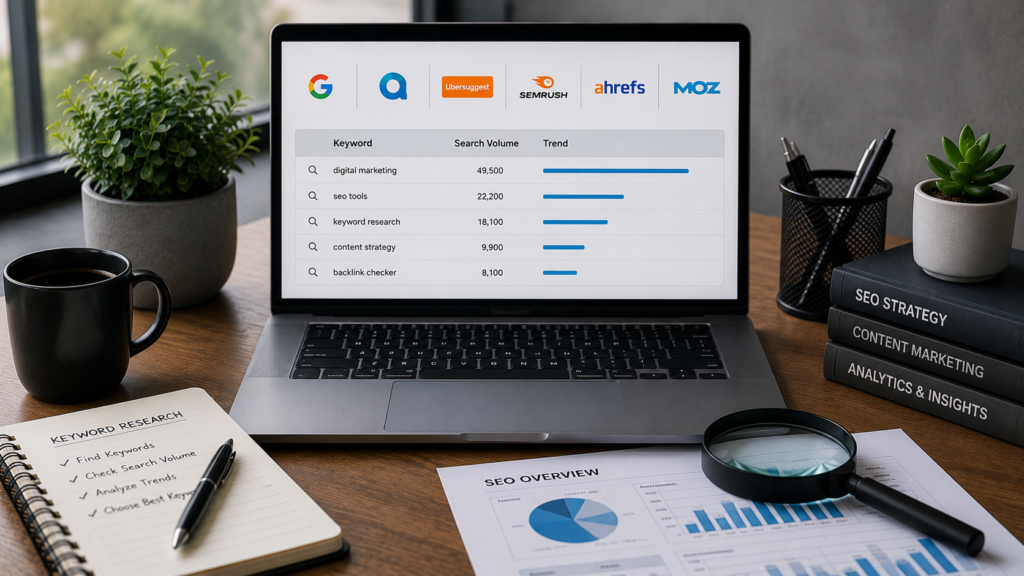
Ahrefs uses clickstream data to provide monthly search volume estimates that are often considered the most accurate among third-party tools. Ahrefs shows exact volume numbers rather than ranges, global and country-specific volumes, and historical volume trends. Its keyword difficulty metric also helps contextualise volume data relative to competition.
SEMrush provides monthly search volume data alongside trend graphs, keyword difficulty scores, CPC estimates, and competitive density indicators. Its Keyword Magic Tool generates thousands of related keyword suggestions with volume data for each.
Moz Keyword Explorer shows monthly volume ranges along with its proprietary Priority score that combines volume, difficulty, and click-through opportunity into a single metric useful for comparing keywords quickly.
Ubersuggest provides volume data in its free version with daily search limits. It is useful for basic keyword search volume checks without a paid subscription.
Keywords Everywhere is a browser extension that overlays volume data directly onto Google search results pages, showing search volume, CPC, and competition data as you browse without requiring you to switch to a separate tool.
For businesses that also run paid campaigns, their Google Ads management platform provides keyword volume data through Keyword Planner that serves double duty for both paid and organic keyword selection.
Keyword Research by Google: Keyword Planner Step-by-Step
Google Keyword Planner is the primary tool for keyword research by Google and is available to anyone with a free Google Ads account.
Step 1: Access Keyword Planner. Log into Google Ads, click the Tools and Settings icon, select Planning, and choose Keyword Planner.
Step 2: Choose Discover New Keywords. Enter up to ten seed keywords related to your topic, or enter a competitor URL to discover keywords your competitors are targeting.
Step 3: Review the keyword suggestions. Keyword Planner generates a list of related keywords with average monthly searches, competition level, and suggested bid ranges.
Step 4: Filter and prioritise. Use the filtering options to narrow results by search volume range, competition level, and keyword text to find terms that match your targeting criteria.
Step 5: Export and organise. Download keyword data into a spreadsheet for further analysis and integration into your keyword map.
One important note when using Google Keyword Planner for organic SEO: the competition column reflects paid advertising competition rather than organic SEO difficulty. A keyword marked “low” competition in Keyword Planner may still be highly competitive in organic search results.
Keyword Research Google Trends: Understanding Demand Over Time
Keyword research on Google Trends provides a dimension that search volume tools alone cannot: trend direction. A keyword with 5,000 monthly searches and rising trend data is more valuable than one with 8,000 searches and declining demand.

Google Trends shows relative search interest on a scale of 0 to 100 over any selected time period, from the past hour to the past five years. This helps answer whether a keyword’s current volume represents a growing opportunity or a fading trend.
Seasonal keywords are particularly important to identify through Google Trends. A keyword that peaks every December and drops to near zero in March requires different content planning than a keyword with consistent year-round demand. Planning content publication to precede peak demand periods by several weeks maximises the opportunity to rank before search interest peaks.
Comparing keywords in Google Trends reveals relative demand between terms that might have similar volume estimates in standard tools but very different actual popularity trajectories. If two keywords have similar reported volumes but one shows significantly higher trend interest, the one with stronger trend data likely has better long-term opportunity.
Google Trends also shows geographic breakdowns of search interest, which is directly relevant for geo-targeted SEO strategies where regional demand patterns determine content and campaign priorities.
How to Interpret Keyword Search Volume Data
Raw search volume numbers mean little without context. Correct interpretation of keyword research volume data requires evaluating each volume figure against several contextual factors.
Volume relative to keyword difficulty. A keyword with 10,000 monthly searches and a keyword difficulty of 85 may deliver less actual traffic to a mid-authority website than a keyword with 2,000 monthly searches and a difficulty of 25. Lower competition keywords with realistic ranking potential often deliver more actual traffic than high-volume terms you cannot realistically rank for.
Volume relative to click-through rates. Average click-through rates vary significantly by search position. Position one captures approximately 30 to 40 per. Place five captures around 8 percent. Position ten captures around 2 percent. Understanding the CTR at your realistic ranking position not position one gives a far more accurate traffic projection than raw volume alone. Understanding the volume at your realistic ranking position gives a more accurate traffic projection than assuming position-one traffic from a keyword you currently rank at position eight.
Position 1 — approx. 30–40% CTR | Position 5 — approx. 8% CTR | Position 10 — approx. 2% CTR
These figures are broadly consistent with published organic click-through rate research, though exact percentages vary by study, query type, device, and whether an AI Overview is present on the SERP — treat them as directional benchmarks, not guarantees.
Informational vs transactional volume. High-volume informational keywords often convert at lower rates than lower-volume transactional keywords. A keyword with 50,000 monthly searches where the intent is purely informational may deliver far less revenue than a keyword with 2,000 monthly searches where every searcher is actively intending to make a purchase.
SERP feature impact. Some keywords trigger featured snippets, knowledge panels, or People Also Ask boxes that capture clicks before the user reaches organic results. These SERP features reduce the effective click-through rate from the reported search volume, meaning actual traffic from that volume will be lower than CTR calculations suggest.
Connecting keyword volume projections to actual ranking performance through analytics and reporting dashboards validates your interpretation and improves future volume-based projections.
How AI Overviews Change What Search Volume Really Means
A keyword’s reported search volume increasingly overstates the organic traffic it can actually deliver. When a query triggers an AI Overview, a growing share of searchers get their answer directly on the results page and never click through to any website organic or otherwise. Google’s AI Overviews documentation.
This doesn’t mean high-volume informational keywords are worthless. It means the effective, clickable portion of that volume is smaller than it used to be, and shrinking fastest for broad, single-fact questions that AI systems answer confidently and completely.
Highly specific, multi-part, or opinion-requiring queries are more likely to still send a click, because a short AI summary can’t fully satisfy them. When prioritizing keywords, weigh specificity and click-through likelihood alongside raw volume not just the volume number itself. This shift is part of why AI SEO now matters alongside traditional keyword research.
Keyword Search Volume vs Keyword Search Ranking
KSV tells you the potential audience size for a keyword. Keyword search ranking tells you your actual position in search results for that keyword, which determines what percentage of that volume you actually capture. The right link building tools can help close that gap.

These two metrics work together to calculate realistic traffic estimates. A keyword with 5,000 monthly searches where you rank at position three delivers approximately 400 to 600 monthly clicks based on typical position-three click-through rates. That same keyword where you rank at position fifteen delivers perhaps 50 to 100 clicks despite identical search volume.
This relationship means keyword ranking improvement has a direct and quantifiable impact on organic traffic from any given keyword. Moving from position ten to position three on a keyword with 3,000 monthly searches can increase organic traffic from that keyword by 300 to 400 percent without any change to search volume.
Monitoring keyword search ranking movement alongside volume data provides the complete picture of SEO performance. Knowing how to know if your SEO is working requires tracking both volume targets and actual ranking positions together rather than either metric in isolation. Volume and ranking data tell you where to focus content checking your backlink profile tells you what’s holding those rankings back.
Keyword Search Volume Finder: Best Methods for Accurate Data
Finding accurate keyword search volume requires using the right source for your specific use case.
For Google-specific volume: Google Keyword Planner remains the most reliable source because it draws from Google’s own search data. And paid campaigns, actual campaign impression data provides even more precise volume information.
For third-party estimates: Ahrefs and SEMrush clickstream-based volume estimates are the most accurate among paid tools. These are generally the best choice for SEO-focused keyword research where exact monthly numbers matter for content investment decisions.
For trend validation: Google Trends validates whether reported volume figures reflect stable, growing, or declining search demand. Always cross-reference static volume data with trend direction before making major content investment decisions.
For your own site: Google Search Console provides the most accurate volume-like data for keywords where you already have organic presence, showing actual impressions rather than modelled estimates.
For niche or industry-specific keywords, combining multiple volume sources and cross-referencing their estimates produces more reliable conclusions than relying on any single tool.
Our complete guide to best free keyword research tools details how to use each free volume source effectively within a consistent research workflow. A complete keyword research workflow.
High Volume vs Low Volume Keywords: Which to Target
One of the most common misconceptions in keyword research is that higher volume always means better opportunity. In practice, keyword opportunity depends on the relationship between volume, competition, and conversion potential.

High volume keywords typically have high keyword difficulty because many established websites are already competing for them. Ranking for a keyword with 100,000 monthly searches requires significant domain authority, exceptional content quality, and a strong backlink profile. For most websites, the realistic traffic from a high-volume keyword they cannot rank above position eight for is lower than the traffic from a lower-volume keyword where they hold a top-three position.
Low volume keywords often represent highly specific queries from users with very clear intent. A keyword with 200 monthly searches where every searcher is looking for a specific product or service to purchase immediately may generate more revenue than a keyword with 20,000 monthly searches where most visitors are seeking general information.
Long-tail keywords combine moderate volume with lower competition and higher conversion rates. These are the most reliable growth opportunity for most websites. Building a portfolio of well-chosen long-tail keyword rankings produces compounding organic traffic growth that high-difficulty head terms cannot match for most businesses.
For local SEO services campaigns, local keyword volumes are typically lower than national terms but the conversion rates are significantly higher because local searchers have immediate geographic intent.
Keyword Research Volume for Different Business Types
Volume targeting strategy should adapt based on the type of website and business goal.
For ecommerce stores. Product and category page keywords should target the volume range that reflects actual purchase searches. A product keyword with 500 monthly searches but strong transactional intent can generate meaningful revenue if the conversion rate is high. Our dedicated eCommerce SEO service incorporates volume analysis specifically designed for online store keyword prioritisation.
For service businesses. Local service keywords often have lower absolute volumes than national terms but deliver the highest-quality leads. A keyword with 300 monthly searches for a specific service in a specific city is highly valuable for a business serving that market.
For content publishers. High-volume informational keywords drive traffic at scale. Publishers monetising through advertising or lead generation benefit from targeting a broad portfolio of informational keywords across a range of volumes.
For healthcare providers. Volume research for medical keywords requires balancing search demand against the accuracy and trustworthiness requirements of healthcare content. Our SEO for hospitals guide addresses how to apply keyword volume research specifically to healthcare and medical website contexts.
For B2B companies. B2B keyword volumes are often lower than B2C equivalents, but leads from B2B organic search often have significantly higher lifetime values. Lower-volume commercial keywords in B2B contexts frequently justify more content investment than their raw numbers suggest.
Common Mistakes When Using Search Volume Data
Treating volume estimates as exact figures. All keyword search volume data, even from the most accurate tools, is an estimate. Volume figures should be used directionally for prioritisation rather than treated as precise traffic forecasts.

Ignoring trend data. A keyword with high current volume but rapidly declining Google Trends data may have limited long-term value. Always verify volume direction before committing content investment.
Targeting volume without checking intent. High-volume keywords often have mixed or ambiguous intent. Creating content that does not match the dominant search intent for a keyword produces rankings that generate impressions but poor click-through rates and high bounce rates.
Overlooking zero-volume keywords. Keywords that appear to have zero or near-zero reported volume sometimes represent underserved niche queries that tools have not captured in their databases. These keywords may generate less competition and convert at exceptional rates when content matches their specific intent.
Ignoring SERP features. Some high-volume keywords are dominated by featured snippets, knowledge panels, or ad placements that capture most of the click-through opportunity before organic results appear. Net click potential is often far lower than raw volume suggests for these keywords.
Running a full technical SEO audit alongside keyword volume analysis ensures that the pages you target high-volume keywords with are technically capable of ranking and capturing that available click-through opportunity.
Frequently Asked Questions
Keyword search volume is the average number of times a specific keyword is searched per month. It quantifies potential audience size for any topic and helps prioritise which keywords to target based on the traffic they could deliver if your page ranks in top search positions.
Use Google Keyword Planner for volume ranges directly from Google’s data. Use Google Trends to understand volume direction over time. This free tiers of tools like Ubersuggest or Ahrefs Free Keyword Generator for more specific estimates. Our guide to best free keyword research tools covers all options in detail.
There is no universally good volume. Newer websites should target keywords with 100 to 1,000 monthly searches and low competition. Established websites can target 1,000 to 10,000 monthly searches in competitive niches. Always balance volume against keyword difficulty and conversion potential rather than chasing the highest numbers.
No. Search volume represents total searches for a keyword. Actual traffic depends on your ranking position and the click-through rate for that position. A keyword with 5,000 monthly searches where you rank at position eight. This may deliver only 200 to 300 monthly clicks, not 5,000.
Volume data in keyword research tools is typically updated monthly and represents a rolling average. Seasonal keywords fluctuate significantly by month. Trend-driven keywords can change rapidly. Always check current Google Trends data alongside historical volume averages before making content investment. This decisions based on a single volume figure.
They reduce it for broad, single answer questions an AI can fully resolve on the SERP. Specific, multi-part, or opinion based queries still tend to send clicks even with an AI Overview present.
Newer sites typically see better results targeting keywords with roughly 100–1,000 monthly searches. There is low competition, building authority before competing for higher-volume terms.
Yes. Tools use different data sources Google Ads data, clickstream panels, or modeled estimates so figures vary. Pick one tool and use it consistently for comparisons.
Conclusion
Keyword research volume is one of the most important but most frequently misunderstood metrics in SEO. It represents the potential ceiling of traffic available from ranking for any given keyword. Also ceiling is only reachable if you can actually rank for the term. This match the search intent, and capture clicks in a competitive SERP.
Checking keyword search volume on Google through Keyword Planner and Google Trends provides a strong free foundation. Paid tools like Ahrefs and SEMrush provide more precise data for strategic decision-making at scale. Combining volume data with keyword difficulty, trend direction, search intent, and SERP feature analysis. It produces keyword prioritisation decisions that reflect actual opportunity rather than raw numbers.
For businesses building SEO strategies where every content investment needs to be justified by realistic traffic. Also revenue potential, volume data is the starting metric that makes every other analysis possible.
Explore our SEO services or read our data-driven marketing complete guide. To understand how keyword volume research connects to a complete, measurable organic growth strategy.

About the author
Ujjwal Kumawat
I specialize in SEO, website development, Google Ads and online business growth strategies. Through my blogs, I share practical insights, marketing tips and proven strategies to help businesses improve their online visibility, generate more leads and grow faster in the digital space.