Multi-location SEO is the practice of optimizing your online presence so that each branch, store, or office of your business ranks prominently in local search results for its specific geographic area. Unlike traditional SEO — which targets broad national or global audiences — geo-targeted SEO ensures that a customer in Jaipur finds your Jaipur branch, while a customer in Delhi lands on your Delhi page.
For franchises, retail chains, healthcare networks, and any enterprise with multiple physical locations, this distinction is critical. A single generic website simply cannot compete with a well-structured, locally optimized digital footprint. That is where franchise SEO strategies and enterprise-grade local optimization come in.
Why Multi-Location SEO Matters for Your Business
When someone searches “best physiotherapy clinic near me” or “car service center in Jaipur,” Google’s algorithm prioritizes businesses that have clearly signaled their location. Without geo-targeted SEO, your branches are invisible to the very customers who are ready to walk through your door.
Businesses that invest in structured multi-location SEO consistently outperform competitors in local packs, Google Maps, and organic local results — often within 90 days of implementation.
Whether you are running a single-city franchise or a pan-India retail chain, a robust enterprise SEO strategy is what separates businesses that dominate local searches from those buried on page three. Understanding how SEO services work at scale is the first step toward building that advantage.
Building High-Converting Location Landing Pages
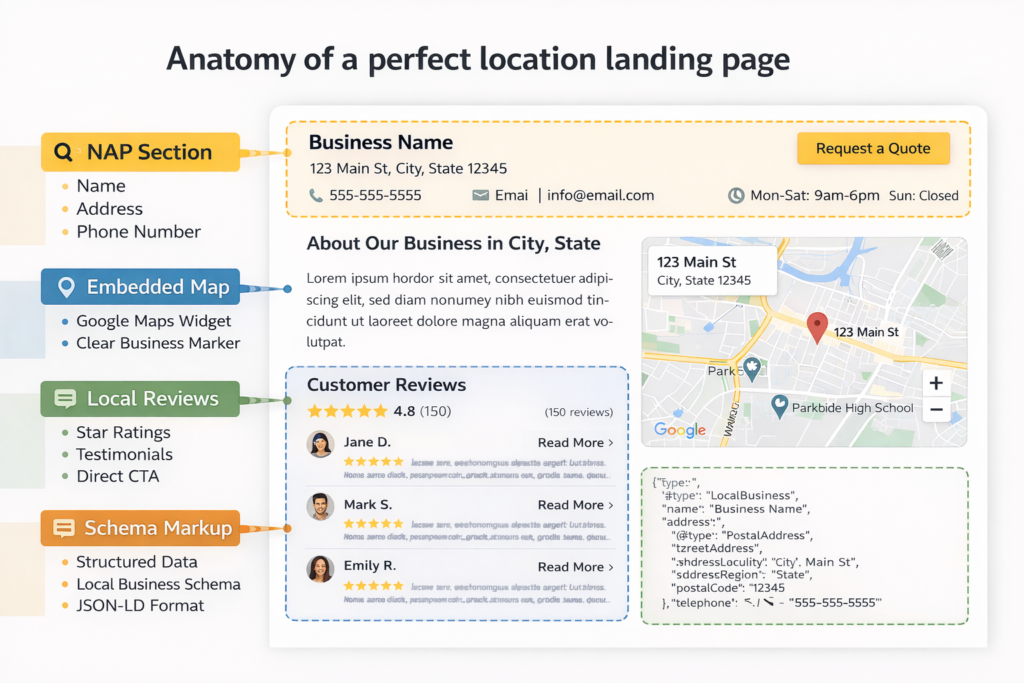
Location landing pages are the cornerstone of multi-location SEO. Each branch needs its own dedicated, uniquely written page — not a copy-paste template with only the city name swapped. Google’s quality guidelines penalize thin, duplicate content. More importantly, local customers convert better when they see relevant, locally resonant information.
What every location page must include
- Unique H1 with city/neighborhood name and primary service keyword
- Original introductory paragraph mentioning local context (landmarks, neighborhoods)
- NAP (Name, Address, Phone) data consistent with Google Business Profile
- Embedded Google Maps with the exact branch pin
- Location-specific customer reviews and testimonials
- Local team photos and branch-specific offers
- Clearly marked operating hours
- Structured data markup (LocalBusiness schema)
Mastering the right content length for location pages is equally important. Aim for at least 600–900 words of genuinely unique content per page to signal depth and authority to Google’s crawlers.
Google Business Profile Optimization for Every Branch
Your Google Business Profile (GBP) is your most powerful local ranking signal. For multi-location businesses, managing GBP at scale requires a systematic approach. Each profile must be individually optimized — not managed as a bulk afterthought.
- Claim and verify every locationEnsure each branch has a separate, verified GBP listing. Unverified listings rank significantly lower.
- Maintain NAP consistency across all listingsName, Address, and Phone must match exactly across GBP, your website, and all directories. Even formatting differences matter.
- Write unique business descriptions per locationAvoid copy-pasting the same description. Mention neighborhood-specific details, local specializations, and relevant nearby landmarks.
- Upload branch-specific photos regularlyGBP profiles with 100+ photos receive significantly more views. Include interior, exterior, staff, and product photos.
- Respond to every review with AI-aware languageResponses that include location names, service details, and natural language help signal relevance. Learn more about responding to reviews with AI in mind.
Schema Markup: The Technical Power Behind Local Rankings
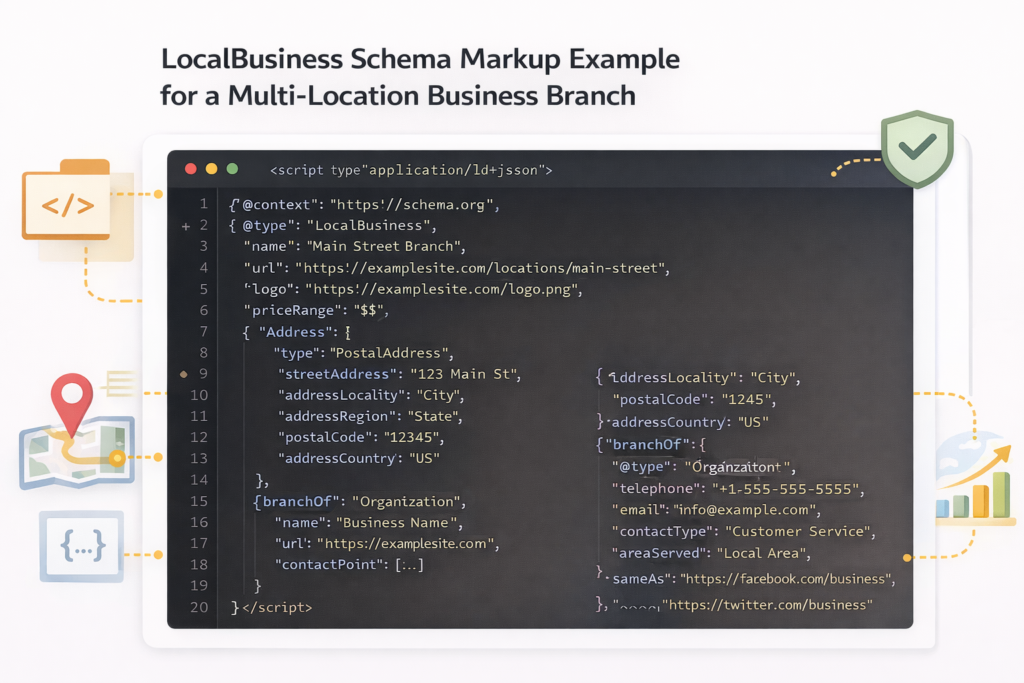
Schema markup (structured data) is how you speak directly to search engine algorithms. For multi-location businesses, properly implemented schema dramatically improves how Google understands, categorizes, and surfaces your branch pages. This is not optional — it is a core ranking factor for local SEO in 2025.
Our complete guide to schema markup covers every type you need, but for multi-location SEO, the following are non-negotiable:
| Schema Type | Purpose | Key Fields |
|---|---|---|
| LocalBusiness | Identifies each branch as a distinct local entity | name, address, geo, telephone, openingHours |
| Organization | Links all branches under the parent brand | legalName, url, sameAs, hasOfferCatalog |
| BreadcrumbList | Helps Google understand site hierarchy | itemListElement, position |
| FAQPage | Targets featured snippet positions | mainEntity, name, acceptedAnswer |
| Review / AggregateRating | Displays star ratings in search results | ratingValue, reviewCount |
Schema errors are among the most common issues we find during a technical SEO audit. After implementing schema, validate every location page using Google’s Rich Results Test. A single malformed tag can suppress rich results across your entire site.
Geo-Targeted Content Strategy: Winning Locally at Scale
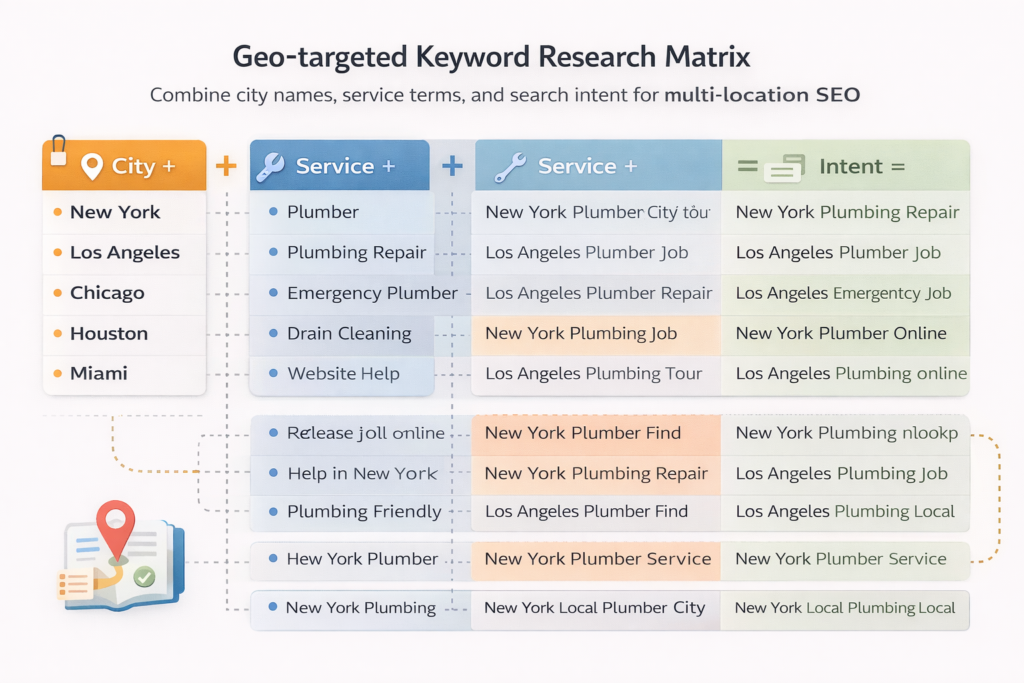
Publishing the same blog content and service descriptions across all location pages is one of the most common mistakes we see in multi-location SEO. Instead, your geo-targeted content strategy should treat each location as a mini-brand with its own voice, local references, and community relevance.
Content formats that work for local store marketing
- City-specific blog posts (e.g., “Best HVAC maintenance tips for Jaipur summers”)
- Local event coverage and community involvement stories
- Branch-specific case studies and customer success stories
- Location-tagged video content and Google Posts
- Area-specific FAQs addressing hyper-local questions
Effective geo-targeted keyword research is the foundation. Beyond the obvious “service + city” pattern, target long-tail phrases like “near me,” neighborhood names, and local landmarks that appear in real customer searches. You can also explore SEO automation tools to scale content creation across dozens of location pages without sacrificing quality.
Local Link Building at Scale: Building Authority for Every Branch
Backlinks from locally relevant, authoritative domains tell Google that your branch genuinely belongs in that community. For multi-location businesses, this means building separate link profiles for each location — not just pointing all links to your homepage.
High-impact local link building tactics
- Partner with local chambers of commerce and business associations
- Sponsor local events, schools, and community organizations
- Get listed in city-specific directories and industry portals
- Pitch guest posts to local news sites and neighborhood blogs
- Build relationships with complementary local businesses for cross-linking
- Leverage PR for branch openings, awards, and community milestones
For logistics-sector businesses, this is particularly valuable. Our breakdown of SEO for logistics and transportation websites shows how geo-specific authority building drives measurable visibility gains. Similarly, healthcare SEO relies heavily on local citation authority for trust signals.
Technical SEO for Multi-Location Websites
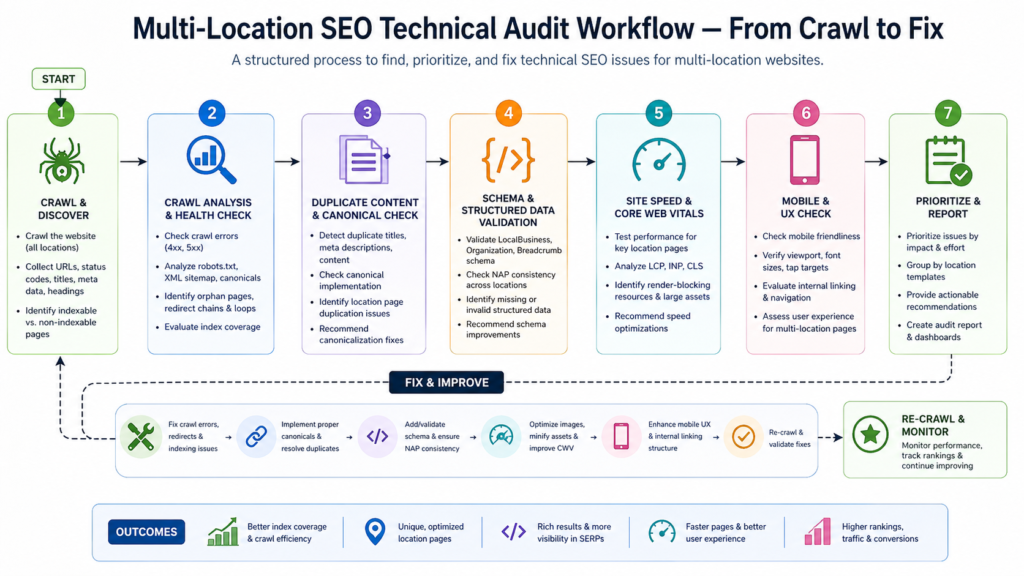
All the content and link building in the world cannot overcome a technically broken website. Multi-location sites face unique technical challenges: duplicate content risks, URL structure complexity, crawl budget allocation, and site speed across location pages.
Technical checklist for multi-location SEO
- Clean URL structure: /locations/city-name/ or /city-name/service/
- Canonical tags to prevent duplicate content penalties
- Hreflang tags for international multi-location businesses
- XML sitemap with all location pages explicitly listed
- Core Web Vitals passing for every location page template
- Mobile-first design with location-specific CTAs prominent on small screens
- Internal linking between related location pages and service pages
Conduct a thorough SEO audit of your location pages at least quarterly. Use our technical SEO for website performance guide to benchmark your page speed and Core Web Vitals — both are direct ranking factors. You can also check your Core Web Vitals optimization status to ensure location templates do not suffer from layout shifts or delayed interactivity.
Pro tip: Ensure your image alt text is optimized on every location page. Images with geo-specific alt text (e.g., “HVAC service team in Jaipur, Rajasthan”) provide additional local relevance signals that many competitors overlook.
How to Measure the Success of Your Multi-Location SEO
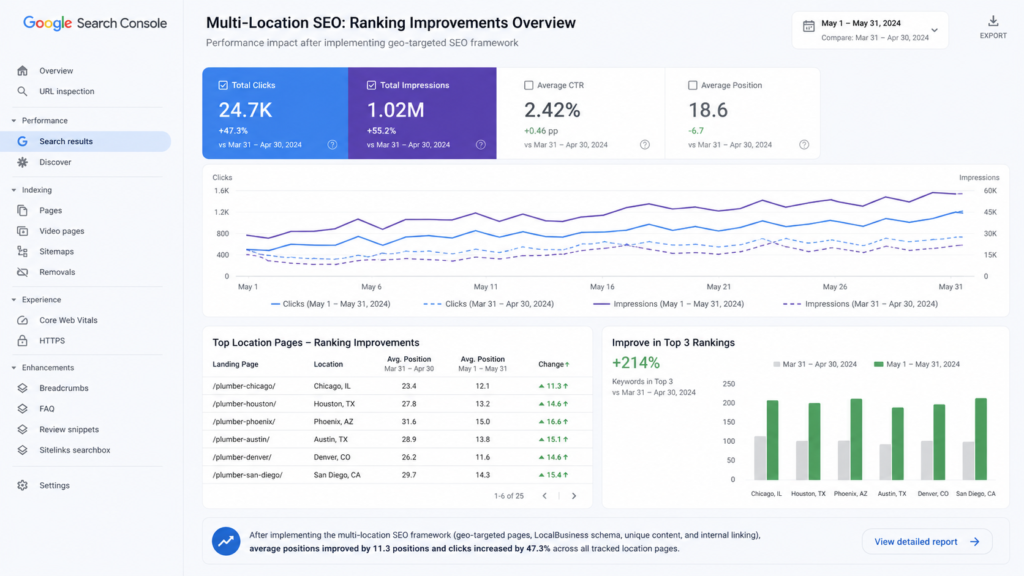
Tracking multi-location SEO performance requires location-level granularity. Aggregate website metrics mask what is actually happening at each branch. Set up separate Google Search Console properties or filtered views for each location group, and monitor these KPIs consistently.
- Organic impressions and clicks per location page (Search Console)
- Local pack appearances and map views (GBP Insights)
- Direction requests and phone call clicks per branch
- Branded vs. non-branded organic traffic split per city
- Conversion rate from location pages (form fills, calls, bookings)
- Review velocity and average star rating per GBP listing
If you are unsure what signals to watch, our guide on how to know if your SEO is working walks through a practical measurement framework. For franchise networks specifically, our franchise digital marketing ROI strategies break down how to report performance across dozens of locations to stakeholders clearly and credibly.
Frequently Asked Questions About Multi-Location SEO
Regular local SEO targets one location for nearby searches. Multi-location SEO scales across many branches, requiring unique pages, profiles, schema, and link-building for each area.
You need one unique location page per branch or service area. Avoid duplicate content; create distinct pages with details to prevent penalties and improve rankings.
Schema markup provides details like address, phone, hours, and services. It helps search engines identify each branch, boosting visibility in local packs and rich results.
No. Duplicate or templated location pages harm rankings. Each page must include unique introductions, details, reviews, and context to ensure relevance and avoid filtering properly.
Most businesses see improvements within 60–90 days. Achieving strong local dominance across locations usually takes 6–12 months, depending on competition, authority, and consistent optimization efforts
Conclusion: Build a Local SEO Machine That Works at Scale
Multi-location SEO is not a one-time project — it is an ongoing system. From building uniquely written location pages and optimizing every Google Business Profile, to implementing precise schema markup and earning local backlinks, every element compounds over time to give your branches an unassailable local presence.
The businesses winning local search today are those that treat geo-targeted SEO as a structured discipline, not an afterthought. They audit regularly, create locally authentic content, manage their online reputation proactively, and stay technically sound.
Ready to dominate local search across every branch? Explore our full range of enterprise digital marketing services, or start with a free SEO report to see exactly where your locations stand today. You can also learn about our local SEO services and discover how we have helped businesses of all sizes build dominant local search presences from the ground up.

About the author
Ujjwal Kumawat
I specialize in SEO, website development, Google Ads and online business growth strategies. Through my blogs, I share practical insights, marketing tips and proven strategies to help businesses improve their online visibility, generate more leads and grow faster in the digital space.