Enterprise marketing doesn’t fail due to budget limits but from poor coordination across teams. Managing SEO, paid media, content, and technical systems with separate goals and data. Enterprise growth strategy aligns these functions into a unified, compounding system. By integrating large-scale SEO with performance marketing and shared data, brands unlock stronger, cross-channel growth.
This guide explains how enterprise SEO differs, how channels integrate. How automation manages scale, and how to build strategies that drive consistent, long-term growth.
Why Enterprise Growth Strategy Differs from Standard Marketing
The principles of effective marketing apply at every scale. The execution constraints are fundamentally different at the enterprise level. Strategies that work for mid-market businesses frequently fail when applied to large organisations without significant adaptation.
The structural challenges unique to enterprise scale
- Volume complexity: Enterprise websites routinely manage tens of thousands to millions of indexable pages. SEO decisions that affect page templates, internal linking patterns, or site architecture propagate across the entire inventory requiring a different decision-making framework from page-by-page optimisation.
- Organisational coordination: Enterprise SEO involves legal review of content claims, brand compliance for messaging, technical release cycles. It govern when changes can be deployed, and procurement processes for tool selection. Decisions that a small team makes in a day take weeks in an enterprise context.
- Data fragmentation: Large organisations accumulate data in disconnected systems paid media data in ad platforms, organic data in Search Console, customer data in the CRM, product data in the ERP. Without deliberate integration, these systems produce contradictory signals and prevent coherent attribution.
- Budget allocation politics: Enterprise marketing budgets are negotiated across teams and quarters. Performance marketing spend and SEO investment are often managed by different functions with different reporting lines, creating structural barriers to the cross-channel coordination that enterprise growth strategy requires.
What enterprise growth strategy addresses
Enterprise growth strategy is not a channel strategy. It is a coordination framework that defines how organic search, paid channels, technical infrastructure, and content production work together toward shared revenue outcomes. The most competitive enterprise brands treat their marketing stack as a single system with interdependent components rather than a portfolio of independent channels.
For a comprehensive view of digital marketing strategy frameworks at scale, see Adclickr digital marketing strategies guide which covers the full strategic architecture that enterprise growth builds upon.
| Dimension | Mid-Market Marketing | Enterprise Growth Strategy |
| SEO scope | Hundreds to low thousands of pages | Tens of thousands to millions of pages |
| Content production | Centralised small team | Distributed across markets, languages, functions |
| Paid channel management | Single team, unified budget | Multiple teams, markets, and budget centres |
| Attribution | Last-click or simple multi-touch | Advanced cross-channel models tied to CRM revenue |
| Technical governance | Agile changes deploy frequently | Controlled release cycles with compliance review |
| SEO automation | Selective specific manual tasks | Systematic handles volume no manual process can |
Large-Scale SEO Architecture: How Enterprise Organic Search Is Built
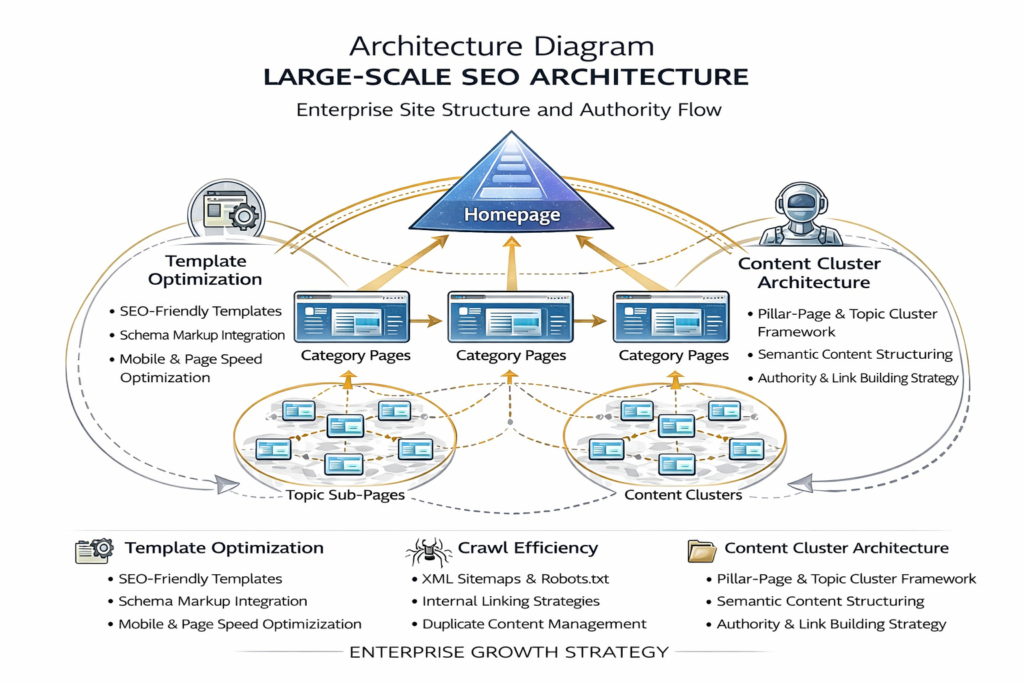
Large-scale SEO is not standard SEO applied to more pages. It requires a fundamentally different architectural approach one that prioritises template-level decisions over page-level decisions, systemic monitoring over periodic audits, and programmatic content production over individually crafted pages.
Template-level optimisation at enterprise scale
When a site has one hundred thousand product pages, the most important SEO decisions are not about any individual page they are about the template that governs all of them. Title tag structure, meta description format, heading hierarchy, internal link placement, and schema markup are all applied at the template level. A single template optimisation that improves click-through rate by two percentage points across a hundred thousand pages produces more total organic traffic than any single page optimisation ever could.
Schema markup implementation at scale is one of the highest-leverage template-level decisions. See Adclickr complete schema markup guide for implementation guidance across large page inventories.
Crawl efficiency and indexing architecture
Search engine crawl budgets are finite. Enterprise sites must earn and preserve crawl budget by ensuring that search engine bots spend their limited attention on pages that matter. Thin pages, duplicate content variations, parameterised URLs without unique value, and orphaned page clusters all consume crawl budget without contributing to organic visibility.
Enterprise SEO architecture requires systematic crawl efficiency management: canonical tag governance, noindex directives for non-valuable pages, XML sitemap segmentation by content type, internal linking that concentrates authority on high-priority page clusters, and log file analysis to verify that intended crawl patterns are actually occurring.
Technical SEO infrastructure forms the foundation of large-scale SEO performance. See Adclickr technical SEO for website performance for the technical architecture that enterprise organic programmes depend on.
For a systematic audit approach across large site inventories, see Adclickr technical SEO audit checklist which covers enterprise-specific audit dimensions.
Enterprise brands building organic authority across broad topic areas require a content architecture that clusters related pages into coherent thematic structures. Pillar pages covering broad topics link to cluster pages covering specific subtopics, creating an internal linking structure that signals topical depth to search engines and distributes authority efficiently across the content inventory.
Content length and depth decisions at enterprise scale require data-driven benchmarking. See Adclickr guide on how to identify the right content length for the research framework behind content scope decisions.
Performance Marketing at Enterprise Scale: Integration Over Isolation
Enterprise performance marketing fails most often not because of poor creative or insufficient budget, but because it operates in isolation from organic channels, customer data, and lifetime value metrics. The most sophisticated enterprise growth strategies treat paid channels as part of a coordinated system rather than an independent revenue driver.
How paid and organic channels should interact at enterprise scale
- Shared audience intelligence: The customer segments that performance marketing identifies as highest-value should inform organic content priorities. If paid data reveals that a specific audience segment converts at two times the average rate, organic content should be built to capture that segment’s informational queries earlier in the funnel.
- Paid coverage for organic gaps: Enterprise organic programmes take months to rank for competitive terms. Paid search can cover high-value terms that organic has not yet claimed, preventing revenue loss during the organic ramp-up period. This requires regular coordination between SEO and paid teams on keyword priority and ranking progress.
- Suppression and audience sharing: Customers already engaged through organic channels should be excluded from broad paid acquisition targeting. Paid budgets are preserved for genuine new audience acquisition when first-party data from organic interactions is used to create suppression lists across ad platforms.
- Cross-channel attribution calibration: Enterprise attribution models must account for the interaction between paid and organic touchpoints across complex, multi-session buying journeys. Last-click models systematically undervalue organic’s role in creating the awareness and consideration that paid channels convert.
For enterprise brands managing paid and organic across multiple locations, see Adclickr enterprise digital marketing services for how cross-channel coordination is structured at enterprise scale.
SEO Automation: The Infrastructure Enterprise Organic Cannot Survive Without
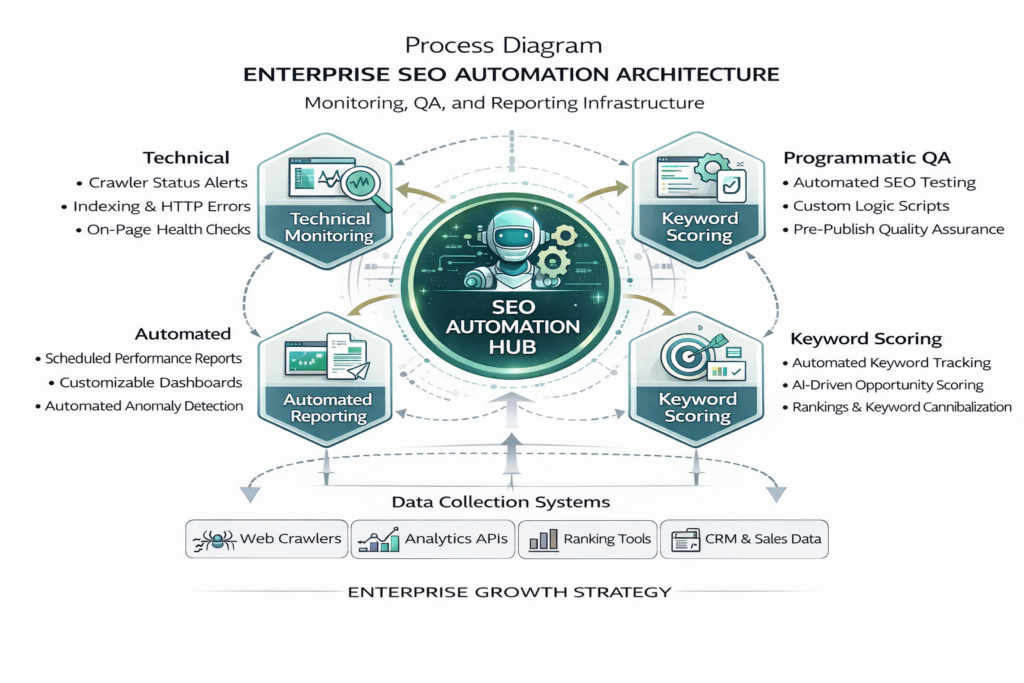
SEO automation is not optional at enterprise scale it is a prerequisite. Manual SEO processes that work for sites with a few hundred pages break down completely when applied to inventories of tens of thousands of pages. Enterprise organic search programmes require automation infrastructure for monitoring, reporting, opportunity identification, and quality assurance.
Where SEO automation creates enterprise-scale leverage
- Automated technical monitoring: Enterprise sites change constantly new pages are published, redirects are added, templates are modified, third-party scripts are updated. Automated crawling and monitoring detect technical regressions as they occur rather than after they have compounded into ranking losses across thousands of pages.
- Programmatic content quality assurance: At enterprise content volumes, human review of every page before publication is impractical. Automated QA systems check content against SEO requirements title tag length, meta description presence, heading hierarchy, internal link targets, image alt text before publication, preventing quality regressions at scale.
- Automated keyword opportunity scoring: Enterprise keyword research involves thousands of terms across multiple markets and languages. AI-powered scoring systems evaluate opportunity across this universe simultaneously, prioritising by traffic potential, competition level, and alignment with existing content a process that would take analyst teams weeks to complete manually.
- Scheduled reporting and anomaly detection: Enterprise SEO reporting involves data from multiple sources Search Console, analytics platforms, rank tracking tools, log files. Automated reporting consolidates these sources and flags anomalies sudden ranking drops, crawl error spikes, Core Web Vitals regressions before they reach the weekly review cycle.
For a practical implementation of SEO automation frameworks, see Adclickr SEO automation guide which covers the automation architecture that enterprise organic programmes require.
Understanding how to validate that your SEO programme is functioning correctly before scaling automation is covered in how to know if your SEO is working a foundational prerequisite.
Industry-Specific Enterprise Growth Applications
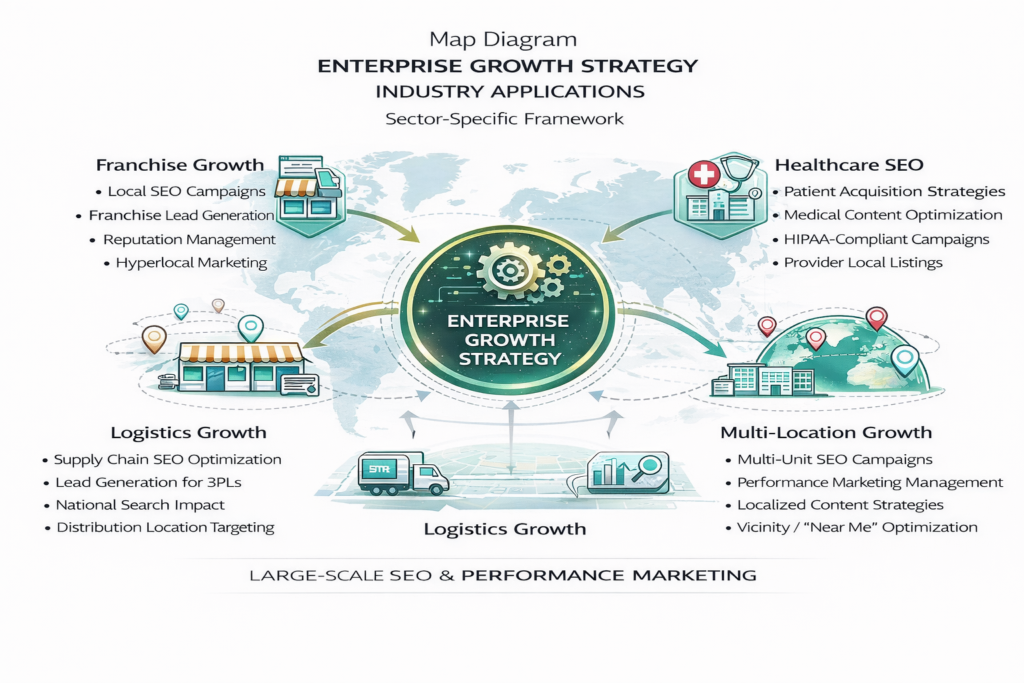
Franchise and multi-location enterprise brands
Enterprise brands operating across hundreds or thousands of locations face a specific version of the large-scale SEO challenge: maintaining national brand authority while ensuring each location has the local organic visibility to capture nearby search demand. This requires a content architecture that distinguishes national informational content from localised service and product content, a link acquisition strategy that builds both national domain authority and local citation profiles, and a technical structure that prevents location pages from cannibalising each other.
Franchise enterprises have specific coordination requirements across their location networks. See Adclickr franchise digital marketing ROI strategies for the enterprise franchise growth framework.
Enterprise franchise SEO requires specialist architecture at scale. See Adclickr enterprise SEO services and
Adclickr franchise SEO services for the technical and content frameworks specific to franchise brand structures.
Healthcare, logistics, and regulated sector enterprise brands
Regulated industry enterprise brands face compliance constraints that affect content creation, link acquisition, and paid channel targeting. Healthcare enterprise SEO must navigate E-E-A-T (Experience, Expertise, Authoritativeness, Trustworthiness) requirements more rigorously than standard categories. Logistics brands managing large site inventories must structure content to capture both commercial and operational search queries effectively.
Healthcare enterprise brands require sector-specific SEO architecture. See Adclickr SEO guide for hospitals and healthcare websites for compliance-aware enterprise SEO strategy.
Logistics enterprise brands face unique content and keyword architecture challenges. See Adclickr SEO guide for logistics and transportation websites for sector-specific enterprise growth strategy.
Future-Proofing Enterprise Growth Strategy in 2026
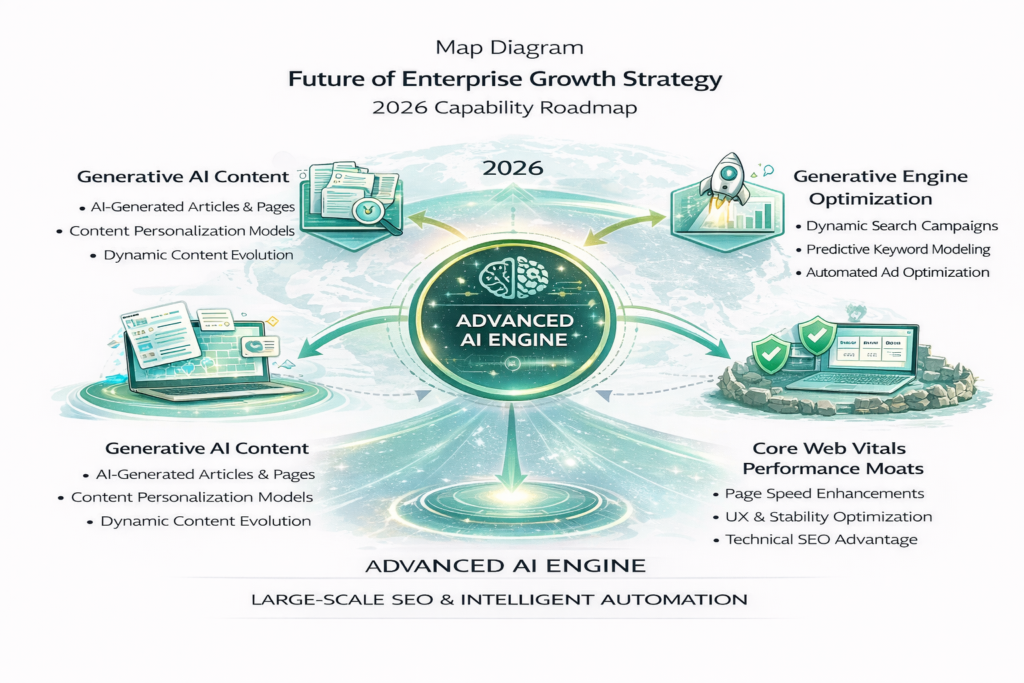
Generative AI and large-scale content production
AI-generated content at enterprise scale compresses the production cycle for content cluster expansion significantly. Brands that build quality control workflows around AI production using AI for draft generation and human editors for quality and brand compliance review can expand topical coverage faster than competitors running fully manual content programmes.
Understanding how AI converts and transforms content at scale is foundational to building enterprise AI content workflows. See Adclickr guide on how AI converts text and images into video for how generative AI applies to enterprise content production.
Generative engine optimisation for AI search surfaces
AI-powered search experiences are changing how enterprise brand content is surfaced. Google AI Overviews, ChatGPT search, and Perplexity increasingly answer queries by synthesising content from cited sources rather than directing users to click through. Enterprise brands whose content consistently appears as a cited source in these AI-generated answers gain visibility that operates independently of traditional ranking positions.
Generative engine optimisation is one of the most significant frontier areas for enterprise growth strategy. See Adclickr guide to geo-generative engine optimisation for how enterprise brands position content for AI search citation.
Core Web Vitals and site performance as competitive moats
Enterprise brands operating large, complex sites face inherent performance challenges third-party script accumulation, image-heavy templates, JavaScript-heavy interactive features that smaller competitors do not. Brands that invest systematically in Core Web Vitals performance and site speed create a technical advantage that is difficult for smaller competitors to replicate at the same content scale.
Core Web Vitals optimisation at enterprise scale requires systematic, template-level intervention. See Adclickr Core Web Vitals optimisation guide for enterprise performance benchmarks and implementation frameworks.
Site speed optimisation directly affects both organic ranking and paid channel Quality Scores. See Adclickr site speed optimisation guide for the revenue impact calculations that justify enterprise performance investment.
Frequently Asked Questions
Enterprise growth strategy integrates SEO, paid, content, and data into one system, focusing on cross-channel coordination and shared outcomes, unlike traditional marketing’s siloed channel optimisation approach.
Large-scale SEO focuses on template-level optimisation, automated monitoring, crawl budget management, and structured content architecture, enabling scalable performance across thousands of pages beyond manual processes.
Enterprise brands should align SEO and paid channels through shared audience data, keyword strategies, attribution models, and content planning to maximise efficiency and cross-channel performance outcomes.
Key priorities include crawl budget optimisation, Core Web Vitals, schema markup, and canonical structures, ensuring efficient indexing, better performance, and scalable SEO impact across large sites.
Results vary: paid channels show impact quickly, SEO improvements take weeks to months, while content and link-building compound over time, with full benefits visible within six to twelve months.
Conclusion: Enterprise Growth Strategy as a Compounding System
Enterprise growth strategy is not a collection of channel tactics at larger budget. It is a system architecture decision about how SEO, paid channels, content, technical infrastructure, and data work together. The brands that outperform at enterprise scale are not those with the largest budgets they are those with the most coordinated systems.
For enterprise brands building this capability with expert strategic and technical support, Adclickr enterprise SEO and digital marketing services provide the infrastructure for scaling enterprise growth strategy across channels and markets.
Contacts | Free SEO Report | All Services

About the author
Ujjwal Kumawat
I specialize in SEO, website development, Google Ads and online business growth strategies. Through my blogs, I share practical insights, marketing tips and proven strategies to help businesses improve their online visibility, generate more leads and grow faster in the digital space.