Is your logistics company spending thousands on Google Ads while your organic visibility for SEO for logistics companies sits at zero?
You’re not alone. Most logistics and transportation businesses pour budget into paid campaigns while ignoring the organic channel that delivers the highest-quality leads at the lowest long-term cost. SEO for logistics companies works differently from general digital marketing, because buyers in this industry are decision-makers with specific, high-intent needs.
They search for freight forwarding, warehousing, supply chain management, and last-mile delivery with purchasing intent already formed ranking for these searches puts your business in front of the right people at exactly the right moment, without paying for every single click.
What Is SEO for Logistics?
SEO for logistics is the process of optimising a logistics or transportation company’s website so it ranks prominently for the queries potential clients are actively searching. It combines keyword strategy, on-page optimisation, technical performance, local search presence, and content that demonstrates real expertise in freight, supply chain, and transportation services.
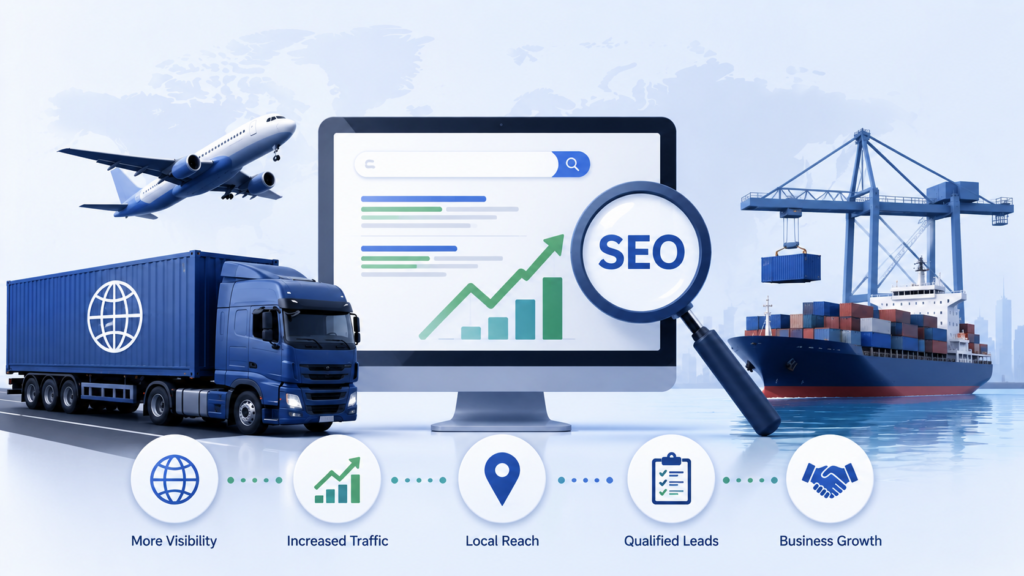
The goal is not just traffic. The goal is qualified, high-intent traffic from shippers, procurement managers, and operations directors who are actively evaluating logistics partners. Unlike consumer searches, B2B logistics searches carry strong purchase intent. A business searching “temperature-controlled freight services Mumbai” is not browsing. They are evaluating providers right now.
For logistics companies that want to reduce dependency on paid search and build sustainable organic visibility. The SEO services tailored to the industry deliver compounding returns that paid advertising cannot replicate.
How Logistics SEO Differs from General SEO
Most SEO frameworks are built for consumer brands or SaaS companies where high-volume keywords and social sharing drive results. Logistics SEO operates on entirely different principles.
Longer sales cycles. Logistics contracts are high-value and involve multiple decision-makers. A prospect may research for weeks before making contact. Your SEO strategy must nurture through every stage of that research journey, not just capture the final conversion click.
B2B audience behaviour. Decision-makers in logistics use specific, technical search language. They search for service types, route-specific solutions, compliance-related queries, and operational efficiency topics. Generic SEO content does not reach them.
Location specificity. Logistics is inherently geographic. Routes, warehouses, distribution hubs, and regional coverage areas all define how potential clients search. A company offering freight services between Delhi and Mumbai needs to rank. As for that specific route query, not generic freight terms.
Compliance and trust signals. Logistics clients scrutinise service providers carefully before committing. Your website must communicate certifications, operational history, safety standards, and case studies. These trust signals directly affect both conversion rates and how search engines evaluate your authority.
Understanding these distinctions is the first step. You can read a broader strategic foundation in our digital marketing strategies guide. As to see how logistics SEO fits within a complete growth framework.
Keyword Research for Logistics Companies
Effective logistics SEO begins with structured keyword research to understand exactly what your ideal clients type into Google. The keyword landscape for logistics divides into three intent categories, each requiring a different content approach.
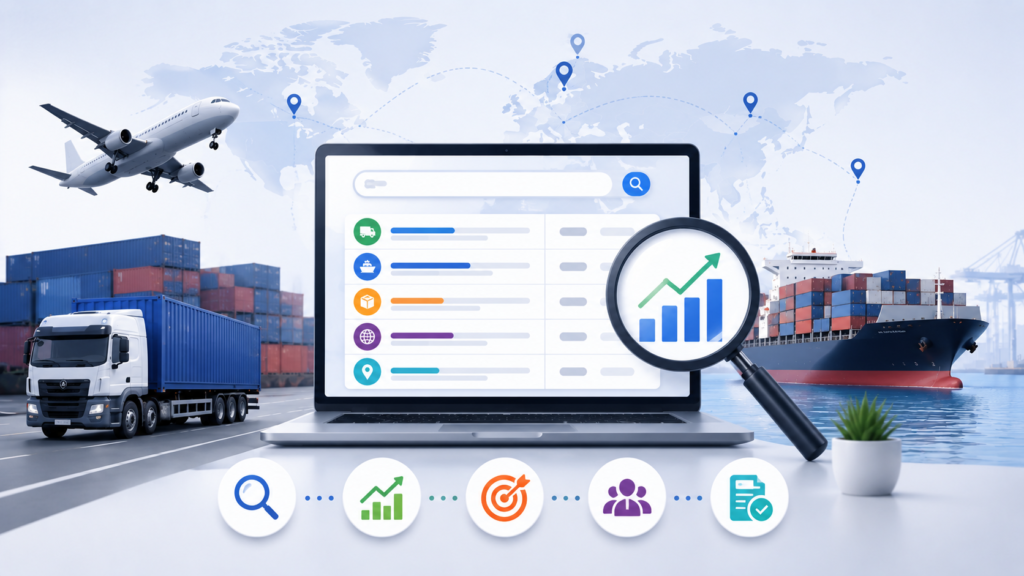
Informational keywords target clients in the research phase. Examples include “how to choose a freight forwarding company,” “what is 3PL logistics,” and “supply chain optimisation strategies.” These build topical authority and bring decision-makers into your ecosystem early.
Commercial keywords target active evaluators comparing providers. Examples include “best logistics companies in India,” “freight forwarding services comparison,” and “3PL warehouse providers near me.” These queries need service pages and case study content to convert.
Transactional keywords capture clients ready to make contact. Examples include “freight quote online,” “logistics services in Jaipur,” “cargo shipping company contact,” and “request logistics proposal.” These need optimised landing pages with clear conversion actions.
Family keywords for logistics SEO that should be woven throughout your content and page structure include:
Logistics company SEO, transportation SEO, freight forwarding SEO, supply chain marketing. Also logistics website optimisation, SEO for shipping companies, local SEO for logistics. The B2B logistics digital marketing, logistics lead generation, cargo company online visibility, trucking company SEO, and warehouse SEO.
Using tools like Google Keyword Planner and Search Console helps identify which terms your target clients in specific regions are actually using. Combining this data with a geo-targeted SEO approach ensures your content matches the precise language of your regional market.
On-Page SEO for Logistics Websites
Every page of your logistics website should be built around a specific search intent and keyword cluster. Weak on-page SEO is the most common reason logistics websites fail to rank despite having strong services.
Service pages are the most important pages on a logistics website for SEO. Each service you offer freight forwarding, warehousing, last-mile delivery, customs clearance, cold chain logistics deserves its own dedicated page optimised for the specific queries clients use when searching for that service. Generic combined service pages rank for nothing specific.
Meta titles and descriptions must include the primary keyword naturally and communicate a clear value proposition. A meta title like “Freight Forwarding Services in Delhi | Adclickr Logistics” targets both the service and location simultaneously.
Header structure using H1, H2, and H3 tags should reflect the natural language of your target keyword clusters. Headers help both search engines understand page structure and users navigate content efficiently.
Image optimisation across your website should include descriptive alt text, compressed file sizes, and relevant file names. A detailed guide to image alt text and SEO covers the exact implementation steps.
Internal linking between service pages, location pages, case studies, and blog content. It distributes authority across your site and helps Google understand which pages are most important. Every page should connect logically to at least two other relevant pages on your site.
For websites requiring a complete rebuild with SEO built into the architecture from the ground up, professional website development services ensure the technical and structural foundations support long-term ranking performance.
Local SEO for Logistics and Transportation
Logistics is one of the most location-dependent industries in existence. Most clients search for providers in specific cities, along specific routes, or serving specific regions. Local SEO for logistics captures this demand and converts it into direct enquiries. A strong local SEO foundation is what makes that possible.
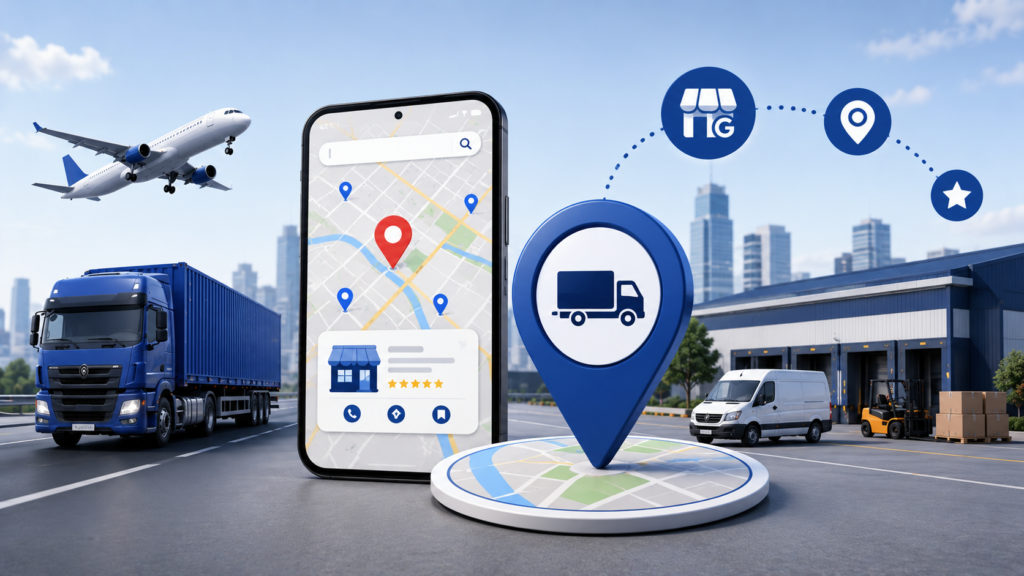
Google Business Profile is the foundation of local logistics SEO. A fully optimised profile with accurate service descriptions, operating hours, service areas, and regularly updated photos outperforms profiles that are left incomplete. Actively requesting reviews from satisfied clients and responding to all reviews, both positive and negative, signals trust to both Google and prospective customers.
Location-specific landing pages should be created for every city, region, or route your company services. A page targeting “freight services in Pune” with content specifically about your operations in that market will outrank a generic national services page for Pune-based searches every time.
Local citation consistency across business directories, industry platforms, and map services ensures Google can confidently verify your business information. Inconsistent name, address, and phone number data across listings actively suppresses local rankings.
For companies operating across multiple cities or regions, a structured multi-location SEO guide provides the framework for scaling local visibility systematically across all service areas without duplicating content or cannibalising rankings. If you’d rather have this managed for you, our local SEO services handle citation building and Google Business Profile optimisation for logistics clients directly.
Three Main Technical SEO Foundations for Logistics Sites
No amount of content or keyword strategy compensates for technical problems that prevent Google from crawling and indexing your pages correctly. Logistics websites often accumulate technical debt over time, particularly as they add new service pages, route pages, and blog content without a structured technical review.
Site speed is a direct ranking signal and a conversion factor. A slow logistics website loses potential clients at the very moment they are evaluating whether to make contact. Site speed optimisation covers the specific improvements that deliver the greatest performance gains.
Mobile-first indexing means Google’s mobile-first indexing documentation to determine rankings for all devices. The majority of logistics decision-makers now use mobile devices for initial research. A site that performs poorly on mobile loses rankings across all devices.
Google’s Core Web Vitals guidance measure loading performance, interactivity, and visual stability. Poor scores on any of these metrics actively suppresses rankings. A complete breakdown of how to measure and improve these scores is available in our Core Web Vitals optimisation guide.
Other Technical SEO Foundations for Logistics Sites
Crawl budget becomes a real constraint once a logistics site publishes pages for every route, hub, and service area combination. Search engines allocate a finite number of pages they’ll crawl on any given visit, and thin or near-duplicate location pages waste that budget on pages that were never going to rank. Use canonical tags to point near-identical route or city variations to the strongest version of that page, keep a clean, current XML sitemap so Google can prioritise your most important service and location pages, and block low-value parameter or filter URLs in robots.txt rather than letting Googlebot spend its budget crawling them. A properly configured robots.txt file and an up-to-date XML sitemap make this prioritisation explicit for Google.
Schema markup for logistics websites should include Organisation schema, Service schema, LocalBusiness schema, and Review schema. Structured data helps search engines understand exactly what your company does, where you operate, and how clients rate your services. Our schema markup complete guide provides implementation instructions for every relevant schema type. For the exact JSON-LD syntax for each schema type, see our schema markup for WordPress guide.
Running a thorough technical SEO audit across your logistics website identifies every crawl error, indexing issue, broken link, and performance problem that is silently suppressing your rankings.
Content Marketing Strategy for Logistics
Content is what builds topical authority in your niche and earns the trust of both search engines and potential clients. Logistics companies that publish consistent, expert-level content rank for a much broader range of queries than those whose websites contain only static service pages.
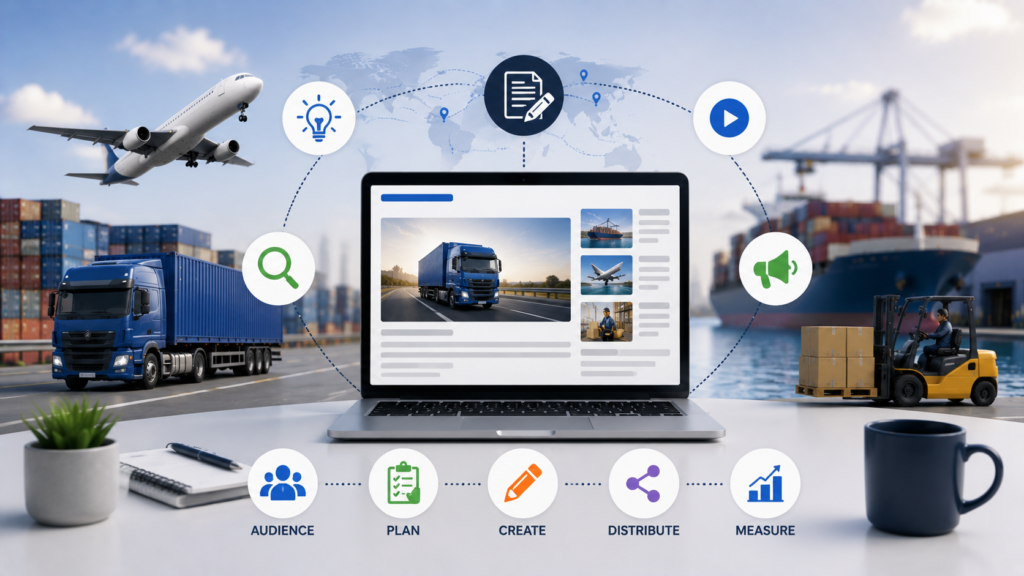
Blog content targeting informational keywords serves dual purposes. It brings potential clients into your website at the research stage and establishes your company as a knowledgeable industry voice. Topics like “how to reduce freight costs,” “customs clearance explained,” “choosing the right 3PL partner,” and “last-mile delivery challenges and solutions” address the exact questions logistics buyers ask before committing to a provider.
Case studies are among the highest-converting content formats in B2B logistics marketing. A detailed case study showing how you reduced a client’s shipping costs by 30% or improved their delivery time across a specific route is more persuasive than any service description. It provides social proof, demonstrates operational capability, and targets the specific outcome-based searches that high-intent buyers use.
Industry insights and regulatory updates position your company as a current, informed resource. Changes in customs regulations, new international shipping routes, evolving compliance requirements, and supply chain disruptions are all topics that logistics buyers actively search for.
Content length and quality matter significantly for competitive logistics keywords. Our guide on identifying the right content length helps you calibrate depth to match what Google is currently rewarding for specific query types in your sector.
Consistent content production requires either dedicated internal resources or professional content writing services that understand the logistics industry and can produce technically accurate, SEO-optimized material at the pace your strategy requires.
Real-World Impact: What Logistics SEO Results Look Like
SEO results in logistics compound rather than spike. A regional freight or Dunnrite Groupage Service Limited that consistently publishes service, location, and route pages typically sees this kind of progression:
| Timeframe | Typical Outcome |
|---|---|
| Months 1–3 | Technical fixes and new service pages get indexed; low-competition, long-tail route and city keywords begin appearing on page 2–3 |
| Months 3–6 | Local pack visibility improves for priority cities; first organic quote requests start arriving |
| Months 6–12 | Primary commercial keywords (e.g., “3PL warehouse provider [city]”) move into the top 10; organic enquiries become a repeatable, trackable channel |
To confirm whether your own logistics SEO investment is paying off, use the diagnostic framework in how to know if your SEO is working.
Link Building and Authority in the Logistics Sector
Backlinks from relevant, authoritative websites remain one of Google’s strongest ranking signals. For logistics companies, building a strong backlink profile requires a targeted approach to the specific publications, directories, and industry platforms that carry weight in this sector.
Industry directories and trade associations such as logistics trade bodies, freight forwarding associations, and transport industry publications provide highly relevant backlinks that signal to Google your company is a genuine, established player in the logistics sector. These links also compound your domain authority over time, which strengthens every other page on your site, not just the one being linked to.
Guest posting on supply chain management publications, business logistics platforms, and trade media outlets build both backlinks and brand visibility among the exact audience you are trying to reach.
Digital PR around company milestones, new route launches, technology investments, or operational achievements generates coverage in business publications that link back to your website.
Running a structured backlink audit identifies your current link profile, highlights toxic links that may be suppressing rankings, and reveals the competitor backlink patterns that show where the most valuable link opportunities exist for your specific market position.
Pair this with a broader look at link building strategies specific to B2B industries like logistics.
AI Search and Logistics Visibility in 2026
The search landscape for logistics has fundamentally changed. AI-powered search experiences including Google AI Overviews, ChatGPT search, and Microsoft Copilot now influence how buyers discover and evaluate logistics providers before they ever visit a website.

Logistics buyers increasingly use conversational queries such as “which freight company is best for shipping electronics from India to Germany” or “what should I look for in a 3PL provider.” AI systems generate direct answers to these queries by drawing from websites that demonstrate strong topical authority, clear structured data, and verified expertise signals.
To appear in AI-generated answers, your logistics website needs comprehensive topic coverage across the full buyer research journey, structured data that clearly communicates your services and location, and E-E-A-T signals including author credentials, case studies, certifications, and client testimonials.
Understanding generative engine optimisation and how Google’s documentation on AI-generated search features systems select content to cite is now as important as traditional keyword ranking strategy for logistics companies operating in competitive markets.
AI SEO services combine traditional optimisation with AI-readiness signals, ensuring your logistics website performs well across both conventional search results and the AI-powered experiences that are growing rapidly as a traffic and lead generation channel.
Measuring Logistics SEO Performance
SEO without measurement is guesswork. Logistics companies need to track specific metrics that connect organic search activity to business outcomes rather than vanity metrics that look impressive but do not reflect lead generation.
Organic traffic by service category shows which areas of your business are gaining search visibility and which need more content investment.
Keyword ranking movement for your primary commercial and transactional terms indicates whether your optimisation work is translating into improved positions.
Lead volume from organic search tracked through Contact form submissions, phone call tracking, and quote requests attributed to organic sessions is the most important metric for logistics SEO because it directly connects ranking performance to revenue pipeline.
Crawl health monitoring through Google Search Console tracks indexing errors, coverage issues, and Core Web Vitals performance across your site on an ongoing basis.
Connecting all of these data points through structured analytics and reporting dashboards gives your team a clear picture of SEO performance and enables data-driven decisions about where to invest additional optimisation effort.
To understand whether your current SEO investment is actually working, our guide on how to know if your SEO is working in 2026 provides a practical diagnostic framework for logistics companies at any stage of their SEO journey.
If your logistics site spans multiple regions or business units, a dedicated enterprise SEO framework keeps measurement consistent across teams.
Frequently Asked Questions
Optimising a logistics website to rank for freight, warehousing, and delivery queries, generating qualified organic leads at lower long-term cost than ads.
Most see ranking improvements in 3–6 months. Competitive keywords take 6–12 months. Local SEO typically shows results faster.
Target service keywords, transactional keywords like “logistics company in [city],” and informational keywords. Long-tail location+service phrases generate the most qualified leads.
Yes. Most clients search by geographic area or route. Local SEO is often the fastest way to generate new enquiries.
It builds topical authority by answering buyer questions case studies, guides, and route-specific content attract traffic and convert researchers into enquiries.
Costs vary by competitiveness and locations targeted, but most companies budget for ongoing monthly engagement rather than a one-time project.
Most logistics companies benefit from both: PPC for immediate visibility on high-intent transactional terms, and SEO for the compounding, lower-cost-per-lead traffic that keeps generating enquiries long after a campaign budget would have run out. Our guide to performance marketing vs growth marketing breaks down when each channel earns priority.
3PL manages physical logistics; 4PL manages supply chain strategy. 3PL targets service+location terms; 4PL targets strategic, consultative queries.
Yes. Defining industry terms like Incoterms, HS codes, and dwell time in plain language builds topical authority, captures long-tail informational searches, and gives AI search tools clear, citable definitions.
Conclusion
SEO for logistics is one of the highest-return digital investments available to transportation and supply chain businesses in 2026. While competitors rely on paid advertising with its rising costs and disappearing returns, companies that build strong organic visibility accumulate an asset that generates leads continuously.
The strategy is clear: research the specific keywords your buyers use, optimise every service page for search intent, build local visibility for every market you serve, fix technical issues that prevent Google from indexing your site correctly, publish expert content that builds authority, and measure results against lead generation outcomes rather than traffic alone.
Whether you are a regional freight company, a global 3PL provider, or a specialist logistics operator, the organic search channel rewards consistent, strategic investment with qualified leads from buyers who are actively looking for exactly what you offer.
For a complete review of your current logistics website SEO performance and a tailored strategy, explore our enterprise growth SEO approach or read our dedicated guide on SEO for logistics and transportation websites.

About the author
Ujjwal Kumawat
I specialize in SEO, website development, Google Ads and online business growth strategies. Through my blogs, I share practical insights, marketing tips and proven strategies to help businesses improve their online visibility, generate more leads and grow faster in the digital space.