Quick answer: A content audit reviews every page on your site to decide what to keep, improve, merge or remove. Pull traffic and ranking data, find outdated, thin and duplicate pages, merge overlapping content with 301 redirects, refresh pages that can rank and track the results over the following months.
Most websites do not have a content problem. They have a content accumulation problem. Pages that once ranked well now sit dormant drawing zero traffic, diluting authority, and cannibalizing your strongest pages. A content audit identifies every underperforming, duplicate, and outdated page. A backlink audit runs alongside it revealing links worth protecting and toxic signals worth removing.
Together, they form the foundation of any serious large-scale SEO strategy. In 2026, this process connects directly to your technical audit health and AI search visibility. If you want professional SEO services that include content auditing as a core deliverable, this guide shows you exactly what that looks like.
Why a Content Audit Is the Fastest Way to Reclaim Lost Traffic
Publishing new content is expensive. Recovering traffic from existing content costs a fraction of that and delivers results faster. Google already knows these pages exist. They have history, backlinks, and indexation. What they need is updating, consolidation, or redirection.
Consequently, businesses that run quarterly content audits consistently outperform those that focus exclusively on new content production. HubSpot reported that updating and republishing old blog posts increased organic traffic by up to 106% on individual URLs.
The Data Behind Decaying Content and Traffic Loss
Content decay is predictable and measurable. These patterns appear consistently across audited sites:
- Pages older than 18 months lose an average of 30–40% of their peak organic traffic without active maintenance
- Duplicate or near-duplicate content across multiple URLs splits ranking signals consolidating them recovers the combined authority in a single stronger page
- Thin content pages under 300 words with no backlinks actively dilute crawl budget on large sites
- Outdated statistics and broken internal links cause Google to lower freshness scores reducing eligibility for featured snippets and AI search citations
- Keyword cannibalization two pages targeting the same term suppresses both pages below where either would rank alone
Therefore, a content audit is not housekeeping. It is one of the highest-return SEO activities available to any website with more than 50 indexed pages.
Free Content Audit Template
Update vs Delete vs Redirect
What Should You Do With Each Page?
- Update → If page has traffic or backlinks
- Delete → If no traffic + no value
- Redirect (301) → If page has backlinks but low traffic
What a Content Audit Actually Covers
A content audit is a systematic evaluation of every indexed page on your site. It measures performance, identifies problems, and produces a prioritized action plan. It is not a subjective review of writing quality it is a data-driven assessment of every page’s contribution to your organic growth.
Content Inventory vs Content Audit Key Difference
A content inventory lists every URL on your site with basic metadata title, word count, publish date, and content type. A content audit goes further. It layers performance data organic traffic, rankings, backlinks, engagement metrics, and conversion data onto every URL in that inventory.
In contrast, most businesses stop at the inventory stage and mistake it for an audit. The inventory tells you what exists. The audit tells you what each page is doing and what to do with it.
Where Backlink Audit Fits Into Content Audit
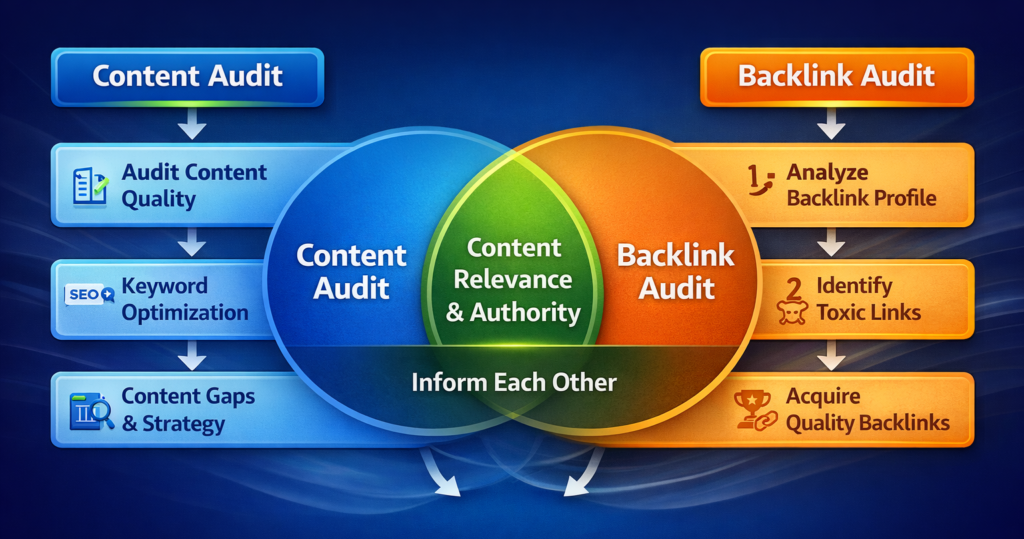
A backlink audit runs as a parallel workstream inside your content audit. It answers three questions your content audit cannot answer alone:
- Which pages attract the most external links and therefore deserve the most protection?
- Which pages carry toxic or spammy backlinks that may be suppressing their performance?
- Which high-value pages have lost backlinks over time representing recoverable link equity?
As a result, your backlink audit data directly informs your content decisions. A thin page with 40 quality backlinks gets updated and strengthened not deleted. A page with zero traffic, zero backlinks, and no conversion history gets removed or consolidated.
Content Audit Tools Comparison
| Tool | Best For | Use |
|---|---|---|
| Screaming Frog | Site crawl | Get all URLs |
| SEMrush | Full audit | Traffic + backlinks |
| ContentKing | Real-time tracking | Ongoing audits |
How to Run a Complete Content Audit — Step by Step
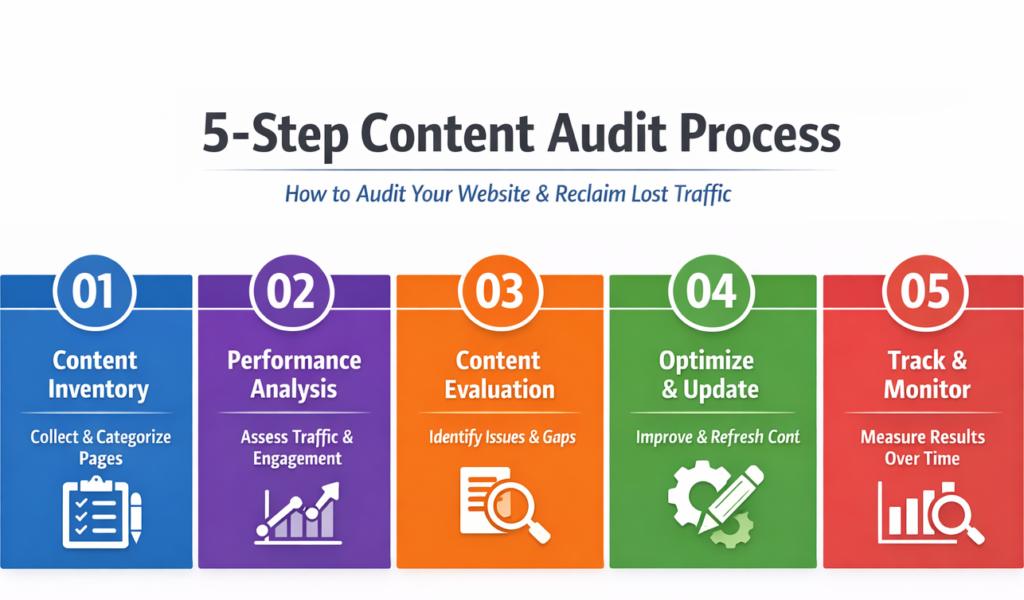
Step 1: Crawl and Inventory Every Page
Use Screaming Frog or Semrush Site Audit to crawl your entire site. Export every indexed URL with these data points: URL, page title, meta description, word count, publish date, last modified date, content type, and canonical tag status.
This becomes your audit master spreadsheet. Every subsequent data layer attaches to this URL list.
Step 2: Pull Performance Data for Every URL
Connect Google Search Console and Google Analytics 4 to your spreadsheet. For every URL, pull these metrics for the previous 12 months:
- Organic impressions and clicks
- Average position for primary keyword
- Organic sessions and session duration
- Bounce rate and pages per session
- Goal completions or conversion events
More importantly, flag every URL with fewer than 100 organic sessions in the past 12 months. These are your primary audit targets pages that exist but contribute nothing measurable to your traffic or revenue.
Step 3: Run Your Backlink Audit
Use Ahrefs or Semrush Backlink Audit to pull the complete backlink profile for your domain. For every URL in your master spreadsheet, record:
- Number of referring domains
- Domain Authority of top linking domains
- Toxic score flag any URL with a toxic score above 45 for disavow consideration
- Lost backlinks in the past 90 days these represent recoverable link equity
Understanding what SEO services involve at a technical level helps you see why backlink data is inseparable from content decisions link equity flows through your site architecture, and content audit decisions directly affect how that equity distributes.
Step 4: Categorize Every Page Into Four Actions
Every URL in your audit gets one of four labels:
| Action | Criteria | What You Do |
|---|---|---|
| Keep and Optimise | Traffic exists, rankings exist, backlinks present | Update content, refresh statistics, improve on-page SEO |
| Consolidate | Multiple pages targeting same keyword or topic | 301 redirect weaker pages to strongest combine content |
| Improve or Rewrite | Low traffic but strong backlinks or high impressions | Full rewrite with updated keyword targeting and structure |
| Remove or Redirect | Zero traffic, zero backlinks, no strategic value | 301 redirect to nearest relevant page or delete and allow 404 |
Step 5: Prioritize and Execute
Sort your action list by impact. Execute in this order:
- Remove or redirect zero-value pages first immediate crawl budget recovery
- Consolidate cannibalizing pages immediate ranking signal recovery
- Update and optimize your top 20 traffic pages protect and grow existing rankings
- Rewrite high-impression, low-click pages recover traffic your impressions prove is available
In addition, our content writing services handle the rewrite and optimization stage combining editorial quality with technical SEO requirements that most content teams miss.
Technical Audit Checks Inside Your Content Audit
A content audit and a technical audit overlap significantly. Every URL you evaluate for content performance should also receive a basic technical health check. Running both simultaneously saves time and produces a more complete picture of each page’s issues.
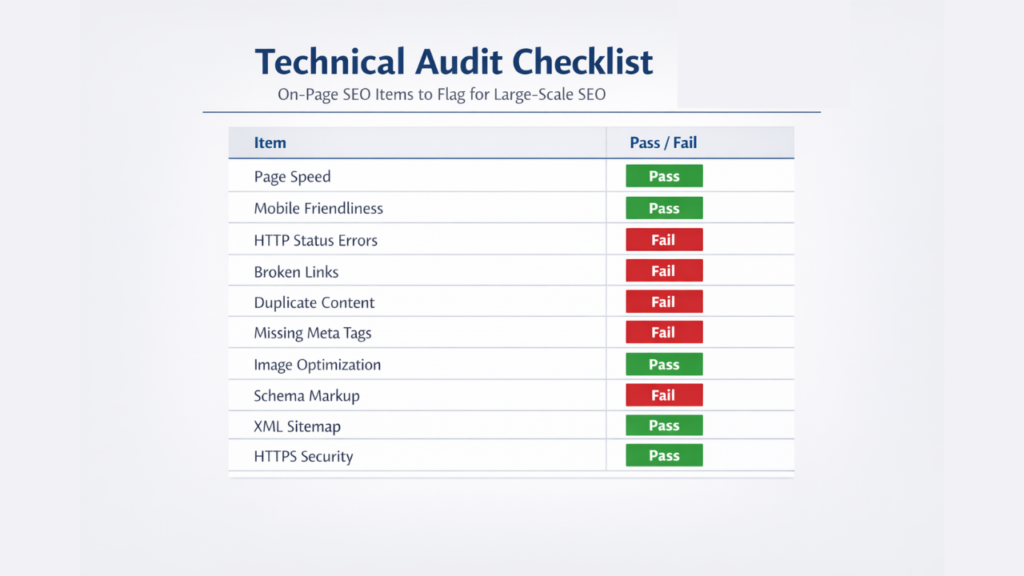
On-Page Technical Items to Flag
For every URL in your content audit, check and record:
- Missing or duplicate title tags: pages sharing identical titles compete with each other in indexation
- Missing meta descriptions: Google writes its own when yours is absent, often pulling irrelevant copy
- Broken internal links: pages linking to 404s waste crawl budget and damage user experience
- Missing or incorrect canonical tags: duplicate content without canonicalization splits ranking signals
- Image alt text gaps: unoptimized images miss ranking opportunities in Google Image Search and AI search citations
- Schema markup presence: flag every page missing relevant structured data as a technical audit action item
For this reason, local SEO services always include a technical audit layer local pages without correct schema markup, canonical tags, and NAP consistency lose ranking signals that their competitors capture.
Schema Markup and AI Search Signals
Pages that pass your content audit but lack schema markup miss a second layer of visibility. In 2025, structured data is a direct AI search signal FAQ Page schema, Article schema, and Local Business schema all increase citation frequency in Google AI Overviews, ChatGPT, and Perplexity.
As a result, add a schema markup column to your audit spreadsheet. Flag every page missing relevant schema as a post-audit implementation task. To know if your SEO is working after your audit, track both organic traffic recovery and rich result appearances as parallel success metrics.
Large-Scale SEO: How Content Audits Work at Enterprise Level
For sites with 500+ indexed pages, a manual content audit is not practical. Large-scale SEO requires a tiered audit approach automated tools handle data collection, human judgment handles categorization decisions.
At enterprise scale, run your content audit in three tiers:
Tier 1 — Automated triage: Screaming Frog crawl plus GSC data export identifies every page with zero traffic automatically. These pages move directly to the remove-or-redirect queue without manual review.
Tier 2 — Data-informed review: Pages with some traffic but declining trends get human review. A trained SEO analyst evaluates keyword targeting, content quality, backlink profile, and competitive positioning before assigning an action label.
Tier 3 — Strategic decisions: Your highest-traffic, highest-backlink pages get full strategic review competitive analysis, content gap assessment, and internal linking optimization. These pages represent your most valuable ranking assets and deserve proportionate attention.
Furthermore, conversion rate optimization data integrates at Tier 3 high-traffic pages that convert poorly need both SEO and CRO treatment simultaneously.
Content Audit Decision Framework — What to Do With Each Page
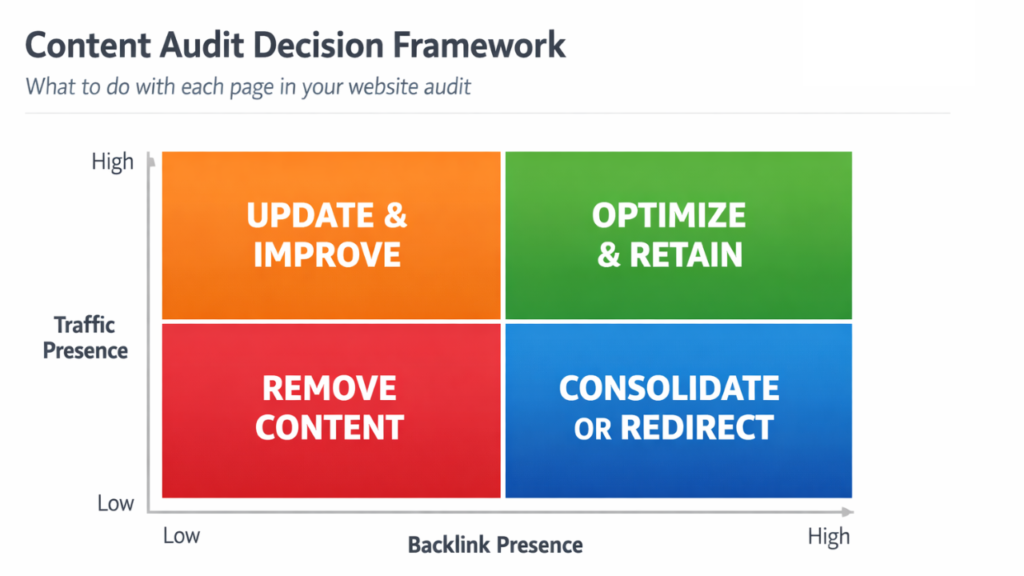
Use this framework for every page that does not clearly fit the four-action categories above:
| Page Signal | Backlinks Present | No Backlinks |
|---|---|---|
| Traffic exists | Keep optimize and protect | Keep optimize and monitor |
| Impressions, no clicks | Improve title and meta rewrite if needed | Rewrite completely new angle |
| No traffic, no impressions | Redirect to strongest related page | Remove 301 to category or homepage |
| Declining traffic | Update content check cannibalization | Consolidate into stronger page |
More importantly, never delete a page with backlinks without first implementing a 301 redirect to the most relevant live page. Deleting a linked page without redirecting it permanently destroys the link equity those backlinks represent.
FAQ’s
A content audit evaluates all indexed pages, analyzing traffic, rankings, backlinks, and engagement to identify opportunities to update, consolidate, improve, or remove underperforming content.
Run a full audit every six to twelve months. Large sites need quarterly reviews of top pages and targeted audits after significant traffic drops.
Use Screaming Frog or Semrush for crawling, Google Search Console for performance, Google Analytics 4 for engagement, and Ahrefs or Semrush for backlink analysis data.
A content audit evaluates on-page performance, while a backlink audit analyzes external links. Together, they guide optimization decisions, link-building priorities, and whether pages need improvement or removal.
A 50-page audit takes two to three days, 500 pages one to two weeks, and enterprise audits several weeks, depending on scale, resources, and required implementation work.
Content audits enable large-scale SEO by managing crawl budget, preventing cannibalization, improving internal linking, and ensuring accurate data for optimizing hundreds or thousands of website pages.
Start Your Content Audit Today

A content audit is the clearest, most data-driven path to reclaiming traffic your site has already earned. On page you remove recovers crawl budget. Every consolidation recovers split ranking signals. Every update recovers freshness scores and AI search citability simultaneously.
Consequently, the sites that grow consistently are not the ones publishing the most new content. At Adclickr, we run complete content audits and backlink audits as part of every SEO services in Jaipur engagement. Start with a free report to see exactly which pages are costing you traffic right now.
Get Your Free Content Audit Report →
Also read: how to identify the right content length · how to know if your SEO is working

About the author
Ujjwal Kumawat
I specialize in SEO, website development, Google Ads and online business growth strategies. Through my blogs, I share practical insights, marketing tips and proven strategies to help businesses improve their online visibility, generate more leads and grow faster in the digital space.