According to Google, 76% of people who conduct a local search on their smartphone visit a business within 24 hours and 28% of those searches result in a purchase. For franchise businesses, those numbers represent real customers walking through real doors. That is exactly why Franchise SEO has become one of the most important investments a franchise owner can make. Franchise SEO means optimizing both your parent brand and each individual franchise location so search engines rank you at every level. The challenge is clear: every location needs strong local search visibility, while the overall brand needs national authority. Balancing both requires a structured approach. This guide gives you the step-by-step strategies to achieve both. If you are already running local SEO for a single location, scaling it across a franchise network is a different game entirely and this article shows you how to win it.
What Is Franchise SEO and Why Does It Matter?
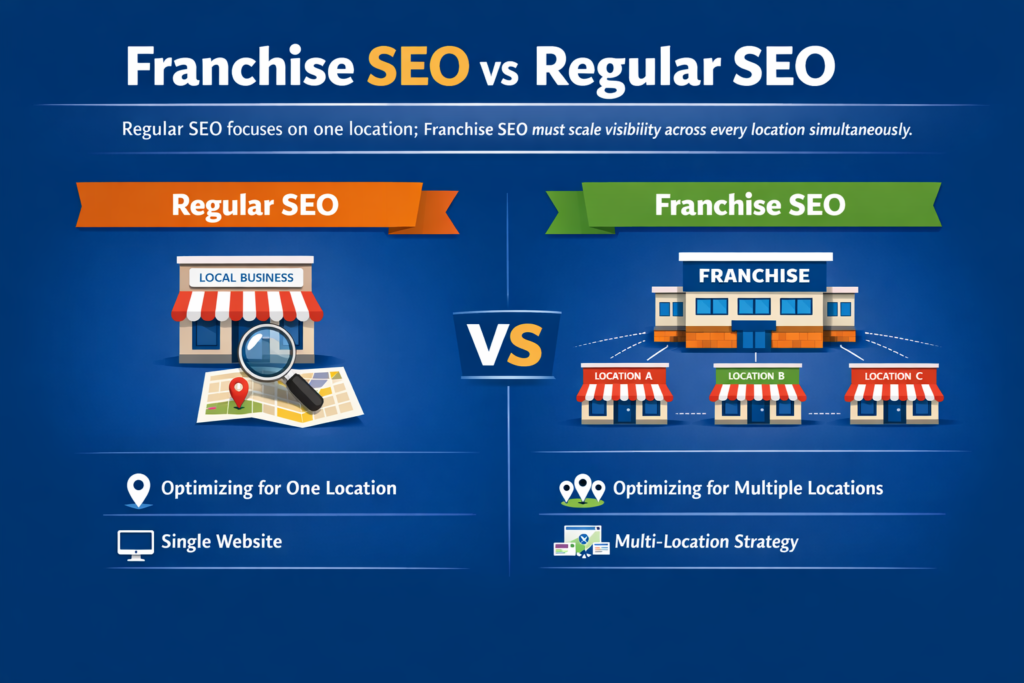
Regular SEO focuses on improving search rankings for one website or one location. Franchise SEO is fundamentally different it optimizes the parent brand and every individual franchise location at the same time. That dual focus is what makes local SEO for franchises both more complex and more rewarding than standard optimization work. Your brand competes on two levels simultaneously. At the national level, customers search for terms like “best coffee chains in India” or “top gym franchises.” At the local level, they search “coffee shop near me open now” or “gym in Bandra.” You need to rank for both.
The real advantage of Franchise SEO is the compounding effect it creates: when the corporate brand performs well, it lifts the local rankings. When local locations build authority, it strengthens the brand. This is not a one-way relationship it is a reinforcing cycle. Your SEO services strategy must account for both directions to work effectively. In the next section, you will see why website architecture is the foundation that makes this possible.
Build the Right Website Architecture for Your Franchise
Website structure is the single most important technical decision in Franchise SEO. It determines how authority flows across all your locations get it wrong and your strongest pages cannot help your weakest ones. There are three main franchise website architecture options, and each has distinct trade-offs. Subfolders structured as domain.com/locations/city-name/ work best for most franchises.
Every location page lives under the main domain, shares its authority, and benefits from every link the brand earns. Search engines understand the hierarchy clearly, and users can navigate from national content to local pages without confusion. Subdomains structured as city.domain.com give individual franchise owners more control over their pages. However, subdomains do not share domain authority as effectively as subfolders do. Each subdomain essentially builds its SEO strength independently, which takes significantly longer to compound.
Separate domains structured as citybrandname.com should be avoided unless a legal or franchise agreement requires it. This approach sacrifices every SEO benefit of brand association entirely. For most franchises, the subfolder structure is the safest and most effective choice. Once your structure is in place, build internal links between corporate service pages and location pages. This creates an authority web where strong pages lift weaker ones. Additionally, add Local Business schema markup to every location page it tells search engines exactly what each location offers and where. A solid technical SEO foundation makes every other strategy in this guide more effective.
Subfolder vs Subdomain vs Separate Domain: Quick Guide
Choose subfolders when you want locations to share the main domain’s authority this is the strongest setup for most franchise networks. Choose subdomains only when franchise owners genuinely need editorial independence and you accept slower authority growth. Avoid separate domains unless a legal agreement forces the decision, as you lose all brand association benefits. When in doubt, choose subfolders they are the industry standard for Franchise SEO at scale.
Optimize Each Location Page to Rank Locally
Generic location pages are one of the biggest killers of Franchise SEO performance. A template that reads “Welcome to [City Name]! We offer the same great service in [City Name]!” does not fool search engines for a moment. Google identifies duplicate or near-duplicate content instantly and gives those pages little to no ranking value. Every location page in your franchise needs five core elements to perform. First, include unique local content feature staff bios from that specific team, customer testimonials from people in that neighborhood, and references to local events or partnerships.
Second, maintain strict NAP consistency: your Name, Address, and Phone Number must be identical across every platform. Third, use geo-targeted keywords based on how locals actually search. Someone in Delhi does not search “Delhi India pizza” they search “pizza in Connaught Place.” Match the language your local customers actually use. Fourth, implement Local Business schema markup on every page. The essential fields are: business name, address, phone number, hours, price range, service area, and accepted payment methods. Fifth, embed a Google Map centered on that specific location and include a visible “Get Directions” call-to-action.
Thorough location page optimization like this is what moves your pages from invisible to ranking. Our local SEO services team handles all of this at scale for franchise networks. One final warning: duplicate content across location pages is one of the most common Franchise SEO mistakes and it is one of the most damaging. Each page must be genuinely distinct.
NAP Consistency Checklist: Where to Keep It Identical
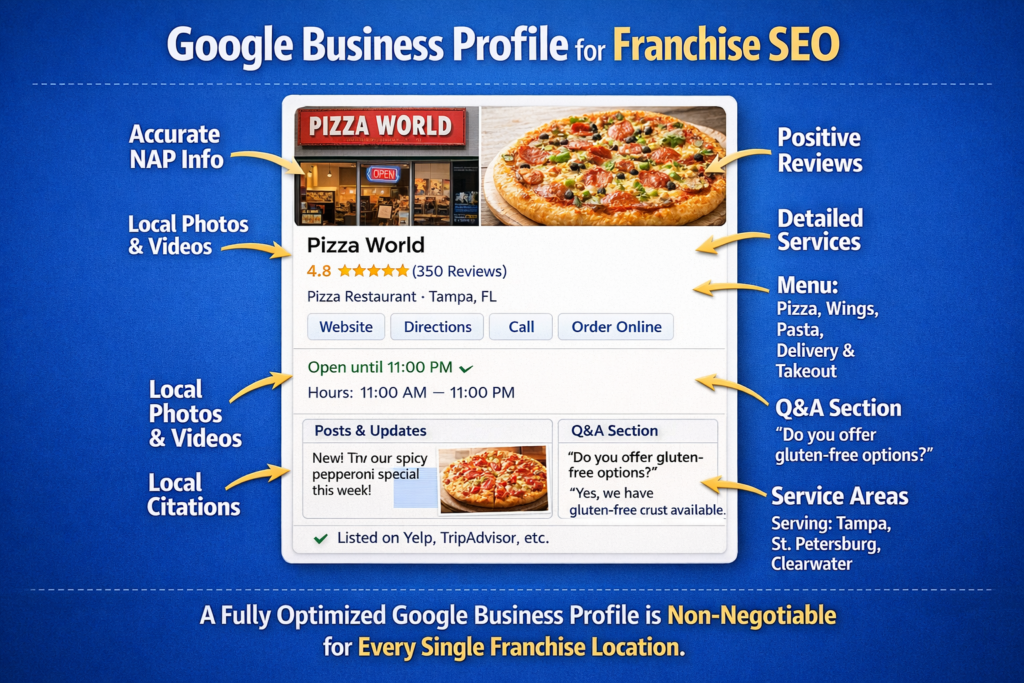
Your Name, Address, and Phone Number must match exactly on Google Business Profile, Yelp, Bing Places, Yellow Pages, Foursquare, Angi, your franchise website, all social media profiles, and local chamber of commerce listings. Every single platform must show the same information in the same format. Even a small formatting difference “123 Main St” vs “123 Main Street” can confuse search engines and drag down local rankings.
Leverage Google Business Profiles for Every Location
Every single franchise location needs its own verified Google Business Profile. This is not optional. A properly set up GBP listing gets your location into the Local Pack the map with three businesses that appears at the top of Google local search results. It also drives visibility in Google Maps, enables direct click-to-call functionality, allows customers to leave reviews, and sends powerful local search ranking signals to Google.
A complete GBP profile includes the accurate business name identical to your website NAP, the precise address, and a local phone number not a corporate call center line. It also requires the correct primary business category, full operating hours including holiday adjustments, and at minimum ten high-quality photos showing the location itself, your team, and your products or services. Additionally, publish weekly Google Posts to signal that the listing is actively managed. On reviews, follow the 48-hour rule: respond to every review positive or negative within 48 hours.
A thoughtful response to a negative review often does more for trust than five positive ones left unanswered. For franchises managing 20 or more locations, use the Google Business Profile API or a dedicated GBP management platform. These tools allow you to update multiple profiles efficiently while preserving the local customization that makes each listing effective. Proper Google Business Profile optimization is the single highest-impact local SEO activity for most franchise networks. With your profiles in order, the next step is building the local content that proves your franchise genuinely belongs in each community.
Create Localized Content That Proves Community Presence
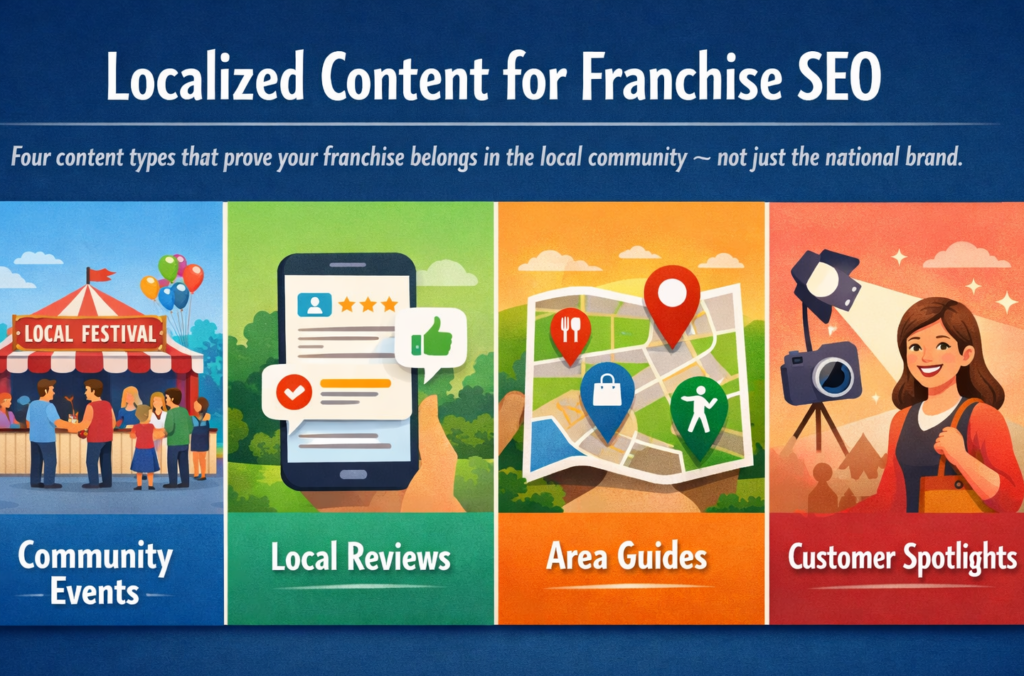
There is a significant difference between lazy localization and real local content. Lazy localization means taking a corporate blog post and inserting a city name. Real local content is rooted in the specific community and search engines, as well as customers, can tell the difference immediately. For effective local content marketing across a franchise network, focus on four content types. First, cover local events and news write about community events your franchise sponsored or participated in.
This creates natural mentions of specific neighborhoods, landmarks, and community names. Second, create area-specific guides. A fitness franchise, for example, could publish “Best Running Routes Near Our Koramangala Location.” These guides attract local search traffic and build genuine relevance. Third, feature customer testimonials per location. Include the customer’s name and neighborhood this proves real people in that specific area trust your business. Fourth, publish local partner spotlights. Write about local suppliers, community organizations, or complementary businesses you work with in each area. The strategic logic behind all of this is straightforward: your corporate content builds brand authority and helps individual location pages rank faster.
Your local content then proves each franchise genuinely belongs in its community not just as an outpost of a national brand. This combination is what makes multi-location SEO compound over time. Our content marketing services team builds these content systems for franchise networks from the ground up. Strong content builds the foundation but links and reviews are what push your locations to the top.
Build Local Links and Reviews to Boost Authority
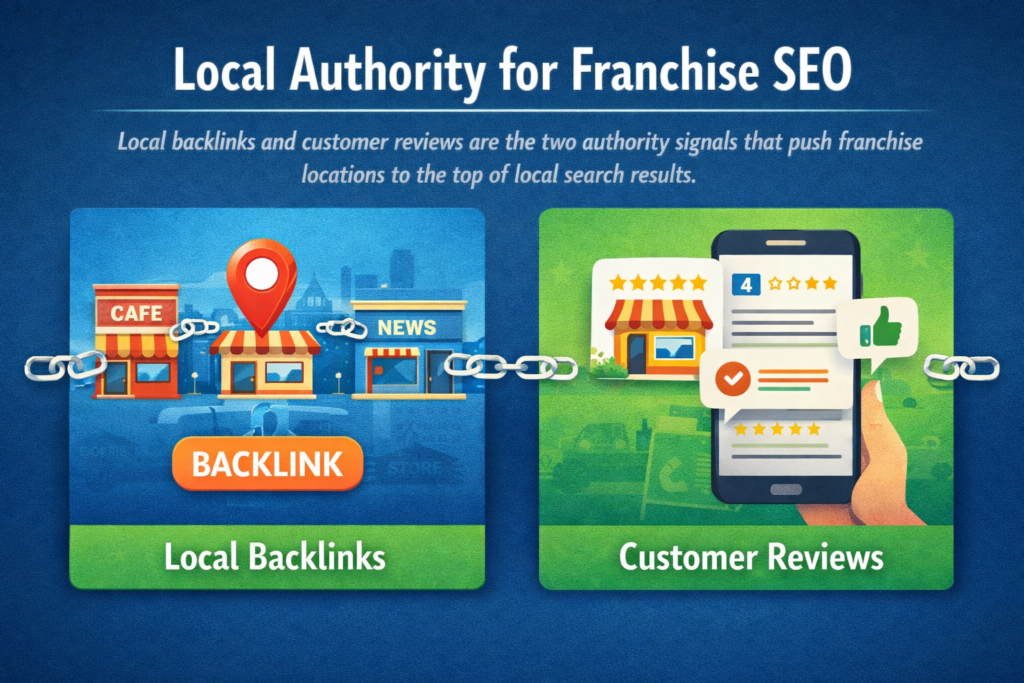
Links and reviews separate the franchise locations that dominate local search from those stuck on page two. Most franchises get the basics right and then stop and this is precisely where the gap opens. Local link building does not require complex outreach campaigns. Sponsor a local Little League team, a community festival, or a neighborhood initiative. Most of these organizations link back to their sponsors directly from their website.
These links carry real weight because they come from genuinely local, relevant sources. In addition to sponsorships, partner with local businesses, journalists, and regional bloggers. Offer expert commentary relevant to your industry or propose story ideas to local publications. Get listed on local chamber of commerce websites and in niche local directories. Each of these activities builds the local link profile that strengthens your individual location pages.
On reviews: Google has confirmed that reviews directly influence local search rankings. Therefore, reviews are not just a trust signal they are an active ranking factor. Build a system around collecting them. Train staff to ask satisfied customers for a review immediately after a positive interaction. Follow up automatically by email or SMS 24 to 48 hours after service, with a direct link to the GBP review page. Set monthly review targets for each location and track the velocity how many new reviews each location earns per month. Our link building services team executes this at franchise scale, building authority for every location systematically.
Frequently Asked Questions About Franchise SEO
Franchise SEO is the practice of optimizing both the parent brand and each individual franchise location for search engines. It combines brand-level optimization improving overall domain authority and national visibility with location-level local SEO so every outlet ranks in its own geographic area.
Local SEO focuses on improving search rankings for a single business location. Franchise SEO manages the same optimization process across multiple locations simultaneously while maintaining consistent brand messaging. The dual challenge is ranking the corporate brand nationally and ranking each individual location locally both at the same time.
Yes, absolutely. Every franchise location needs a dedicated page with unique content, local keywords, and location-specific details. Use the subfolder URL structure for example, domain.com/locations/city-name/ so each page shares the main domain’s authority while ranking independently for local searches. A proper technical SEO setup ensures this structure is built correctly from the start.
Start Dominating Local Search With Franchise SEO Today
A strong Franchise SEO strategy rests on five pillars: the right website architecture, fully optimized location pages, verified Google Business Profiles for every outlet, genuine localized content, and a consistent system for earning local links and reviews. Each pillar reinforces the others. Consistency beats complexity. A franchise executing the basics well across every location will always outrank a competitor doing advanced tactics inconsistently.
Start with your site structure, audit your location pages for duplicate content, verify your GBP listings, and build a content plan rooted in each community. The results compound over months and the franchises that start now will be the ones dominating local search a year from today. Ready to build a Franchise SEO strategy that actually drives customers through your doors? Contact the Adclickr team for a free SEO audit today.