According to McKinsey, companies that fully deploy digital marketing capabilities grow revenue 2.5 times faster than their peers. Yet most large organizations still operate fragmented marketing systems that bleed budget and miss opportunities at scale. Customer expectations have shifted permanently — buyers demand personalized, seamless experiences across every channel, every time. Enterprise teams face compounding pressure: legacy technology, siloed departments, and complex procurement cycles all work against agility. Standard marketing approaches simply cannot handle this level of complexity. This is where enterprise digital marketing services become not just useful — but essential.
What Are Enterprise Digital Marketing Services?
Enterprise digital marketing services are comprehensive, technology-driven marketing solutions designed specifically for large organisations that operate at scale, across multiple markets, teams, and customer segments.
Unlike SMB or mid-market marketing — which typically focuses on a single channel or campaign — enterprise marketing requires deep technology integration, cross-department alignment, and a unified strategy that connects every customer touchpoint. It is the difference between running campaigns and operating a marketing system.
The outcomes are measurable and significant. Organisations that invest in the right solution achieve scalability across global markets, ROI clarity through unified attribution, personalisation at scale that drives conversion, and marketing automation that eliminates manual inefficiency. This is digital transformation applied directly to revenue growth — not as a concept, but as an operational reality.
Then vs Now: The Evolution of Enterprise Marketing
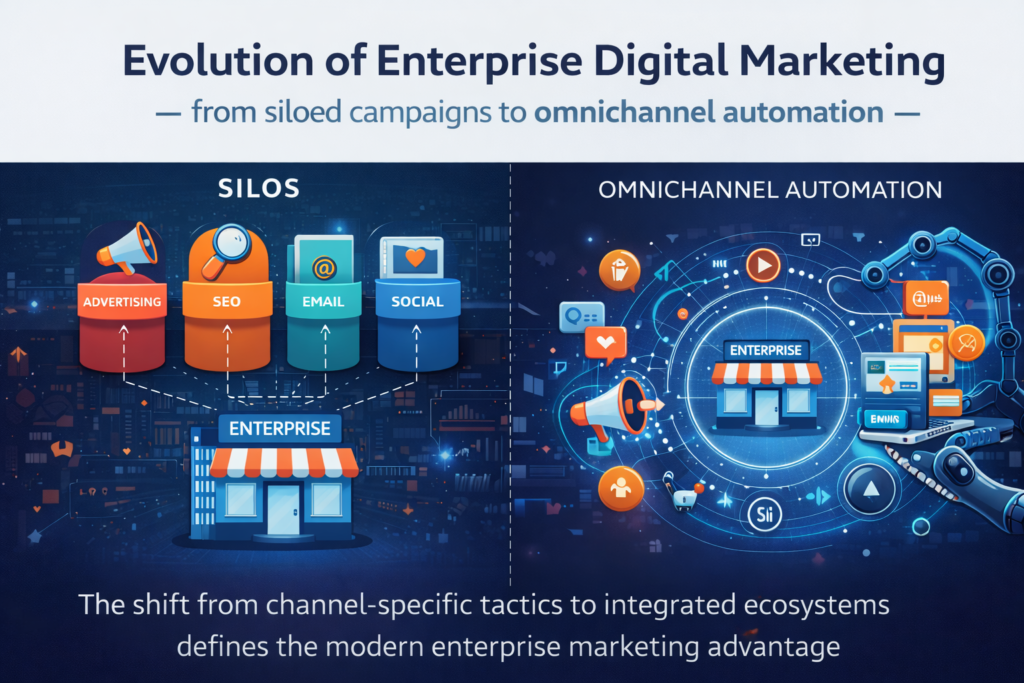
The gap between traditional and modern enterprise marketing is not incremental. It is structural. Understanding this evolution is the first step toward closing it.
| Dimension | Traditional Marketing | Enterprise Digital Marketing |
|---|---|---|
| Team structure | Siloed by channel or department | Integrated, cross-functional pods |
| Campaign approach | Manual, batch-based execution | Automated, always-on campaigns |
| Data usage | Retrospective reporting | Real-time data and live dashboards |
| Channel strategy | Single or dual-channel focus | Full omnichannel strategy |
| Personalisation | Segment-level messaging | Individual-level targeting via AI |
Modern enterprise marketing runs on an omnichannel strategy powered by real-time data and AI-driven automation. These three forces work together to create consistent, relevant experiences across search, social, email, paid, and owned channels. This shift demands a more strategic, integrated, and scalable approach to marketing.
Core Components of Enterprise Digital Marketing Services
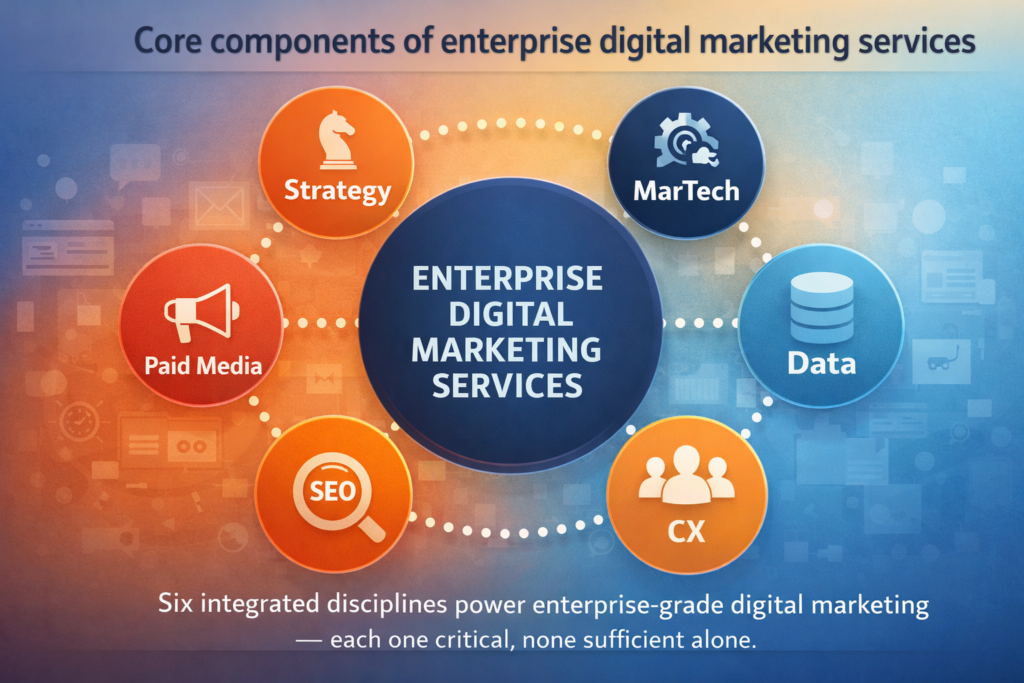
Effective enterprise digital marketing services are not a single offering. They are an integrated ecosystem of specialized disciplines working toward unified growth objectives.
Strategy and Consulting
Every enterprise marketing system starts with strategic clarity. This means defining revenue goals, audience architecture, competitive positioning, and a roadmap that aligns marketing investment with business outcomes. Without strategy, even the best technology produces noise, not results.
Marketing Technology (MarTech Stack)
The MarTech stack is the operational backbone of enterprise marketing. It encompasses CRM platforms, marketing automation tools, data management systems, and integration layers that allow every component to communicate. A well-architected stack eliminates manual work and creates a single source of truth for all marketing data.
Data and Analytics
Data without interpretation is just storage. Enterprise analytics transforms raw signals into decisions — identifying which segments convert, which channels drive pipeline, and where budget is being wasted. Real-time reporting allows teams to optimise campaigns in motion rather than after the fact.
Enterprise SEO and Content
Enterprise SEO at scale requires systems, not just tactics. This means scalable content frameworks, technical site architecture, structured data implementation, and authority-building strategies that drive organic visibility across thousands of pages and multiple markets. For more on what this involves, explore what SEO service providers actually deliver.
Paid Media and Performance Marketing
Performance marketing connects every pound of paid spend to a measurable outcome. Enterprise paid media spans search, display, programmatic, and social — all managed through unified bidding strategies, audience segmentation, and conversion-focused creative. PPC services and search engine marketing sit at the core of this discipline.
Customer Experience (CX) Optimisation
Customer journey mapping reveals every friction point between awareness and conversion. CX optimisation removes those friction points through personalisation, A/B testing, UX improvements, and conversion rate optimisation — turning existing traffic into measurable revenue without increasing ad spend.
Key Benefits and What Each Means for Your Bottom Line
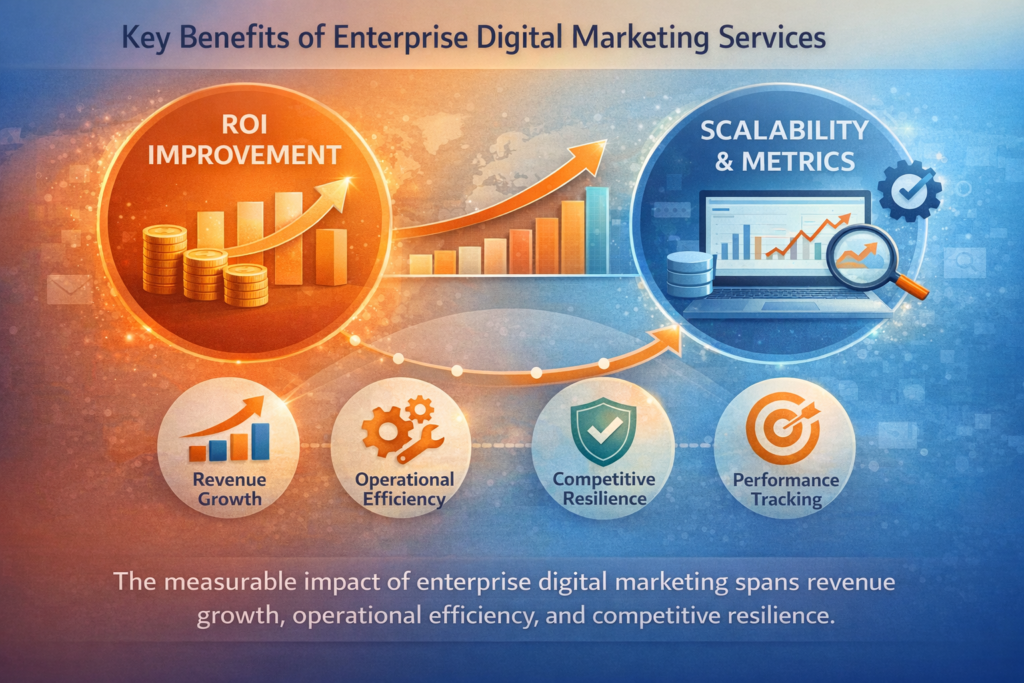
Enterprise digital marketing services deliver impact across three dimensions: growth, operational efficiency, and long-term competitive resilience.
From a growth perspective, scalability allows enterprises to expand campaigns into new markets without rebuilding from scratch. Omnichannel presence ensures consistent brand messaging whether a buyer encounters you on Google, LinkedIn, email, or a trade publication. Personalisation at enterprise scale drives measurable lift — research from McKinsey indicates that personalisation can deliver five to eight times the ROI on marketing spend and lift sales by 10% or more.
On the efficiency side, marketing automation eliminates repetitive manual tasks — enterprises using automation report up to a 14.5% increase in sales productivity according to Nucleus Research. Cost efficiency compounds over time as unified technology replaces redundant tools and manual processes. Flexibility means campaigns adapt to market changes in real time, rather than waiting for the next planning cycle.
Looking forward, data-driven decisions replace gut-feel budget allocation with evidence-based strategy — every channel, every audience, every creative variant tracked and optimised continuously. Future-proofing through a scalable MarTech foundation means the organisation can absorb emerging channels, AI capabilities, and new customer behaviours without rebuilding its marketing infrastructure from the ground up.
Best Practices to Build Your Enterprise Digital Marketing Strategy
The difference between enterprises that extract full value from digital marketing and those that struggle comes down to how the strategy is built and executed. These seven practices define the approach that consistently produces results.
- Set Clear KPIs. Define success before you invest. Establish revenue-connected metrics — cost per acquisition, marketing-sourced pipeline, customer lifetime value — not vanity metrics like impressions. Every campaign must map to a KPI that matters to the CFO, not just the marketing team.
- Align Teams and Stakeholders. Marketing cannot operate in isolation. Therefore, bring sales, product, customer success, and finance into strategic planning early. Shared objectives eliminate the internal friction that derails even well-funded programmes.
- Audit Your Existing Systems. Before adding new technology, understand what you already have. A thorough SEO audit and MarTech stack review will reveal redundancy, integration gaps, and quick wins that most enterprises overlook entirely.
- Invest in the Right MarTech Stack. Choose platforms that integrate natively, scale with your volume, and give your team a single data view. Review our full services portfolio to understand which technology combinations deliver results for enterprise-scale operations. For businesses in Delhi NCR, our SEO company in Delhi provides hands-on stack consulting.
- Map the Full Customer Journey. Identify every touchpoint from first awareness to post-purchase advocacy. Customer journey mapping surfaces the moments where prospects drop off and where personalised intervention drives the most revenue impact.
- Test, Measure and Optimise Continuously. No strategy survives first contact with the market unchanged. Build systematic A/B testing, channel attribution, and ROI optimisation reviews into your operational calendar — monthly at minimum. Track whether your SEO is working with clear benchmarks rather than assumptions.
- Build a Culture of Innovation. Technology and strategy are only as effective as the team deploying them. Invest in training, reward experimentation, and create psychological safety for testing new approaches. Enterprises that build this culture consistently outperform those that treat marketing as a cost centre.
Real-World Examples: How Enterprises Are Winning
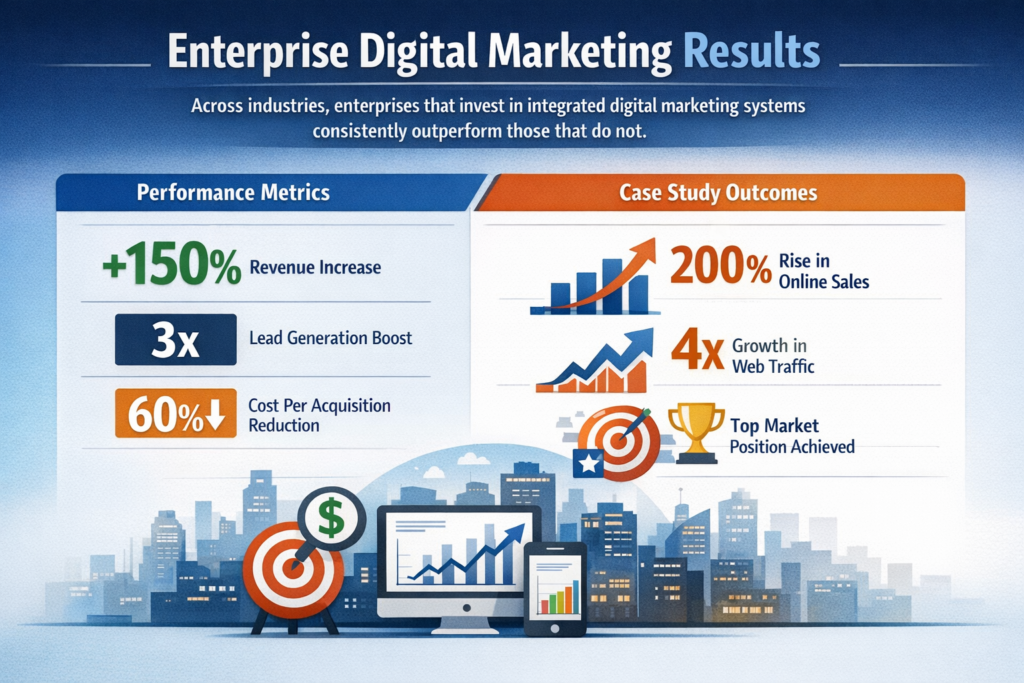
A global retail brand with operations across 14 markets struggled with campaign inconsistency and poor cross-channel attribution. After unifying their MarTech stack and implementing a centralised data platform, they reduced customer acquisition cost by 34% within nine months and increased repeat purchase rate by 22%.
A Fortune 500 financial services firm recognised that their organic search visibility was declining despite significant content investment. Following a full enterprise SEO restructure — including technical site architecture improvements and image alt text optimisation — they recovered first-page rankings for 47 high-intent commercial keywords within six months, driving a 31% increase in inbound qualified leads.
A B2B SaaS enterprise operating across the APAC region deployed email marketing automation and personalised nurture sequences across their full prospect database. The result: a 58% reduction in sales cycle length and a 19% improvement in trial-to-paid conversion rate — without increasing headcount in the marketing team.
Frequently Asked Questions
Enterprise digital marketing services are integrated, technology-driven marketing solutions built for large organisations operating across multiple markets, teams, and customer segments. They combine strategy, MarTech, SEO, paid media, content, data analytics, and customer experience optimisation into a unified system. The goal is scalable, measurable revenue growth — not individual campaign performance.
Pricing varies significantly based on scope, geography, and the specific disciplines required. Most enterprise engagements begin at a monthly retainer of 8,00000–25,00000+ INR for comprehensive multi-channel management, with technology and media spend additional. The more relevant question is ROI: well-executed enterprise digital marketing consistently delivers 3x–8x return on investment when measured across a 12-month horizon. Contact us for a tailored commercial proposal.
B2B digital marketing refers to marketing directed at business buyers rather than consumers — it spans companies of all sizes. Enterprise digital marketing specifically addresses the unique complexity of large organisations: multi-market operations, complex buying committees, long sales cycles, legacy technology, and the need for cross-departmental alignment. Enterprise marketing requires a different level of infrastructure, integration, and strategic sophistication than standard B2B campaigns.
B2B digital marketing refers to marketing directed at business buyers rather than consumers — it spans companies of all sizes. Enterprise digital marketing specifically addresses the unique complexity of large organisations: multi-market operations, complex buying committees, long sales cycles, legacy technology, and the need for cross-departmental alignment. Enterprise marketing requires a different level of infrastructure, integration, and strategic sophistication than standard B2B campaigns.
Conclusion: Transform Your Enterprise Marketing Today
Enterprises that treat digital marketing as a collection of disconnected tactics will continue to underperform. Those that build integrated systems — anchored in data, powered by automation, and aligned across every customer touchpoint — will consistently outgrow their markets. The case for enterprise digital marketing services is not theoretical: it is evidenced in revenue, pipeline velocity, and competitive positioning across every major industry vertical.
The path forward starts with one strategic decision: commit to building a marketing system, not just running marketing campaigns. Request your free SEO report to identify your highest-priority gaps. Explore our full service offering to understand how AdClickr builds enterprise marketing systems that scale. Or speak to our team directly to schedule a strategy session tailored to your organisation’s objectives.
The enterprises that win tomorrow are the ones transforming today.