Microsoft ranks number one on Google for over 371,000 search terms in the US that is Enterprise SEO operating at full scale. For large organizations managing thousands or millions of web pages, it is the practice of optimizing every single one of those pages for consistent, high-performance search visibility. The scale differentiator is critical to understand: Enterprise SEO is defined by page count, not company size.
A mid-sized business running a 50,000-page website needs enterprise strategies just as much as a global corporation. With 81% of web traffic still flowing through search engines, organic visibility is a non-negotiable growth channel for any large organization. This guide covers the complete strategy, implementation framework, common challenges, and the tools you need to make it work. Explore our SEO services to see how Adclickr approaches this at scale. Let’s start with what Enterprise SEO actually is and how it fundamentally differs from traditional approaches.
What Is Enterprise SEO and How Does It Differ From Traditional SEO?
Enterprise SEO applies optimization techniques at a scale that standard tools and conventional workflows simply cannot handle. Where traditional SEO manages dozens or hundreds of pages, this discipline manages thousands to millions simultaneously. Large-scale SEO requires dedicated teams, advanced tooling, and strategies built specifically for complexity not adapted from single-site playbooks. The most important distinction is this: the online scale of an organization is not defined by its business size.
It is defined by its page count. A single technical SEO fix in an enterprise environment can shift the performance of hundreds of thousands of pages at once for better or worse. That is a level of impact traditional SEO never encounters. Understanding what changes at this scale is the foundation of building a strategy that actually works.
Enterprise SEO vs Traditional SEO: What Actually Changes
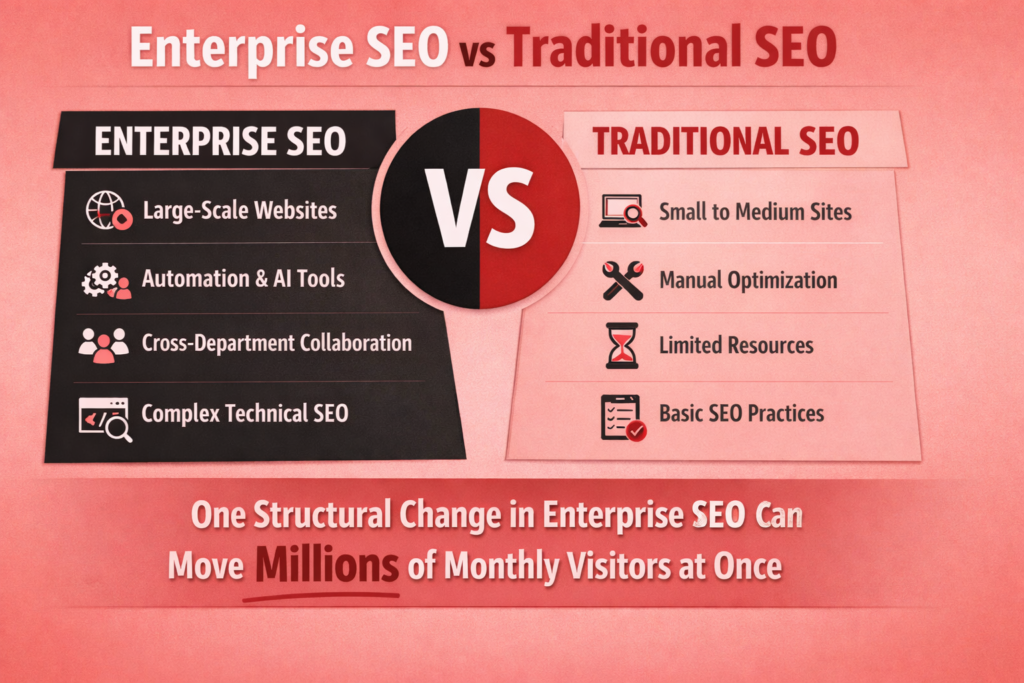
Enterprise SEO differs from traditional SEO across five core dimensions. Every element from how teams are structured to how success is measured must be rebuilt for scale:
- Scope: Traditional SEO manages dozens of pages; Enterprise SEO manages thousands to millions, where every structural decision has site-wide consequences.
- Resources: Small in-house teams or freelancers are replaced by dedicated cross-functional departments spanning SEO, development, content, and legal.
- Tooling: Standard off-the-shelf platforms give way to advanced and often custom-built systems designed for large-scale monitoring and automation.
- Strategy: Niche or local keyword targeting is replaced by industry-level Share of Voice domination across entire keyword categories.
- Success metric: Individual keyword position tracking is replaced by Share of Voice (SOV) percentage as the primary performance measure.
In short, every element of SEO from crawling to reporting must be rebuilt for scale.
Why Enterprise SEO Matters: Benefits You Can Measure
- The primary success metric for Enterprise SEO is Share of Voice (SOV) not rankings for a handful of keywords. Share of Voice measures your brand’s visibility in search results relative to your total market. The formula is straightforward: divide your brand’s total search impressions by the total market search volume, then multiply by 100.
- This matters because tracking individual keyword positions across thousands of pages is neither scalable nor strategically meaningful. SOV tells you how much of your industry’s organic search visibility you actually own and that is the number that drives real business decisions.
- When you improve organic search visibility at enterprise scale, traffic compounds in ways that single-location SEO never achieves. One of our clients an international school operating across multiple Indian cities saw organic traffic increase by 214% through a structured Enterprise SEO program. Therefore, the volume of inbound organic traffic becomes a significant business asset, not just a marketing metric.
- Revenue impact follows directly from that traffic growth. Enterprise SEO captures high-intent transactional queries users who are actively ready to buy or enquire.
- A leading hospital in India saw organic leads grow by 81.95% after implementing a targeted Enterprise SEO strategy. As a result, organic SEO consistently reduces cost per acquisition compared to paid channels.
Core Components of a Winning Enterprise SEO Strategy
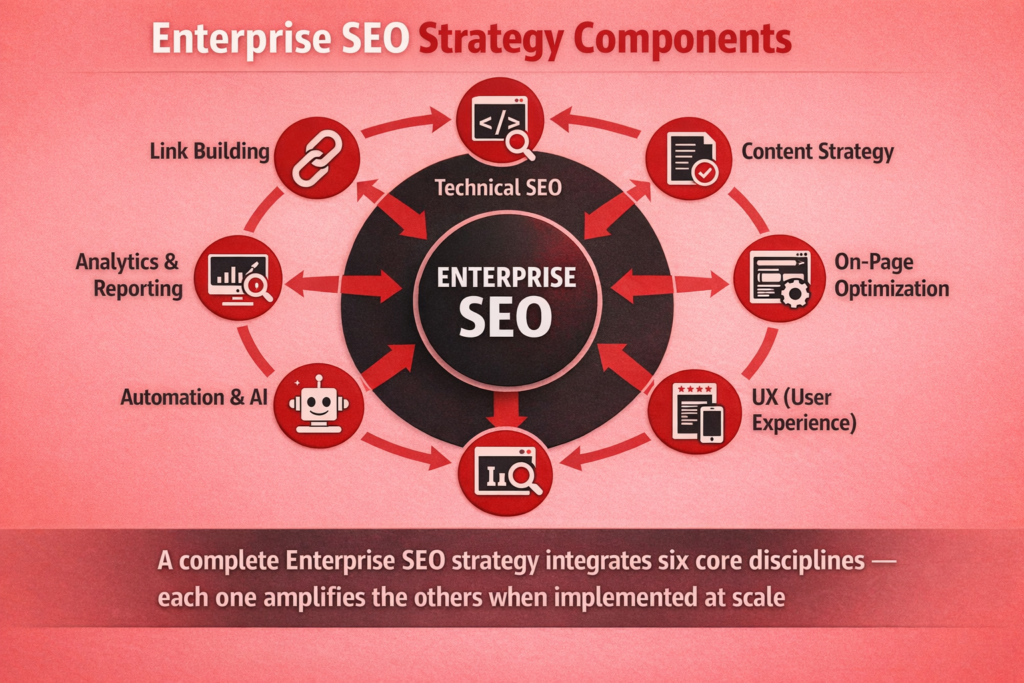
A winning Enterprise SEO strategy is not a single discipline. It is six interconnected disciplines that must operate in coordination. When one component underperforms, it actively limits every other component in the system. Here is what each one does and why it matters:
- Site architecture and URL structure: A clean, logical page hierarchy allows search engine crawlers to access, interpret, and index every page efficiently. Without this foundation, even the strongest content will not rank consistently at scale.
- Enterprise keyword strategy: Keywords must be mapped to individual pages across every content category covering brand-level terms, category-level terms, and long-tail queries. Each page gets a distinct keyword cluster to prevent cannibalization, where two pages compete against each other for the same query.
- Technical SEO at scale: Managing Core Web Vitals, canonical tags, XML sitemaps, HTTPS compliance, and 4XX error resolution across thousands of pages requires automated monitoring systems and clear escalation workflows between SEO and development teams.
- Content strategy and topic clusters: The topic cluster model replaces fragmented content silos with a structured authority-building system. A central pillar page covers a broad topic, while cluster pages cover related subtopics and link back to the pillar signaling topical authority to search engines systematically.
- Backlink strategy: A quality-focused link profile built through outreach, strategic partnerships, and digital PR builds domain authority far more effectively than high-volume link schemes that create risk rather than value.
- Local SEO integration: For brands with physical locations, NAP (Name, Address, Phone) consistency across all listings and active local listing management must be built directly into the broader strategy not treated as a separate workstream. Our local SEO services team manages this integration for enterprise clients across multiple locations.
How to Implement Enterprise SEO: A Step-by-Step Framework
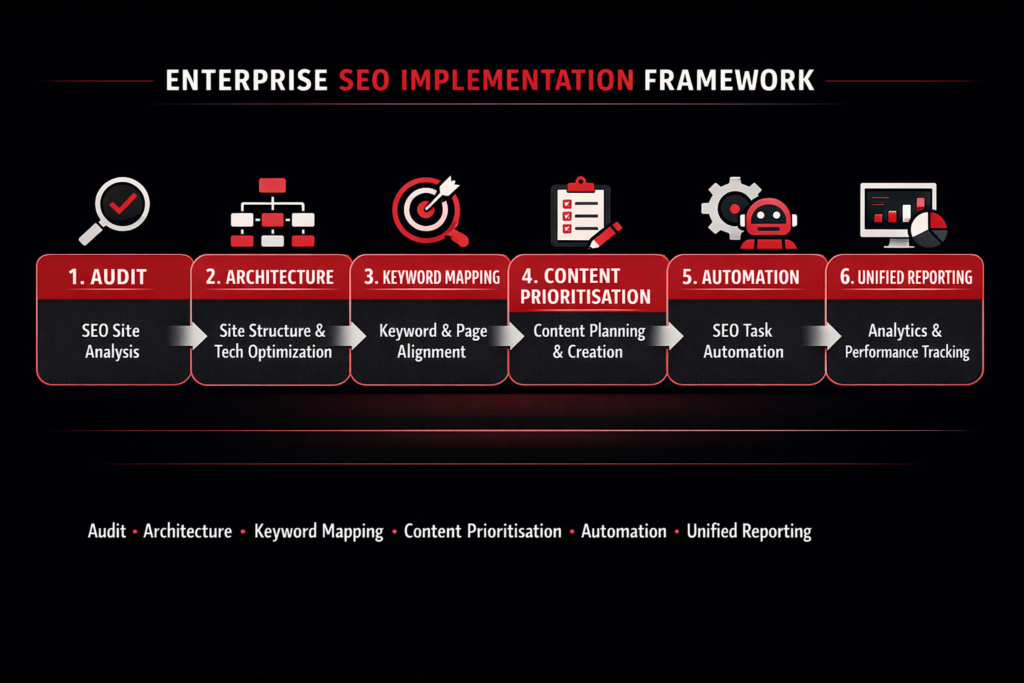
Most Enterprise SEO guides explain what the discipline is. Very few explain how to actually build it. This section provides the implementation framework the six steps that turn strategy into measurable results.
Audit. Crawl the entire website to surface every technical error: 4XX status codes, redirect chains, duplicate content, thin content pages, orphan pages, and missing or broken schema markup. This audit establishes your performance baseline and priorities fixes by their projected traffic impact.
Architecture. Establish a clean URL hierarchy across the site and build a systematic internal linking structure. Strong, high-authority pages must deliberately flow that authority to weaker pages through intentional linking not by accident.
Keyword mapping. Assign distinct keyword clusters to individual page groups across the entire site. No two pages should target the same primary keyword overlap creates cannibalization that dilutes the ranking potential of both pages.
Content prioritization. Run a content gap analysis to identify decay (pages actively losing traffic) and gaps (topics your site has not yet covered). Refresh decaying pages before building new ones this produces faster ranking improvements at lower cost.
Automation. Automate rank tracking, schema validation, and technical error alerts across every page. “There’s great scope for automation in Enterprise SEO it allows teams to execute with accuracy and efficiency at a scale that manual workflows simply cannot reach.” Manual processes do not scale to thousands of pages, and the implementation depends on solving this early. Our SEO audit process identifies exactly which automation gaps are costing you rankings right now.
Dynamic dashboards. Integrate Google Search Console, SEMrush, and Ahrefs data into a single Looker Studio dashboard. This gives every stakeholder SEO, content, development, and leadership a unified, real-time view of performance against the same metrics.
AI and Automation Tools Reshaping Enterprise SEO in 2025
AI tools have fundamentally changed how Enterprise SEO teams operate at scale. Five trends are reshaping enterprise SEO implementation right now:
- AI content auditing — Platforms like MarketMuse and Clearscope ensure every page maintains topical relevance as search intent evolves, without manual review of thousands of URLs.
- Automated internal linking — Tools now detect internal link gap opportunities and build intelligent link maps across the entire site automatically.
- Predictive SEO — Machine learning models forecast ranking fluctuations before they happen, allowing teams to act before traffic drops.
- AI-powered schema generation — Structured data tagging is automated at scale, improving SERP feature eligibility across entire page categories simultaneously.
- Voice and visual search optimisation — Enterprise sites can now capture conversational and image-based queries that standard keyword strategies miss entirely.
Automation is not a shortcut it is how Enterprise SEO teams maintain precision across hundreds of thousands of pages simultaneously.
Biggest Enterprise SEO Challenges — And How to Solve Them
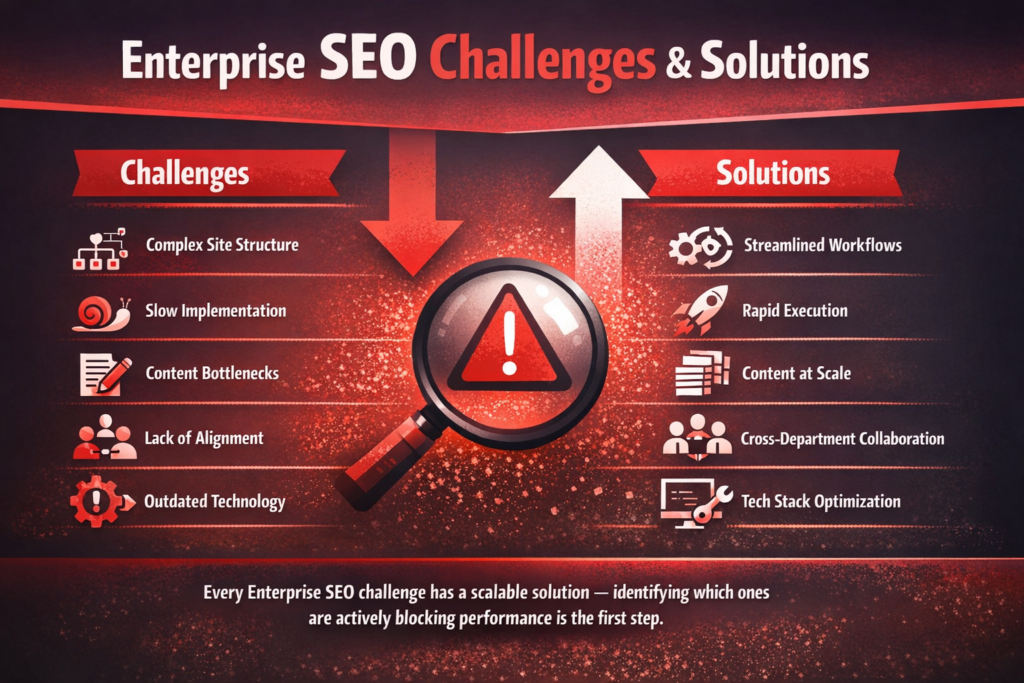
Every Enterprise SEO challenge traces back to one root cause: scale. What is entirely manageable at 100 pages becomes a systemic, organization-wide problem at 100,000 pages. However, each challenge has a practical, scalable solution:
- Legacy systems: Outdated platforms make it impossible to set canonical tags, deploy ahref lang attributes, or improve page speed at scale. The solution is focused prioritization identify which legacy components actively block SEO performance and modernize those first. Not everything needs to change at once.
- Content decay: Pages that ranked strongly two years ago lose relevance as information becomes outdated and competitor content improves. The solution is a quarterly content gap analysis cycle review and refresh decaying content before traffic metrics fall, not after. Our link building services team works in parallel with content refresh cycles to compound authority recovery.
- Siloed teams: When SEO, development, content, legal, and brand teams each control separate parts of the website without shared workflows, approved changes get blocked, reversed, or deprioritised. The solution is cross-functional workflows with shared success metrics and a single reporting dashboard that every team references.
- Technical errors at scale: A redirect chain problem affecting 10,000 URLs will not be caught through periodic spot-checks. The solution is automated real-time monitoring set up alerts for 4XX spikes, redirect chain growth, Core Web Vitals regressions, and schema validation failures. Catching problems at the moment they occur prevents small errors from compounding into major ranking losses.
Frequently Asked Questions About Enterprise SEO
Enterprise SEO is the practice of optimizing large-scale websites — those with thousands to millions of pages — for consistent search engine visibility across every page simultaneously. It is defined by page count, not company size. The primary success metric is Share of Voice (SOV), not individual keyword rankings, because SOV reflects true market dominance.
Enterprise SEO differs from traditional SEO across five dimensions: scope (thousands of pages vs dozens), resources (dedicated cross-functional teams vs small teams or freelancers), tooling (advanced or custom-built platforms vs standard tools), strategy (industry-level Share of Voice domination vs niche keyword targeting), and workflow (coordinated multi-department execution vs individual management).
The primary metric is Share of Voice (SOV) — not individual keyword positions. Tracking thousands of keywords individually is neither scalable nor strategically meaningful. Supporting metrics include organic traffic growth, organic lead volume, Core Web Vitals scores, and conversion rates by page category. Start with a professional SEO audit to establish your current baseline across all these dimensions
Build Your Enterprise SEO Strategy Today

This guide has covered every pillar of successful Enterprise SEO what it is and how it differs from traditional approaches, why it creates measurable business value through Share of Voice, the six core strategic components that must work in coordination, the step-by-step implementation framework that turns strategy into execution, and the four most common challenges paired with their practical solutions. Enterprise SEO consistently delivers results that paid media cannot sustain: organic leads generated through Enterprise SEO consistently outperform paid media at a significantly lower cost per acquisition. The brands building their organic search dominance now will own their industry’s search landscape for years ahead. Ready to build a strategy that dominates your industry’s search landscape? Get a free SEO audit from the Adclickr team today.