A strong backlink audit is one of the most important steps you can take to protect and grow your site’s authority. Without regular audits, harmful links build up silently dragging down your rankings and triggering manual penalties from Google.
This guide walks you through the full process: understanding what toxic backlinks are, running a proper technical audit, finding risky links, removing or disavowing them, and replacing them with white hat link building strategies that earn genuine authority links.
Whether you’re recovering from a Google penalty or proactively protecting your domain, these steps apply to every site and industry.
What Is a Backlink Audit and Why Does It Matter?
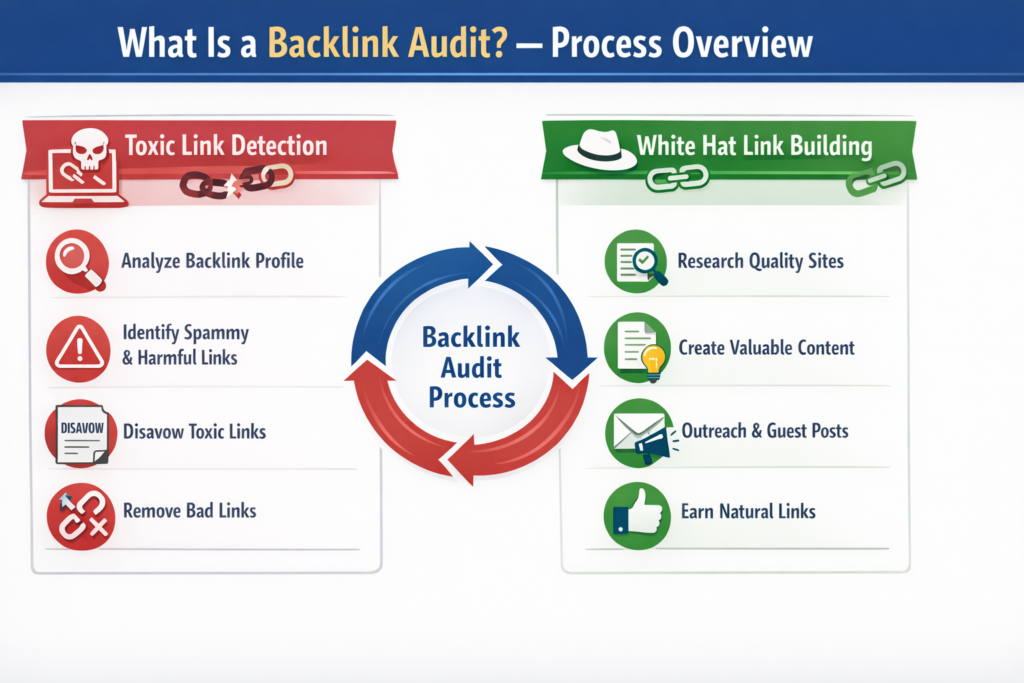
A backlink audit is a structured review of every external link pointing to your website. The goal is to identify links that are harmful, manipulative, or low-quality and to understand how your overall link profile compares to what search engines expect.
Google uses backlinks as a trust signal. Editorial, relevant links tell Google that your content is worth citing. By contrast, links created through manipulation paid schemes, private blog networks, or automated bots can trigger algorithmic penalties or even manual actions that remove pages from search results entirely.
Google’s Official Stance
Google’s spam policies are clear: links built primarily to manipulate rankings are link spam. Their systems actively work to detect and nullify these patterns at scale.
Regular audits also help you spot negative SEO attacks early situations where competitors point spammy links at your domain intentionally to weaken your rankings. Catching these patterns quickly limits the damage.
When Should You Run a Backlink Audit?
You should run a backlink audit if any of the following apply to your site:
- You’ve participated in link building campaigns in the past
- Your organic rankings have dropped unexpectedly
- You’ve received a manual action notice in Google Search Console
- You recently acquired a domain or migrated a website
- You notice a sudden spike in new referring domains
Understanding Toxic Backlinks: Key Warning Signs
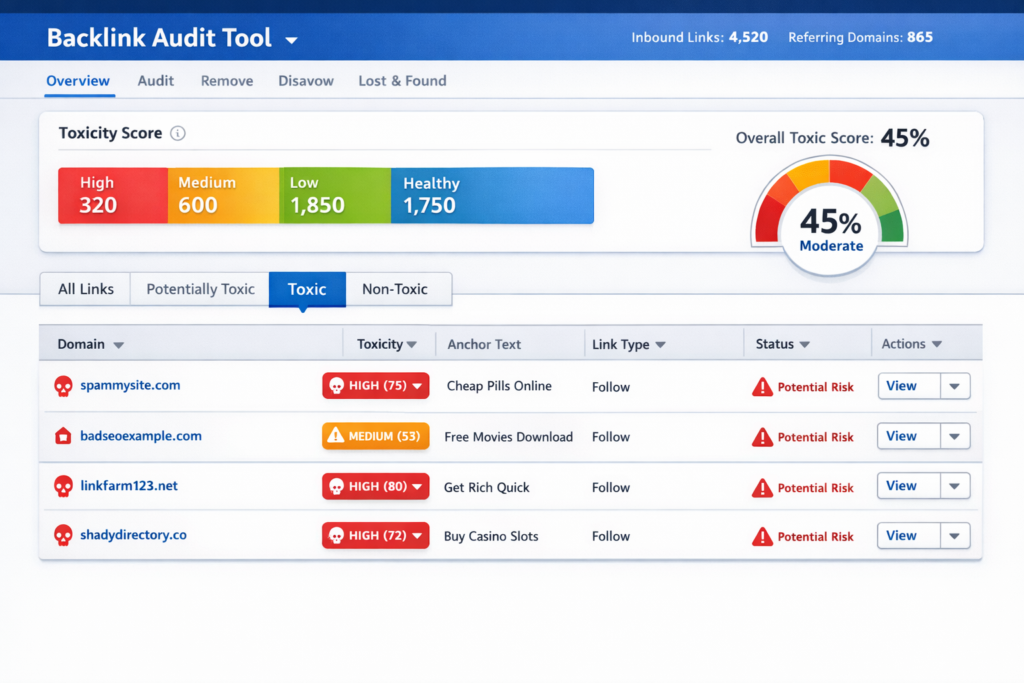
Toxic backlinks are links that form patterns violating Google’s link spam guidelines. No single link is automatically “toxic” context, intent, and scale all matter. Still, certain warning signs consistently appear in problematic link profiles.
Common Toxic Backlink Indicators
Exact-match commercial anchor text
Links from private blog networks (PBNs)
Paid follow links without nofollow tags
Bot-generated directory spam links
Links from hacked or compromised sites
Sudden link spikes from irrelevant domains
Editorial links from relevant industry sites
Branded or natural anchor text
Links with proper nofollow/sponsored tags
Consistent, gradual link growth over time
9 Common Causes of Toxic Backlinks (And How to Spot Them)
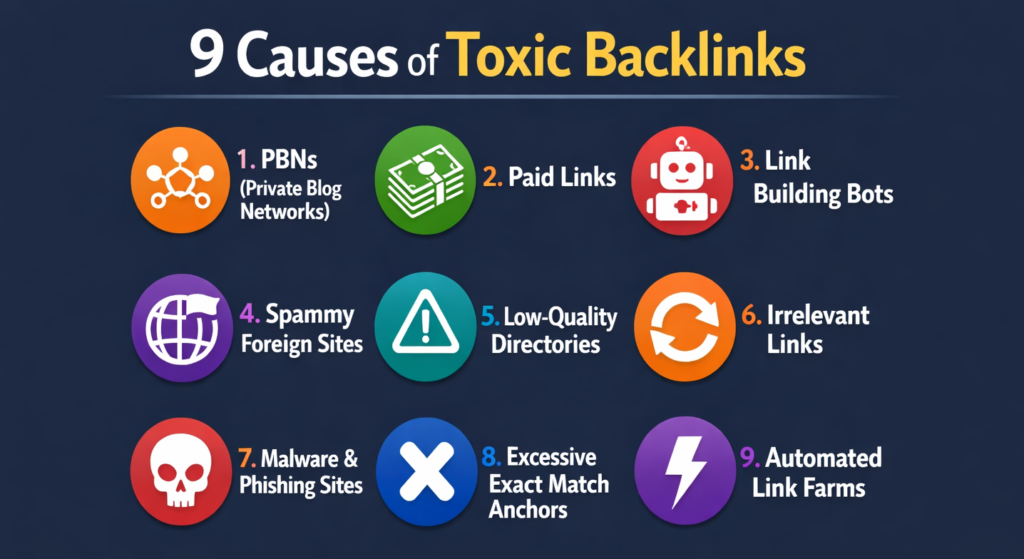
Understanding where toxic backlinks come from helps you prevent them and prioritize cleanup. These nine practices are the most frequent sources of problematic link patterns.
1. Paying for Follow Links
Buying backlinks isn’t always against Google’s rules but paying for follow links that pass PageRank is. Any paid link must include a rel="nofollow" or rel="sponsored" attribute. This covers digital ads, influencer partnerships, gifted products, and paid directory listings.
2. Excessive Link Exchanges
A few natural reciprocal links are harmless. However, systematic link exchanges arranged purely for SEO purposes create unnatural patterns. Review reciprocal links and remove any that were structured as part of a trading scheme.
3. Private Blog Networks (PBNs)
PBNs are groups of sites controlled by one owner, built purely to supply links to a target domain. Google actively detects these networks. Any links coming from known PBNs should be removed or disavowed as quickly as possible.
4. Automated Link Building Bots
Bots that place links in comment sections, forums, or user-generated content areas are a major red flag. These links are easy to spot: they appear at scale, in unrelated contexts, and often carry spammy anchor text.
5. Low-Quality Directory Submissions
Directories with no editorial oversight where anyone can get listed rarely add value and often create risky signals. Be especially cautious of directories that charge for listings while emphasizing the backlink as the benefit.
6. Unnatural Forum and Comment Links
Dropping links to your site in forum threads or comment sections purely for SEO purposes is a form of link spam. Google recommends the rel="ugc" attribute for user-generated content links to signal these shouldn’t pass ranking value.
7. Widget Links Without Nofollow Tags
Embeddable widgets that include follow links to your site can appear manipulative at scale. Site owners embedding the widget have no control over the link’s placement so Google doesn’t treat these as editorial endorsements. Always qualify widget links with no follow attributes.
8. Contractual Backlink Requirements
Requiring a backlink in a contract, terms of service, or similar agreement without allowing the publisher to qualify it is considered link spam. Review existing agreements and update templates accordingly.
9. Negative SEO Attacks
Competitors sometimes point large volumes of spammy links at your domain to trigger a penalty. Google says these attacks rarely succeed, but sudden spikes in low-quality referring domains are worth monitoring closely and documenting in case a reconsideration request is needed.
How to Run a Technical Backlink Audit: Step-by-Step
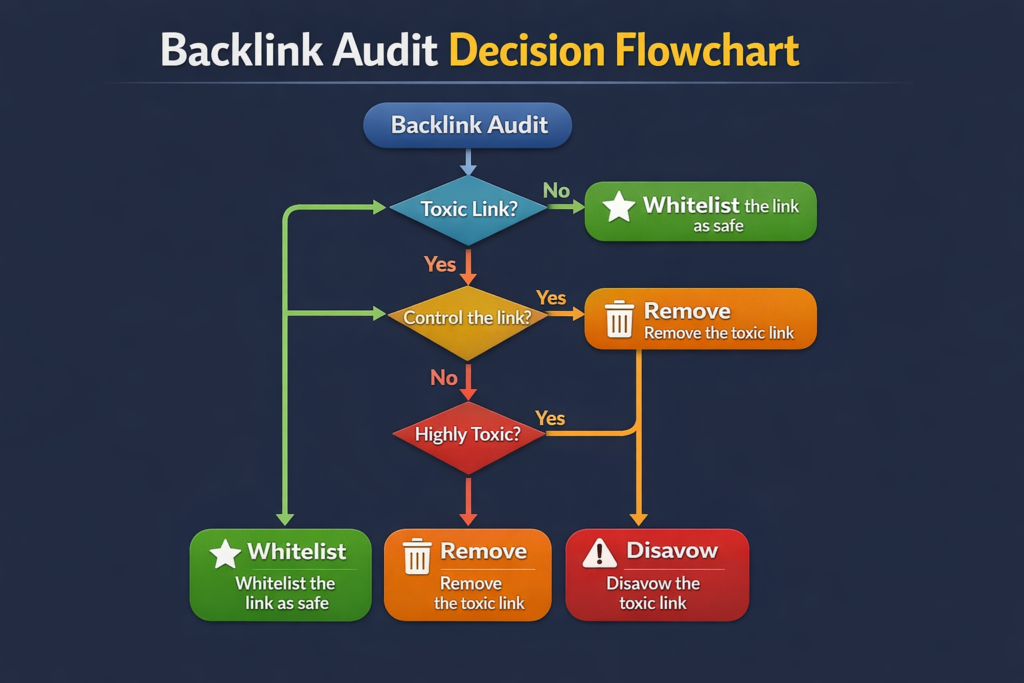
Running a proper technical audit of your backlink profile combines automated tools with manual review. Follow these steps to identify toxic links systematically.
Check Google Search Console First
Navigate to Security & Manual Actions → Manual Actions. Confirm whether Google has already applied a penalty. If you see “No issues detected,” proceed to a proactive audit. If a manual action exists, prioritize removal and disavowal immediately.
Export Your Backlink Data
From Search Console, go to Links → Top Linking Sites → Export. This gives you a base list of referring domains. Note that GSC shows only a sample supplement this with a dedicated audit tool for complete coverage.
Run an Automated Backlink Audit Tool :
Tools like Semrush’s Backlink Audit score each link against dozens of toxic markers and assign a Toxicity Score (0–100). Connect Google Analytics and Search Console to improve accuracy. Review “Dangerous” and “Potentially dangerous” flags first.
Evaluate Anchor Text Patterns
Focus on money anchor text (exact keyword matches like “best SEO agency”) and compound anchors (brand + keyword). High concentrations of exact-match anchors across referring domains often signal manipulative link building.
Manually Review Flagged Links
Visit each flagged page directly. Ask: Is this a real site? Does the link appear in context? Was it editorially placed? A link from a hacked site looks different from a link from a deliberate spam network and both require different responses.
Categorize: Remove, or Disavow:
Flag manipulative links for outreach removal. Reserve disavowal only for links you cannot remove and that are clearly harmful or tied to a manual action.
Pro Tip: Domain-Level vs URL-Level Disavowal
When disavowing, target entire domains (domain:example.com) rather than individual URLs. This covers duplicate pages and future links from the same bad source, reducing the risk of missing related toxic links.
How AI-Powered Search Affects Backlink Quality
AI-driven search experiences including Google’s AI Overviews, ChatGPT search, and Perplexity evaluate source credibility at a broader level than traditional link-based ranking alone. These systems assess authority, trust signals, and content quality holistically.
A backlink profile filled with manipulative or low-quality links can influence whether your site gets cited, summarized, or excluded in AI-generated answers. This makes white hat link building more important than ever not just for rankings, but for visibility in the next generation of search.
Keeping your link profile clean, contextually relevant, and consistently built through editorial relationships protects you across both traditional and AI-driven search surfaces. For a deeper look at how AI search is reshaping SEO strategy, explore Adclickr’s AI SEO strategy guide.
White Hat Link Building: How to Earn Authority Links the Right Way
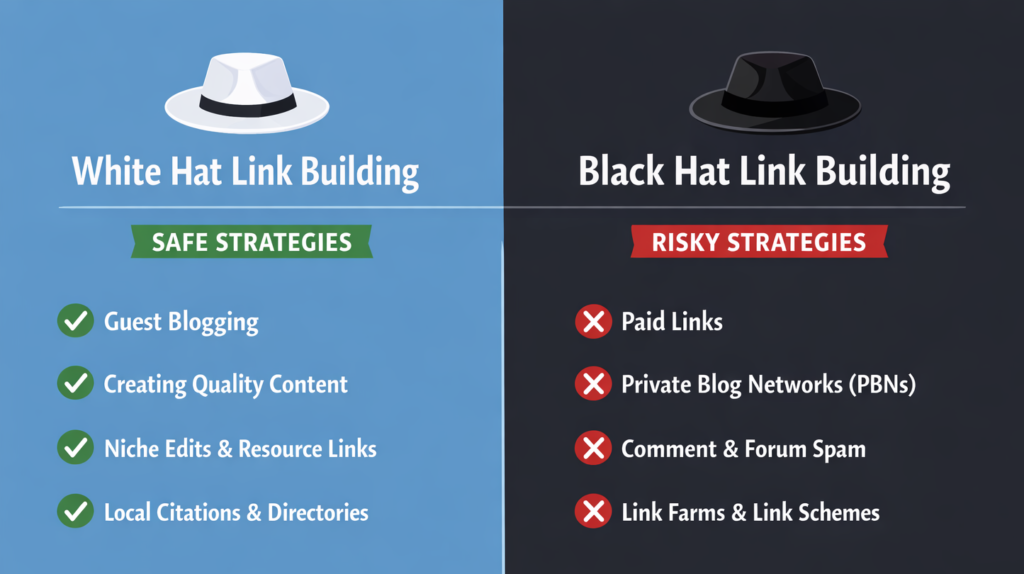
Removing toxic links is only half the equation. Long-term authority comes from earning high-quality, editorially relevant authority links through legitimate means. The following strategies consistently deliver results without the risk of penalties.
Create Link-Worthy Content Assets
Original research, comprehensive guides, and data-driven studies attract links naturally. When your content answers questions better than anything else in your niche, other sites link to it without being asked.
Digital PR and Thought Leadership
Earning coverage in industry publications, podcasts, and news outlets generates authoritative backlinks at scale. Pitch expert commentary, unique data, or strong opinions on trending topics in your field. Learn how Adclickr’s digital PR service helps brands earn press-quality authority links.
Guest Posting on Relevant Sites
Contributing expert articles to reputable publications in your industry remains a valid strategy provided the content is genuinely useful and the site has editorial standards. Avoid mass guest posting on low-quality blogs purely for link volume.
Resource Page Link Building
Many industry sites maintain resource pages that link to useful tools, guides, and references. Identifying and reaching out to these pages with a genuinely valuable asset is one of the most efficient white hat link building strategies available.
Building Genuine Partnerships
Collaborations with complementary businesses, co-authored content, and legitimate co-marketing partnerships produce natural, high-value backlinks. These links come with brand context that AI search systems recognise as authoritative citations.
How to Remove or Disavow Toxic Backlinks
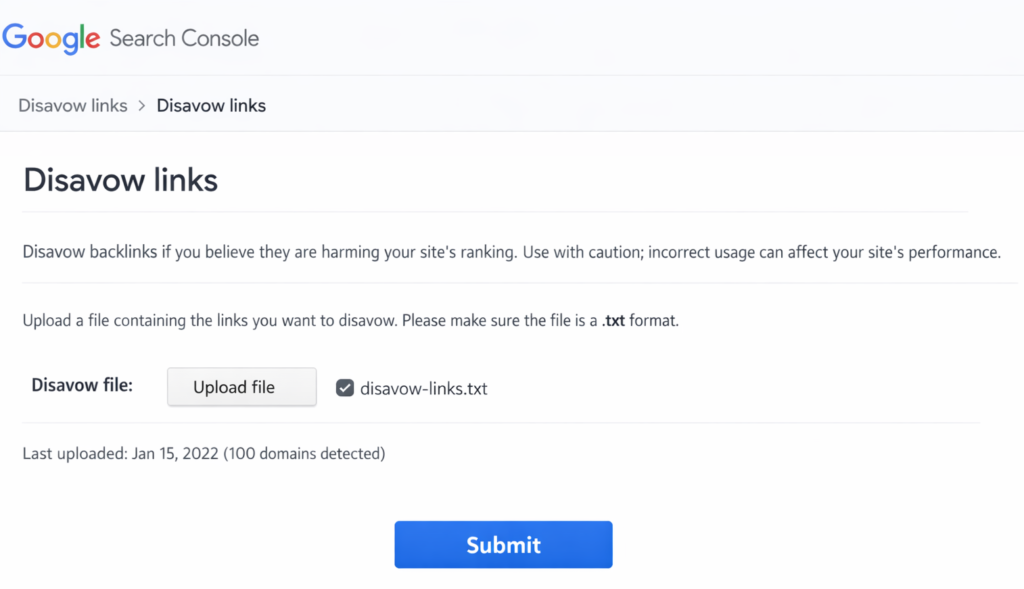
Once you’ve identified genuinely harmful links through your backlink audit, you have two options: request removal or disavow. Use removal first disavowal is a last resort.
Requesting Link Removal
Contact the referring site’s webmaster and request that the link be removed or qualified with a no follow attribute. Keep outreach messages brief, neutral, and professional. Explain the link’s location and the reason for the request. Follow up once if you don’t receive a response.
Using Google’s Disavow Tool
Use the disavow tool only when removal attempts have failed and you have a compelling reason such as a manual action or a clearly manipulative link-building history. Upload a .txt disavow file through Google Search Console. Effects typically take several weeks to process.
Disavow With Caution
Over-disavowing can harm your SEO. Google’s Gary Illyes has noted that broad, unnecessary disavowal files sometimes do more damage than the links they’re meant to address. Only disavow links you have strong evidence are harmful.
If your site has an active manual action, submit a reconsideration request in Search Console after completing your cleanup documenting the steps taken and the links addressed.
Real-World Backlink Audit Examples
Seeing how toxic backlink issues play out in practice helps you recognize similar patterns in your own profile. These four scenarios reflect situations SEO professionals commonly encounter.
Sudden Directory Link Spike
A financial services company noticed 500+ new backlinks from low-quality Eastern European directories appearing in a single weekend. Toxicity markers included foreign-language exact-match anchors and IP clustering. Organic visibility dropped 40% within two weeks. After failed removal attempts, a bulk disavow resolved the issue.
Negative SEO Attack
An ecommerce retailer suffered unexplained ranking drops traced to 1,000+ spammy links from adult content sites and pharmaceutical forums. Google issued a manual action. After documenting the attack timeline and submitting a disavow file with a reconsideration request, rankings recovered within 45 days.
Hacked Website Backlinks
A SaaS company found hundreds of backlinks from high-authority sites that had been compromised hidden footer links and injected spam pages pointing to unrelated domains. The team notified affected webmasters and disavowed links that couldn’t be removed in time.
Inherited PBN Links from an Acquired Domain
A healthcare company discovered that a domain they acquired had previously been part of a PBN scheme. Historical mismatched anchor text and identical-template referring sites flagged the issue. The team disavowed PBN-sourced links and focused on building fresh, relevant backlinks to rebalance the profile.
Ready to Clean Up and Scale Up?
A healthy backlink audit is the foundation of sustainable SEO. Adclickr’s team combines technical audit expertise with proven white hat link building strategies to protect and grow your authority. Get a Free Backlink Audit Explore Link Building Services
Frequently Asked Questions
A backlink audit reviews all inbound links to identify harmful or low-quality sources. Run quarterly, or monthly when actively building links, recovering penalties, or facing ranking changes.
Toxic backlinks can trigger penalties if manipulative patterns exist. Google may ignore some links, but large-scale schemes can cause manual actions and ranking suppression.
Removing backlinks involves contacting site owners to delete links. Disavowing submits a file asking Google to ignore links. Removal is preferred; disavow is a last resort.
Authority links come from reputable, relevant sites and signal trust to Google. They improve rankings, build credibility, and support sustainable SEO through high-quality content and relationships.
White hat link building earns links through ethical methods like content and outreach. Black hat uses manipulative tactics like buying links, risking penalties and long-term ranking loss.
Backlink quality impacts AI search visibility by signaling trust and authority. Strong profiles increase chances of being cited, while manipulative links reduce credibility even without penalties.
Need a Backlink Audit?
Our technical SEO team identifies toxic links and builds a clean authority profile for your site.Talk to an Expert →