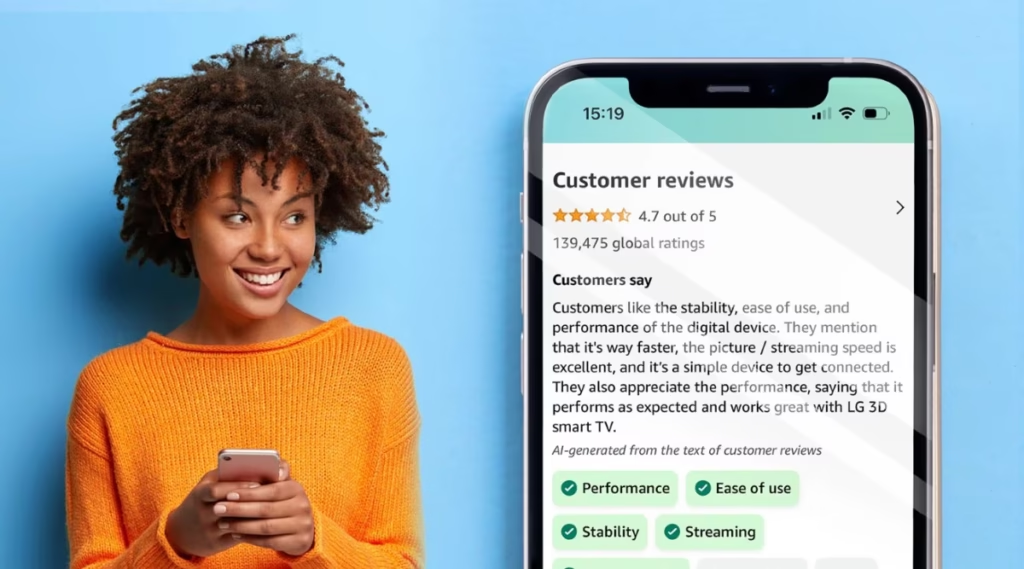
Online reviews are no longer written for human readers alone. Search engines powered by large language models (LLMs) now analyze review content to generate summaries that can appear before traditional SEO results.
Because of this shift, review management is no longer only about tracking ratings or sentiment. It now depends on how clearly customer feedback and the brand’s responses communicate intent, actions, and outcomes.
This blog explores how businesses can adapt their review responses for AI-driven discovery without compromising brand voice. When replies clearly acknowledge the issue raised and explain what happened next, they build trust with people while providing clarity for artificial intelligence systems.
Why AI Reads Your Reviews
Artificial intelligence platforms now use customer reviews to understand business quality, customer satisfaction, and service reliability. OpenAI ChatGPT analyzes review content and business responses to identify common experiences and customer sentiment. Similarly, Google AI Overviews summarize reviews directly in search results to help users make faster decisions.
Perplexity AI also evaluates review patterns, keywords, and customer feedback to generate business recommendations. Clear, detailed review responses help AI systems better understand your brand, improving visibility, trust, and discoverability in AI-powered search experiences.
Why AI Readability Is Now Critical in Review Responses

Review replies have become a form of structured data for AI-driven search and discovery systems. Large language models analyze customer reviews alongside brand responses to identify recurring problems, service patterns, and resolution outcomes. In this environment, AI and customer feedback are tightly connected.
AI generated summaries depend on explicit, unambiguous language. Generic phrases like “we appreciate your feedback” or “we’ll look into this” communicate sentiment but fail to define actions or results. As a result, they provide weak signals for AI interpretation.
Clear responses that identify the issue, recognize its impact, and explain what occurred afterward help AI systems connect cause and effect. This improves how a brand’s reputation is summarized and surfaced across AI-powered platforms.
The same principle applies across digital touchpoints whether it’s review replies, service descriptions, or even an SEO optimized Instagram Caption, clarity is now a discoverability signal.
5 Practical Tips for Writing AI-Readable Review Replies

Review responses now act as interpretive inputs for AI systems. This reflects how AI affects online reviews and why precision matters more than politeness alone.
The following best practices help brands create responses that work for both customers and AI models.
1. Use Complete Sentences With Clear Actions
Structured sentences make it easier for AI to identify who acted and what occurred. Avoid vague or incomplete phrasing.
2. Reflect the Reviewer’s Language Without Copying It
Referencing the same issue or experience strengthens relevance without repeating the review word-for-word. This reinforces context within AI analysis.
3. Clearly State Outcomes Instead of Suggesting Them
AI systems struggle with implied intent. Explicitly stating what was resolved, changed, or followed up provides usable signals.
4. Avoid Promotional or Buzzword-Heavy Language
Marketing phrases introduce noise. Review replies should stay factual, specific, and focused on the interaction being discussed.
5. Write as If an AI Will Summarize the Reply
Each response should stand alone with enough detail to be accurately condensed. This discipline supports a consistent AI-focused review strategy.
Effective review management today depends on clarity and accountability. When responses communicate actions plainly, they serve customers better while strengthening AI-driven visibility.
Example 1: Negative Review About Service
Weak Response
“Thank you for your feedback. We apologize for the inconvenience and appreciate you bringing this to our attention. We strive to provide excellent service and will do better in the future.”
This reply acknowledges sentiment but fails to reference the specific issue. It offers no explanation or outcome, making it low-value for AI interpretation.
Optimized Response
“Thank you for sharing your experience regarding the extended wait time during your appointment on Monday. The delay occurred due to an unexpected staff shortage, and we understand the frustration this caused. Since then, we have adjusted our scheduling process to reduce wait times and reviewed this feedback with our team.”
This response mirrors the concern, identifies the cause, and explains the corrective action. The language is factual and structured, making it easier for AI systems to interpret accurately.
Example 2: Positive Review About Staff
Weak Response
“Thanks for the kind words. We appreciate your support and look forward to seeing you again.”
While polite, this response doesn’t reinforce what the customer valued and provides little context for AI systems.
Optimized Response
“Thank you for highlighting our front desk team’s effort to take extra time answering your questions during check-in. Providing clear guidance and support is a core part of our service approach, and we’re glad it helped make your visit smoother.”
This reply reflects the specific praise and confirms the behavior as intentional, reinforcing a consistent service narrative.
3 Tools That Support Modern Review Response Workflows
Managing reviews at scale requires more than manual replies. Platforms designed for AI-driven visibility help brands treat reviews as structured reputation data rather than isolated comments.
1. Review Monitoring and Alerts
AI-enabled monitoring tools notify teams when new reviews are published across platforms. Alerts reduce response delays and ensure feedback is addressed promptly without manual tracking.
2. AI-Assisted and Automated Review Responses
Modern platforms support automated replies for positive feedback and AI-assisted drafts for more detailed responses. These drafts can be edited to maintain brand tone while improving efficiency.
3. Consistent Reputation Engagement
Centralized dashboards allow businesses to standardize response workflows across locations and platforms. This consistency supports stronger engagement signals while aligning with platform guidelines.
Businesses already applying these principles across content from review replies to content writing services and AI-driven SEO strategies are better positioned for AI-based discovery.
How ChatGPT and Perplexity Read Google Reviews
- AI scans keywords in reviews
- Looks for repeated complaints
- Detects service quality patterns
- Uses review replies for business summaries
Learn more about AI visibility in our guide
Generative Engine Optimization (GEO)
FAQ’s
Google review responses improve customer trust, strengthen local SEO signals, and help AI systems better understand business quality, service reliability, and customer satisfaction patterns.
Yes. OpenAI ChatGPT analyzes reviews and responses to identify customer experiences, business reputation, recurring issues, and service quality for AI-generated summaries and recommendations.
Businesses should acknowledge the issue, explain the resolution clearly, remain professional, and provide transparent responses that build trust with customers and AI systems.
Yes. Consistent, relevant review responses improve engagement signals, strengthen local SEO visibility, and help search engines better understand customer experiences and business reputation.
AI readability helps systems like Google AI Overviews and Perplexity AI accurately summarize customer experiences and recommend trusted businesses to users.
Taking Control of Reviews in the AI Search Era
Understanding how AI interprets online reviews is now essential for maintaining visibility and trust. Review responses influence how brands are summarized and evaluated by AI systems not just how individual customers perceive them.
Rather than reacting to feedback case by case, businesses need structured workflows that prioritize clarity, consistency, and accountability. This approach mirrors broader SEO principles, where intent and structure matter more than surface-level optimization a concept explored further in how to know if your SEO is working.
For brands looking to strengthen reputation signals alongside services like local SEO or social media marketing, review response strategy is no longer optional.
If you want to future proof your online reputation and ensure your brand communicates clearly to both humans and AI systems, connect with the Adclickr team via our contact page or explore our full range of digital marketing services.

About the author
Ujjwal Kumawat
I specialize in SEO, website development, Google Ads and online business growth strategies. Through my blogs, I share practical insights, marketing tips and proven strategies to help businesses improve their online visibility, generate more leads and grow faster in the digital space.