A question marketers, writers, and business owners still ask is how long a blog post should be for search engine optimization (SEO). It’s a reasonable question but it’s not the best starting point.
Search engines no longer reward content simply for meeting a specific word count. Instead, they prioritize content that clearly fulfills search intent. A strong piece of content demonstrates expertise, answers the user’s question efficiently, and delivers real value. That’s why debates around the “ideal” blog post length for SEO are increasingly outdated.
Some studies show that the average word count of content ranking on the first page of search engine results (SERPs) is around 1,447 words. However, averages don’t explain performance. In many industries, shorter articles outperform longer ones, which makes it impossible to define a universal best word count for blog posts.
Whether there’s an ideal blog length for SEO has been debated since search engines first appeared. The reality is simpler: the right content length depends on your goal, your audience, and where that content fits into your broader strategy.
Whether your goal is organic traffic, lead generation, or engagement, this guide helps you balance quality, strategy, and measurable performance.
Context Matters More Than Word Count
If you’re chasing a fixed word count for every blog post, you’re solving the wrong problem. SEO rewards relevance, not formulas.
A 600-word article can outperform a 2,000 word guide if it answers the user’s question perfectly. In other cases, a topic requires depth, nuance, and explanation that only longer content can provide. That’s why context not word count should guide your decisions.
Google explains that when a user searches, its systems aim to return results that are both relevant and high quality, factoring in location, language, device, and how well content matches the query. Word count alone doesn’t determine rankings.
To apply context effectively, ask:
- Who is your audience? Beginners need clarity and examples; experts want direct insights.
- What kind of question are you answering? Some topics need depth, others just precision.
- Where is the user in the funnel? Educational blogs differ from decision-stage content.
As one industry expert put it, bloated keyword lists may look like content, but they fail to serve readers. Modern search engines especially with AI penalize irrelevant fluff.
Your goal isn’t to hit a number. It’s to match depth to expectations. When content length aligns with intent, engagement rises and bounce rates fall signals Google pays attention to.
What the Data Reveals About Blog Length Benchmarks
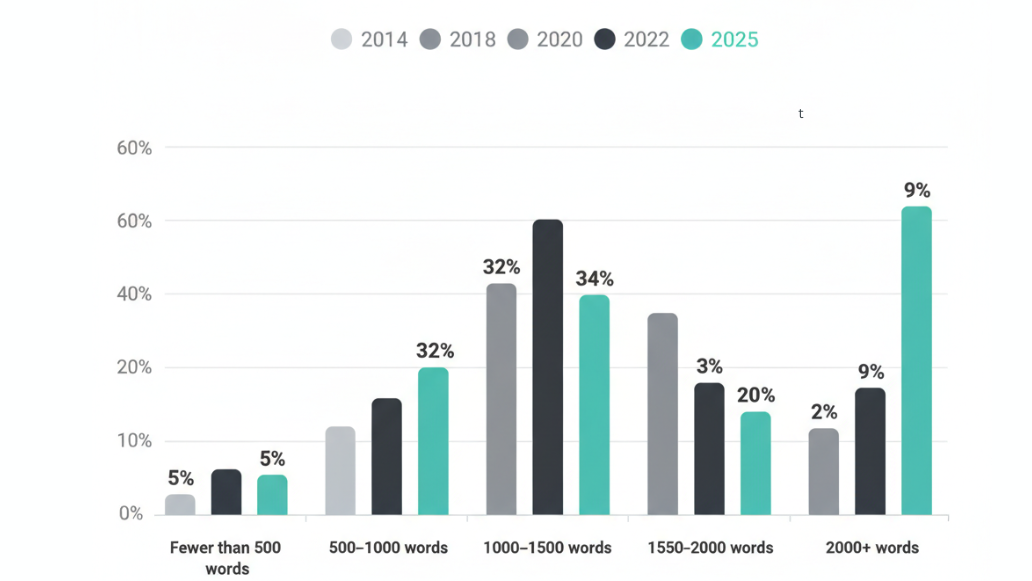
You shouldn’t chase numbers blindly, but data still offers useful context. Research across industries shows that longer content often ranks better but only when it provides genuine value.
Here are common benchmarks:
- Many top-ranking SEO blogs fall between 1,700 and 2,400 words
- First-page results often average 1,447–2,400 words
- Evergreen guides frequently exceed 2,000 words
- Listicles and how-to posts typically perform well at 500–1,500 words
- B2B content trends longer than B2C due to higher consideration cycles
What matters most is whether your content fully addresses the topic. That’s how topical authority is built.
If you’re targeting a keyword and wondering how many words a blog post should be for SEO, analyze what’s already ranking then improve upon it with better clarity and depth.
Choose Content Length Based on Your Objective
SEO content generally falls into two categories: long-form and short-form. Neither is inherently better they serve different purposes.
Long-form content (1,000+ words) works best for competitive informational topics, pillar pages, and thought leadership. It allows space to demonstrate expertise and answer follow-up questions.
Common long-form formats include:
- Blog guides and resources
- Tutorials and pillar pages
- White papers and ebooks
- Webinars and educational content
Short-form content (under 1,000 words) is ideal for fast consumption and engagement. It’s concise, shareable, and effective for awareness.
Examples include:
- News-style blogs
- Email newsletters
- Infographics
- Social media posts, including an SEO optimized Instagram Caption designed for discoverability
Before writing, always check what format dominates the SERPs for your keyword. Guides compete with guides not landing pages.
Why Search Intent Determines Word Count
Trying to force a predetermined blog length is one of the biggest SEO mistakes. If you want rankings and conversions, you must understand why someone is searching.
There are four primary types of search intent:
- Informational learning or research
- Navigational finding a specific site or brand
- Transactional ready to act or purchase
- Commercial investigation comparing options
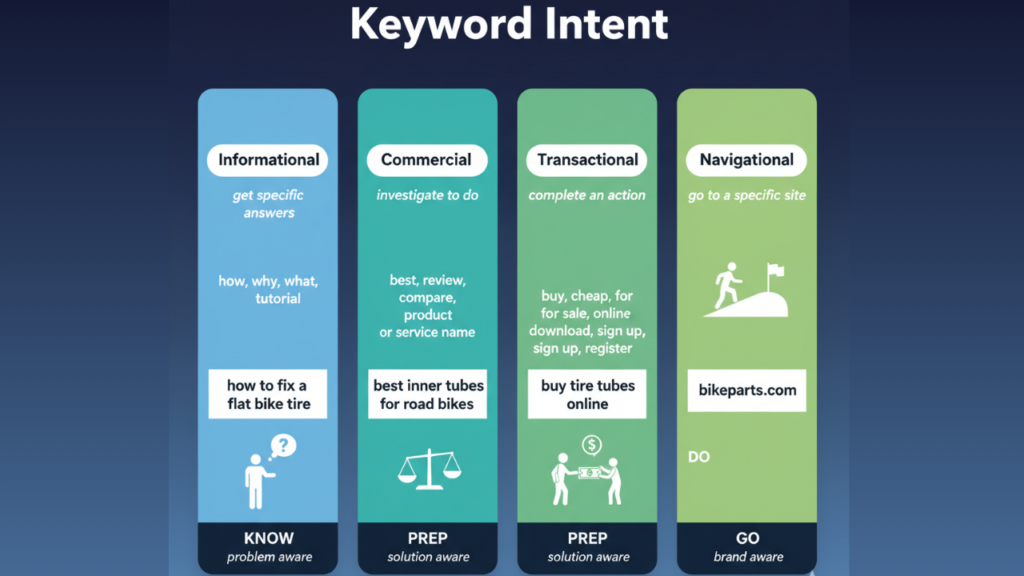
Each intent demands a different content length.
- Informational queries often need 1,500 – 2,500+ words
- Navigational queries may need very little content
- Transactional pages perform well at 1,000 – 1,500 words
- Comparison content usually falls between 1,500 – 2,000 words
When word count doesn’t match intent, performance suffers regardless of writing quality.
Topic Depth and Expertise: When Longer Hurts Performance
A long article that says nothing new adds noise, not value. Search engines reward usefulness, clarity, and trust not padding.
Depth means:
- Fully answering the main question
- Covering related subtopics
- Supporting claims with examples or insights
- Addressing objections and confusion
Authority comes from precision, not verbosity. A 700-word niche tutorial can outperform a 2,500-word general overview if it delivers exactly what users need.
Topical authority is built through ecosystems:
- Pillar content for core topics
- Supporting cluster content for subtopics
This structured approach consistently outperforms isolated posts.
SEO Word Count Checklist Before You Write
Word count should be a result of planning not a goal. Use this checklist before drafting:
1. Analyze What’s Ranking
Review the top results for your keyword. Look at length, structure, and depth.
2. Identify Search Intent
Match format and length to user expectations.
3. Find Content Gaps
Improve on competitors by covering what they missed.
4. Evaluate Keyword Competition
High-difficulty keywords require stronger authority and deeper coverage.
5. Plan Internal Links
Link naturally to related resources like SEO services, content writing services, or AI SEO solutions.
Internal linking improves UX, crawlability, and conversions.
Is Long-Form Content the Key to Ranking?
Long content often ranks but not because it’s long. It ranks because it’s comprehensive, well-structured, and trusted.
Highly competitive keywords require authority, backlinks, and engagement signals. Length supports these factors only when it enables better coverage.
The takeaway is simple: longer content works when the topic demands it not because word count alone influences rankings.
Repurpose Content Across Channels
Once your blog is published, its value multiplies through repurposing.
- Social media extracts short insights
- Emails highlight one takeaway with a CTA
- Ads reuse headlines and hooks
- Landing pages adapt high-performing sections
A single blog can fuel Instagram posts, LinkedIn carousels, email campaigns, and even portfolio examples like Instagram marketing projects.
What Google Really Evaluates: E-E-A-T and UX
Google doesn’t measure word count it evaluates trust, experience, and usability.
Strong content:
- Reflects real experience
- Explains concepts clearly
- Builds authority through consistency
- Delivers smooth user experience
Well-placed internal links to pages like SEO insights or image optimization guides signal depth and relevance.
The Strategic Sweet Spot Between Length and Results
The best content length sits at the intersection of:
- Search intent
- Topic complexity
- Competitive landscape
- Business goals
Typical ranges:
- B2B content: 1,800 – 2,500+ words
- B2C content: 1,200 – 1,800 words
- Landing pages: Variable, driven by conversion needs
Strategy always beats volume.
FAQs:
In competitive niches, longer content often performs better because it allows deeper coverage, stronger internal linking, and clearer demonstrations of expertise. However, depth—not length alone drives rankings.
Run A/B-style comparisons over time. Publish both comprehensive guides and concise posts targeting similar intent types, then measure rankings, dwell time, conversions, and engagement.
No. Service and landing pages prioritize clarity, trust signals, and conversions. Their length should support persuasion and usability rather than informational depth.
AI-powered search systems extract concise, structured answers. Content should include scannable sections and direct responses, even within longer guides, to improve visibility.
It depends on search intent. If users expect a comprehensive guide, keep it unified. If the topic includes distinct subtopics with separate intent, cluster them into supporting articles linked to a pillar page.
Conclusion: Focus on Value, Not Numbers
The real question isn’t how many words your blog should have. It’s how effectively it serves your audience.
If a topic needs 600 words, write 600. If it needs 2,000, make every sentence earn its place.
When content aligns with intent, user expectations, and business outcomes, word count becomes a byproduct not a target.
That’s how you determine the right content length for your strategy and how you create content that consistently performs.
For expert led, SEO driven content strategies, explore Adclickr’s content marketing solutions or get in touch with our team.

About the author
Ujjwal Kumawat
I specialize in SEO, website development, Google Ads and online business growth strategies. Through my blogs, I share practical insights, marketing tips and proven strategies to help businesses improve their online visibility, generate more leads and grow faster in the digital space.