SEO automation is not a strategy. It is a capability. And the difference between an SEO team that uses it well and one that uses it poorly comes down to a single question: are you automating the right things ?Teams that insist everything must be manual overpay for mechanical work. Teams that automate everything publish unreviewed output that damages their reputation connecting SEO automation to measurable business outcomes rather than just activity volume is what separates both extremes.
This guide covers what to automate, what to keep human, an AI marketing strategy framework for 2026, and a practical starter stack. You will also find large-scale SEO workflows, technical audit checks, and a phase matrix to guide every decision.
What Is SEO Automation? (And What It Isn’t)
SEO automation uses software tools, scripts, and AI agents to perform repetitive SEO tasks rank tracking, site crawling, reporting, and citation monitoring without constant manual intervention. It frees your team to focus on strategic, judgment-intensive work that actually differentiates results.
SEO automation is not a replacement for strategy. It is not a substitute for editorial review. It is not a shortcut to publishing content your team has never read.
Not sure where your site’s baseline sits? Get a free SEO report to see exactly what issues exist before building automation around them.
What to Automate: 5 High-Volume SEO Tasks
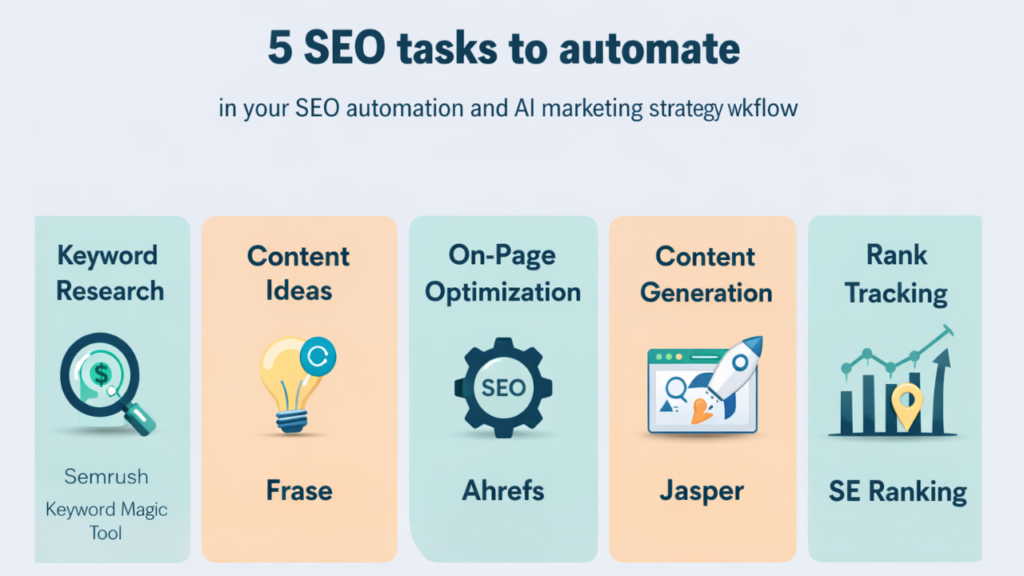
The best candidates for automation share three traits: they are repetitive, rule-based, and the cost of a minor error is low. In SEO, five major workflows fit this profile precisely.
- Rank Tracking: Automated rank tracking is mature and reliable set your keywords, locations, and frequency once. Geo-grid tracking for local businesses, for example, covers hundreds of location points simultaneously. That is literally impossible to do manually at scale. Automate the tracking. Keep the analysis human.
- Site Crawling and Technical Audits: A technical audit on a 200+ page site takes days if done manually. Automated weekly crawls catch issues as they arise broken links, missing meta tags, schema errors, redirect chains, and page speed regressions. This is the foundation of any large-scale SEO operation.
- SEO Reporting and Dashboard Updates: The manual reporting cycle multiple logins, CSV exports, slide decks, narrative summaries is a textbook candidate for automation. Understanding what SEO services involve helps you see where automation fits within the broader workflow. Automate data collection from GSC, GA4, and rank trackers. Keep narrative interpretation and recommendations human.
- Citation Monitoring: Local citations NAP (name, address, phone) across directories must stay consistent. Automated tools scan, update, and alert your team when discrepancies appear. Pair this with dedicated local SEO services for maximum directory coverage and accuracy.
- Content Workflow Guardrails: Use automation for guardrails not content generation. Safe to automate: brief generation, keyword density checks, schema markup suggestions, meta tag recommendations, and publishing workflow approvals. Strong content writing still requires human editorial review at every stage. The content itself must go through genuine human review before it ever publishes.
What NOT to Automate: 5 Judgment-Intensive Tasks
The tasks that must stay human share their own characteristics: they require business context, involve trade-offs between competing priorities, and carry a high cost of error.
- Strategy and Prioritization: An automated system can identify 50 opportunities. It cannot decide which 5 to pursue this quarter given your budget, competition, and goals. Strategic prioritization requires understanding what matters to YOUR specific business no tool can replicate that.
- Content Quality Review: Automated checks flag structure issues. They cannot flag that a blog post contradicts your client’s current pricing or misrepresents brand voice. Every published piece needs genuine review not a glance.
- Client Communication: Automated reports are useful. Automated client communication is not. When a client asks “why did my rankings drop?” they need a thoughtful explanation from someone who understands their business not a templated response.
- Competitive Strategy: Tools track what competitors publish and how rankings shift. Interpreting what those moves mean requires human judgment. A competitor publishing 10 posts this month could mean brilliant execution or desperate flailing the data looks identical, the response is opposite.
- Crisis Response: When a manual action, ranking collapse, or site hack occurs, automated systems detect it. They cannot navigate the high-stakes decisions crisis situations demand. This is non-negotiable human territory in every SEO workflow.
The SEO Automation Matrix: Automate Throughput, Keep Judgment Human
![SEO Automation Matrix Diagram] Alt text: "SEO automation matrix — which phases to automate vs keep human in large-scale SEO and technical audit workflow](https://adclickr.com/wp-content/uploads/2026/03/gfhkh-1024x576.png)
If you need one rule for deciding what to automate, it is this: automate everything that increases throughput, and keep human everything that requires judgment.
| Phase | Automate This | Keep This Human |
|---|---|---|
| Monitoring | Rank tracking, site health checks, review alerts | Interpreting anomalies, assessing business impact |
| Analysis | Data collection, pattern detection, competitor scanning | Strategic assessment, opportunity prioritisation |
| Planning | Brief generation, keyword clustering, opportunity scoring | Goal setting, budget allocation, campaign timeline |
| Execution | Schema generation, citation updates, meta tag suggestions | Editorial review, strategic content, link outreach |
| Reporting | Dashboard updates, metric aggregation, alert generation | Narrative analysis, recommendations, client calls |
One of the clearest signals automation is performing is a measurable improvement in rankings and traffic learn how to know if your SEO is working to benchmark that impact accurately.
SEO Automation and AI Marketing Strategy in 2025
Most SEO automation guides ignore AI search entirely. In 2025, AI marketing strategy extends automation into schema markup generation for AI search citations, FAQ content structuring for Google AI Overviews, and brand citation monitoring across ChatGPT and Perplexity.
AI tools now handle content brief generation, keyword clustering, and meta tag optimization at scale. AI agents monitor brand citation frequency across AI-generated answers a channel standard analytics cannot track. This visibility gap is one reason AI marketing strategy has become a standalone discipline alongside traditional SEO.
The core rule remains unchanged AI generates the draft, humans review the output. The same principle governs any AI marketing strategy across SEO, paid search, or content human review at the output stage is not optional. Remove that layer and you accept errors published at scale.
Your Starter SEO Automation Stack — 5 Steps to Begin
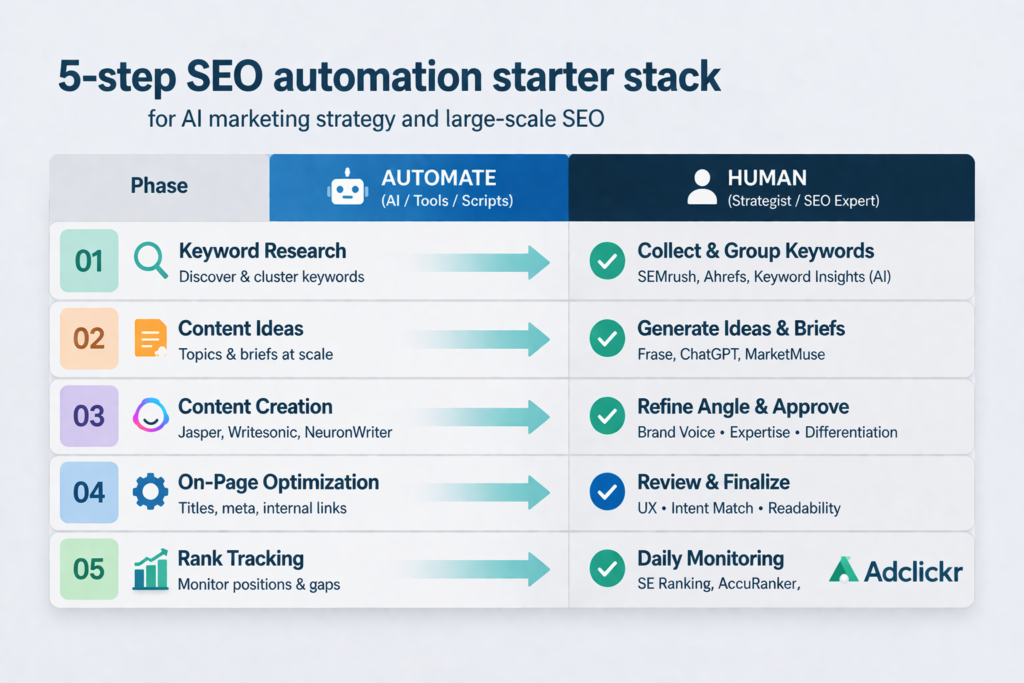
If you want to build more automation into your SEO workflow, start with documentation. You cannot automate a process you have not mapped.
- Set up automated rank tracking: lowest risk, most mature automation category. Configure priority keywords, set weekly tracking, and enable alerts for significant ranking changes before anything else.
- Schedule weekly site crawls: use SEMrush Site Audit or Screaming Frog on a recurring schedule. Check for broken links, missing title tags, image alt text, schema errors, and redirect chains.
- Build a unified reporting dashboard: connect Google Search Console, GA4, and your rank tracker in one view. Add automated weekly email summaries for key metrics above a defined threshold.
- Automate citation monitoring: set up NAP consistency scanning across your top directories. Configure alerts for new incorrect or duplicate listings immediately.
- Add content guardrails last: automated brief generation and structural checks only. Do not automate content publishing without human editorial approval at every stage.
Frequently Asked Questions About SEO Automation
SEO automation uses software, scripts, and AI agents to perform repetitive tasks rank tracking, crawling, reporting, citation monitoring without manual effort. It gives SEO teams time to focus on strategy, content quality, and client communication rather than mechanical execution.
No. AI automates throughput processing data, monitoring changes, and generating drafts. It cannot replace the judgment required to decide which opportunities to pursue, how to respond to competitor moves, or how to communicate during a crisis.
Start with rank tracking and reporting the most mature, lowest-error automation categories. Automate data collection into a dashboard and set up alerts for significant ranking or traffic changes. Once this runs reliably, expand to site auditing and citation monitoring.
Only if you automate tasks that require human judgment publishing unreviewed AI content, implementing bulk technical changes without testing, or running mass automated outreach. Automating monitoring and data collection carries zero ranking risk. These processes observe your site they do not change it.
Large-scale SEO managing sites with thousands of pages is only practical with automation. Weekly crawls catch issues across every page immediately; geo-grid rank tracking covers dozens of locations at once; automated reporting aggregates signals from thousands of keywords simultaneously.
Start with your highest-value commercial terms, primary brand keywords, and top competitor phrases. The process of selecting the right keywords applies across all platforms automation tracks them efficiently once identified.
Build the Automation Stack That Sets You Apart

The SEO teams that get automation right are measurably more productive not because they cut corners, but because they spend human time on human-grade work and machine time on machine-grade work. At Adclickr, our SEO services combine automated monitoring, auditing, and reporting with human-led strategy giving you the efficiency of automation and the quality of expert judgment in every campaign. Start with a free SEO report to see exactly where your site stands right now.
Also read: How to know if your SEO is working · What is SEO service