Expanding into new country markets sounds straightforward: publish content, add a language, watch rankings grow. In practice, something else happens. Pages start competing against each other. Authority fragments across domains. Rankings plateau at mediocre levels across every territory.
The problem is almost never structural it is executional. A site can have a clean international SEO setup and still underperform because the keyword strategy was copied from the home market, the content was run through a translation tool, and nobody built country-specific credibility signals from the ground up.
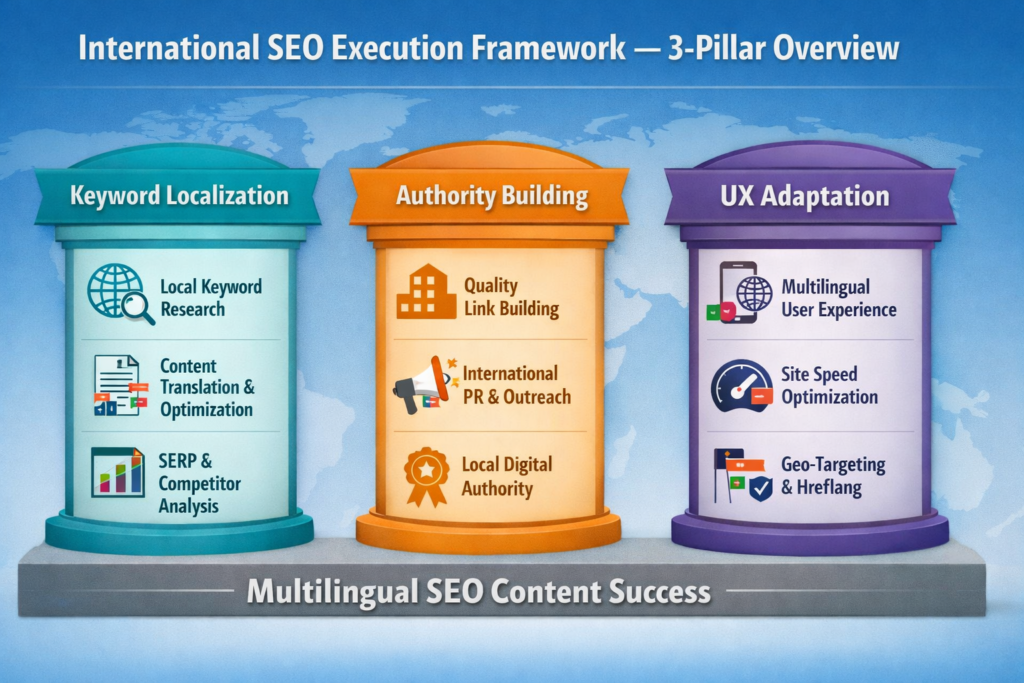
This guide takes a different approach. Every section focuses on the decisions that actually separate a multilingual SEO content strategy that compounds authority from one that dilutes it. You will learn how geo-targeted SEO campaigns are structured for different markets, how multi-location SEO avoids the cannibalization trap, and how cultural relevance shapes both rankings and conversions.
Why execution separates winners from also-rans
Global beauty brand Gisou recorded a 1,365% jump in organic traffic after rebuilding its content and link strategy market-by-market rather than applying a single global template to every territory.
What Is International SEO and How Does Traffic Cannibalization Occur?
International SEO is the discipline of configuring a website so search engines assign the correct page to the correct audience in each country or language market. It covers both the technical signals URL structure, hreflang annotations, geo-targeting settings and the content signals that tell Google a page was built for a specific audience rather than simply translated for them.
Traffic cannibalization in this context means your own pages are competing for ranking positions in the same query. When two or more country or language variants target an identical keyword without differentiated signals, search engines cannot make a confident choice. The result is rank splitting neither version performs well because both appear partially relevant.
Three structural triggers that cause cannibalization
- Country variants share keyword targets but carry no hreflang annotations to separate their intended audiences
- Translated content mirrors the source page’s keyword density without addressing local intent variations
- URL architecture sends mixed geo-targeting signals for instance, subdirectory structure used inconsistently with Search Console property assignments
Resolving these issues begins with choosing an architecture that sends clear, unambiguous signals.
International Keyword Research: Building a Market-Native Foundation
The instinct to port your highest-volume domestic keywords into new markets is understandable but it consistently produces weak results. Keyword demand is shaped by geography, purchasing culture, regulatory context, and the competitive vocabulary that has developed naturally in each market over time.
Winning at multilingual SEO content starts with accepting that a word-for-word swap between languages is not research it is a shortcut that skips everything your audience actually cares about.
Six dimensions where search behavior diverges across markets
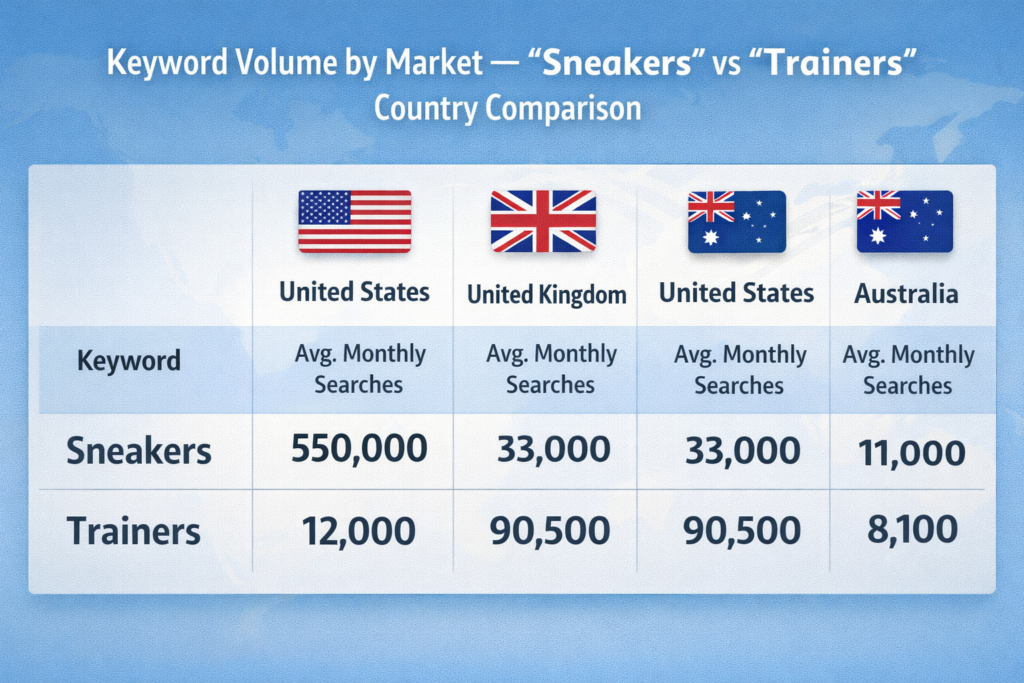
Same language, divergent vocabulary: Athletic shoes sold as “sneakers” in the US are universally called “trainers” across the UK. Campaigns optimized for one term reach the wrong audience in the other market.
No lexical equivalent exists: Certain concepts require a culturally embedded phrase rather than a translated one. The French term “casier judiciaire” carries legal meaning that no literal English-to-French translation of “background check” replicates.
Query construction reflects culture: German audiences construct detailed, specification-heavy queries. Japanese audiences shift between character sets depending on whether a query is formal or conversational a dimension translation tools cannot anticipate.
Demand calendars differ by country: Tax filing deadlines, national holidays, and regulatory cycles create search spikes that are entirely invisible in domestic data. A US-centered strategy misses Germany’s GDPR-driven compliance searches or India’s festival-period commerce peaks entirely.
Competitive vocabulary sets the normal: Italian car finance seekers use “finanziamento auto” a term shaped by how dominant lenders advertise rather than a literal translation of “car loan.” The market decides the language.
Device and income context alter phrasing: Mobile-dominant markets produce shorter, voice-influenced queries. Price-conscious audiences prepend affordability signals “budget,” “EMI,” “instalment” that never appear in premium-market data.
A five-step process for market-native keyword research
Query the native SERP before any tool
Configure Google’s location and language settings to simulate the target country. Autocomplete suggestions, related searches, and People Also Ask boxes reveal how audiences actually phrase queries data that no keyword database reflects as accurately.
Apply country filters inside research platforms
Country-segmented databases in platforms like Semrush surface local volume and competitive density. Treat these figures directionally a native SERP check should always validate what the data suggests.
Map competitors at the country level, not globally
Run manual SERP checks to identify the five to ten sites consistently appearing for target queries. Regional incumbents often dominate without any international presence, which means global authority metrics will not flag them.
Commission validation from a market-native expert
Bring in an in-country specialist to review your shortlisted keywords for cultural register, legal connotations, and naturalness of phrasing. They contribute strategic insight, not just translation correction.
Map negative signals what not to localize
Zero or near-zero volume for a high-performing domestic keyword in a new market is informative data. It signals a demand mismatch: either the product concept, the terminology, or the intent category does not translate to that context.
Cross-market SERP comparison reveals intent gaps
Pull the same keyword across five country-specific SERPs and compare the page types that rank editorial, commercial, video, local. Differing SERP compositions indicate differing intent, which means your content format may need to change, not just the language.
Geo-Targeted SEO: Earning Credibility Market by Market
Ranking in a new country requires more than placing relevant content on a geo-targeted URL. Search engines evaluate whether a site has genuine credibility within a market earned through local citation patterns, regional publication coverage, and authority signals that originate inside the target geography.
A domain’s global authority score does not transfer across borders automatically. A brand that dominates in one country can be invisible in another because it has never established a presence in that market’s trust ecosystem. This is the core challenge of multi-location SEO at scale.
- Government portals, regulatory bodies, and public institutions signal foundational trust in most markets
- Regional trade press, vertical magazines, and specialist news publications carry editorial weight that broad directories cannot replicate
- Professional associations specific to the industry and country provide contextually relevant citation sources
- Verified business directories and review aggregators that are actually used by local consumer not just created for SEO purposes
Mapping this landscape before beginning outreach prevents wasted effort on contacts with no meaningful influence in the target market.
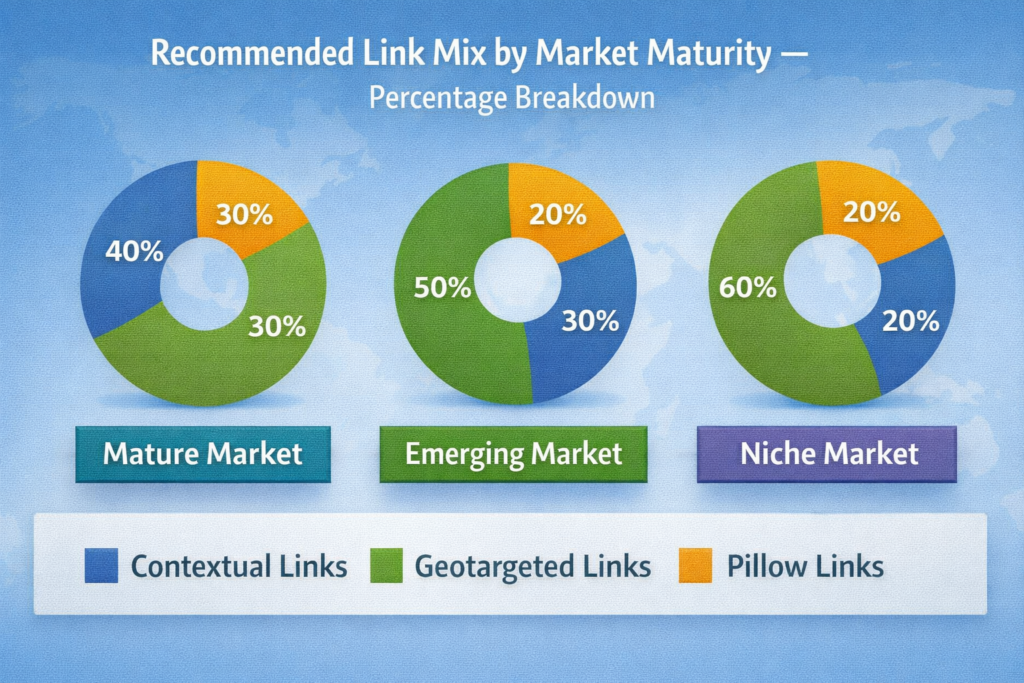
Link acquisition ratios by market category
- Established markets (US, UK, Germany, Spain): 70% country-origin links / 20% regional / 10% international
- Emerging markets (Brazil, India, Mexico): 80% country-origin / 15% regional / 5% international
- Specialist markets (Nordics, Belgium, Portugal): 60% country-origin / 30% regional / 10% international
Content formats that attract editorial links by region
- Germany: Comprehensive technical documentation with sourced statistics
- Japan: Consensus-oriented analysis citing multiple credible contributors
- Latin America: Visual storytelling grounded in locally recognisable scenarios
- UK: Long-form, well-referenced editorial with clear expert attribution
- Nordics: Concise, evidence-based content with minimal promotional framing
- United States: Data-backed trend analysis with rapid publication cycles
Identical outreach across markets signals inauthenticity
Applying a copy-paste link acquisition template to every country produces link patterns that look manufactured rather than editorially earned. Country-specific outreach is not optional it is what separates credible signals from noise.
Multilingual SEO Content: Localisation Over Translation
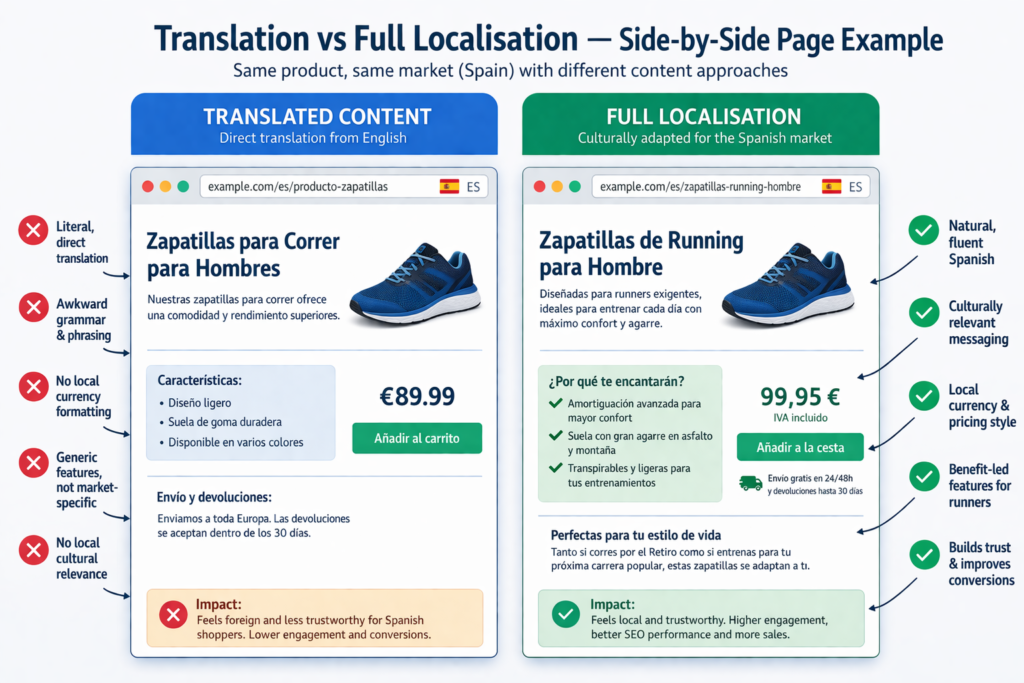
Publishing content in multiple languages is table stakes. Publishing multilingual SEO content that ranks and converts requires a different standard: every page must feel like it was conceived for that market, not adapted from somewhere else.
How hreflang prevents duplicate content penalties and rank splitting
Hreflang attributes communicate to search engines which version of a page corresponds to which language and country audience. A missing or misconfigured hreflang setup leaves Google free to choose a version itself which may mean the wrong language variant ranks for a query, or competing versions split the ranking signal entirely.
Correct implementation requires: a language code (ISO 639-1), a region qualifier where a language spans multiple markets (ISO 3166-1), a self-referencing hreflang on every variant, and an x-default fallback for audiences matched to no specific version.
The practical gap between translation and localisation
- Translation: converts words the sentence structure, examples, and cultural assumptions remain those of the origin market
- Localization: reconstructs the argument with local examples, culturally appropriate references, market-specific pricing context, and tone calibrated to local professional norms
- Localized: pages convert at measurably higher rates because the audience recognizes their own context rather than someone else’s
Platforms serving AI-generated responses including Google’s AI Overviews evaluate credibility signals broadly. A page localized for its target audience, with market-native authority links, is significantly more likely to appear as a cited source than a machine-translated equivalent with no local trust signals.
International UX: Why Cultural Design Is a Ranking Variable
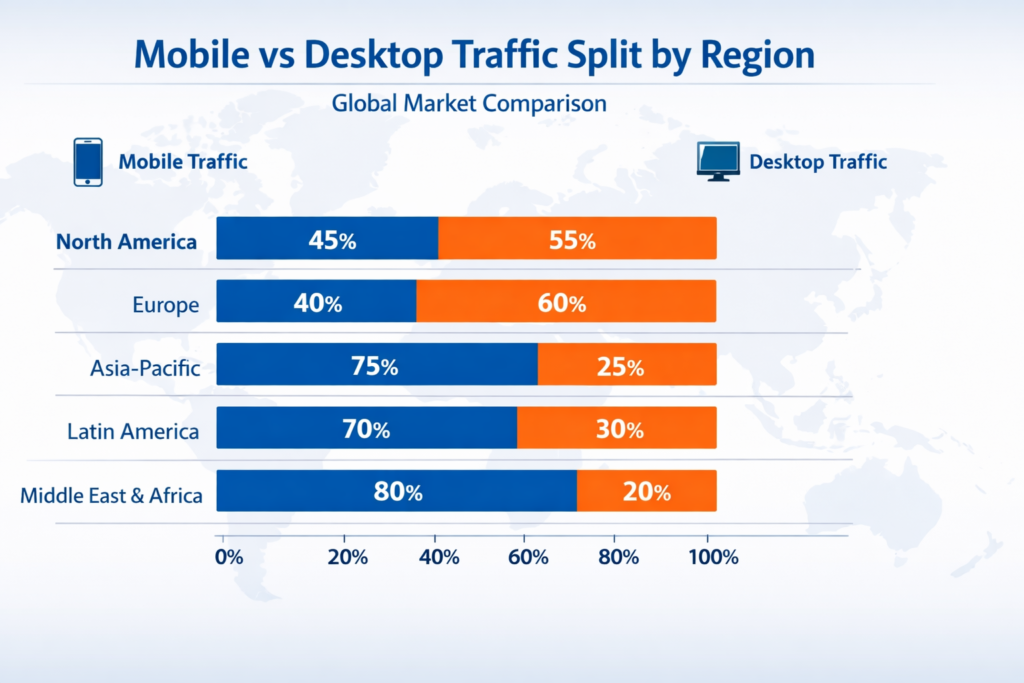
Getting a visitor to a country-specific page is half the work. Persuading them to stay and act requires a page that signals familiarity, not foreignness. International audiences read design cues through a cultural filter: layout density, color choices, form field conventions, and payment options all communicate trustworthiness in market-specific ways.
Google’s quality evaluations increasingly weigh engagement metrics session length, bounce rate, task completion as proxies for page quality. A page that ranks well but converts poorly in a specific market will face downward pressure over time. Strong multi-location SEO treats UX as an SEO input, not a post-launch concern.
Design expectations vary significantly by region
- German-speaking markets: Audiences expect detailed specification tables, dense information architecture, and formal register visual minimalism reads as a lack of thoroughness
- Scandinavian markets: Preference for clean layouts with generous whitespace; cluttered pages signal low quality regardless of content depth
- East Asian markets: High information density is comfortable and expected; social validation through peer reviews and certifications carries strong conversion influence
- Latin American markets: Warm visual language, family-oriented imagery, and visible social proof accelerate trust-building compared to text-heavy formats
- Middle Eastern markets: Right-to-left text rendering is a hard requirement; pages that break under RTL localisation lose credibility immediately
Site performance across geographies
Network latency increases with physical distance from the origin server. For visitors in regions far from a site’s hosting infrastructure, page load times can add multiple seconds degrading both user experience and Core Web Vitals scores in markets where those scores directly influence ranking positions.
A content delivery network with strong regional node coverage flattens this latency gap. For sites using subdirectory architecture (/de/, /fr/), CDN cache rules should be scoped at the folder level to ensure localized pages are served from the nearest edge location. Real-user monitoring by country rather than lab-based testing from a fixed location produces the most actionable performance data.
Scaling International SEO: One Market at a Time, Then Multiplying
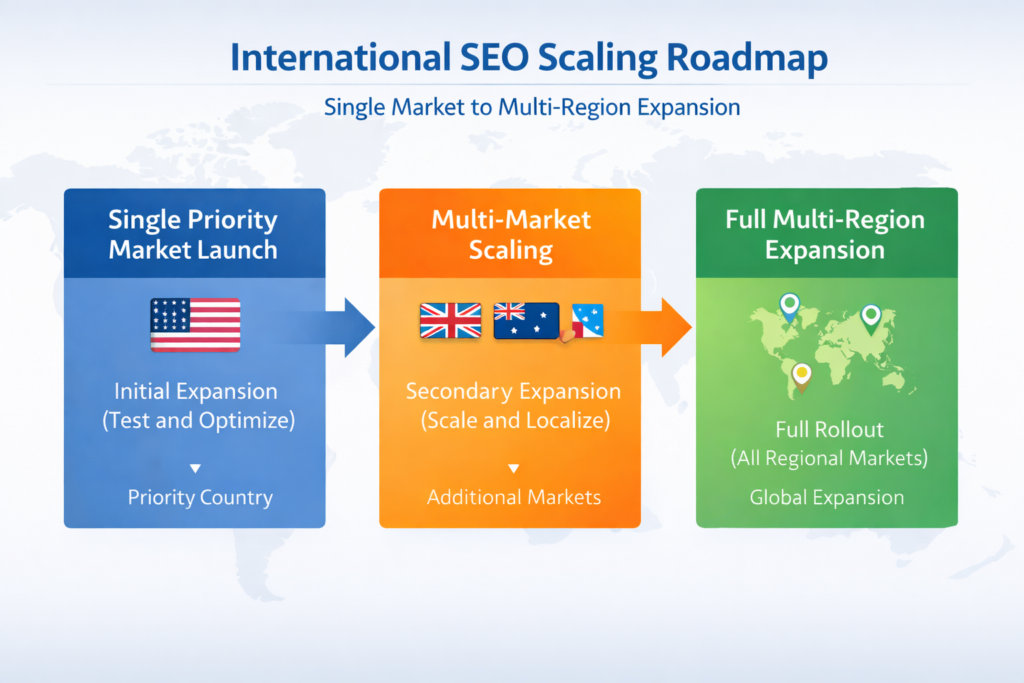
Simultaneous expansion across five countries is a common ambition and an unreliable strategy. Spreading research, content, and outreach resources too thin produces average results everywhere rather than strong results in a priority market that can then fund the next phase.
Criteria for selecting the first priority market
- Revenue ceiling: Addressable search volume multiplied by realistic conversion benchmarks for the category in that country
- Competitive entry point: Whether the incumbent landscape allows a new entrant to accumulate authority within a reasonable timeline
- Brand-market fit: How closely the product proposition matches established expectations and purchasing norms in the target country
- Resource access: Whether native-language content creators and outreach contacts are available without a prohibitive sourcing cost
Building a framework that multiplies across markets
A well-documented first-market rollout becomes the architecture for every subsequent expansion. Every decision — keyword validation methodology, content brief format, link acquisition targets, UX localisation checklist, technical QA steps — should be recorded with enough specificity that a second team in a second market can replicate the process without reinvention.
Market two moves in months rather than quarters when this documentation exists.
Ship with fundamentals in place, then iterate
A strong first-market launch with room to improve outperforms a delayed launch waiting for perfection. Real audience data from a live market will recalibrate your strategy faster than any pre-launch modelling can.
Frequently Asked Questions
International SEO targets multiple countries or languages, requiring hreflang, geo-targeting, localized content, and market-specific strategies, unlike standard SEO focused on a single audience and language.
Cannibalization occurs when similar pages target identical queries across regions due to missing hreflang, duplicate keyword usage, or conflicting geo-targeting signals without proper differentiation.
ccTLDs minimize cannibalization but need separate authority building. Subdirectories share authority and suit most cases. Subdomains fall between, depending on resources, branding, and localization priorities.
Keyword translation fails because search intent, phrasing, and demand vary by culture, competitors, and behavior, requiring localized keyword research rather than direct linguistic translation.
Geo-targeted SEO focuses on country-level visibility using hreflang and structure, while local SEO targets proximity-based queries using Google Business Profile, citations, and localized signals.
International SEO typically shows results within three to six months, with stronger growth by twelve months, depending on competition, domain authority, content velocity, and local link-building efforts.
Ready to Build Authority Across Borders?
Adclickr’s international SEO team delivers market-native keyword research, localized content strategy, and country-specific link acquisition — so every territory strengthens the whole rather than dividing it. Request a Free Audit View International SEO Services